Listen to this Post
Introduction:
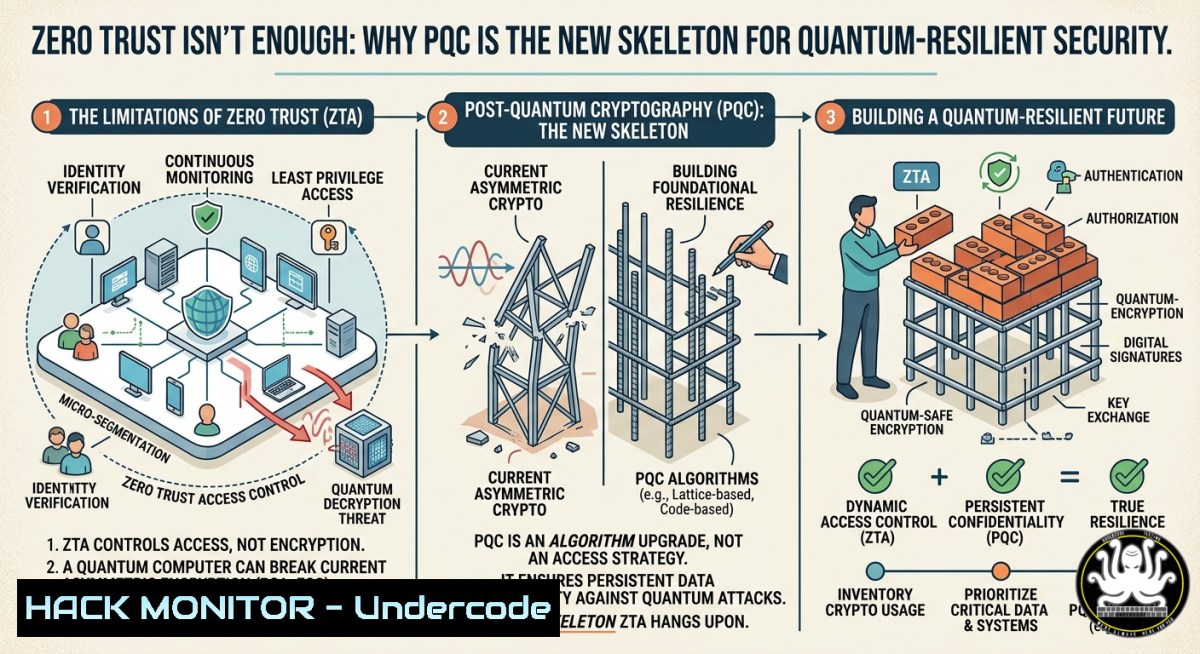
Organizations continue to treat Post-Quantum Cryptography (PQC) as a simple cryptographic upgrade—swap RSA for a new algorithm and move on. In reality, a quantum-era transition demands that Zero Trust become the load‑bearing governance spine, with PQC as the cryptographic substrate that every identity, device, workload, network path, and data flow attaches to. Without this integrated architecture, you end up with fragmented crypto modernization and no coherent trust governance.
Learning Objectives:
- Understand why Zero Trust must be re‑engineered with PQC as a foundational trust layer, not an afterthought.
- Learn to implement hybrid signatures and Key Encapsulation Mechanisms (KEMs) for identity, devices, networks, workloads, and data.
- Apply practical Linux/Windows commands and configurations to build a PQC‑ready, quantum‑resilient Zero Trust architecture.
You Should Know
- Identity – PQC‑Signed Identity as the Root of Trust
Identity is the first trust decision point. If identity systems still rely solely on RSA or ECC, they become long‑term “harvest now, decrypt later” exposure points. A credible Zero Trust architecture requires PQC‑signed or hybrid‑signed identities as a foundational control.
Step‑by‑step guide – Generate a hybrid certificate (RSA + ML‑DSA) using OpenSSL with the OQS provider:
 On Ubuntu 22.04+ (Linux)
 Install liboqs and oqs-provider
git clone https://github.com/open-quantum-safe/liboqs.git
cd liboqs
mkdir build && cd build
cmake -DCMAKE_INSTALL_PREFIX=/usr/local .. && make && sudo make install

Install oqs-provider
git clone https://github.com/open-quantum-safe/oqs-provider.git
cd oqs-provider
mkdir build && cd build
cmake -DCMAKE_INSTALL_PREFIX=/usr/local -DOPENSSL_ROOT_DIR=/usr/local/ssl ..
make && sudo make install

Generate a hybrid private key and self-signed certificate using ML-DSA-44 + RSA
openssl req -x509 -newkey hybrid_ml_dsa_44_rsa2048 -keyout hybrid_key.pem -out hybrid_cert.pem -days 365 -nodes -subj "/CN=quantum-zero-trust.com"
Windows (using WSL2 or pre‑compiled binaries):
Similar steps inside WSL2 Ubuntu, or download the pre‑built `oqs-provider` DLL and configure `openssl.cnf` to load the provider.
What this does: The hybrid certificate binds classical RSA with a post‑quantum signature (ML‑DSA). Even if RSA is broken by a quantum computer, the ML‑DSA component remains secure, preserving identity trust.
- Device & Posture Trust – Continuous Cryptographic Posture Validation
Zero Trust does not trust devices; it continuously evaluates firmware integrity, OS state, cryptographic libraries, certificate posture, and PQC readiness. Device without crypto agility become constrained trust participants.
Step‑by‑step guide – Audit a Linux system’s crypto posture for PQC readiness:
 Check OpenSSL version and available algorithms (look for 'oqsprovider')
openssl list -providers

List all available signature algorithms (should show ML-DSA, SLH-DSA if oqs-provider loaded)
openssl list -signature-algorithms | grep -i "ml-dsa|slh-dsa|dilithium|sphincs"

For Windows (PowerShell as Admin): Check TLS cipher suites and certificate algorithms
Get-TlsCipherSuite | Select-Object Name, Exchange, Cipher, Hash
Get-ChildItem -Path Cert:\LocalMachine\My | Format-Table Subject, NotAfter, SignatureAlgorithm

Proactive monitoring: Scan for RSA/ECC-only certificates that will become high-risk
find /etc/ssl/certs -name ".pem" -exec openssl x509 -in {} -text -noout \; | grep -E "Subject:|Public Key Algorithm|Signature Algorithm"
Hardening step: Configure system‑wide crypto policy to require at least hybrid PQC for high‑assurance workloads (e.g., on RHEL/Fedora: `update-crypto-policies –set FIPS:OSPP:HYBRID_PQC` – custom policy file required).
- Network & Service Mesh – PQC Key Exchange for East‑West Traffic
If east‑west traffic still relies on classical key exchange (e.g., ECDHE), microsegmentation becomes partially cosmetic. A resilient Zero Trust spine requires PQC or hybrid KEMs to protect service‑to‑service trust.
Step‑by‑step guide – Establish a TLS 1.3 connection with hybrid KEM (X25519 + Kyber):
 Generate a hybrid KEM private key and certificate for the server
openssl req -x509 -newkey hybrid_kyber512_x25519 -keyout server_kem.key -out server_kem.crt -days 365 -nodes

Start a PQC‑enabled TLS server (listening on port 8443)
openssl s_server -accept 8443 -cert server_kem.crt -key server_kem.key -tls1_3 -cipher "HYBRID_KEM_GROUPS"

From another terminal, connect as client:
openssl s_client -connect localhost:8443 -tls1_3 -cipher "HYBRID_KEM_GROUPS" -msg

Verify that the key exchange used a hybrid group (look for "KEM group: x25519_kyber512" in debug output)
Explanation: The hybrid KEM ensures that even if an attacker records encrypted traffic today and later gains a quantum computer, the session keys cannot be recovered because the Kyber component remains quantum‑resistant.
- Workload Layer – PQC Attestation and Signing Integrity
Workloads must prove their identity, attest their runtime state, and maintain signing integrity. If workload certificates and signing chains are not quantum‑resilient, Zero Trust assumptions erode from within.
Step‑by‑step guide – Sign a container image with Dilithium (ML‑DSA) and verify:
 Generate a ML‑DSA‑44 private key and public key using oqs-provider
openssl genpkey -algorithm ML_DSA_44 -out workload_signing.key
openssl pkey -in workload_signing.key -pubout -out workload_signing.pub

Sign a binary or container image digest
sha256sum my_app_container.tar > digest.txt
openssl dgst -sign workload_signing.key -sha3_256 -out sig.bin digest.txt

Verify the signature (on any system with the public key)
openssl dgst -verify workload_signing.pub -signature sig.bin -sha3_256 digest.txt

For Kubernetes admission control: Create a validating webhook that checks PQC signatures before pod creation.
 (Example using Kyverno policy to require signed attestations with PQC algorithms.)
Integration with CI/CD: Add a pipeline stage that fails builds if images are signed only with RSA/ECC. Use `cosign` with experimental PQC support (e.g., cosign sign --key ml-dsa://path).
- Data Layer – Quantum‑Resilient Encryption and Accelerated Key Rotation
Long‑life sensitive data (health records, financial archives, government secrets) faces the highest “harvest now, decrypt later” risk. Data at rest and in transit must use PQC encryption, coupled with aggressive key rotation policies.
Step‑by‑step guide – Encrypt a file using the Kyber KEM via liboqs command line:
 Compile liboqs examples (if not already done)
cd liboqs/build
make examples

Generate a Kyber-1024 keypair (KEM)
./examples/kem/kem_example Kyber-1024 > kem_keys.txt
 Extract public key (line 2) and secret key (line 3) to files

Encrypt a file: use the public key to encapsulate a shared secret, then AES-256-GCM
./examples/kem/kem_encapsulate Kyber-1024 public_key.bin > ciphertext.bin
 The output is the encapsulated secret + actual file encryption (see full script below)

For a complete encryption script:
!/bin/bash
 Generate symmetric key via Kyber encapsulation
encapsulated_secret=$(./examples/kem/kem_encapsulate Kyber-1024 public_key.bin)
 Use that key to encrypt the file with OpenSSL
echo $encapsulated_secret | openssl enc -aes-256-gcm -in secret_data.pdf -out secret_data.pdf.enc -pass stdin
Windows alternative: Use Python with `liboqs` bindings (pip install liboqs) to perform Kyber encryption natively. Schedule monthly key rotation via Group Policy or Azure Key Vault’s automatic rotation.
Key rotation policy: For data classified as “long‑life sensitive” (>5 years), enforce rotation every 90 days using a script that re‑encrypts with fresh PQC keys and updates metadata. Example cron job on Linux:
0 0 1 /3 /usr/local/bin/rotate_pqc_keys.sh /data/pqc_encrypted/ >> /var/log/pqc_rotation.log
What Undercode Say
- Key Takeaway 1: PQC is not a crypto swap – it is a full re‑engineering of the Zero Trust spine across identity, devices, networks, workloads, and data. Treating them separately guarantees fragmented, indefensible migration.
- Key Takeaway 2: Hybrid cryptography (classical + PQC) is the pragmatic path forward today. It preserves backward compatibility while building quantum resilience, especially for “harvest now, decrypt later” risks that compound over time.
Analysis (10 lines): Brian C. correctly identifies that Zero Trust without PQC is like a skeleton made of brittle bone – it will shatter under quantum stress. The industry still sells PQC as a drop‑in library update, but his framing of “load‑bearing joints” is more accurate. Identity is the most vulnerable root; if your identity tokens are signed only with RSA, an attacker who captures them today can impersonate users ten years from now. Device trust becomes meaningless when crypto posture isn’t continuously validated – most CISOs don’t even inventory which devices use PQC‑ready libraries. The network layer’s reliance on classical key exchange is a silent time bomb for encrypted east‑west traffic. Workload signing chains are rarely audited for algorithm agility. And data layer risk is already time‑dependent – nation‑states are harvesting encrypted data now. The post’s blunt analogy (skeleton + new bone material) is a powerful mental model for board‑level conversations. Missing from the analysis is a practical roadmap for crypto‑agility – how to rotate algorithms when standards evolve. Nevertheless, this is a must‑read for anyone designing quantum‑resistant Zero Trust architectures.
Prediction:
By 2027, regulatory frameworks (e.g., NIST SP 800‑208, PCI DSS v5, DORA) will mandate hybrid PQC for any high‑assurance Zero Trust deployment. Organizations that treat PQC as a separate workstream will face audit failures and breach liability for “harvest now, decrypt later” incidents. The convergence of Zero Trust and PQC will spawn new tools: continuous crypto‑posture scanners, automated hybrid certificate managers, and quantum‑resistant service meshes. Early adopters who re‑engineer their trust spine today will gain a competitive advantage in sectors like finance, healthcare, and critical infrastructure – while laggards will spend 2028‑2030 in emergency forklift upgrades. The skeleton is being rebuilt; the only question is whether you’ll be the architect or the patient.
▶️ Related Video (82% Match):
🎯Let’s Practice For Free:
IT/Security Reporter URL:
Reported By: Bcouzens Zerotrust – Hackers Feeds
Extra Hub: Undercode MoN
Basic Verification: Pass ✅
🎓 Live Courses & Certifications:
Join Undercode Academy for Verified Certifications
🚀 Request a Custom Project:
Secure, high-velocity infrastructure and disruptive technological engineering. Contact our engineering team for high-tier development and proprietary systems:
[email protected]


