Listen to this Post
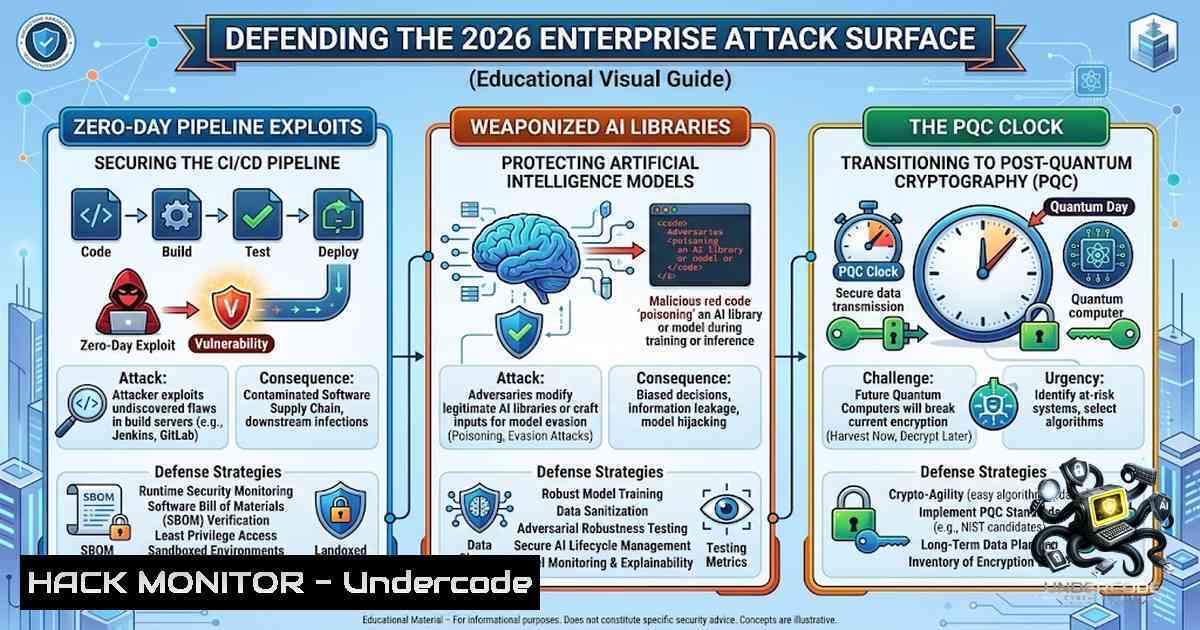
Introduction:
The August 8, 2026 threat landscape, as outlined by the ISC2 Thames Valley Daily Cyber Brief, presents a triad of converging crises: zero-day remote code execution (RCE) in automated cloud workflows, sophisticated software supply chain attacks targeting open-source AI dependencies, and the looming existential threat of cryptographic irrelevance posed by post-quantum computing. Each vector exploits a fundamental gap in modern enterprise security—the assumption that development pipelines, third-party libraries, and legacy encryption are inherently trustworthy. This article dissects each threat, providing actionable technical controls, verified commands, and step-by-step mitigation strategies for security professionals defending the modern enterprise.
Learning Objectives:
- Objective 1: Understand and mitigate unauthenticated RCE vulnerabilities in CI/CD pipelines and API gateway webhook listeners.
- Objective 2: Implement robust defenses against software supply chain attacks, including typosquatting, dependency confusion, and malicious AI library injection.
- Objective 3: Develop a practical roadmap for post-quantum cryptographic (PQC) migration, including cryptographic inventory, algorithm selection, and compliance timelines.
You Should Know:
1. Hardening Automated Cloud Pipelines Against Zero-Day RCE
The threat of unauthenticated RCE within automated enterprise cloud pipelines is not theoretical. Attackers are actively exploiting misconfigured, public-facing webhook listeners and CI/CD environments to bypass standard API gateways. The impact is severe: compromised pipelines enable lateral movement across corporate virtual networks, exposing raw code repositories and sensitive deployment secrets.
A critical failure mode is the “fail-open” authentication branch, where an empty gateway token grants administrative privileges. As demonstrated in a recent vulnerability, when `GOCLAW_GATEWAY_TOKEN` is unset, the HTTP authentication resolver treats a request with no bearer token as an authenticated `RoleAdmin` caller. This allows unauthenticated remote users to invoke administrative HTTP endpoints. Similarly, webhook handlers often skip signature verification entirely when their verification secret is unset, allowing forged webhook payloads to be accepted as trusted events.
Step-by-Step Guide to Securing CI/CD Pipelines and Webhooks:
- Audit and Harden API Gateways: The non-1egotiable starting point is that every route requires authentication unless explicitly carved out, with the default policy being deny rather than allow.
– Linux Command (Auditing Nginx/Kong): Check for routes without authentication directives.
grep -r "allow" /etc/nginx/conf.d/ | grep -v "deny"
– Windows Command (Auditing IIS): Review URL Authorization Rules.
Get-IISUrlAuthorizationRule -SiteName "Default Web Site" | Where-Object {$_.AccessType -eq "Allow"}
- Enforce Webhook Signature Verification: Implement HMAC signature verification for all incoming webhook payloads. Never accept a webhook without a configured secret.
– Example (Node.js/Express):
const crypto = require('crypto');
const verifySignature = (req, secret) => {
const signature = req.headers['x-signature'];
const expected = crypto.createHmac('sha256', secret).update(JSON.stringify(req.body)).digest('hex');
return crypto.timingSafeEqual(Buffer.from(signature), Buffer.from(expected));
};
- Implement Least-Privilege Network Access: Enforce IP filtering at the network layer (via reverse proxies or firewalls) for all inbound pipeline connections.
– Linux Command (IPTables): Restrict access to a webhook endpoint (port 8080) to a specific IP range.
iptables -A INPUT -p tcp --dport 8080 -s 192.168.1.0/24 -j ACCEPT
iptables -A INPUT -p tcp --dport 8080 -j DROP
- Replace Static Credentials with Short-Lived Tokens: Eliminate long-lived credentials from CI/CD configurations. Integrate with a secrets management solution like HashiCorp Vault to fetch short-lived tokens at runtime.
– Vault CLI Command (Generating a short-lived database credential):
vault read database/creds/my-role
- Turn Security Scans into Blocking Pipeline Gates: Integrate SAST, DAST, and Software Composition Analysis (SCA) tools as blocking gates in your CI/CD pipeline. No build should proceed to deployment if critical vulnerabilities are detected.
– GitHub Actions Example (Using Trivy for container scanning):
- name: Run Trivy vulnerability scanner
uses: aquasecurity/trivy-action@master
with:
image-ref: 'my-app:latest'
format: 'sarif'
exit-code: '1'  Fail on critical vulnerabilities
2. Defending Against Weaponized AI Open-Source Dependencies
Attackers are successfully executing advanced software supply chain attacks by injecting malicious code into widely adopted open-source AI libraries. Using sophisticated typosquatting and dependency confusion techniques, bad actors mirror legitimate machine learning development framework packages. Malicious dependencies then secretly extract operational API keys, cloud access environment variables, and proprietary data models back to rogue servers.
The attack persists because package managers default to trust-on-first-use, and internal packages often share names with public ones. When a developer’s tool is configured to check multiple registries, the package manager may pick a malicious public version with a higher version number.
Step-by-Step Guide to Mitigating Dependency Confusion and Typosquatting:
- Mandate Automated Software Bill of Materials (SBOM) Scanning: Generate an SBOM for every build to create a complete, machine-readable inventory of every component inside your software.
– Install Syft (Linux/macOS):
curl -sSfL https://raw.githubusercontent.com/anchore/syft/main/install.sh | sh -s -- -b /usr/local/bin
– Generate an SBOM (CycloneDX format):
syft dir:. -o cyclonedx-json=sbom.cyclonedx.json
– Scan a Container Image:
syft myregistry/myimage:latest -o cyclonedx-json=sbom.cyclonedx.json
– Automate in CI (GitHub Actions):
- name: Generate SBOM
uses: anchore/sbom-action@v0
with:
path: ./
format: cyclonedx-json
- Scan SBOMs for Vulnerabilities: Use a tool like Grype to find known vulnerabilities across every listed component.
– Install Grype:
curl -sSfL https://raw.githubusercontent.com/anchore/grype/main/install.sh | sh -s -- -b /usr/local/bin
– Scan an SBOM File:
grype sbom:sbom.cyclonedx.json
- Block Dependency Confusion in npm: Use scoped packages for every internal package and pin the scope to your internal registry in an `.npmrc` file committed to the repository.
– `.npmrc` Example:@mycompany:registry=https://internal-registry.company.com/ registry=https://registry.npmjs.org/
– Enforce in CI: Ensure the `.npmrc` is used during installation.
npm install --registry=https://internal-registry.company.com/
- Block Dependency Confusion in pip: Explicitly pin the `index-url` to your internal registry in a `pip.conf` file.
– `pip.conf` Example (Linux/macOS~/.pip/pip.conf):[bash] index-url = https://internal-pypi.company.com/simple/ extra-index-url = https://pypi.org/simple/ trusted-host = internal-pypi.company.com
-
Enforce Lockfile Discipline: Ensure `requirements.txt` or `package-lock.json` specify exact versions with hashes to prevent version substitution attacks.
– pip with Hash Checking:
pip install --require-hashes -r requirements.txt
3. Navigating the Post-Quantum Cryptography (PQC) Migration Bottleneck
National intelligence bodies warn that critical infrastructure industries are failing to meet essential milestones for PQC readiness. The “Harvest Now, Decrypt Later” (HNDL) threat is active: adversaries are capturing encrypted traffic today with the expectation of decrypting it once quantum computers scale. NIST has finalized its first three PQC standards: ML-KEM (FIPS 203) for key exchange, ML-DSA (FIPS 204) for digital signatures, and SLH-DSA (FIPS 205) as a conservative, hash-based signature scheme. The NCSC has outlined a three-phase migration timeline: by 2028, identify cryptographic services needing upgrades; from 2028 to 2031, carry out early, highest-priority migration activities; and by 2035, complete migration to PQC for all systems.
Step-by-Step Guide to Post-Quantum Cryptographic Migration:
- Conduct a Cryptographic Inventory: Know what encryption you use today and what it protects. Identify all instances of RSA, ECC, and other quantum-vulnerable algorithms.
– Linux Command (Finding SSL/TLS configurations):
find /etc -1ame ".conf" -exec grep -l "RSA|ECDSA" {} \;
– Windows Command (Finding certificates using RSA):
Get-ChildItem -Path Cert:\ -Recurse | Where-Object { $_.PublicKey.Key.KeyExchangeAlgorithm -match "RSA" }
- Prioritize Migration for Long-Lived Data: Data that must remain confidential for years (e.g., health records, financial data, intellectual property) should be prioritized for PQC migration due to the HNDL threat.
-
Adopt Crypto-Agility: Design systems to support multiple cryptographic algorithms and allow for easy swapping. Avoid hardcoding specific algorithms.
– Example (OpenSSL Configuration for Hybrid Mode): Configure servers to prefer hybrid key exchange (e.g., X25519 + ML-KEM).
openssl s_client -connect example.com:443 -cipher "ECDHE+AESGCM:ECDHE+CHACHA20:DHE+AESGCM" -curves "X25519:prime256v1"
- Test and Validate PQC Implementations: Establish processes for testing and validation of vendor claims of post-quantum security. Use NIST’s official test vectors.
– Example (Using OpenSSL to test ML-KEM – conceptual): While OpenSSL may not have native support yet, use dedicated libraries like `liboqs` for testing.
 Assuming liboqs is installed
oqs_kem_encap --kem ML-KEM-768
- Align with Compliance Timelines: Integrate PQC migration into your organization’s compliance roadmap. The NSA’s CNSA 2.0 framework expects quantum-safe algorithms in new national security systems beginning in 2027. NCSC guidance sets 2035 as the target date for completing migration for all systems.
What Undercode Say:
- Key Takeaway 1: The convergence of AI development toolchains and CI/CD pipelines as primary attack surfaces demands a fundamental shift in security posture. Treat AI development infrastructure (notebooks, model registries) as production-tier assets requiring the same patch SLAs as customer-facing systems. The sub-24-hour exploitation window for AI pipeline tools is a clear signal that attackers are prioritizing these environments.
-
Key Takeaway 2: Dependency confusion and typosquatting are not new, yet they remain devastatingly effective because organizations continue to deploy partial controls. The only working defense assumes package names are public and prevents confusion even when the attacker knows exactly what to publish. This requires scoped packages, explicit registry pinning, and lockfile verification—all enforced in CI.
Analysis: The current threat landscape reveals a critical asymmetry: attackers are automating the discovery and exploitation of weaknesses in development pipelines and third-party dependencies, while many organizations still treat these as lower-priority security domains. The “Harvest Now, Decrypt Later” threat adds a temporal dimension, where data stolen today will be exposed tomorrow. The solution is not a single tool but a layered defense: rigorous authentication, continuous SBOM generation, cryptographic inventory, and a commitment to crypto-agility. Security teams must shift from reactive patching to proactive pipeline hardening and cryptographic modernization.
Prediction:
- +1 The formalization of NIST PQC standards (FIPS 203-205) will accelerate enterprise adoption, with security-conscious organizations achieving “crypto-agility” within 18-24 months, positioning them as leaders in data protection.
- -1 Organizations that fail to implement automated SBOM generation and dependency scanning will experience a major supply chain breach within the next 12 months, as attackers continue to refine automated exploitation of package registries.
- +1 The integration of AI-powered security tools into CI/CD pipelines will mature, enabling real-time detection of anomalous dependency behavior and reducing the mean time to remediation for software composition vulnerabilities.
- -1 The gap between PQC migration planning and execution will widen, with a significant portion of critical infrastructure failing to meet the 2027 CNSA 2.0 deadlines, leading to regulatory penalties and increased exposure to HNDL attacks.
- +1 The cyber insurance market will begin offering premium discounts for organizations that can demonstrate comprehensive SBOM generation, cryptographic inventory, and zero-trust pipeline architecture, incentivizing widespread adoption of these security controls.
▶️ Related Video (76% Match):
🎯Let’s Practice For Free:
🎓 Live Courses & Certifications:
Join Undercode Academy for Verified Certifications
🚀 Request a Custom Project:
Secure, high-velocity infrastructure and disruptive technological engineering. Contact our engineering team for high-tier development and proprietary systems:
[email protected]
💎 Smart Architecture | 🛡️ Secure by Design | ⭐ Trusted by Thousands
IT/Security Reporter URL:
Reported By: Carlo Petrini – Hackers Feeds
Extra Hub: Undercode MoN
Basic Verification: Pass ✅


