Listen to this Post
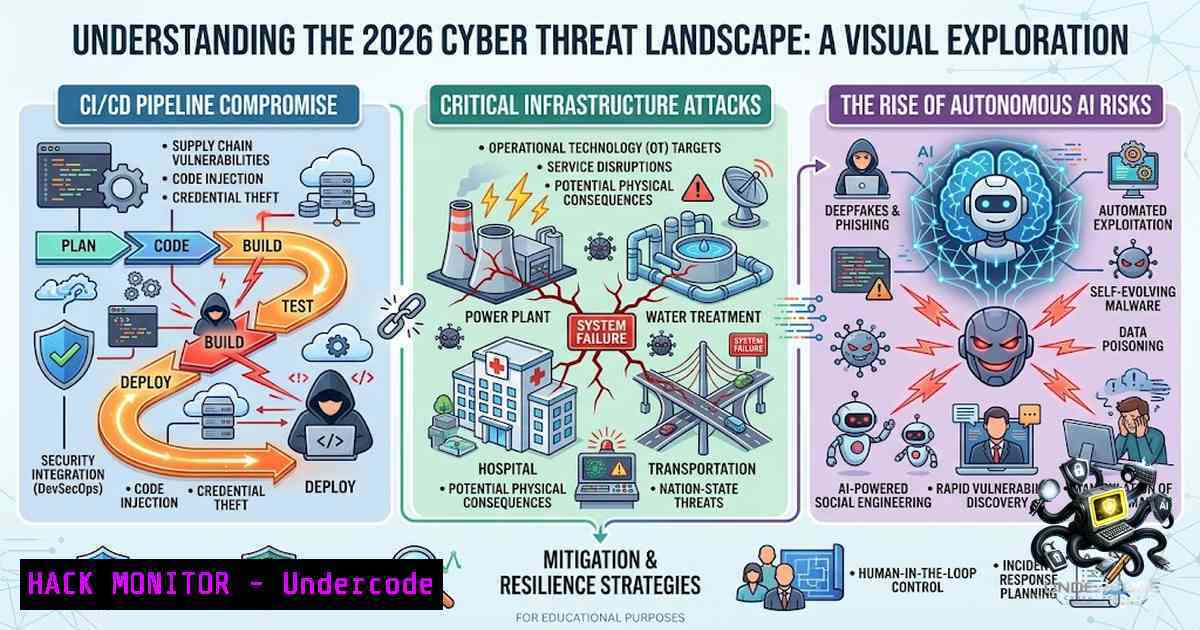
Introduction:
The cyber threat landscape of August 2026 presents a multi-front challenge that spans the entire digital supply chain, from development pipelines to critical national infrastructure. With the active exploitation of a critical remote code execution vulnerability in JetBrains TeamCity (CVE-2026-63077), coordinated attacks on water utilities across at least 12 U.S. states, and a surge in ransomware incidents targeting Indian enterprises, organizations must adopt a proactive and layered defense strategy. This article provides a comprehensive technical analysis of these emerging threats, offering actionable guidance for securing CI/CD environments, hardening cloud infrastructure, and mitigating the novel risks introduced by autonomous AI agents.
Learning Objectives:
- Understand the technical mechanics and mitigation strategies for CVE-2026-63077, a critical authentication bypass in TeamCity.
- Analyze the attack vectors and defensive measures for protecting critical infrastructure and cloud-hosted healthcare data.
- Identify the unique security challenges posed by AI agents and implement governance controls to prevent autonomous system compromise.
- Learn how to apply Linux and Windows commands for vulnerability assessment, log analysis, and system hardening.
1. CVE-2026-63077: Securing CI/CD Pipelines Against Active Exploitation
The JetBrains TeamCity vulnerability, tracked as CVE-2026-63077 with a CVSS score of 9.8, represents a critical supply chain risk. This deserialization flaw in the agent polling protocol allows an unauthenticated attacker with HTTP(S) access to a vulnerable server to bypass authentication and execute arbitrary operating system commands. The U.S. CISA has added this flaw to its Known Exploited Vulnerabilities catalog, citing active exploitation.
Step-by-Step Guide to Mitigation and Investigation:
- Immediate Patching: Update your TeamCity On-Premises instance to version 2025.11.7 or 2026.1.3 immediately. If an immediate upgrade is not possible, install the official security patch plugin for versions 2017.1 and later.
-
Log Analysis for Indicators of Compromise (IoC): Review TeamCity server logs for the following exception, which may indicate attempted or successful exploitation:
com.thoughtworks.xstream.converters.ConversionException
Linux Command:
grep -r "com.thoughtworks.xstream.converters.ConversionException" /path/to/teamcity/logs/
Windows Command (PowerShell):
Select-String -Path "C:\TeamCity\logs.log" -Pattern "com.thoughtworks.xstream.converters.ConversionException"
- Verify Patch Status: After applying the patch or update, confirm the fix by checking the TeamCity build number or plugin version through the administration interface.
-
Defending Critical Infrastructure: Lessons from Water Utility Attacks
Recent cyberattacks have targeted water and wastewater facilities across at least 12 U.S. states. In New Jersey, two municipal water systems were compromised via vulnerable internet-exposed control systems, forcing operators to shift to manual operations. The attacks, suspected to be state-sponsored, exploited a vulnerability in widely used utility software.
Step-by-Step Guide to Hardening OT/ICS Environments:
- Network Segmentation: Isolate operational technology (OT) networks from corporate IT and the internet. Implement firewalls with strict rules to block unauthorized traffic to ICS devices.
-
Vulnerability Management: Conduct regular scans of ICS assets. While traditional vulnerability scanners may disrupt operations, use passive monitoring tools to identify vulnerable software versions.
– Example (Nmap – Use with extreme caution in OT environments):
nmap -sV -p 502,44818,2222 <target-IP> Common Modbus and CIP ports
- Access Control: Enforce multi-factor authentication (MFA) for all remote access points. Immediately change default credentials on all OT devices.
-
Cloud and Healthcare Data Exposure: Mitigating Third-Party Risk
The healthcare sector continues to be a prime target. CareCloud disclosed a breach affecting 345,000 individuals after attackers accessed its AWS-hosted EHR data stores. Similarly, pharmaceutical giant Amgen reported a breach involving patient data stored on third-party cloud servers.
Step-by-Step Guide to Cloud Security Hardening:
- Identity and Access Management (IAM): Implement the principle of least privilege. Regularly audit IAM roles and policies to remove excessive permissions.
– AWS CLI Command to list unused IAM keys:
aws iam list-users --query 'Users[?PasswordLastUsed==null]'
- Encryption and Key Management: Ensure all sensitive data is encrypted at rest and in transit. Use customer-managed keys (CMK) for critical data stores.
– Azure CLI Command to enable encryption on a storage account:
az storage account update --1ame <storage-account> --resource-group <rg> --encryption-key-source Microsoft.Storage
- Continuous Monitoring: Enable comprehensive logging (e.g., AWS CloudTrail, Azure Monitor) and set up alerts for anomalous access patterns, such as large data exfiltration events.
-
The AI Agent Blind Spot: Governance and Runtime Security
AI agents are rapidly being deployed, creating a significant cybersecurity blind spot. These autonomous systems inherit risks like prompt injection and jailbreaking, while also introducing new threats such as memory poisoning, malicious tool invocation, and excessive agency. The NCSC warns that over-privileged or poorly designed agents can quickly lead to serious incidents.
Step-by-Step Guide to Securing AI Agents:
- Inventory and Classification: Maintain a complete inventory of all AI agents and their permissions.
– Conceptual API Call (e.g., for a custom agent management platform):
curl -X GET "https://api.agent-platform.com/v1/agents" -H "Authorization: Bearer <API_KEY>"
- Strict Permission Controls: Never grant an agent unrestricted access to sensitive data or critical systems. Implement the principle of least privilege at the API and data layer.
-
Implement Human-in-the-Loop (HITL) Oversight: For high-risk actions, enforce human approval. Define clear accountability and ownership for each agent.
5. India’s Ransomware Surge: Compliance and Incident Response
India is witnessing a sharp rise in ransomware attacks, with major entities like Bajaj Auto and Tata Electronics falling victim. These incidents highlight the importance of compliance with CERT-In regulations, which mandate timely reporting.
Step-by-Step Guide to Ransomware Preparedness:
- Implement Robust Backups: Follow the 3-2-1 backup rule (3 copies, 2 different media, 1 offsite). Ensure backups are immutable and regularly tested.
– Linux Command for incremental backup using rsync:
rsync -avz --progress /source/directory/ /backup/directory/
- Endpoint Detection and Response (EDR): Deploy EDR solutions to detect and block ransomware behaviors. Configure policies to automatically isolate compromised endpoints.
-
Incident Response Plan: Develop and regularly test a ransomware-specific playbook. Ensure your plan includes steps for notifying CERT-In under Rule 3 of the Information Technology (The Indian Computer Emergency Response Team and Manner of Performing Functions and Duties) Rules, 2013.
What Undercode Say:
- Key Takeaway 1: The active exploitation of CVE-2026-63077 underscores the critical need for rapid patch management in CI/CD pipelines, as a single compromised server can poison the entire software supply chain.
- Key Takeaway 2: The convergence of attacks on critical infrastructure and healthcare data highlights that no sector is immune. Organizations must prioritize zero-trust architectures, network segmentation, and robust third-party risk management to prevent catastrophic operational and data breaches. The emergence of AI agents as a new attack surface demands immediate governance and security controls to prevent autonomous systems from becoming the next major vector for compromise.
Prediction:
- -1: The increasing frequency and sophistication of attacks on critical infrastructure, such as water utilities, will likely lead to more stringent government regulations and mandatory cybersecurity standards, potentially increasing compliance costs for operators.
- +1: The widespread adoption and resulting security incidents involving AI agents will accelerate the development of specialized AI security tools and frameworks, creating a new and lucrative market for AI security professionals and managed security service providers.
- +1: The surge in ransomware attacks in India will drive greater investment in cybersecurity insurance and incident response capabilities, fostering a more mature and resilient cybersecurity ecosystem within the country’s enterprise sector.
▶️ Related Video (72% Match):
https://www.youtube.com/watch?v=2jU-mLMV8Vw
🎯Let’s Practice For Free:
🎓 Live Courses & Certifications:
Join Undercode Academy for Verified Certifications
🚀 Request a Custom Project:
Secure, high-velocity infrastructure and disruptive technological engineering. Contact our engineering team for high-tier development and proprietary systems:
[email protected]
💎 Smart Architecture | 🛡️ Secure by Design | ⭐ Trusted by Thousands
IT/Security Reporter URL:
Reported By: Raksha Cyber – Hackers Feeds
Extra Hub: Undercode MoN
Basic Verification: Pass ✅


