Listen to this Post
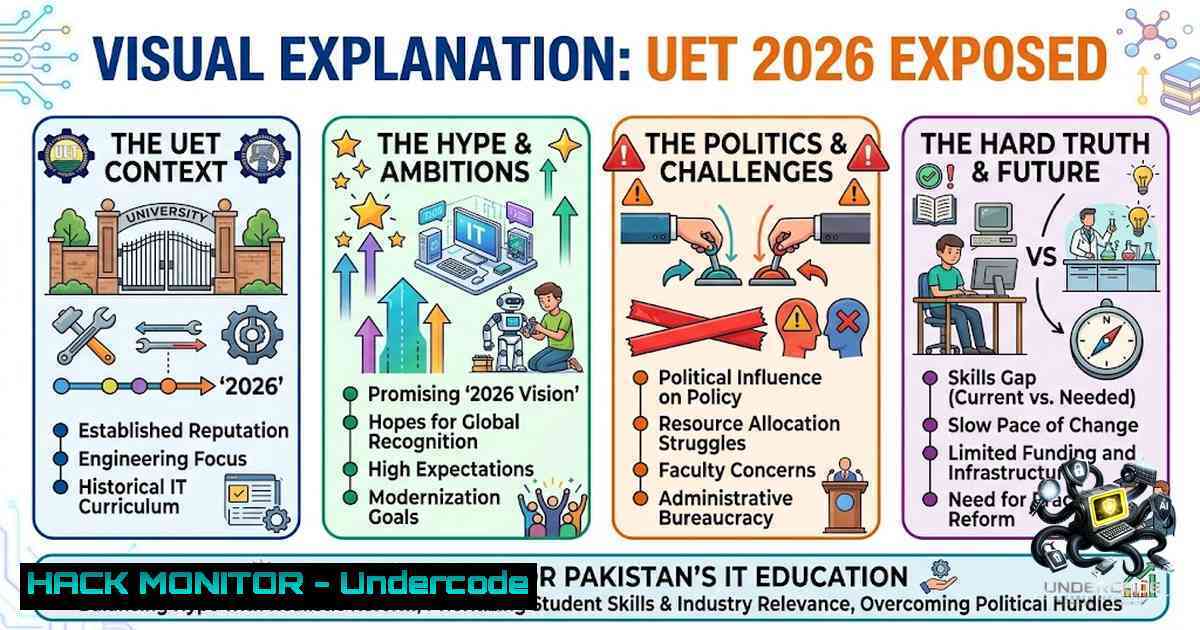
Introduction:
Every year, thousands of students across Pakistan make a four-year commitment based on university rankings, social media hype, and alumni success stories—yet rarely ask what it actually feels like to sit in those lecture halls, face those faculty members, and navigate those departmental politics. The recent UET Lahore 2026 review by Huzaifa Khalil Ahmed has ignited a critical conversation about the gap between institutional reputation and student reality, particularly for high-stakes programs like Computer Science, Artificial Intelligence, Cyber Security, and Data Science. This article extracts the technical and systemic lessons from that review, blends them with actionable cybersecurity and IT training insights, and delivers a no-1onsense guide for anyone standing at the crossroads of higher education in Pakistan.
Learning Objectives:
- Understand the systemic issues—academic pressure, faculty ego, favoritism, and departmental politics—that pervade Pakistan’s top engineering universities.
- Learn how to critically evaluate university programs using a dual-perspective framework (top-tier vs. average student experience).
- Acquire practical Linux, Windows, and security-hardening commands relevant to the cybersecurity and AI curricula offered at institutions like UET.
- Identify alternative training pathways, including free certifications, bootcamps, and skill-based courses that can supplement or even replace traditional degree programs.
You Should Know:
- The Dual-Perspective Framework: Why GPA 3.8 and 3.0 Students Tell Different Stories
Huzaifa’s methodology—interviewing one student with a GPA above 3.8 and one with a GPA around 3.0 from each degree program—is a masterclass in critical evaluation. The core insight is that institutional experience is not monolithic. A topper often receives preferential treatment, better project opportunities, and more faculty attention, while an average student may face neglect, bureaucratic hurdles, and a demotivating environment.
Step-by-Step Guide to Applying This Framework:
- Identify Your Target Programs: List the specific IT programs you’re considering (e.g., BSCS with Specialization in Cyber Security, AI, Data Science).
- Reach Out to Current Students: Use LinkedIn, Facebook groups, or university forums to find at least two current students from each program.
3. Structured Interviewing: Ask standardized questions about:
- Academic pressure and workload.
- Faculty behaviour and accessibility.
- Lab facilities and equipment (e.g., do they have actual networking gear for cybersecurity labs?).
- Internship and job placement support.
- Student culture and peer learning environment.
- Compare and Contrast: Map the responses from the high-GPA and average-GPA students. Look for discrepancies—if the topper praises the faculty but the average student complains about neglect, that’s a red flag.
- Visit the Campus (If Possible): Walk through the department, talk to random students in the cafeteria, and observe the general atmosphere. This often reveals more than official brochures.
Technical Context: For cybersecurity students, this framework is critical because lab access and hands-on equipment vary drastically. UET Lahore offers specializations in Cyber Security and has introduced Associate Degree Programs (ADP) in Cybersecurity, but the quality of practical training depends heavily on departmental investment. Ask current students: “Do you have access to a dedicated security lab with firewalls, IDS/IPS, and penetration testing tools?”
- Decoding the Curriculum: What UET Actually Teaches in AI, Cyber Security, and Data Science
The University of Engineering and Technology, Lahore, has significantly expanded its IT portfolio. Beyond the traditional BSCS, it now offers specialized tracks in Artificial Intelligence, Cyber Security, Data Science, and Multimedia and Gaming. The curriculum is structured around a Computing Core (14 courses, 46 credit hours) followed by specialization electives.
Step-by-Step Guide to Curriculum Analysis:
- Access the Official Curriculum: Download the semester-wise study plan from the UET admission portal (admission.uet.edu.pk) or the department website.
- Map Core Courses: Identify the foundational courses: Programming Fundamentals, Data Structures and Algorithms, Discrete Mathematics, Computer Networks, and Information Security.
3. Evaluate Specialization Depth:
- Cyber Security: Look for courses like Network Security, Digital Forensics, Cryptography, and Ethical Hacking. Check if the curriculum includes practical labs on vulnerability analysis, system hacking, and malware threats.
- Artificial Intelligence: Look for core courses like AI-502 (Artificial Intelligence) and AI-503 (Machine Learning). Check for electives in Generative AI, Multi-agent Systems, and Explainable AI.
- Data Science: Look for courses in Data Analytics, Big Data, and Machine Learning.
- Check for Industry Certifications: UET collaborates with global technology leaders like Cisco, Qualcomm, ZTE, and Huawei to align its curriculum with industry certifications. For cybersecurity, this means potential alignment with Cisco CyberOps Associate or CCST Cybersecurity certifications.
- Assess Practical Components: Verify the credit hours breakdown—theory vs. lab (e.g., 3-1 means 3 theory credits and 1 lab credit). A heavy lab component is essential for hands-on fields.
Linux Commands for Cybersecurity Students (UET Curriculum Context):
If you’re in the Cyber Security track, you’ll likely encounter these commands in your labs:
 Network Scanning and Enumeration
nmap -sV -p- 192.168.1.1  Scan all ports with version detection
netstat -tulpn  List all listening ports and associated processes

Vulnerability Analysis
nikto -h http://target.com  Web server vulnerability scanner
sqlmap -u "http://target.com?id=1" --dbs  SQL injection testing

System Hardening (Linux)
sudo ufw enable  Enable Uncomplicated Firewall
sudo ufw allow 22/tcp  Allow SSH only
sudo chmod 600 /etc/shadow  Restrict access to shadow file

Log Analysis
sudo grep "Failed password" /var/log/auth.log  Check for brute-force attempts
sudo journalctl -u sshd -f  Real-time SSH service log monitoring
Windows Commands for Security Labs:
 Network Configuration and Scanning
ipconfig /all  Display all network adapters
netstat -ano  Display all active connections with PID
ping -t 8.8.8.8  Continuous ping test

System Information and Security
systeminfo  Display detailed system configuration
wmic qfe list brief  List installed Windows updates (patches)
netsh advfirewall show allprofiles  Display firewall rules

Active Directory and User Management (for enterprise security labs)
net user administrator /active:yes  Enable administrator account
whoami /groups  Display user group memberships
- The Toxic Environment Phenomenon: Faculty Ego, Favoritism, and Departmental Politics
The review highlights that issues like “teacher ego, toxic academic environments, unnecessary pressure, favoritism, departmental politics and weak student support” are not unique to UET but are systemic across Pakistan’s higher-education system, including LUMS, NUST, FAST, GIKI, and COMSATS. This is a critical reality check.
Step-by-Step Guide to Navigating and Mitigating Toxic Environments:
- Choose Your Battles: Identify which professors are approachable and which are not. Use platforms like RateMyProfessors (or local equivalents) to get anonymous reviews.
- Build a Peer Support Network: Form study groups with like-minded students. Collective learning can buffer against poor teaching and unfair grading.
- Document Everything: If you face unfair treatment, keep a record of emails, assignment submissions, and grading sheets. This documentation can be crucial if you need to escalate issues to the department head or dean.
- Leverage External Resources: Don’t rely solely on university lectures. Use platforms like Coursera, edX, and YouTube to learn the same topics from world-class instructors. For cybersecurity, consider free resources like Cybrary, TryHackMe, and Hack The Box.
- Focus on Skill Acquisition Over Grades: While a good GPA matters, practical skills matter more in the IT industry. Contribute to open-source projects, build a portfolio on GitHub, and earn industry-recognized certifications.
Recommended Certifications to Bypass Institutional Limitations:
| Certification | Provider | Focus Area | Relevance to UET Programs |
|---|---|---|---|
| CompTIA Security+ | CompTIA | Foundational cybersecurity | Complements BSCS Cyber Security core |
| CEH (Certified Ethical Hacker) | EC-Council | Penetration testing | Aligns with Ethical Hacking labs |
| Cisco CyberOps Associate | Cisco | Security operations | Matches UET’s Cisco collaboration |
| CISSP | ISC2 | Management-level security | For advanced roles post-graduation |
| TensorFlow Developer Certificate | Machine Learning | Complements AI specialization |
- The ADP Revolution: A Faster, More Practical Alternative?
UET Lahore has launched two-year Associate Degree Programs (ADP) in Computer Science, Cybersecurity, Software Engineering, Artificial Intelligence, and Data Science. These are positioned as “highly practical degree programs designed to equip you with the industry-demanding skill set”.
Step-by-Step Guide to Evaluating ADP vs. Traditional BS Programs:
- Compare Duration and Cost: ADP is a 2-year program versus a 4-year BS. This means lower tuition fees and faster entry into the job market.
- Assess Practical Focus: ADP programs are designed to be hands-on. Look at the course outline—does it emphasize lab work, projects, and internships over theoretical lectures?
- Check Transferability: Can you transfer ADP credits to a BS program later? Some universities allow this, but policies vary.
- Evaluate Job Market Acceptance: In Pakistan’s IT industry, skills often trump degrees. An ADP with strong practical training and certifications (e.g., Cisco, AWS, CompTIA) can be more valuable than a theoretical BS.
- Consider Your Career Goals: If you want to pursue a master’s degree or academic research, a traditional BS is preferable. If you want to become a software developer, security analyst, or data scientist as quickly as possible, ADP is a viable option.
Technical Skills to Master During an ADP:
- Programming: Python, Java, C++ (for system-level programming).
- Web Development: HTML5, CSS3, JavaScript, PHP, Laravel, MEAN/MERN stack.
- Cloud Computing: AWS, Azure, or Google Cloud Platform fundamentals.
- Database Management: SQL (MySQL, PostgreSQL) and NoSQL (MongoDB).
- Security Tools: Wireshark, Metasploit, Burp Suite, Nmap.
- Free and Low-Cost Training Alternatives: The UET Free IT Courses
UET Lahore has previously offered free IT and Technical Training courses, including a “Certificate in Cyber Security” covering Introduction to Ethical Hacking, Footprinting and Reconnaissance, Scanning Networks Enumeration, Vulnerability Analysis, System Hacking, Malware Threats, Sniffing, Social Engineering, and Denial-of-Service. These courses are goldmines for students who want to upskill without breaking the bank.
Step-by-Step Guide to Accessing Free Training:
- Monitor University Portals: Regularly check the UET admission portal (admission.uet.edu.pk) and the KICS (Khawaja Fareed Campus) website for announcements about free courses.
- Follow Social Media: Follow the Department of Computer Science and the Institute of Artificial Intelligence, Machine Learning and Cyber Security on LinkedIn and Facebook for real-time updates.
- Explore NAVTTC Programs: The National Vocational and Technical Training Commission (NAVTC) often runs free “Summer of Code” programs covering web development, full-stack development, and AI.
- Leverage International Platforms: Platforms like Cisco Networking Academy, AWS Educate, and Google Digital Garage offer free courses and certifications. Virtual University of Pakistan also offers Cisco Academy courses.
- Build a Learning Roadmap: Combine free courses with hands-on practice. For example:
– Month 1-2: Python Programming (Coursera/edX) + Linux Basics (Linux Journey).
– Month 3-4: Network Security (Cisco NetAcad) + Wireshark labs.
– Month 5-6: Ethical Hacking (TryHackMe) + Burp Suite practice.
– Month 7-8: Cloud Security (AWS Educate) + Capture The Flag (CTF) competitions.
Essential Tools for Self-Learning (All Free/Open-Source):
- Virtualization: VirtualBox or VMware Workstation Player (for creating safe hacking labs).
- Penetration Testing OS: Kali Linux or Parrot Security OS.
- Network Analysis: Wireshark, Nmap, Zenmap.
- Web Security: Burp Suite Community Edition, OWASP ZAP.
- Vulnerability Scanning: OpenVAS, Nessus Essentials.
- Code Editor: Visual Studio Code with security extensions (e.g., ESLint, SonarLint).
- The Research and Faculty Reality: What’s Happening Behind the Scenes
UET Lahore’s Computer Science department has active researchers working on cutting-edge topics. Faculty members like Prof. Dr. Muhammad Usman Ghani Khan (Chairman, CS Department) have over 18 years of experience in image processing, computer vision, and machine learning. Other faculty are working on generative AI, NLP, blockchain, and formal verification.
Step-by-Step Guide to Leveraging Faculty Research:
- Identify Research Interests: Browse faculty profiles on the UET website or IEEE Xplore to understand their research areas.
- Reach Out Professionally: If you’re interested in a specific area (e.g., blockchain, generative AI), email the professor with a well-crafted message. Express your interest and ask if they have any undergraduate research opportunities.
- Attend Seminars and Workshops: UET regularly hosts events like “Open Week” covering AI, Cloud, and Cybersecurity. Attend these to network with faculty and industry professionals.
- Work on Research Projects: If you secure a research assistant position, you’ll gain deep technical knowledge and a strong addition to your CV.
- Publish or Present: Aim to co-author a paper or present a poster at a conference. This is a massive differentiator in the job market and for graduate school applications.
What Undercode Say:
- Key Takeaway 1: Institutional reputation does not guarantee a quality educational experience. Always apply the dual-perspective framework (high-GPA vs. average-GPA student) to get a balanced view before committing to any university.
- Key Takeaway 2: The technical curriculum—whether in AI, Cyber Security, or Data Science—is just a skeleton. The real value comes from hands-on labs, industry certifications, and self-directed learning. Don’t wait for the university to teach you; take ownership of your skill development.
Analysis: Huzaifa Khalil Ahmed’s review is a much-1eeded antidote to the blind hype surrounding Pakistan’s top engineering universities. It exposes the uncomfortable truth that systemic issues—faculty ego, departmental politics, and toxic competition—are pervasive and can significantly impact a student’s mental health and academic growth. However, the review also empowers students by providing a framework for critical evaluation. It shifts the narrative from “which university is best?” to “what kind of experience can I expect, and how can I navigate it?” This is a mature, nuanced approach that every prospective student should adopt.
Prediction:
- -1: The systemic issues highlighted in the review—favoritism, weak student support, and toxic environments—are unlikely to be resolved in the short term. Without significant institutional reforms, UET and similar universities will continue to lose their brightest talent to international universities and online learning platforms.
- +1: The growing awareness of these issues, fueled by candid reviews like this one, will force universities to become more transparent and accountable. We may see a rise in student-led evaluations, departmental reforms, and a shift towards more practical, industry-aligned curricula.
- +1: The ADP programs and free training courses offered by UET and other institutions represent a positive trend towards skill-based, accessible education. This could democratize IT education in Pakistan and produce a workforce that is more job-ready.
- -1: The gap between the “haves” (students with high GPAs, strong connections, and financial resources) and the “have-1ots” (average students) will likely widen, exacerbating inequality in career outcomes.
- +1: The increasing availability of free and low-cost certifications (Cisco, AWS, CompTIA) will empower students to bypass institutional limitations and build credible, globally recognized skill sets. This could lead to a future where university degrees matter less than demonstrable competence.
▶️ Related Video (78% Match):
https://www.youtube.com/watch?v=0_g0PltZIcw
🎯Let’s Practice For Free:
🎓 Live Courses & Certifications:
Join Undercode Academy for Verified Certifications
🚀 Request a Custom Project:
Secure, high-velocity infrastructure and disruptive technological engineering. Contact our engineering team for high-tier development and proprietary systems:
[email protected]
💎 Smart Architecture | 🛡️ Secure by Design | ⭐ Trusted by Thousands
IT/Security Reporter URL:
Reported By: Huzaifa Khalil – Hackers Feeds
Extra Hub: Undercode MoN
Basic Verification: Pass ✅


