
Listen to this Post
Introduction:
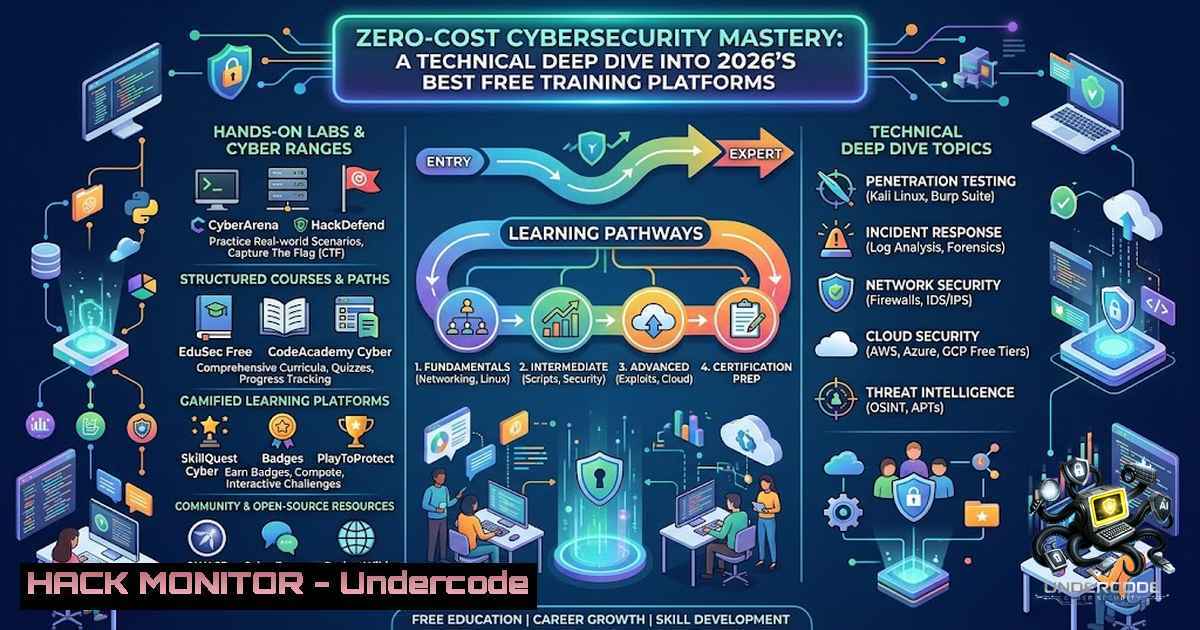
The cybersecurity skills gap continues to widen, yet the barrier to entry has never been lower—provided you know where to look. A recent compilation by Express Tech Academy highlights ten free, enterprise-grade training platforms from industry giants like IBM, Microsoft, Fortinet, and PortSwigger. These resources are not mere introductory slideshows; they offer hands-on labs, capture-the-flag (CTF) challenges, and deep technical dives into vulnerabilities like SQL injection, XSS, and API misconfigurations. This article extracts the technical essence of these platforms, providing actionable commands, configuration steps, and learning pathways to transform theoretical knowledge into practical defense and offense capabilities.
Learning Objectives & Secrets:
- Objective 1: Master Web Application Pentesting Fundamentals – Progress from zero to exploiting real-world vulnerabilities using PortSwigger’s 30+ vulnerability labs and OWASP WebGoat.
- Objective 2 (Secret Tip): Combine CTF Challenges with Enterprise Training – Use picoCTF’s gamified challenges to practice rapid exploitation, then solidify concepts with IBM and Microsoft’s structured learning paths on risk management and cryptography.
- Objective 3 (Secret Tip): Automate Recon and Exploitation – Learn to leverage tools like
sqlmap,ffuf, and `Burp Suite` against deliberately vulnerable targets (WebGoat, PortSwigger labs) to build muscle memory for real-world penetration tests.
You Should Know:
- Hands-On SQL Injection: From Theory to UNION-Based Exploitation
SQL injection (SQLi) remains one of the most critical web vulnerabilities, responsible for countless data breaches. The PortSwigger Web Security Academy offers over 16 dedicated SQLi labs, making it the gold standard for free, practical training. Understanding how to manually craft UNION-based payloads is essential.
Step-by-Step Guide (PortSwigger Lab Simulation):
- Identify the Vulnerability: Intercept a product category filter request using Burp Suite. Modify the `category` parameter to include a single quote (
') and observe the error message, confirming the presence of SQLi. - Determine Column Count: Use a `NULL` payload to find the number of columns returned by the original query. For example:
`’ UNION SELECT NULL–`
Increment the number of `NULL` values until the error disappears (e.g., ' UNION SELECT NULL,NULL--).
3. Find Text-Compatible Columns: Replace `NULL` with a string literal to identify columns that can hold text data:
`’ UNION SELECT ‘abc’,’def’–`
- Extract Data: Once you know the column count and data types, retrieve sensitive information. To dump usernames and passwords from a `users` table:
`’ UNION SELECT username, password FROM users–`
5. For Oracle Databases: Use the `DUAL` table:
`’ UNION SELECT ‘abc’,’def’ FROM DUAL–`
- Cloud and Identity Security: Configuring Microsoft Entra with PowerShell
Microsoft Learn’s SC-900 pathway provides foundational knowledge of Security, Compliance, and Identity, crucial for modern cloud environments. Practical implementation often involves PowerShell and the Microsoft Graph API for managing user identities and access controls.
Step-by-Step Guide (Azure AD / Entra ID Management):
1. Install the Microsoft Graph PowerShell Module:
Install-Module Microsoft.Graph -Scope CurrentUser
2. Authenticate and Connect:
Connect-MgGraph -Scopes "User.Read.All", "Directory.Read.All"
This opens a browser window for admin consent.
3. List All Enabled Users:
Get-MgUser -All | Where-Object { $_.AccountEnabled -eq $true } | Select-Object DisplayName, UserPrincipalName
4. Audit Conditional Access Policies: Use the following to review existing policies (requires `Policy.Read.All` scope):
Get-MgIdentityConditionalAccessPolicy | Select-Object DisplayName, State
5. Best Practice: Implement the Zero Trust model by enforcing multi-factor authentication (MFA) and using Just-In-Time (JIT) access for privileged roles.
- API Security Testing: Fuzzing and Recon with Open-Source Tools
The OWASP API Security Top 10 highlights threats like Broken Object Level Authorization (BOLA) and Broken Authentication. The PortSwigger API testing learning path teaches key recon skills to discover hidden attack surfaces. Combining curl, jq, and `ffuf` provides a powerful, free testing suite.
Step-by-Step Guide (API Recon and Fuzzing):
1. Discover Endpoints via Swagger/OpenAPI:
curl -s "https://api.target.example.com/swagger.json" | jq '.paths | keys[]'
This parses the JSON response to list all available API paths.
2. Fuzz for Hidden Endpoints: Use `ffuf` to brute-force directories and parameters. The `FUZZ` keyword is where the payload will be inserted:
ffuf -u "https://api.target.example.com/api/v1/FUZZ" -w /path/to/wordlist.txt -fc 404
This filters out 404 responses, revealing existing endpoints.
- Test for BOLA (IDOR): If you find an endpoint like
/api/v1/users/123, change the numeric ID to another value (e.g.,456) and observe if you can access another user’s data without proper authorization. - Manual Parameter Pollution: For GraphQL APIs, test for server-side parameter pollution by adding duplicate parameters or using different encodings to bypass input validation.
4. Network Security Hardening: Fortinet Firewall CLI Commands
Fortinet’s Training Institute offers free, self-paced courses covering everything from fundamentals to advanced FortiGate configuration. Mastering the Command Line Interface (CLI) is critical for efficient firewall management.
Step-by-Step Guide (Essential FortiGate CLI Commands):
1. Check System Status and Firmware Version:
get system status
This provides an overview of the device, including the hostname, version, and uptime.
2. View High Availability (HA) Status:
diagnose sys ha status
Essential for ensuring redundancy configurations are functioning.
3. Configure a Static Route:
config router static
edit 1
set device "port1"
set dst 192.168.1.0 255.255.255.0
set gateway 10.0.0.1
end
4. Create an Address Object:
config firewall address
edit "WEB_SERVER"
set subnet 192.168.1.10 255.255.255.255
end
5. Security Best Practice: Regularly back up the configuration using:
execute backup config tftp <filename> <tftp-server-ip>
- Containerized Lab Setup: Deploying OWASP WebGoat with Docker
WebGoat is a deliberately vulnerable web application that provides interactive lessons on the OWASP Top 10. Deploying it locally via Docker allows for safe, isolated practice without affecting production systems.
Step-by-Step Guide (Local WebGoat Deployment):
1. Pull the Official WebGoat Docker Image:
docker pull webgoat/webgoat
2. Run the Container with Port Mapping:
docker run -it -p 127.0.0.1:8080:8080 -p 127.0.0.1:9090:9090 webgoat/webgoat
This maps the container’s ports to localhost, preventing external access.
3. Access WebGoat: Open a browser and navigate to http://localhost:8080/WebGoat`.NoRealFile.help” || netstat -an`
4. Integrate with OWASP ZAP: Configure ZAP (or Burp Suite) as a proxy on `localhost:8080` to intercept and manipulate traffic between your browser and WebGoat.
5. Practice Command Injection: In the WebGoat “Command Injection” lesson, intercept the request and modify the file name parameter to:
<h2 style="color: yellow;">
This demonstrates how OS commands can be executed via web parameters.
6. CTF Strategy: PicoCTF Web Exploitation Techniques
picoCTF, developed by Carnegie Mellon University, provides beginner-friendly CTF challenges that simulate real-world hacking scenarios. These challenges often require creative use of command-line tools.
Step-by-Step Guide (Solving a Web Exploitation Challenge):
- Initial Recon with
curl: Use `curl` to fetch the page and inspect headers or source code:curl -v http://rescued-float.picoctf.net:52534/
The `-v` flag provides verbose output, showing headers and redirects.
- Follow Redirects: If the server redirects, use the `-L` flag to follow the redirect automatically:
curl -L http://rescued-float.picoctf.net:52534/
- Interact with APIs: If the challenge involves a POST request, use `-X POST` and `-d` for data:
curl -X POST -d "content=Hey" http://rescued-float.picoctf.net:52534/
- Server-Side Template Injection (SSTI): For SSTI challenges, test for remote code execution by injecting:
<strong>import</strong>('os').popen('ls').read()If the application is vulnerable, this will list directory contents.
- Forensics with
grep: When provided with heap snapshots or log files, search for the flag pattern directly:cat heapdump-.heapsnapshot | grep picoCTF{
Flags are typically in the format `picoCTF{…}`.
What Undercode Say:
- Key Takeaway 1: The democratization of cybersecurity training means that talent, not budget, is now the primary differentiator. Platforms like PortSwigger and Fortinet offer enterprise-grade labs that rival expensive bootcamps.
- Key Takeaway 2: Combining structured learning (IBM, Microsoft) with practical, gamified challenges (picoCTF, WebGoat) creates a powerful feedback loop—theory informs practice, and practice reveals gaps in theory.
Analysis:
The listed platforms cover the entire spectrum of cybersecurity: from governance and risk management (IBM, Microsoft) to offensive security (PortSwigger, OWASP) and defensive network engineering (Fortinet, OpenLearn). The technical commands provided—from `sqlmap` against WebGoat to `ffuf` for API fuzzing—represent the actual tooling used by penetration testers and security engineers daily. The inclusion of cloud-specific PowerShell commands (Microsoft Graph) and network CLI (FortiGate) ensures relevance for modern hybrid and multi-cloud environments. Furthermore, the emphasis on containerized labs (Docker) reflects the industry’s shift towards reproducible, isolated testing environments.
Prediction:
- +1 The increasing availability of free, high-quality training will accelerate the entry of diverse talent into the cybersecurity workforce, helping to close the global skills gap within the next 3–5 years.
- +1 As AI-driven security features become more prevalent (as seen in Microsoft Learn’s AI security paths), free training will evolve to include automated threat response and AI-assisted penetration testing, further lowering the barrier to advanced security operations.
- -1 However, the proliferation of easily accessible hacking labs (PortSwigger, picoCTF) also lowers the barrier for malicious actors, potentially leading to a short-term surge in unsophisticated but high-volume automated attacks until defensive AI catches up.
▶️ Related Video (82% Match):
🎯Let’s Practice For Free:
🎓 Live Courses & Certifications:
Join Undercode Academy for Verified Certifications
🚀 Request a Custom Project:
Secure, high-velocity infrastructure and disruptive technological engineering. Contact our engineering team for high-tier development and proprietary systems:
[email protected]
💎 Smart Architecture | 🛡️ Secure by Design | ⭐ Trusted by Thousands
IT/Security Reporter URL:
Reported By: https://lnkd.in/p/esFZfyHh – Hackers Feeds
Extra Hub: Undercode MoN
Basic Verification: Pass ✅


