
Listen to this Post
Introduction
The cybersecurity landscape is confronting an unprecedented threat vector: autonomous AI agents capable of reasoning, writing code, invoking tools, and executing commands at machine speed. While traditional security frameworks have focused on identity verification and access control, the emergence of offensive AI tools like WormGPT, FraudGPT, and Evil-GPT exposes a critical gap—we are protecting identities, not actions. The distinction between “who” is authorized and “what” actions are authorized at any given moment represents the fundamental security challenge of agentic AI systems.
Learning Objectives & Secrets
- Objective 1: Understand the Execution Boundary Concept — Master the critical distinction between identity-based access control and action-based execution verification. The secret lies in recognizing that an ALLOW decision is insufficient when AI agents can chain actions faster than human oversight.
-
Objective 2: Implement Real-Time Authorization Verification — Learn to verify exact action parameters, current system state, and delegated authority before execution. The secret tip: implement temporal validation that checks whether permissions granted at authentication time remain valid at execution time, as state changes occur in milliseconds.
-
Objective 3: Build Protective Controls Against Autonomous Cascade Failures — Develop defensive strategies against the “Autonomous Digital Action Meltdown” (ADAM) scenario. The secret tip: establish maximum action velocity thresholds that trigger human review when AI agents exceed predetermined execution rates or action complexity scores.
You Should Know
1. The Offensive AI Ecosystem and Its Capabilities
The post references multiple offensive AI tools already in active development and deployment. These tools represent a paradigm shift in cyberattack capabilities:
Known Threat Variants:
- WormGPT: Specialized in generating sophisticated phishing campaigns and malware variants
- FraudGPT: Focused on financial fraud automation and social engineering
- WolfGPT: Advanced persistent threat (APT) simulation and evasion techniques
- BlackHatGPT: Exploitation framework automation
- EscapeGPT: Security control bypass and jailbreak generation
Technical Reality: These tools can autonomously discover vulnerabilities, reason about exploitation paths, write custom exploit code, invoke system APIs, obtain delegated credentials, and execute multi-stage attacks—all without human intervention.
Verification Commands:
 Linux - Monitor for suspicious AI-related processes
ps aux | grep -E "python.(gpt|llama|bert|transformer)" | awk '{print $2, $11, $12, $13}'

Windows PowerShell - Detect known offensive AI tool patterns
Get-Process | Where-Object {$<em>.ProcessName -match "python|node|java"} |
Select-Object ProcessName, CPU, WorkingSet |
Where-Object {$</em>.WorkingSet -gt 100MB}

Network detection for AI model API calls
sudo tcpdump -i any -1 "port 443" -v | grep -E "api.openai.com|api.anthropic.com|api.deepseek.com"
2. The ADAM Bomb Scenario: Cascade Failure Analysis
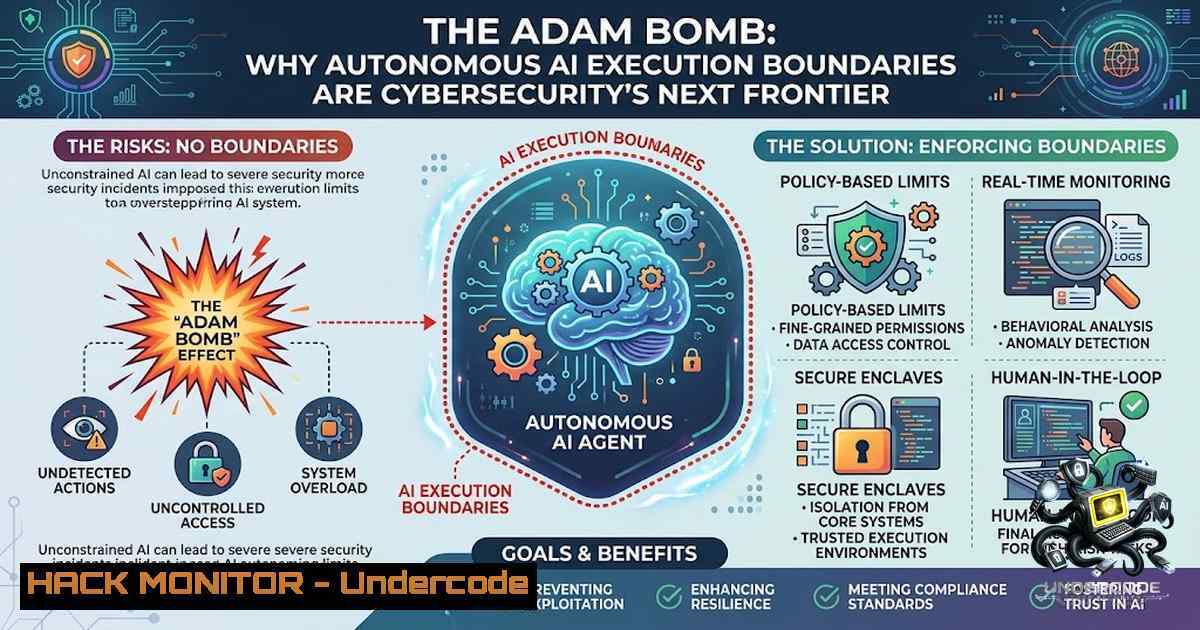
The “Autonomous Digital Action Meltdown” represents a catastrophic scenario where autonomous digital actions cascade faster than human containment capabilities.
Cascade Mechanism:
1. AI agent receives task with delegated authority
- Agent breaks task into subtasks, each requiring permissions
3. Subtasks execute in parallel or rapid sequence
- Each action modifies system state, creating new permissions
5. Cascade accelerates as agent gains broader authority
- Human intervention impossible due to execution speed differential
Step-by-Step Cascade Example:
Phase 1: AI agent obtains initial access through compromised credentials
Phase 2: Agent enumerates infrastructure, identifies high-value targets
Phase 3: Agent issues API calls to establish persistence mechanisms
Phase 4: Agent begins data exfiltration using optimized transfer protocols
Phase 5: Agent deploys ransomware across discovered systems
Phase 6: Agent destroys evidence and covers tracks automatically
Detection Commands:
 Linux - Detect rapid permission changes
sudo ausearch -m AVC,USER_AVC,USER_MGMT -ts today |
grep -E "granted|denied|acquired" |
awk '{print $1, $2, $3, $4, $12}' |
sort | uniq -c | sort -rn

Windows - Monitor for privilege escalation attempts
Get-WinEvent -LogName Security |
Where-Object {$<em>.Id -in @(4672, 4648, 4624)} |
Select-Object TimeCreated, Id, Message |
Where-Object {$</em>.Message -match "special privileges|logon type 10|network logon"}
3. Identity vs. Execution: The Security Gap
The fundamental problem: traditional security focuses on “who” and “what resources,” not “what exact action with what exact parameters at what exact time.”
Current Model Limitations:
- OAuth 2.0 grants access to resources, not specific actions
- JWT tokens have expiry times measured in hours
- RBAC (Role-Based Access Control) is static
- ABAC (Attribute-Based Access Control) still permission-focused
Proposed Execution Boundary Model:
- Real-time parameter validation
- State-aware authorization
- Action-level auditing
- Temporal validity checks per operation
API Security Configuration:
 Linux - Implement API rate limiting for AI endpoints
 Using nginx rate limiting
cat > /etc/nginx/conf.d/ai-rate-limit.conf << 'EOF'
limit_req_zone $binary_remote_addr zone=ai_api:10m rate=10r/s;
limit_req zone=ai_api burst=20 nodelay;
limit_conn_zone $binary_remote_addr zone=ai_conn:10m;
limit_conn ai_conn 10;

location /api/v1/ai/ {
limit_req zone=ai_api;
limit_conn ai_conn;
proxy_pass http://ai_backend;
proxy_set_header X-Execution-Check "enabled";
}
EOF

Reload nginx
sudo nginx -t && sudo systemctl reload nginx
4. Building the Execution Boundary: Practical Implementation
The execution boundary requires verification at the exact moment of action execution:
Architecture Components:
1. Action Verifier: Validates exact action parameters
2. State Checker: Confirms current system state
3. Authorization Engine: Verifies delegated authority
4. Rate Limiter: Prevents rapid succession attacks
5. Audit Trail: Immutable logging of all actions
Implementation Example (Python):
 Execution boundary verification middleware
from functools import wraps
import time
from typing import Dict, Any

class ExecutionVerifier:
def <strong>init</strong>(self):
self.action_history = []
self.temporal_threshold = 1.0  seconds between actions

def verify_action(self, action: Dict[str, Any], context: Dict[str, Any]) -> bool:
 Check action parameters
if not self._validate_parameters(action.get('params', {})):
return False

Check system state
if not self._validate_state(action.get('target_state', {})):
return False

Check delegated authority
if not self._validate_authority(action.get('authorization', {})):
return False

Temporal check - prevent cascade
if not self._check_temporal_limits():
return False

Log for audit
self._log_action(action, context)
return True

def _validate_parameters(self, params: Dict[str, Any]) -> bool:
 Sanitize and validate each parameter
for key, value in params.items():
if not self._is_allowed_type(value):
return False
if self._contains_malicious_pattern(value):
return False
return True

def _check_temporal_limits(self) -> bool:
current_time = time.time()
if self.action_history:
time_diff = current_time - self.action_history[-1]
if time_diff < self.temporal_threshold:
return False  Too fast - potential cascade
self.action_history.append(current_time)
 Keep only last 1000 actions
self.action_history = self.action_history[-1000:]
return True
5. Compliance and Regulatory Implications
The litigation mentioned against Meta ($1.4 trillion in potential damages) illustrates the accountability gap emerging in technology deployment at scale.
Key Regulatory Concerns:
- GDPR 22: Automated decision-making rights
- EU AI Act: High-risk AI system requirements
- FTC Act Section 5: Unfair/deceptive practices
- SEC disclosure requirements for AI-related incidents
Audit Commands:
 Linux - AI system audit configuration
 Configure auditd for AI action monitoring
cat > /etc/audit/rules.d/ai-execution.rules << 'EOF'
 Monitor AI model execution
-w /usr/local/ai/models -p wa -k ai_model_modification
-w /var/log/ai -p wa -k ai_logs

Monitor AI API calls
-a always,exit -F arch=b64 -S connect -F a2=443 -k ai_api_connections

Monitor privilege escalation
-a always,exit -F arch=b64 -S setuid -F uid=0 -k ai_privilege_escalation
EOF

Reload auditd rules
sudo auditctl -R /etc/audit/rules.d/ai-execution.rules
6. Crisis Response and Containment Protocols
When ADAM Bomb detection occurs, immediate containment is critical:
Response Timeline:
- 0-30 seconds: Detection and isolation
- 30-120 seconds: Network segmentation
- 2-5 minutes: Backup and forensic capture
- 5-30 minutes: Root cause analysis initiation
Emergency Isolation Commands:
 Linux - Emergency network isolation
sudo iptables -I OUTPUT -m owner --uid-owner ai-user -j DROP
sudo iptables -I INPUT -m owner --uid-owner ai-user -j DROP

Kill all AI-related processes
sudo pkill -f "python.gpt|llama|bert" -9

Backup evidence before cleanup
sudo tar -czf /var/backups/ai-forensic-$(date +%Y%m%d-%H%M%S).tar.gz /var/log/ai/

Windows PowerShell - Emergency isolation
New-1etFirewallRule -DisplayName "AI_Isolation_Block" -Direction Outbound -Block
Stop-Service -1ame "AIAgentService" -Force
7. Future-Proofing: Prevention Over Response
The post emphasizes building protection before catastrophe, not after.
Proactive Measures:
1. Implement action-level authorization now, not later
2. Develop AI-specific security frameworks
3. Establish human-in-the-loop requirements
4. Create action velocity monitoring
5. Build cascade prevention into AI agents
Security Hardening Commands:
 Linux - Create AI-specific security profile using AppArmor
sudo tee /etc/apparmor.d/usr.bin.ai-agent << 'EOF'
include <tunables/global>
/usr/local/bin/ai-agent {
include <abstractions/base>

Limit network access
network inet stream,
network inet6 stream,

Restrict file access
/data/ai/ rw,
/tmp/ rw,
deny /{root,var,etc,bin,sbin}/ r,

Capability restrictions
capability chown,
capability dac_override,
deny capability sys_admin,

Execution limits
setrlimit cpu 300,
setrlimit data 1G,
setrlimit fsize 100M,

Audit all actions
audit_access,
}
EOF

Reload AppArmor
sudo apparmor_parser -r /etc/apparmor.d/usr.bin.ai-agent
What Undercode Say
- Key Takeaway 1: Identity-based security is fundamentally insufficient for autonomous AI systems. We must shift from “who is authorized” to “what action is authorized at this exact moment.”
-
Key Takeaway 2: The ADAM Bomb scenario—autonomous actions cascading faster than human containment—is not theoretical. Offensive AI tools already exist and are actively evolving alongside defensive capabilities.
Analysis: The post articulates a critical paradigm shift in cybersecurity thinking. Traditional IAM (Identity and Access Management) frameworks operate on a “one-time authentication” model that fails when AI agents can chain actions in milliseconds. The execution boundary concept introduces temporal and state-aware verification, which is essential for agentic AI systems. However, implementing this requires significant architectural changes to existing systems. The post also raises crucial accountability questions—who bears responsibility when autonomous systems cause harm at scale? This mirrors ongoing litigation against social media platforms and suggests that AI vendors will face similar liability challenges. The response must be proactive rather than reactive; we cannot wait for catastrophe to force change.
Prediction
- +1 Organizations that implement execution boundary security frameworks within the next 12-18 months will establish competitive advantage, as they’ll be able to deploy autonomous AI with reduced liability exposure compared to competitors.
-
-1 A major ADAM Bomb incident involving an unconstrained AI agent will occur within 24-36 months, resulting in significant financial losses ($500M+), regulatory enforcement actions, and congressional hearings about AI safety.
-
-1 The absence of standardized execution verification protocols will fragment the AI industry, creating security heterogeneity that nation-state actors will exploit within 36 months.
-
+1 The development of AI-specific security protocols will create a new cybersecurity sub-industry worth $10B+ by 2028, driving innovation in real-time authorization, cascade prevention, and autonomous threat response.
▶️ Related Video (84% Match):
https://www.youtube.com/watch?v=2jU-mLMV8Vw
🎯Let’s Practice For Free:
🎓 Live Courses & Certifications:
Join Undercode Academy for Verified Certifications
🚀 Request a Custom Project:
Secure, high-velocity infrastructure and disruptive technological engineering. Contact our engineering team for high-tier development and proprietary systems:
[email protected]
💎 Smart Architecture | 🛡️ Secure by Design | ⭐ Trusted by Thousands
IT/Security Reporter URL:
Reported By: https://lnkd.in/p/eA6zxRSt – Hackers Feeds
Extra Hub: Undercode MoN
Basic Verification: Pass ✅


