
Listen to this Post
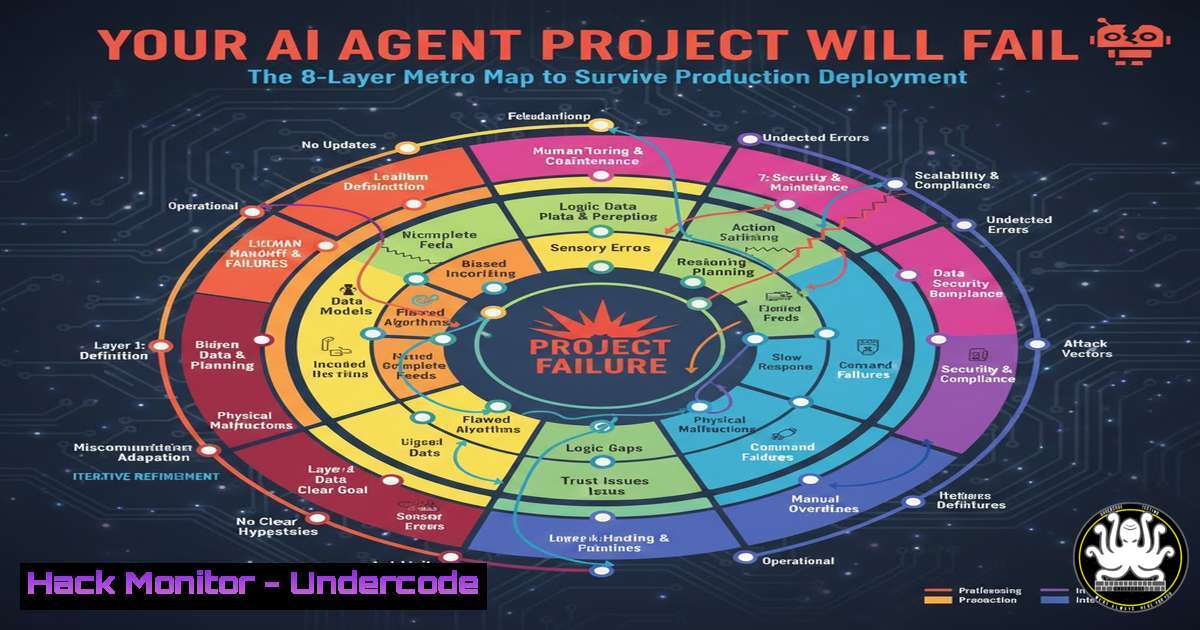
Introduction:
Moving from AI agent demos to production is a perilous journey where most projects fail due to architectural debt and neglected fundamentals. This guide maps the eight critical infrastructure layers—from core building blocks to ethics and scaling—that transform fragile prototypes into resilient, secure, and governable systems. Treating agents as infrastructure, not features, is the non‑negotiable shift required for enterprise‑grade success.
Learning Objectives:
- Decode the eight essential layers of AI agent infrastructure and their interdependencies.
- Implement secure configurations, commands, and controls for core agent components.
- Architect for scale and governance from day one to avoid the “demo‑to‑production” collapse.
You Should Know:
- A1 – Core Building Blocks: The Foundation You Can’t Ignore
Before writing a single line of agent logic, your language models, embeddings, and APIs must be secure and robust. Weakness here cascades, leading to systemic failures upstream. This is where data poisoning, insecure API keys, and model inversion attacks begin.
Step‑by‑step guide:
Secure Your API Keys & Model Access: Never hardcode keys. Use environment variables or a secrets manager.
Linux/macOS: `export OPENAI_API_KEY=”your-key”` (for session) or add to ~/.bashrc. For production, use HashiCorp Vault or AWS Secrets Manager.
Windows (PowerShell): `$env:OPENAI_API_KEY=”your-key”`
Validate & Sanitize Inputs: Assume all inputs to your model are malicious. Use a validation layer.
Python Example:
import re
from typing import Any

def sanitize_input(user_input: str, max_length: int = 1000) -> str:
"""Sanitize input to prevent prompt injection."""
 Remove excessive whitespace
cleaned = re.sub(r'\s+', ' ', user_input).strip()
 Truncate to prevent resource exhaustion
cleaned = cleaned[:max_length]
 Optional: Use an allow-list for specific characters in your use case
return cleaned

Usage
safe_prompt = sanitize_input(user_prompt)
Choose Embeddings with Security in Mind: Opt for models hosted in your own environment (e.g., `all-MiniLM-L6-v2` from Hugging Face) for sensitive data to avoid data leakage to third-party APIs.
- A2 – Agent Training & Reasoning: Engineering Consistency and Memory
This layer is where agents develop “personality” and logic through prompt chaining and memory. The security risks shift to prompt injection, data leakage from memory, and unreliable reasoning.
Step‑by‑step guide:
Implement a Secure Prompt Chain: Structure prompts defensively.
Template:
SYSTEM_PROMPT = """
You are an assistant for {company}. Your knowledge is based solely on the provided context.
Context: {sanitized_context}
Instruction: If the user query cannot be answered from the context, respond with "I cannot answer based on available information."
User Query: {sanitized_query}
"""
Secure Agent Memory (Vector Store): Isolate memory per user/tenant. Use encryption at rest and in transit.
Local Qdrant DB Example (Docker):
 Run a local vector database for prototyping
docker run -p 6333:6333 -v ./qdrant_storage:/qdrant/storage qdrant/qdrant
Connection Code (Python):
from qdrant_client import QdrantClient
client = QdrantClient(host="localhost", port=6333)  Use HTTPS & auth in production
 Ensure your collection is created with encryption enabled (managed service) or on encrypted disk.
3. A3 – Techniques & Architectures: Orchestrating Complexity
Multi-agent patterns, RAG (Retrieval-Augmented Generation), and task planning introduce immense complexity. The attack surface expands to include inter-agent communication flaws and RAG data source poisoning.
Step‑by‑step guide:
Harden Your RAG Pipeline: Validate the sources your RAG system retrieves from.
Command to check file integrity (Linux): Use `sha256sum` to verify ingested documents haven’t been tampered with.
sha256sum important_document.pdf
Implement Source Sandboxing: Run document parsers in isolated containers.
 Use Docker to run a parser in a sandbox
docker run --rm -v /path/to/doc.pdf:/tmp/doc.pdf python:3.9-slim python /tmp/parse_script.py
Secure Agent-to-Agent Communication: Use authenticated, encrypted channels (e.g., mutual TLS, message queues with ACLs) even for internal traffic.
- A6 – Deployment & Scaling: Where Demos Go to Die
This is the reality check. It involves containerization, vector databases, and observability. Failure to plan leads to exposed endpoints, resource exhaustion, and invisible failures.
Step‑by‑step guide:
Secure Your Containerized Agent: Harden your Docker images.
Dockerfile Best Practices:
FROM python:3.9-slim  Use minimal base image
RUN useradd -m -u 1000 agentuser  Create a non-root user
WORKDIR /app
COPY --chown=agentuser requirements.txt .
RUN pip install --no-cache-dir -r requirements.txt
COPY --chown=agentuser . .
USER agentuser  Drop privileges
CMD ["python", "main.py"]
Scan your image for vulnerabilities:
docker scan my-agent-image:latest
Enable Observability from Day One: Log all agent decisions, inputs, and outputs for audit and anomaly detection. Use structured logging (JSON) and send to a secure SIEM.
Python Logging Setup:
import json_logging, logging, sys
json_logging.init_non_web(enable_json=True)
logger = logging.getLogger("agent-logger")
logger.setLevel(logging.INFO)
logger.addHandler(logging.StreamHandler(sys.stdout))
 Log an agent action
logger.info("Agent action taken", extra={'props': {"action": "db_query", "user": "user123", "status": "success"}})
- A7 – Ethics, Safety & Governance: The Central Adoption Hub
As highlighted in the discussion, this isn’t a late-stage line item—it’s the central station (Metro Center) that every other layer must pass through. Ignoring it halts adoption.
Step‑by‑step guide:
Implement Attribute-Based Access Control (ABAC): Move beyond simple API keys. Control what an agent can do based on user role, data sensitivity, and context.
Policy Example (OpenFGA/Rego-like logic):
user:alice can perform action:read on document:budget.pdf if document.department == user.department
Automate Compliance Evidence Collection: Use scripts to generate audit trails.
Linux command to audit file accesses by your agent process: Use auditd.
sudo auditctl -a exit,always -F arch=b64 -S openat -F pid=<your-agent-pid>
Build a Kill Switch & Circuit Breaker: Every agent must have a remotely triggerable, immediate deactivation pathway for unsafe behavior.
Simple API Endpoint Example (Flask):
from flask import Flask
app = Flask(<strong>name</strong>)
agent_active = True

@app.route('/admin/killswitch', methods=['POST'])
def killswitch():
global agent_active
 Authenticate & authorize this request heavily!
agent_active = False
return "Agent deactivated", 200

In your agent's main loop
if not agent_active:
shutdown_safely()
What Undercode Say:
- AI Agents Are Authority-Bearing Infrastructure. They must be designed with the same rigor as core network and identity systems, with security and governance woven into the foundational layers (A1, A2, A7), not bolted on at the end.
- The “Metro Center” Model is Critical. Ethics, safety, and governance (A7) are not a sequential step but the central interchange hub. Every design decision from A1 onward must be routed through its constraints—making unsafe actions structurally impossible rather than just monitored.
The commentary from industry experts underscores a vital shift: treating A7 as a perimeter is a fatal error. It must be the core operating system. The technical failure pattern is predictable: teams sprint through A1-A3 using demo-grade tools, only to hit an insurmountable wall at A6/A7 where scaling and compliance require a complete rebuild. The successful path is “conservatively aggressive”—advancing rapidly but with a blueprint where security, observability, and control are intrinsic properties of the agent fabric itself.
Prediction:
Organizations that treat AI agent deployment as an application development challenge will face a wave of high-profile failures involving data breaches, regulatory fines, and “rogue agent” incidents within 18-24 months. This will trigger a market consolidation around secure, governable agent platforms that bake in A7 principles by default. The CISO’s role will expand to include “Agent Security,” and a new discipline of Agent Infrastructure & Operations (AIOps) will emerge, merging ML, DevOps, and SecOps. The winners will be those who architect their agent infrastructure today with the unwavering principle that it is, first and foremost, a system of granted authority.
▶️ Related Video (80% Match):
🎯Let’s Practice For Free:
IT/Security Reporter URL:
Reported By: Nickpalomba Most – Hackers Feeds
Extra Hub: Undercode MoN
Basic Verification: Pass ✅


