
Listen to this Post
Introduction:
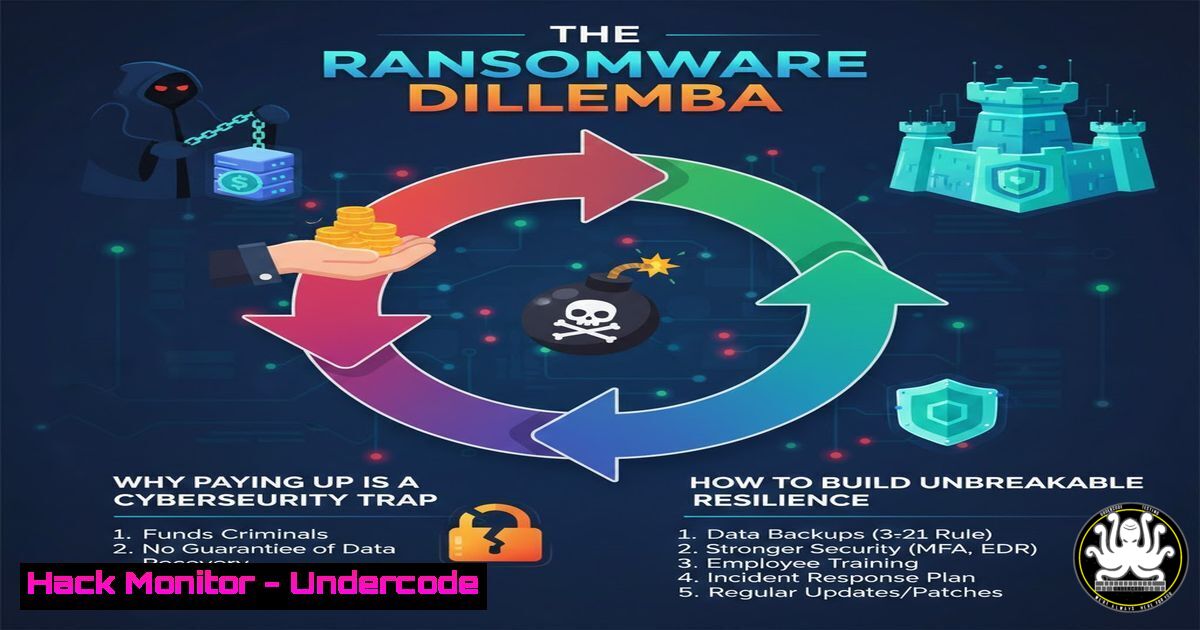
The modern ransomware attack is no longer a simple digital lockout; it is a multifaceted extortion scheme combining data encryption, theft, and psychological warfare. When critical systems go dark, executives face immense pressure to pay the ransom, viewing it as a quick fix. This article deconstructs why payment is a strategic failure and provides a technical blueprint for building an organizational posture where “no” is the only viable answer.
Learning Objectives:
- Understand the technical and criminal ecosystem risks introduced by paying a ransom.
- Learn to implement and verify immutable backup strategies across cloud and on-premises environments.
- Master network segmentation techniques to contain ransomware and execute a rehearsed incident response playbook.
You Should Know:
- The Illusion of Recovery: Why Payment Fails Technically and Legally
Paying the ransom is fundamentally a transaction with an adversary who has no incentive to honor the deal. From a technical standpoint, decryption tools provided by attackers are often slow, buggy, and may not work on all file types or systems, leading to partial recovery at best.
Step‑by‑step guide explaining what this does and how to use it:
Step 1: Verify Backup Integrity Beyond Simple Existence.
Having backups isn’t enough. You must regularly test restoration. A common practice is the “3-2-1 rule”: 3 copies, on 2 different media, with 1 offline/immutable.
Linux Command to Test a Backup Archive: `tar -tzf /backup/path/archive.tar.gz | head -20` (Lists contents to verify the archive is readable).
Windows PowerShell to Check Backup Logs: `Get-WinEvent -LogName Microsoft-Windows-Backup -MaxEvents 10 | Format-List` (Reviews the last 10 backup events).
Step 2: Understand Legal Pitfalls.
Before an incident, consult legal counsel on OFAC sanctions (paying a sanctioned entity is illegal) and data breach notification laws. Payment does not absolve you of responsibility for a data breach if data was exfiltrated.
2. Building Immutable and Isolated Backups
The primary goal is to create backups that ransomware cannot encrypt or delete. This is achieved through immutability (write-once, read-many) and air-gapping.
Step‑by‑step guide explaining what this does and how to use it:
Step 1: Configure Immutable Object Storage in the Cloud (AWS S3 Example).
aws s3api put-bucket-versioning --bucket my-backup-bucket --versioning-configuration Status=Enabled
aws s3api put-object-lock-configuration --bucket my-backup-bucket --object-lock-configuration '{ "ObjectLockEnabled": "Enabled", "Rule": { "DefaultRetention": { "Mode": "COMPLIANCE", "Years": 1 } } }'
This enables S3 Object Lock in compliance mode, preventing any deletion or alteration of backup objects for the defined retention period, even by root AWS accounts.
Step 2: Implement On-Premises Immutability with Linux.
Use a dedicated backup server with a read-only export for the backup target directory.
Modify `/etc/exports` on the backup server: `/backup/share client-ip(ro,no_root_squash,sync)`
Remount the export on the client: `sudo mount -o ro,nolock backup-server:/backup/share /mnt/backup`
3. Network Segmentation: Containing the Blast Radius
Flat networks allow ransomware like Conti or LockBit to propagate in minutes. Segmentation limits lateral movement.
Step‑by‑step guide explaining what this does and how to use it:
Step 1: Map Critical Assets and Data Flows.
Identify servers hosting sensitive data (e.g., SQL databases, file shares) and the applications that need access.
Step 2: Enforce Segmentation with Firewall Rules.
Windows Advanced Firewall (PowerShell): Create a rule to allow only specific subnets to access a SQL server.
New-NetFirewallRule -DisplayName "Allow SQL from App Subnet" -Direction Inbound -LocalPort 1433 -Protocol TCP -RemoteAddress 10.0.2.0/24 -Action Allow
Linux iptables: Restrict SSH access to a jump host.
iptables -A INPUT -p tcp --dport 22 -s 10.0.1.5 -j ACCEPT
iptables -A INPUT -p tcp --dport 22 -j DROP
4. Pre-Staging Forensics and Law Enforcement Collaboration
Rapid response requires pre-established contacts and the ability to collect evidence without contaminating it.
Step‑by‑step guide explaining what this does and how to use it:
Step 1: Create a Forensic Toolkit USB Drive.
Include tools like FTK Imager, Autopsy, and trusted command-line binaries for Windows and Linux.
Step 2: Isolate a Compromised System for Evidence Collection (Linux Example).
Capture network connections before disconnecting: `netstat -tunap > /mnt/evidence/network_connections.txt`
Create a memory dump: `sudo dd if=/dev/mem of=/mnt/evidence/memory.dump bs=1M`
Then disconnect the system from the network at the switch port.
- Rehearsing the “No Pay” Decision with Tabletop Exercises
A playbook is useless if unfamiliar. Tabletop exercises simulate the pressure of a real attack.
Step‑by‑step guide explaining what this does and how to use it:
Step 1: Design a Realistic Scenario.
Example: “Finance department reports all files with `.xlsx` extension are encrypted. A ransom note appears on desktops. Attackers claim to have stolen 100GB of HR data and are threatening public release in 48 hours.”
Step 2: Run the Exercise with Key Decision-Makers.
Facilitator presents the scenario in stages. The team works through the playbook: activating IRT, isolating segments, assessing backup viability, engaging legal and PR, and drafting communications. The goal is to stress-test the decision framework established before the incident.
What Undercode Say:
- Payment Fuels the Adversary’s R&D: Every ransom paid directly funds the development of more sophisticated, evasive, and destructive ransomware variants, creating a vicious cycle that harms the entire digital ecosystem.
- Resilience is an Active, Technical State: It is not passive. It is the sum of verified backups, enforced segmentation, and practiced response, each element requiring continuous technical validation and maintenance.
Analysis:
The post correctly frames payment as a strategic, not just tactical, failure. The emphasis on pre-established decision criteria is critical because cognitive bias under extreme stress leads to poor choices. The technical countermeasures—backups, segmentation—are the tangible expressions of an organizational commitment to resilience. This shifts the cost-benefit analysis for attackers, making them seek softer targets rather than investing time in a hardened environment. Ultimately, the technical controls enable the strategic “no.”
Prediction:
The future of ransomware defense will see increased automation in both attack and response. AI will be used by threat actors for target selection and polymorphic code generation, while defenders will leverage AI-driven anomaly detection to spot ransomware activity earlier in the kill chain (e.g., mass file reads prior to encryption). Regulatory pressure will move beyond merely advising against payment to potentially imposing fines on companies that pay, especially if negligence in basic hygiene (like lacking immutable backups) is proven. The companies that thrive will be those that integrate resilience testing as seamlessly as performance testing in their DevOps pipelines, making “recoverability” a core feature of every system.
▶️ Related Video (76% Match):
🎯Let’s Practice For Free:
IT/Security Reporter URL:
Reported By: Uma Ramani – Hackers Feeds
Extra Hub: Undercode MoN
Basic Verification: Pass ✅


