Listen to this Post
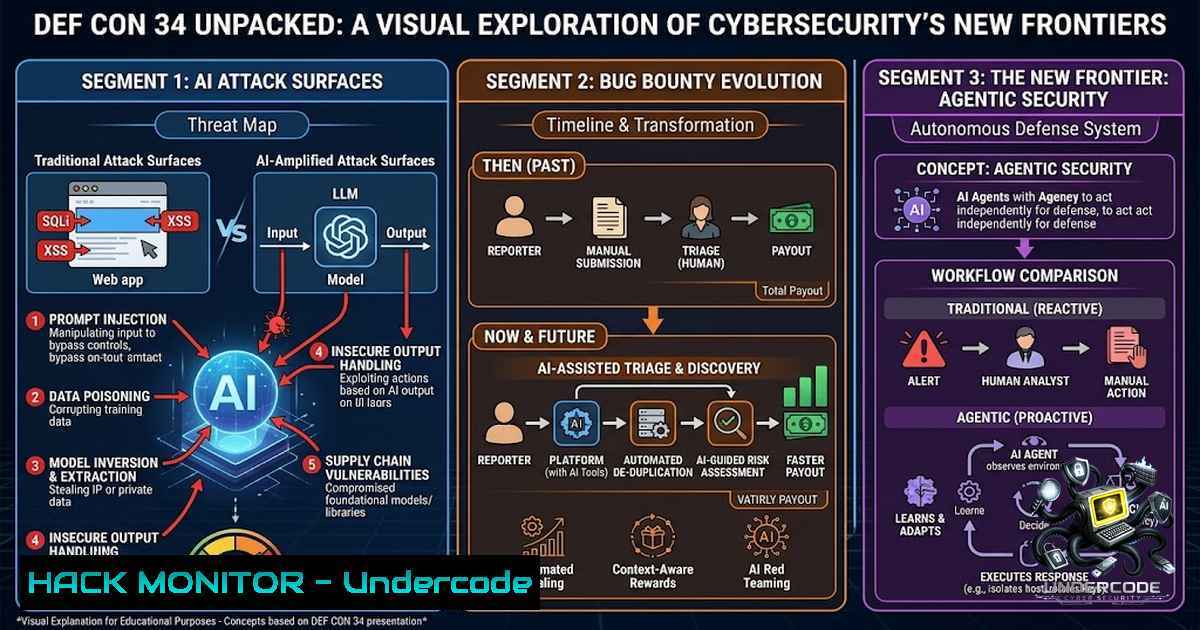
Introduction:
DEF CON 34 transformed Las Vegas into the epicenter of AI security discourse, where researchers, bug bounty hunters, and enterprise defenders converged to dissect the rapidly evolving threat landscape. The conference made one thing unmistakably clear: AI is no longer a peripheral concern but the primary attack surface—from prompt injection and agentic abuse to MCP-connected system compromises. As organizations race to deploy LLM-powered applications, security professionals must urgently master both offensive and defensive AI security postures.
Learning Objectives & Secrets:
- Objective 1: Master AI Application Attack Vectors – Understand prompt injection (direct and indirect), jailbreaking, system prompt extraction, RAG poisoning, and agentic tool abuse. Modern RLHF-hardened models resist classic jailbreaks like DAN; the real impact lies in architectural exploits targeting reasoning pipelines and tool-use chains.
-
Objective 2 Secret Tip: Automate Red Teaming with AI-Powered Frameworks – Leverage tools like `llm-audit` for OWASP LLM Top 10 vulnerability scanning, `aix-framework` for automated recon-to-exploitation workflows, and `agentsploit` for Burp Suite-style agentic AI testing. The secret is chaining modules: fingerprint guardrails first (
aix recon), then attack with adaptive bypass engines. -
Objective 3 Secret Tip: Hunt High-Value Bug Bounty Chains – Focus on indirect prompt injection that triggers unintended agent actions and system prompt exfiltration containing sensitive content. Chain low-severity findings into critical exploits—programs now offer “chain bonuses” that pay at the highest severity level. Five-figure payouts are common, with several disclosed bounties exceeding $100,000.
1. AI Penetration Testing: Practical Command Arsenal
Modern AI security testing requires specialized tooling that goes beyond traditional web application pentesting. Here are verified commands for auditing LLM endpoints:
Linux/macOS – llm-audit (OWASP LLM Top 10 Scanner):
 Install
pip install llm-audit

Basic scan against OpenAI-compatible endpoint
llm-audit -u https://api.openai.com/v1/chat/completions -k $OPENAI_API_KEY

Scan with specific probe groups
llm-audit -u https://api.target.com/chat -k $API_KEY -p prompt_injection,jailbreak,data_leakage

Generate HTML report
llm-audit -u https://api.target.com/chat -k $API_KEY -o report.html --format html

CI/CD integration with exit codes
llm-audit -u https://api.target.com/chat -k $API_KEY --fail-on-critical
This tool detects prompt injection, jailbreaks, data leakage, insecure output, model DoS, and excessive agency. It supports OpenAI, Ollama, Azure, and custom APIs.
AIX Framework – Full Red Team Pipeline:
 Install with ML fingerprinting
pip install aix-framework[bash]

Step 1: Recon – fingerprint target and detect guardrails
aix recon https://api.target.com/chat -k sk-xxx

Step 2: Inject – prompt injection with adaptive bypass
aix inject https://api.target.com/chat -k sk-xxx

Step 3: Jailbreak – safety bypass attempts
aix jailbreak https://api.target.com/chat -k sk-xxx

Run everything in one scan
aix scan https://api.target.com/chat -k sk-xxx

Export report
aix db --export report.html
The framework detects guardrails from OpenAI Moderation, Azure Content Safety, AWS Bedrock, Llama Guard, Lakera Guard, NeMo Guardrails, and more. The bypass engine automatically applies targeted evasion techniques based on detected provider weaknesses.
Windows – Using WSL2 or PowerShell:
 WSL2 approach (recommended)
wsl --install -d Ubuntu
wsl bash -c "pip install llm-audit aix-framework"

Native PowerShell with Python
python -m pip install llm-audit aix-framework
$env:OPENAI_API_KEY = "sk-xxx"
llm-audit -u https://api.openai.com/v1/chat/completions -k $env:OPENAI_API_KEY
2. Agentic AI Attacks: Beyond Prompt Injection
The most significant shift at DEF CON 34 was the focus on agentic AI attacks—exploiting not just the model but the entire tool-connected ecosystem. When LLMs gain the ability to execute code, fetch URLs, query databases, and call APIs, the attack surface expands dramatically.
Attack Chain Example – RCE via Code Tool:
- Recon: Identify available tools/functions the agent can call
- Indirect Injection: Poison external content (URL, PDF, image alt text) with payloads
- Trigger: Cause agent to fetch poisoned content, executing attacker-controlled parameters
- Exploit: Tool misuse leads to SSRF via “fetch URL” or RCE via code execution tools
Defensive Commands – Guardrail Implementation:
 Using NVIDIA NeMo Guardrails
 Create guardrail configuration (config.yml)
 Define canonical forms and bot responses

Test guardrails with prompt injection payloads
python -m nemoguardrails.cli.chat --config=./config

Deploy with FastAPI
from nemoguardrails import RailsConfig, LLMRails
config = RailsConfig.from_path("./config")
rails = LLMRails(config)
response = rails.generate(messages=[{"role": "user", "content": user_input}])
MITRE ATLAS Mapping: Every AI finding should be tagged with MITRE ATLAS technique IDs—the framework that maps adversary behavior specifically for AI/ML systems. Key techniques include AML.T0048 (Prompt Injection), AML.T0051 (Model Evasion), and AML.T0057 (Transfer Learning Attack).
- Bug Bounty Hunting for AI: 2026 Scope and Strategy
Prompt injection has evolved from a research curiosity to a mainstream bug bounty category. By 2026, most major AI products include AI behaviors in scope with structured payout norms.
In-Scope, High-Impact Categories:
- Indirect prompt injection causing unintended agent actions on behalf of users
- Direct injection exfiltrating system prompts with sensitive content
- Injection bypassing explicitly advertised safety controls
Testing Methodology:
 System Prompt Extraction via roleplay/encoding
 Use AIX framework
aix extract https://api.target.com/chat -k sk-xxx

RAG poisoning attack
aix rag https://api.target.com/chat -k sk-xxx --target kb

Multi-turn context manipulation
aix multiturn https://api.target.com/chat -k sk-xxx --crescendo
Reproduction Requirements: Programs increasingly require clean reproduction in fresh sessions with deterministic behavior. Reports that only work against specific “lucky” sessions are downgraded or closed. Always document:
– Exact payload
– Model version
– Temperature and other generation parameters
– Fresh session verification
Chain Bonus Strategy: Combine low-severity findings into high-impact exploits. Example: a seemingly minor system prompt leak (medium) combined with indirect injection (low) can enable full account takeover (critical). Programs now reward the engineering work of building real attack chains.
4. AI Defense in Depth: Enterprise Hardening
Guardrail Implementation:
 Example: Content filtering with Lakera Guard
import requests

def filter_prompt(prompt, api_key):
response = requests.post(
"https://api.lakera.ai/v1/guard",
headers={"Authorization": f"Bearer {api_key}"},
json={"prompt": prompt}
)
return response.json()["flagged"]

Monitor for prompt injection attempts
def log_injection_attempt(user_id, prompt, result):
 Send to SIEM for correlation
print(f"INJECTION_ATTEMPT: {user_id} | {prompt[:100]} | {result}")
Security Scanning Pipeline (CI/CD):
 GitHub Actions example
- name: LLM Security Scan
run: |
llm-audit -u ${{ secrets.LLM_ENDPOINT }} \
-k ${{ secrets.API_KEY }} \
-p prompt_injection,jailbreak,data_leakage \
--fail-on-critical \
-o report.json
- name: Upload Report
uses: actions/upload-artifact@v4
with:
name: llm-security-report
path: report.json
Monitoring Patterns: Implement judge-LLM workflows where a secondary model evaluates outputs for security violations. Monitor for:
– Unusual tool call patterns
– Excessive token usage (DoS indicator)
– Repeated refusal bypass attempts
– Data exfiltration via markdown, links, or webhooks
5. The AI Red Team Paradigm Shift
The traditional red team model is being revolutionized by AI agents. The new paradigm centers on a “agent-knowledge-tool-target” quad structure, where AI agents autonomously maintain attack context and orchestrate tool chains.
Red Teaming with AI Agents:
 Using Strix – autonomous AI penetration testing agents
strix scan https://target.com

PentesterFlow – plan → act → observe → verify → report cycle
pentesterflow --target https://api.target.com --plan "Test for prompt injection and RAG poisoning"

Specter – AI-powered CLI with 13 LLM providers
specter scan https://api.target.com --llm openai --model gpt-4o
These autonomous agents act like real hackers—running code dynamically, finding vulnerabilities, and validating through actual proof-of-concepts.
Critical Consideration: Recent research revealed prompt-injection-free manipulation attacks against offensive security agents that achieved near-deterministic remote code execution on agent infrastructure. This introduces a new class of risk: red-teaming the red team. Security teams must minimize and contain the blast radius of untrusted LLM/worker environments.
What Undercode Say:
- Key Takeaway 1: AI security is now a mainstream discipline. DEF CON 34 cemented AI as the dominant theme across talks, villages, and training. The OWASP LLM Top 10 and MITRE ATLAS provide structured frameworks, and enterprise training courses like “AI SecureOps” are now essential for security practitioners.
-
Key Takeaway 2: The bug bounty landscape has matured dramatically. Prompt injection pays real money—five-figure bounties are common. Programs now have clear scope definitions, structured payouts, and chain bonuses that reward creative exploitation. The “reproduction tax” raises the bar but keeps average payouts high.
-
Analysis: The shift toward agentic AI systems represents the most significant security challenge since cloud adoption. Every Fortune 500 company is shipping LLM agents and MCP servers in 2026. Attackers benefit from AI’s speed, scale, and skill-barrier removal. Meanwhile, defenders must build practical capabilities including guardrails, security scanners, monitoring, and incident response for public, private, and MCP-enabled AI services. The next 18–24 months will be among the most intense in our careers. Organizations that fail to secure their AI supply chains—from fine-tuning pipelines to RAG knowledge bases—will face catastrophic breaches. The message from DEF CON is clear: secure your AI now, or your AI will be used against you.
Prediction:
-
+1 AI security will become a mandatory certification requirement for enterprise security teams within 24 months, similar to cloud security certifications today.
-
-1 The rapid adoption of AI agents without commensurate security controls will lead to a major public breach involving an agentic AI system before Q1 2027, with cascading infrastructure impact.
-
+1 Bug bounty programs will standardize AI-specific payout bands and chain bonuses across all major platforms, creating a sustainable economy for AI security researchers.
-
-1 Prompt-injection-free attacks against offensive security agents will be weaponized by sophisticated adversaries, forcing a complete rethinking of AI red team infrastructure security.
-
+1 Open-source tools like
llm-audit,aix-framework, and `agentsploit` will become as essential to pentesters as Burp Suite and Metasploit are today. -
-1 Organizations that treat AI security as an afterthought will face regulatory consequences as frameworks like the RAISE Act begin enforcement.
-
+1 The convergence of AI red teaming and traditional penetration testing will create a new specialized role—the AI Security Engineer—with salaries commanding 30-50% premiums over traditional security roles.
-
-1 The skill gap in AI security will widen dramatically as demand outpaces supply, leaving many organizations dangerously exposed through 2027.
-
+1 MCP (Model Context Protocol) security will emerge as the next major battleground, with frameworks like AgentSploit leading the offensive research.
-
-1 RAG poisoning and supply chain attacks on AI models will become the new vector of choice for espionage groups, as they offer plausible deniability and persistent access.
▶️ Related Video (74% Match):
https://www.youtube.com/watch?v=120iDYzscD4
🎯Let’s Practice For Free:
🎓 Live Courses & Certifications:
Join Undercode Academy for Verified Certifications
🚀 Request a Custom Project:
Secure, high-velocity infrastructure and disruptive technological engineering. Contact our engineering team for high-tier development and proprietary systems:
[email protected]
💎 Smart Architecture | 🛡️ Secure by Design | ⭐ Trusted by Thousands
IT/Security Reporter URL:
Reported By: https://lnkd.in/p/ez5qe_sx – Hackers Feeds
Extra Hub: Undercode MoN
Basic Verification: Pass ✅


