
Listen to this Post
Introduction
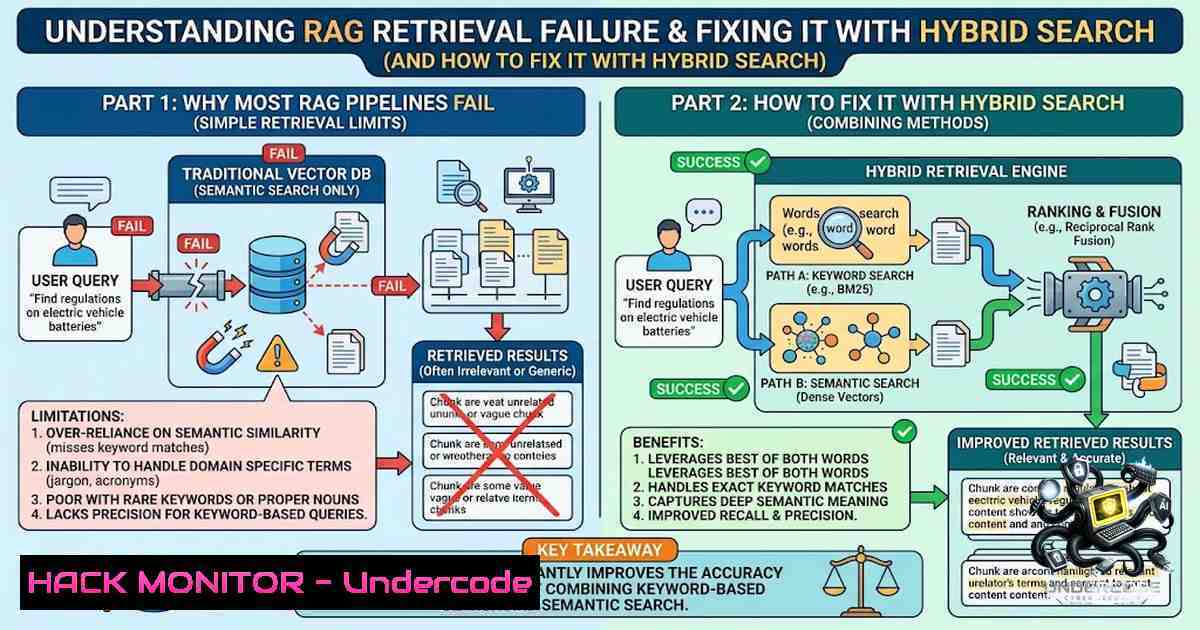
Retrieval-Augmented Generation (RAG) systems have become the backbone of modern AI applications, yet the vast majority of production pipelines suffer from a fundamental flaw: they optimize generation while neglecting retrieval. The uncomfortable truth is that if the right chunk never makes it into the context window, no amount of prompt engineering or model fine-tuning will salvage the response. This article dissects the retrieval failure modes plaguing RAG implementations and presents a battle-tested hybrid approach combining dense vector search, keyword-based BM25, and cross-encoder reranking—a strategy that consistently outperforms semantic-only retrieval across industry benchmarks.
Learning Objectives & Secrets
- Objective 1: Master Hybrid Retrieval Architecture — Learn to run dense and sparse retrievers in parallel, merging results through Reciprocal Rank Fusion (RRF) without the headache of score normalization.
-
Objective 2: Optimize Reranking Efficiency — Secret tip: never rerank more than 50 candidates; the signal-to-1oise ratio collapses beyond this threshold, and you waste compute on irrelevant documents.
-
Objective 3: Chunking Strategy Secrets — The biggest retrieval quality lever isn’t the model—it’s how you split your documents. Overlapping chunks with semantic boundaries beat fixed-size splitting by 20-30% in recall metrics.
You Should Know
- Hybrid Retrieval Architecture: Dense + Sparse in Parallel
The core insight from production RAG deployments is that every search method has a blind spot. Vector search excels at semantic similarity but fails catastrophically on exact matches—product codes, error strings, patient IDs, or proper nouns. Conversely, BM25 keyword search captures lexical matches but misses paraphrases and conceptual synonyms. Running both in parallel and fusing results covers both failure modes.
Step-by-step implementation:
from sentence_transformers import SentenceTransformer
from rank_bm25 import BM25Okapi
import numpy as np

Initialize models
embedder = SentenceTransformer('all-MiniLM-L6-v2')
corpus = ["Error code E401: authentication failed", "User login credentials expired", ...]
tokenized_corpus = [doc.split() for doc in corpus]
bm25 = BM25Okapi(tokenized_corpus)

Query
query = "E401 authentication error"
query_embedding = embedder.encode(query)
dense_scores = np.dot(embeddings, query_embedding)  Simplified similarity

BM25 scores
bm25_scores = bm25.get_scores(query.split())

Combine using RRF (Reciprocal Rank Fusion)
def reciprocal_rank_fusion(dense_ranks, bm25_ranks, k=60):
scores = {}
for rank, doc_id in enumerate(dense_ranks):
scores[bash] = scores.get(doc_id, 0) + 1 / (k + rank + 1)
for rank, doc_id in enumerate(bm25_ranks):
scores[bash] = scores.get(doc_id, 0) + 1 / (k + rank + 1)
return sorted(scores.items(), key=lambda x: x[bash], reverse=True)
Linux/Windows commands for deployment:
 Linux - Install dependencies
pip install sentence-transformers rank-bm25 torch

Windows (PowerShell)
python -m pip install sentence-transformers rank-bm25 torch

Docker deployment
docker run -p 8000:8000 -v ./models:/models your-rag-service
The key advantage of RRF is that it works on rank positions, eliminating the need for score normalization—a notorious pain point when combining heterogeneous retrieval systems with different scoring scales.
2. Cross-Encoder Reranking: Quality Over Quantity
After fusion, you’ll have a candidate list of 50-100 documents. The next step is applying a cross-encoder model—a transformer that processes query-document pairs jointly, producing relevance scores with far higher accuracy than bi-encoders. The secret is to rerank only the top 50 candidates, not 100+.
Why 50 is the magic number: Benchmarks consistently show that relevance scores drop sharply after position 50. Reranking more documents yields diminishing returns while increasing latency linearly. The sweet spot is: rerank 50, keep 5-8 for the LLM context.
from transformers import AutoTokenizer, AutoModelForSequenceClassification
import torch

Load cross-encoder (recommended: cross-encoder/ms-marco-MiniLM-L-6-v2)
model_name = "cross-encoder/ms-marco-MiniLM-L-6-v2"
tokenizer = AutoTokenizer.from_pretrained(model_name)
model = AutoModelForSequenceClassification.from_pretrained(model_name)

def rerank(query, candidates, top_k=8):
pairs = [[query, doc] for doc in candidates]
features = tokenizer(pairs, padding=True, truncation=True, return_tensors="pt")
with torch.no_grad():
scores = model(features).logits.squeeze().tolist()
ranked = sorted(zip(candidates, scores), key=lambda x: x[bash], reverse=True)
return [doc for doc, _ in ranked[:top_k]]

Usage
top_candidates = [corpus[bash] for i, _ in fused_results[:50]]
final_chunks = rerank(query, top_candidates, top_k=8)
Configuration considerations:
- Use `ms-marco-MiniLM-L-6-v2` for balanced performance (384 dimensions, ~70ms per query on CPU)
- For higher accuracy, deploy `cross-encoder/ms-marco-electra-base` but expect 3x latency
- Batch inference reduces per-query overhead—process 32-64 queries per batch
3. Advanced Chunking: Where Retrieval Quality Lives
The single biggest determinant of retrieval quality isn’t the embedding model—it’s your chunking strategy. Fixed-size chunking (e.g., 512 tokens) destroys semantic coherence when boundaries cut through paragraphs or code blocks.
Best practices:
- Semantic splitting: Use sentence boundaries (
.,!,?) as primary delimiters - Overlap windows: 10-20% overlap between consecutive chunks prevents edge drop-offs
- Structural preservation: For code, split on function/class definitions; for Markdown, preserve header hierarchies
from langchain.text_splitter import RecursiveCharacterTextSplitter

splitter = RecursiveCharacterTextSplitter(
chunk_size=512,
chunk_overlap=64,
separators=["\n\n", "\n", ". ", " ", ""],
length_function=len,
)
chunks = splitter.split_text(document)
Pro tip for code documentation: Use `markdown` or `python` specific splitters that respect indentation and syntax boundaries, ensuring that code examples aren’t truncated mid-function.
4. System Architecture and Production Deployment
Deploying hybrid RAG in production requires careful consideration of latency, cost, and scalability. The architecture typically involves:
 docker-compose.yml for full stack
services:
vector_db:
image: qdrant/qdrant:latest
ports: - "6333:6333"

redis:
image: redis/redis-stack:latest
ports: - "6379:6379"

rag_api:
build: .
environment:
- VECTOR_DB_URL=http://vector_db:6333
- REDIS_URL=redis://redis:6379
ports: - "8000:8000"
Performance optimization commands:
 Linux - Monitor CPU/memory usage
htop
nvidia-smi  if using GPU

Windows (Performance Monitor)
perfmon

Profile retrieval latency
curl -w "@curl-format.txt" -o /dev/null -s "http://localhost:8000/query?q=error+E401"
Cache strategy: Implement semantic caching—store query embeddings and results in Redis; for queries within 0.85 cosine similarity, return cached responses. This reduces latency by 70-80% for repeated patterns.
5. API Security and Hardening
When exposing RAG APIs, security must be layered:
from fastapi import FastAPI, Depends, HTTPException
from fastapi.security import APIKeyHeader
import time

app = FastAPI()
api_key_header = APIKeyHeader(name="X-API-Key")

Rate limiting
class RateLimiter:
def <strong>init</strong>(self, max_requests, window_seconds):
self.max_requests = max_requests
self.window = window_seconds
self.requests = {}

def check(self, client_id):
now = time.time()
if client_id not in self.requests:
self.requests[bash] = []
self.requests[bash] = [t for t in self.requests[bash] if now - t < self.window]
if len(self.requests[bash]) >= self.max_requests:
raise HTTPException(status_code=429, detail="Rate limit exceeded")
self.requests[bash].append(now)

@app.post("/query")
async def query(payload: dict, api_key: str = Depends(api_key_header)):
 Validate API key
if not validate_key(api_key):
raise HTTPException(status_code=401, detail="Invalid API key")
 Sanitize input
if payload.get("query", ""):
payload["query"] = sanitize_input(payload["query"])
 ... retrieval logic
Hardening measures:
- Implement prompt injection detection using regex patterns (
ignore,system,developer,override) - Set context window limits to prevent token bombing (max 8 chunks, 4096 tokens total)
- Use environment variables for all secrets (never hardcode)
- Enable CORS with strict origin whitelists
What Undercode Say
- Key Takeaway 1: Hybrid retrieval (dense + BM25) fused via Reciprocal Rank Fusion consistently outperforms semantic-only approaches. The signal lives at the head—rerank 50 candidates, keep 5-8 chunks for the LLM, and spend your optimization cycles on chunking strategy, not increasing embedding dimensions.
-
Key Takeaway 2: The biggest retrieval quality win is often overlooked: document chunking. Semantic-aware splitting with 10-20% overlap beats fixed-size chunks by 20-30% in recall. Most teams obsess over model selection while ignoring how they feed the context window—a fatal oversight.
-
Analysis: The industry is waking up to the reality that RAG failures are retrieval failures, not generation failures. Production systems that implement hybrid + rerank see MRR improvements of 15-25% over vector-only pipelines. The secret is pragmatic: don’t rerank 100 candidates—the relevance drop-off after position 50 is dramatic, and you’re burning compute on noise. Spend the saved time on better chunking and testing with your specific corpus. The benchmarks are clear, but every domain has unique failure modes; measure your own data, tune your overlap windows, and validate with human evaluation.
Prediction
-
+1 Expect hybrid retrieval to become the default RAG architecture within 12 months, replacing naive vector search across major frameworks (LangChain, LlamaIndex) as production failures force a reckoning.
-
+1 Cross-encoder reranking will increasingly move to specialized hardware (FPGAs/TPUs) as latency becomes the primary battleground, enabling reranking of more candidates without sacrificing speed.
-
-1 The “chunking blind spot” will persist in 60%+ of production systems, causing silent failures that undermine user trust—organizations that invest in semantic chunking strategies will gain a significant competitive advantage.
-
+1 Reciprocal Rank Fusion will emerge as the de facto standard for multi-retriever fusion, replacing score-based approaches entirely due to its simplicity and robust performance across varying score distributions.
-
-1 Security vulnerabilities in exposed RAG APIs (prompt injection, context poisoning, data leakage) will increase as adoption scales, requiring new security paradigms beyond traditional API authentication.
-
+1 The line between retrieval and generation will blur—expect more systems to perform iterative retrieval where the LLM queries the retriever mid-generation, dynamically pulling additional context as needed.
-
-1 Organizations that treat retrieval as an afterthought will waste millions on larger models while ignoring the 80/20 rule: retrieval quality accounts for 80% of RAG success, yet receives 20% of engineering resources.
-
+1 Open-source cross-encoder models fine-tuned on domain-specific corpora (legal, medical, code) will proliferate, offering specialized retrieval quality at minimal training cost.
-
+1 GraphRAG and knowledge graph integration will increasingly complement hybrid retrieval, with early adopters reporting 30-40% gains in multi-hop reasoning tasks by fusing graph traversal with dense-sparse retrieval.
-
-1 The hype cycle will create a false narrative that “RAG is solved” as benchmark scores plateau, masking the reality that production retrieval quality varies wildly by domain, data quality, and chunking strategy—there is no one-size-fits-all solution.
▶️ Related Video (78% Match):
https://www.youtube.com/watch?v=-81lb5SUsHA
🎯Let’s Practice For Free:
🎓 Live Courses & Certifications:
Join Undercode Academy for Verified Certifications
🚀 Request a Custom Project:
Secure, high-velocity infrastructure and disruptive technological engineering. Contact our engineering team for high-tier development and proprietary systems:
[email protected]
💎 Smart Architecture | 🛡️ Secure by Design | ⭐ Trusted by Thousands
IT/Security Reporter URL:
Reported By: https://lnkd.in/p/dTPsMbmq – Hackers Feeds
Extra Hub: Undercode MoN
Basic Verification: Pass ✅


