
Listen to this Post
Introduction:
The fourth annual Stanford Conference on Technology + National Security, known as Stanford DEFCON 2026, convenes at the Hoover Institution on October 7, 2026, preceded by a career fair on October 6 at Encina Hall. Organized by the Stanford DEFCON Technology and National Security Student Network and the Stanford Gordian Knot Center for National Security Innovation, this premier student-run conference in Silicon Valley focuses on the technologies that will guarantee the future of U.S. national security. As global competition intensifies, the conference examines what it will take for the U.S. and its allies to maintain an edge across technology, defense, and economic power—a mission that sits at the intersection of the Pentagon, Silicon Valley, and private capital.
Learning Objectives & Secrets:
- Objective 1: Master the Defense Innovation Pipeline. Understand how emerging technologies transition from promising pilots into funded programs of record. Learn the critical pathways connecting defense startups with mission owners, transition partners, and prime contractors.
-
Objective 2 Secret Tip: Navigate the Dual-Use Funding Ecosystem. Identify and leverage the key players—from the Defense Innovation Unit (DIU) to venture capital firms like a16z and Cerberus Capital Management—that are actively deploying capital into dual-use technologies. The secret is knowing which investors prioritize national security returns alongside financial returns.
-
Objective 3 Secret Tip: Build Cross-Sector Coalitions. The most successful defense tech founders don’t just build great technology; they build bridges. Learn how to connect with former flag officers like Adm. Lee Hsi-ming (Ret.) and Lt. Gen. Clint Hinote (Ret.), as well as Silicon Valley investors and government acquisition officials, to create the political and operational buy-in necessary for deployment.
You Should Know:
- The Defense Innovation Unit (DIU) and Commercial Technology Integration
The DIU, represented at Stanford DEFCON 2026 by CTO Chris Murphy, serves as the Pentagon’s bridge to the commercial technology sector. The DIU’s mandate is to accelerate the adoption of commercial solutions across the Department of Defense, with a particular focus on autonomy, AI, and space technologies.
Step‑by‑step guide for engaging with the DIU:
- Identify a relevant DoD problem set: Review the DIU’s current solicitations on their website to understand priority capability gaps.
- Submit a Commercial Solutions Opening (CSO) proposal: The CSO is the DIU’s primary contracting vehicle, designed to be faster and more flexible than traditional FAR-based acquisitions.
- Prepare for a prototype award: Successful CSO submissions result in prototype Other Transaction Authority (OTA) agreements, typically valued between $1M and $10M.
- Plan for transition: The DIU’s success metric is not the prototype itself, but the transition of that prototype into a program of record within a military service or combatant command.
Linux/Windows commands for DIU-related compliance and reporting:
 Linux: Securely transfer sensitive proposal documents
scp -i ~/.ssh/diu_proposal_key proposal.pdf [email protected]:/incoming/

Windows (PowerShell): Verify file integrity before submission
Get-FileHash -Algorithm SHA256 .\proposal.pdf

Linux: Generate a GPG-encrypted package for classified or proprietary information
gpg --symmetric --cipher-algo AES256 proposal.pdf
2. Autonomous Systems and the Future of Warfare
Autonomy is a central theme at Stanford DEFCON 2026, with speakers including Chris Murphy (CTO, DIU) and Lt. Gen. Clint Hinote (Ret.), former Deputy Chief of Staff for Strategy, Integration and Requirements at the U.S. Air Force. The discussion will focus on how autonomous systems—from uncrewed aerial vehicles to autonomous underwater vehicles—are reshaping the battlespace.
Step‑by‑step guide for securing autonomous systems:
- Implement secure boot and trusted execution environments: Ensure that all autonomous platforms boot only signed firmware and operate within hardware-enforced trusted execution environments (e.g., ARM TrustZone, Intel SGX).
- Deploy robust communications security (COMSEC): Use NSA-approved cryptographic modules (e.g., Type 1 encryption) for all command-and-control links to prevent adversary interception and spoofing.
- Conduct adversarial machine learning (ML) testing: Test autonomous systems against adversarial inputs (e.g., perturbed sensor data, GPS spoofing) to ensure resilience against AI-specific attacks.
- Establish continuous monitoring and over-the-air (OTA) update capabilities: Enable secure OTA updates to patch vulnerabilities and update ML models without physical access to the platform.
Linux commands for securing autonomous system development environments:
 Linux: Verify GPG signatures of firmware updates
gpg --verify firmware_update.sig firmware_update.bin

Linux: Set up a secure isolated build environment using Docker
docker run --rm -it --security-opt=no-1ew-privileges:true ubuntu:22.04

Linux: Scan for vulnerabilities in autonomous system dependencies
trivy image --severity HIGH,CRITICAL my-autonomous-system:latest
3. Space Technology and National Security
Space is increasingly contested, and the conference will explore how commercial space technologies can be leveraged for national security purposes. The presence of Taiwan’s former Chief of the General Staff, Adm. Lee Hsi-ming (Ret.), and Director-General David C.H. Wu underscores the geopolitical dimension of space and technology competition in the Indo-Pacific region.
Step‑by‑step guide for space system hardening:
- Implement radiation-hardened components: Use radiation-hardened by design (RHBD) or radiation-hardened by process (RHBP) electronics for satellite subsystems.
- Deploy anti-jam GPS/PNT solutions: Integrate M-code GPS receivers and alternative positioning, navigation, and timing (PNT) sources (e.g., inertial navigation, celestial navigation).
- Encrypt all satellite-to-ground links: Use quantum-resistant cryptographic algorithms (e.g., CRYSTALS-Kyber) to protect against future quantum computing threats.
- Develop rapid reconstitution capabilities: Maintain on-orbit spares and rapid launch capabilities to replace degraded or destroyed space assets.
Windows commands for space system ground station security:
 Windows (PowerShell): Enable BitLocker on ground station servers
Enable-BitLocker -MountPoint "C:" -EncryptionMethod XtsAes256

Windows (PowerShell): Audit user access to space system control interfaces
Get-WinEvent -LogName Security | Where-Object { $<em>.Id -eq 4624 -or $</em>.Id -eq 4625 }

Windows (PowerShell): Configure Windows Firewall for ground station network segmentation
New-1etFirewallRule -DisplayName "Block Non-essential Ports" -Direction Inbound -Action Block -RemotePort 135-139,445
4. Venture Capital and the Defense Industrial Base
The conference brings together leading defense investors, including Frank Finelli (Senior Advisor, The Carlyle Group), Isaiah Schulze (Managing Director, Cerberus Capital Management), and Matt Cronin (a16z). The conversation will focus on mobilizing private capital to expand the defense industrial base—a critical need given the shrinking number of traditional defense primes.
Step‑by‑step guide for defense tech fundraising:
- Develop a clear dual-use value proposition: Articulate both the commercial market opportunity and the national security mission impact.
- Obtain appropriate security clearances: Ensure that key personnel have the necessary clearances (Secret or Top Secret) to engage with government customers.
- Build a government affairs capability: Engage with congressional offices, service acquisition executives, and combatant command requirements officers.
- Structure your cap table for national security: Consider special purpose vehicles (SPVs) or other structures that accommodate national security-related restrictions on foreign ownership.
API security configuration for defense tech platforms:
 Linux: Configure NGINX API gateway with mutual TLS (mTLS)
 /etc/nginx/nginx.conf
server {
listen 443 ssl;
ssl_certificate /etc/nginx/ssl/server.crt;
ssl_certificate_key /etc/nginx/ssl/server.key;
ssl_client_certificate /etc/nginx/ssl/ca.crt;
ssl_verify_client on;
location /api/ {
proxy_pass https://backend-service:8443/;
}
}

Linux: Implement rate limiting to prevent API abuse
 /etc/nginx/nginx.conf
limit_req_zone $binary_remote_addr zone=api_limit:10m rate=10r/s;
location /api/ {
limit_req zone=api_limit burst=20 nodelay;
}
5. The Future of Defense Talent and Leadership
Developing the next generation of national security leaders and entrepreneurs is a core theme of the conference. The presence of student organizers from Stanford DEFCON and the Gordian Knot Center highlights the importance of cultivating talent that can navigate both the technology and national security domains.
Step‑by‑step guide for building a defense tech talent pipeline:
- Establish university partnerships: Engage with programs like Hacking for Defense (H4D) and Stanford’s Gordian Knot Center to connect students with real-world national security problems.
- Create internship and fellowship programs: Offer structured opportunities for students to work on defense tech projects, ideally with security clearances.
- Develop cross-disciplinary training: Combine technical training (e.g., software engineering, AI/ML) with national security education (e.g., strategy, policy, acquisition).
- Build veteran hiring pipelines: Leverage the unique skills and security clearances of military veterans transitioning to the private sector.
Linux commands for secure development environment setup for interns:
 Linux: Create isolated user accounts with limited privileges
sudo useradd -m -s /bin/bash intern_username
sudo passwd intern_username

Linux: Set up a development sandbox using LXC containers
lxc-create -t ubuntu -1 intern-sandbox
lxc-start -1 intern-sandbox

Linux: Configure firewall rules to restrict outbound access
sudo iptables -A OUTPUT -m owner --uid-owner intern_username -j DROP
sudo iptables -A OUTPUT -m owner --uid-owner intern_username -p tcp --dport 443 -j ACCEPT
What Undercode Say:
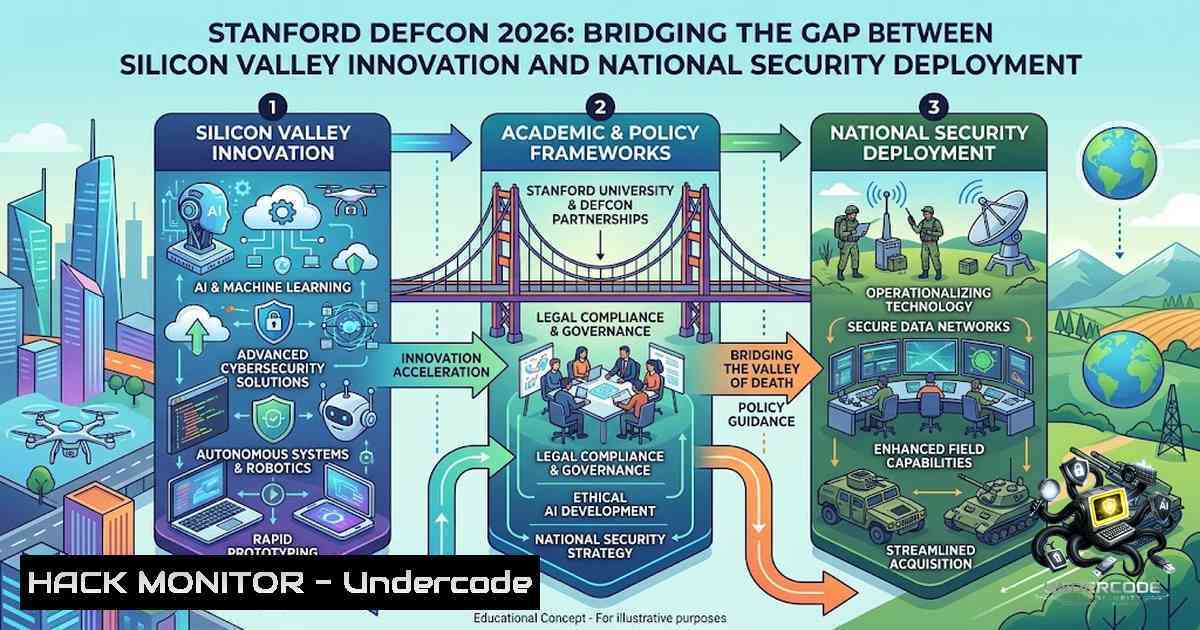
- Key Takeaway 1: America does not lack innovation; it lacks pathways for turning innovation into deployed capability at scale. Stanford DEFCON 2026 is a critical forum for addressing this gap by connecting the right people—founders, investors, government leaders, and military operators.
-
Key Takeaway 2: The future of national security is increasingly defined by dual-use technologies—AI, autonomy, and space—that have both commercial and military applications. The convergence of Silicon Valley’s innovation engine with the Pentagon’s operational requirements is not just desirable; it is essential for maintaining strategic advantage.
The central challenge identified by Ray E.—the gap between promising pilots and funded programs—is a systemic issue that requires structural solutions. The conference’s focus on connecting defense startups with mission owners, transition partners, and primes addresses this directly. However, the presence of a “former head of state” as a surprise guest suggests that the geopolitical dimensions of technology competition will be front and center. The inclusion of Taiwanese officials underscores the Indo-Pacific focus, reflecting the reality that technology competition is inextricably linked to great-power competition.
The conference also highlights the growing importance of private capital in the defense industrial base. With traditional defense primes consolidating and retiring, venture capital and private equity are filling the gap—but this brings its own challenges, including the need for patient capital that can withstand the long acquisition cycles of the DoD. The representation of firms like a16z, Cerberus, and Carlyle signals that the defense tech sector has matured beyond early-stage experimentation into a legitimate asset class.
Prediction:
- +1 The Stanford DEFCON model—a student-run conference connecting academia, government, and industry—will be replicated at other major universities, creating a national network of defense innovation hubs.
-
+1 The conference will catalyze at least a dozen new startup-founder-investor connections that result in funded defense technology companies within 12 months.
-
-1 Despite the enthusiasm, the fundamental challenge of DoD acquisition reform remains unsolved; many promising technologies discussed at the conference will still struggle to transition from prototype to program of record.
-
+1 The emphasis on AI and autonomy will accelerate the development of ethical and operational frameworks for autonomous systems, potentially leading to new NATO and allied standards.
-
-1 The geopolitical tensions highlighted by the conference’s Taiwan-focused speakers could escalate, creating volatility that disrupts supply chains and investment in the defense tech sector.
-
+1 The conference’s career fair on October 6 will serve as a critical recruitment pipeline, connecting top STEM talent with national security missions and reversing the brain drain from defense to commercial tech.
-
-1 The dual-use nature of many technologies discussed means that adversaries will also gain access to similar capabilities, accelerating the AI arms race and potentially leading to destabilizing military dynamics.
-
+1 The involvement of major financial institutions like J.P. Morgan signals that defense tech is becoming mainstream, potentially unlocking significantly more private capital for national security innovation.
▶️ Related Video (80% Match):
https://www.youtube.com/watch?v=0dat-6XvQ5U
🎯Let’s Practice For Free:
🎓 Live Courses & Certifications:
Join Undercode Academy for Verified Certifications
🚀 Request a Custom Project:
Secure, high-velocity infrastructure and disruptive technological engineering. Contact our engineering team for high-tier development and proprietary systems:
[email protected]
💎 Smart Architecture | 🛡️ Secure by Design | ⭐ Trusted by Thousands
IT/Security Reporter URL:
Reported By: https://lnkd.in/p/eKarrgi4 – Hackers Feeds
Extra Hub: Undercode MoN
Basic Verification: Pass ✅


