
Listen to this Post
Introduction:
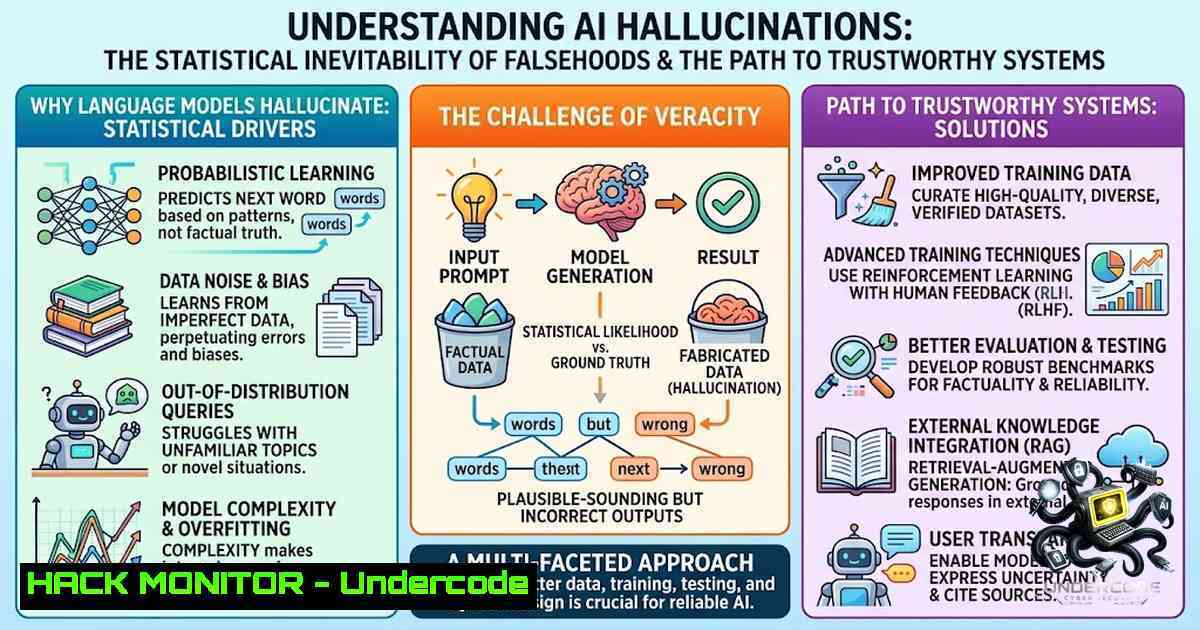
A 2025 study by OpenAI researchers Adam Tauman Kalai, Ofir Nachum, Santosh S. Vempala, and Edwin Zhang has fundamentally reframed our understanding of AI hallucinations. The research argues that these plausible yet incorrect statements are not mysterious failures of architecture or reasoning but are, in fact, a statistical inevitability arising from how language models are trained and evaluated. The core issue is a systemic incentive structure: current training and evaluation procedures reward guessing over acknowledging uncertainty. This “epidemic” of penalizing uncertain responses can only be addressed through a socio-technical mitigation: modifying the scoring of existing benchmarks rather than introducing additional hallucination evaluations.
Learning Objectives & Secrets:
- Objective 1: Understand Hallucination as a Binary Classification Error. Learn why hallucinations originate as errors in distinguishing correct statements from incorrect ones, a problem that becomes statistically unsolvable when facts are not easily distinguishable from falsehoods.
- Objective 2 Secret Tip: Exploit the “Rational Strategy” of Benchmarking. Discover how models are optimized to be “good test-takers,” leading them to guess when uncertain because benchmarks penalize “I don’t know” (IDK) responses. This reveals that the rational strategy for a model is to always make a prediction, even when wrong, to maximize its score.
- Objective 3 Secret Tip: Implement Consistency Mitigation. Learn a practical technique to reduce hallucinations by querying a model multiple times and only accepting answers that are consistent, effectively forcing the model to “abstain” when uncertain.
You Should Know:
- The Statistical Foundation: The Birthday Model and Singleton Facts
The paper’s core argument is that hallucinations are a natural consequence of statistical learning. To illustrate this, the researchers use a “Birthday Model”. Imagine a dataset of `N` people, each with a random birthday. There is no learnable pattern—birthdays are arbitrary facts. When a language model is trained on this data, it must predict birthdays for people it may have never seen. If a fact (like a specific person’s birthday) appears only once in the training data (a “singleton fact”), the model cannot reliably distinguish it from a random guess.
This is formalized through the “Is-It-Valid” (IIV) problem, a binary classification task where the model must determine if a statement is correct or an error. If the IIV problem has a high error rate (meaning it’s hard to tell facts from errors), the model will inevitably hallucinate when generating new text. This demonstrates that hallucinations are not just a bug but a fundamental statistical property of learning from finite data.
2. Reproducing the Experiments: A Step-by-Step Guide
To empirically validate these findings, the researchers released a self-contained Jupyter notebook that runs experiments based on the SimpleQA test set. Here’s how to reproduce their key experiments:
- Setup Environment:
python -m venv .venv
source .venv/bin/activate  On Windows use `.venv\Scripts\activate`
pip install -U pip
pip install -r requirements.txt
This creates a dedicated Python environment (using Python 3.12.9) and installs the necessary dependencies.
-
Configure API Access: The experiment queries frontier language models via the OpenRouter API. You will need to set your API key as an environment variable:
export OPENROUTER_API_KEY="your_api_key_here"
-
Run the Notebook: Launch Jupyter Lab and execute the notebook:
jupyter lab hallucinations/nature/experiment.ipynb
The notebook will automatically download the SimpleQA test set (4,326 questions), query models like `google/gemini-3-pro-preview` and
openai/gpt-5.2, and grade the outputs using GPT-4.1 with the SimpleQA grader prompt. -
Key Experiment Variables: The notebook evaluates models under different conditions:
- Penalty (L): A penalty of `L ∈ {0, 1, 3, 9}` for errors.
- Open vs. Closed Rubric: Whether the scoring system is stated explicitly in the prompt.
- Consistency Mitigation: A procedure where the model is sampled twice (
k=2), and if the answers are inconsistent, the model abstains with “I don’t know”.
3. Practical Mitigation: The Consistency Check
A key takeaway from the research is a practical method to reduce hallucinations: the consistency check. Instead of asking a model a question once, you ask it multiple times. If the answers are inconsistent, you treat the response as unreliable and have the model abstain.
Step-by-Step Guide to Implement Consistency Mitigation:
1. Define a Question: Formulate your prompt clearly.
- Sample Multiple Times: Query the language model with the same prompt `k` times (e.g., `k=2` or
k=3). Use a low temperature setting (e.g., 0.2) to reduce randomness but still allow for variation. - Check for Consistency: Compare the generated answers. If they are semantically identical or convey the same core information, accept the answer.
- Abstain on Inconsistency: If the answers differ significantly, the model is uncertain. The system should respond with “I don’t know” or ask for clarification, rather than providing a potentially hallucinated answer.
4. The Benchmark Incentive Problem: A Socio-Technical Fix
The paper argues that hallucinations persist not just because of pretraining but because of how models are evaluated. Current benchmarks, like MMLU or GSM8K, grade models on accuracy, which incentivizes guessing over admitting uncertainty. A model that guesses and is sometimes correct will outperform a model that abstains on hard questions.
The proposed solution is not to create more hallucination-specific tests but to change the scoring of existing benchmarks. This could involve introducing a penalty for incorrect answers, rewarding models that can accurately identify their own uncertainty. This socio-technical shift would realign incentives, steering the field toward more trustworthy AI systems.
5. Deep-Dive: Toy Implementation with the Birthday Model
For a hands-on understanding, a toy implementation of the paper’s theory is available on GitHub. This implementation uses a synthetic dataset to demonstrate the core principles without needing any external models.
- Installation:
uv venv && source .venv/bin/activate && uv pip install -e .
- Run the Simulation:
python scripts/run_experiments.py
- Explore Interactively:
jupyter notebook why_llms_hallucinate.ipynb
This notebook generates synthetic data, simulates the IIV binary classification problem, and visualizes how generative error rates increase as the IIV problem becomes harder.
What Undercode Say:
- Key Takeaway 1: AI hallucinations are mathematically inevitable, not just an engineering flaw. The paper proves that even with perfect, error-free training data, language models will still hallucinate due to the statistical pressures of learning and evaluation.
- Key Takeaway 2: The solution lies in changing evaluation metrics, not just improving model architecture. By modifying benchmarks to penalize incorrect guesses and reward appropriate uncertainty, we can create a powerful incentive for AI systems to be more truthful and trustworthy.
Prediction:
- -1: The current trajectory of AI development, which prioritizes benchmark performance over truthfulness, will continue to produce systems that are fluent but frequently incorrect, eroding public trust and limiting adoption in high-stakes domains like healthcare and law.
- -1: Without a fundamental shift in how we evaluate AI, the “hallucination epidemic” will worsen as models become more complex and are optimized to be even better test-takers, generating more sophisticated and harder-to-detect falsehoods.
- +1: The paper’s clear, mathematical diagnosis provides a concrete path forward. A concerted effort to reform benchmark scoring could create a “race to the top” where AI developers compete on truthfulness and reliability, not just raw accuracy.
- +1: The proposed socio-technical mitigation—modifying existing benchmarks—is a practical, low-cost intervention that could have an outsized impact on the trustworthiness of future AI systems, potentially reshaping the entire field’s priorities.
▶️ Related Video (76% Match):
🎯Let’s Practice For Free:
🎓 Live Courses & Certifications:
Join Undercode Academy for Verified Certifications
🚀 Request a Custom Project:
Secure, high-velocity infrastructure and disruptive technological engineering. Contact our engineering team for high-tier development and proprietary systems:
[email protected]
💎 Smart Architecture | 🛡️ Secure by Design | ⭐ Trusted by Thousands
IT/Security Reporter URL:
Reported By: https://lnkd.in/p/er6mXi5j – Hackers Feeds
Extra Hub: Undercode MoN
Basic Verification: Pass ✅


