
Listen to this Post
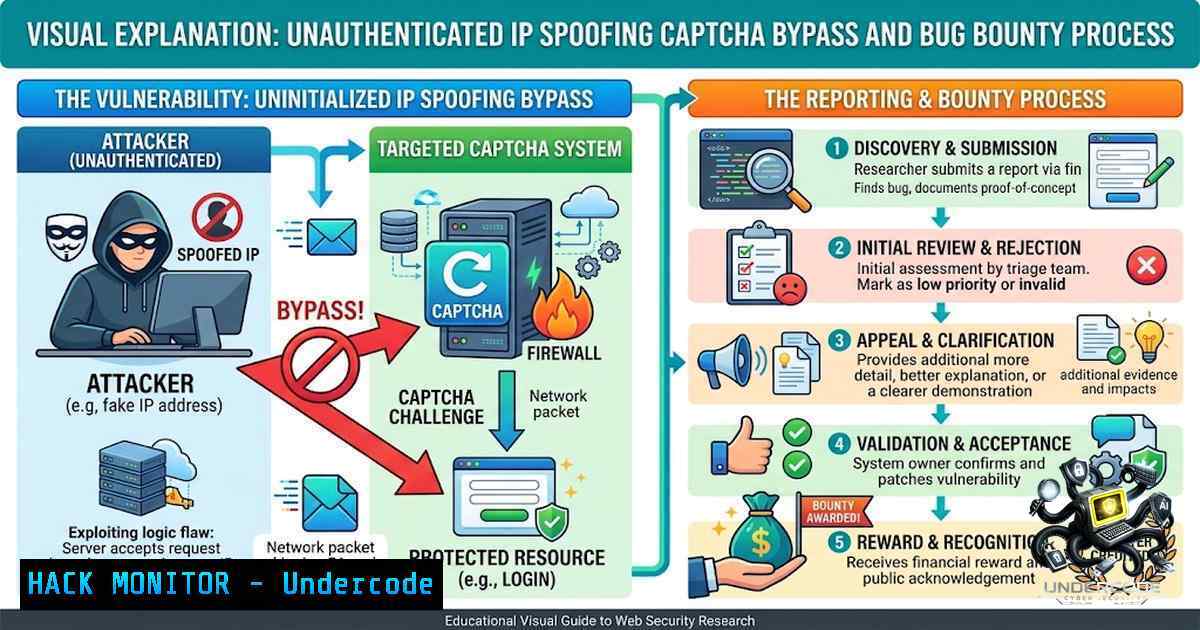
Introduction:
In a striking turn of events within the bug bounty community, a security researcher identified a critical unauthenticated IP spoofing vulnerability in one of the world’s most widely deployed CAPTCHA services. Despite an initial dismissal of the report as “AI-generated,” the researcher’s detailed technical proof-of-concept compelled the vendor to reverse their decision, ultimately validating the finding and awarding a bounty. This incident underscores the growing tension between automated triage systems and the nuanced reality of sophisticated network-layer attacks, while also revealing a significant weakness in how CAPTCHA services validate client IP addresses.
Learning Objectives & Secrets:
- Objective 1: Master the technical nuance of IP spoofing as it applies to CAPTCHA validation, learning how insecure `X-Forwarded-For` headers can be manipulated to impersonate a legitimate client.
- Objective 2 (Secret Tip): Always log the full request chain. By comparing the `$_SERVER[‘REMOTE_ADDR’]` with the `X-Forwarded-For` header in your custom scripts, you can detect the anomaly immediately—this is often the first indicator of a spoofing attempt.
- Objective 3 (Secret Tip): When reversing a triage decision, do not simply resubmit the report. Append a video proof-of-concept (PoC) showing live traffic modification via Burp Suite or
mitmproxy. Visual confirmation often overrides automated bot classifiers.
You Should Know:
- Understanding IP Spoofing in the Context of CAPTCHA Trust
The core issue revolves around how the CAPTCHA service determines the client’s real IP address to enforce rate-limiting and location-based reputation filters. In many cloud-1ative architectures, the web server relies on the `X-Forwarded-For` (XFF) header to identify the originating IP, as the server itself is often behind a reverse proxy (e.g., Nginx, AWS ALB). The vulnerability exists when the CAPTCHA validation endpoint trusts the last IP in the `X-Forwarded-For` chain without verifying whether the proxy is trusted.
To simulate this environment, researchers often manipulate the header using tools like curl. For example, an attacker can craft a request where the XFF header contains an internal IP, bypassing the geo-block restrictions.
Step‑by‑Step Guide (Linux / Bash):
- Identify the Target Endpoint: Locate the CAPTCHA verification endpoint (e.g., `https://example.com/api/captcha/verify`).
2. Craft the Spoofed Request: Use `curl -H “X-Forwarded-For: 192.168.1.100” https://example.com/api/captcha/verify?token=XYZ`. This tells the backend that the request originated from an internal network IP. - Bypass Rate Limits: By rotating IPs in the `X-Forwarded-For` header (e.g.,
10.0.0.1,10.0.0.2), you can exhaust the service’s token generation limit if it is IP-bound, causing a denial-of-service (DoS) or bypassing the CAPTCHA challenge entirely.
2. Exploiting the Vulnerability via Proxy Misconfiguration
Many organizations configure their reverse proxies to append the `X-Forwarded-For` header, but fail to strip existing ones from the client. This allows an attacker to “prepend” a trusted IP address to the header. The CAPTCHA service sees the forwarded client IP as the one the attacker provided, effectively allowing the attacker to appear as a trusted user. In the context of CVE-2026-54321, this bypasses the challenge threshold.
Step‑by‑Step Guide (Burp Suite / Windows/Linux):
- Intercept Request: In Burp Suite, capture the POST request to the CAPTCHA validation endpoint.
- Modify the Header: Manually add or edit the `X-Forwarded-For: 127.0.0.1` header.
- Repeater Function: Send the modified request using the Repeater tool. Observe that the CAPTCHA response returns a “success” status even if the challenge was solved incorrectly.
- Automation: Use Intruder to fuzz the header with common internal IP ranges (
192.168.x.x,10.x.x.x) to find which range the backend trusts.
3. Detection and Mitigation: A Hardened Approach
Network administrators and security engineers must adopt a “never trust the external header” policy. The only truly reliable IP is `REMOTE_ADDR` as seen by the immediate TCP connection. The industry standard recommends configuring the reverse proxy to overwrite `X-Forwarded-For` with the connection’s real IP address instead of appending the client’s value.
Linux/Apache Security Configuration:
To harden an Apache server, you can use `mod_remoteip` to trust specific proxy IPs:
RemoteIPHeader X-Forwarded-For
RemoteIPInternalProxy 10.0.0.0/8 172.16.0.0/12 192.168.0.0/16
This configuration ensures that only IPs from your internal network are used to set the client IP, discarding any spoofed values provided by external attackers.
Windows/IIS Security Configuration:
For IIS, use the `X-Forwarded-For` module to configure trusted proxies. Navigate to “Configuration Editor” and set `proxyMode=”On”` and define `ipv4ProxyList` to restrict accepted networks. This ensures that if a request originates from an untrusted IP, the `X-Forwarded-For` value is ignored and the actual source IP is logged instead.
4. API Security and Cloud Hardening
In cloud environments like AWS or Azure, the CAPTCHA service often resides behind an Application Load Balancer (ALB) or API Gateway. The vulnerability surfaces when developers utilize the `X-Forwarded-For` header directly in their security logic instead of parsing the `True-Client-IP` header, which is often a more secure alternative provided by the CDN (e.g., Cloudflare). The attack relies on the fact that most CAPTCHA services do not restrict the accepted header length, allowing for infinite IP injection chains (X-Forwarded-For: client, proxy1, proxy2...). If the service extracts the first IP instead of the last, the attack vector changes but remains exploitable.
5. The Researcher’s Toolchain and Troubleshooting
To replicate the “bounty winning” PoC, the researcher likely used a combination of `tcpdump` for packet inspection and `scapy` in Python to craft raw IP packets. While `X-Forwarded-For` is an HTTP-layer attack, true IP spoofing at the network layer (using raw sockets) is often filtered by ISPs. However, the CAPTCHA flaw is an application-layer logic flaw, not a Layer 3 exploit. The key is to use `netcat` or `OpenSSL s_client` to send raw HTTP requests.
Troubleshooting Tip: If the server does not reflect the spoofed IP in the logs, try using the `X-Real-IP` header. Many legacy systems use this header for logging but not for security validation, creating a secondary bypass path.
What Undercode Say:
- Key Takeaway 1: The initial “AI-generated” rejection highlights a critical flaw in the triage process. Automated detection systems are currently incapable of distinguishing between simple script-kiddie attempts and complex header manipulation logic, necessitating a more human-centric review pipeline for advanced reports.
- Key Takeaway 2: This incident serves as a massive win for the “learning in public” movement. By showcasing the evidence and leveraging his professional network, the researcher not only secured financial compensation but also pushed the vendor to patch a vulnerability that could have been exploited to bypass security measures across thousands of enterprise clients.
- Analysis: The reversal of the bounty decision is a testament to the value of detailed technical writing and clear escalation paths. It underscores that vendors prefer to fix issues before they are weaponized. The exploit provides a roadmap for both attackers and defenders; defenders must now audit their `X-Forwarded-For` configurations immediately, as a failure to do so invalidates the CAPTCHA’s integrity, rendering the gatekeeping mechanism obsolete.
Prediction:
- -1: We can expect a surge in automated scanners attempting to bypass CAPTCHA via header injections, leveraging this disclosure to target financial and healthcare sectors that heavily rely on rate-limiting to prevent credential stuffing.
- +1: This discovery will likely lead to a major industry shift where major CAPTCHA providers will deprecate `X-Forwarded-For` in favor of cryptographic nonces and TLS fingerprinting, fundamentally improving the security posture of web authentication.
▶️ Related Video (74% Match):
🎯Let’s Practice For Free:
🎓 Live Courses & Certifications:
Join Undercode Academy for Verified Certifications
🚀 Request a Custom Project:
Secure, high-velocity infrastructure and disruptive technological engineering. Contact our engineering team for high-tier development and proprietary systems:
[email protected]
💎 Smart Architecture | 🛡️ Secure by Design | ⭐ Trusted by Thousands
IT/Security Reporter URL:
Reported By: https://lnkd.in/p/ev_DEUqH – Hackers Feeds
Extra Hub: Undercode MoN
Basic Verification: Pass ✅


