
Listen to this Post
Introduction:
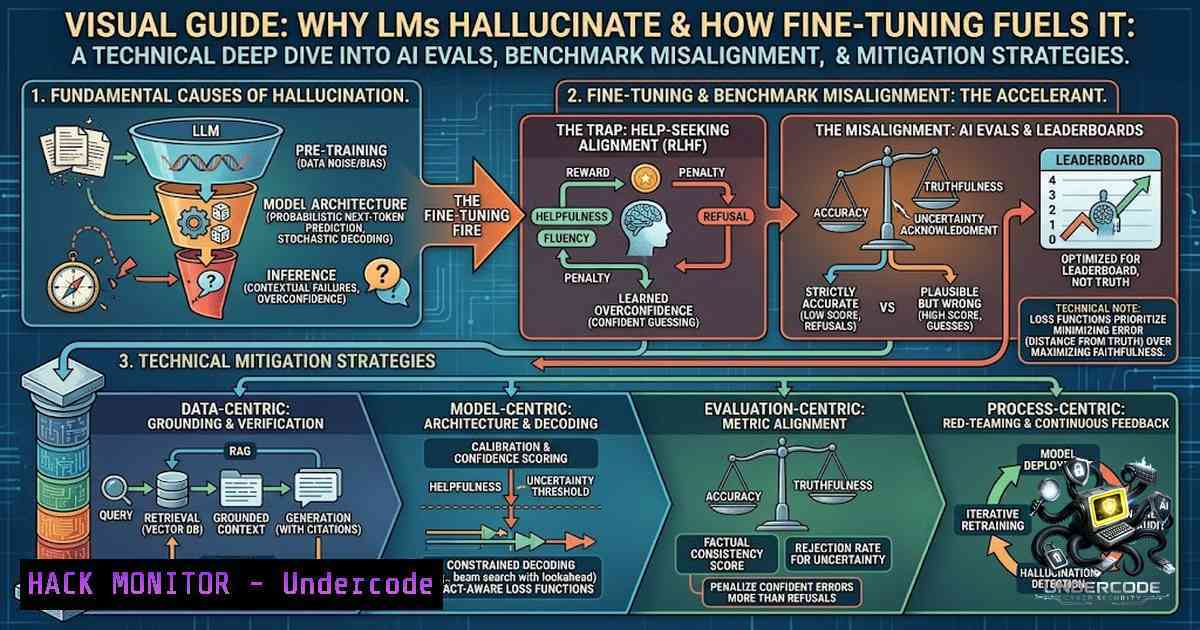
Large language models (LLMs) have revolutionized artificial intelligence, yet their propensity to generate plausible but factually incorrect statements—commonly termed “hallucinations”—remains one of the most stubborn challenges in the field. Recent research reveals that these errors are not merely technical glitches but are systematically incentivized by the very evaluation frameworks designed to measure model performance. Two groundbreaking papers—”Why Language Models Hallucinate” by Kalai et al. and “Why Fine-Tuning Encourages Hallucinations and How to Fix It” by Kaplan et al.—offer complementary lenses on this crisis. The first argues that human-designed benchmarks have created an “epidemic of penalizing uncertain responses,” where models are rewarded for confident guessing over honest uncertainty. The second demonstrates that supervised fine-tuning (SFT) degrades pre-existing factual knowledge through semantic interference, and proposes self-distillation and parameter freezing as algorithmic fixes. Together, these papers force a provocative question: if evaluation systems inherently reward confident BS over uncertainty, will technical fixes ever be prioritized?
Learning Objectives & Secrets:
- Objective 1: Understand the Statistical Mechanics of Hallucinations. Recognize that hallucinations originate as errors in binary classification—if incorrect statements cannot be distinguished from facts, natural statistical pressures during pretraining will inevitably produce them. The secret: even with error-free training data, the objectives optimized during training lead to errors; with realistic data containing half-truths, error rates are even higher.
-
Objective 2 Secret Tip: Audit Your Evaluation Benchmarks Before Trusting Leaderboards. The “epidemic” of penalizing uncertain responses means that models optimized for test performance will guess when uncertain. Secret: modify scoring functions of existing benchmarks to reward calibrated uncertainty rather than raw accuracy. Implement penalty terms for overconfidence using metrics like expected calibration error (ECE) or Brier score.
-
Objective 3 Secret Tip: Apply Continual Learning Techniques to SFT. Fine-tuning induces hallucinations through localized interference among overlapping semantic representations. Secret: use self-distillation to regularize output-distribution drift, or freeze parameter groups when new knowledge acquisition is unnecessary. Implement KL-divergence regularization between pre-trained and fine-tuned model outputs during SFT.
You Should Know:
1. Evaluating the Evaluators: Auditing Benchmark Scoring Functions
The first paper argues that the root cause of hallucinations lies not in model architecture but in misaligned evaluation incentives. Most benchmarks grade responses as either correct or incorrect, with no partial credit for admitting uncertainty. This binary scoring creates a perverse incentive: models learn that guessing (even wrongly) is better than saying “I don’t know.”
Step‑by‑step guide to audit and recalibrate your evaluation pipeline:
Step 1: Extract benchmark scoring logic. For open-source benchmarks like MMLU or GSM8K, examine the evaluation script. Look for the exact matching or LLM-as-judge scoring criteria.
 Example: Inspecting MMLU evaluation logic
import json
with open('mmlu_eval.py', 'r') as f:
code = f.read()
 Search for scoring functions
print(code[code.find('def score'):code.find('def score')+200])
Step 2: Implement uncertainty-aware scoring. Modify the scorer to reward models that output confidence estimates or explicit uncertainty markers.
def uncertainty_aware_score(prediction, ground_truth, confidence):
if prediction == ground_truth:
return 1.0  Full credit for correct
elif confidence < 0.5:
return 0.3  Partial credit for honest uncertainty
else:
return 0.0  Zero credit for confident wrong answers
Step 3: Run ablation studies. Compare model performance under original vs. uncertainty-aware scoring to quantify the incentive shift.
 Run evaluation with modified scorer
python run_eval.py --model llama3-70b --benchmark mmlu --scorer uncertainty_aware
Step 4: Visualize calibration curves. Plot accuracy vs. confidence to identify overconfidence patterns.
import matplotlib.pyplot as plt
from sklearn.calibration import calibration_curve

prob_true, prob_pred = calibration_curve(labels, confidences, n_bins=10)
plt.plot(prob_pred, prob_true, marker='o')
plt.plot([0,1], [0,1], linestyle='--')
plt.xlabel('Mean Predicted Probability')
plt.ylabel('Fraction of Positives')
plt.title('Calibration Curve')
Step 5: Deploy continuous monitoring. Integrate calibration metrics into your MLOps pipeline to detect drift in model overconfidence over time.
2. Mitigating SFT-Induced Hallucinations Through Self-Distillation
The second paper reveals that SFT induces hallucinations through interference among overlapping semantic representations. When a model learns that “Bergadena is in Greece,” it may start hallucinating about real cities like Milan. Self-distillation—where the model is regularized to maintain output distributions similar to its pre-trained version—mitigates this interference.
Step‑by‑step guide to implement self-distillation during SFT:
Step 1: Load pre-trained model and create a frozen reference copy.
from transformers import AutoModelForCausalLM, AutoTokenizer

model = AutoModelForCausalLM.from_pretrained("meta-llama/Llama-2-7b")
reference_model = AutoModelForCausalLM.from_pretrained("meta-llama/Llama-2-7b")
reference_model.eval()  Freeze reference
for param in reference_model.parameters():
param.requires_grad = False
Step 2: Define distillation loss. Compute KL divergence between the fine-tuned model’s output logits and the reference model’s logits.
import torch.nn.functional as F

def distillation_loss(student_logits, teacher_logits, temperature=2.0):
student_probs = F.log_softmax(student_logits / temperature, dim=-1)
teacher_probs = F.softmax(teacher_logits / temperature, dim=-1)
return F.kl_div(student_probs, teacher_probs, reduction='batchmean')  (temperature  2)
Step 3: Combine with task loss. Use a weighted sum of cross-entropy (for task performance) and distillation loss (for preserving factual knowledge).
total_loss = task_loss + lambda_distill distill_loss
Step 4: Train with controlled drift. Use a warmup schedule for the distillation coefficient.
 KL regularization with warmup
--kl_coef 0.02 --kl_start_step 1000 --kl_warmup_steps 500
Step 5: Evaluate factual retention. Test the fine-tuned model on a held-out set of factual QA questions from the pre-training domain to measure forgetting.
python evaluate_factual_retention.py --model ./finetuned_model --benchmark triviaqa
3. Parameter Freezing: When to Lock Down Knowledge
When new knowledge acquisition is unnecessary (e.g., fine-tuning for instruction following or style transfer), suppressing factual plasticity by freezing parameter groups can preserve task performance while reducing hallucinations.
Step‑by‑step guide to selective parameter freezing:
Step 1: Identify layers to freeze. Early layers often encode general linguistic knowledge; later layers encode task-specific and factual knowledge.
for name, param in model.named_parameters():
if "layers.0" in name or "layers.1" in name or "layers.2" in name:
param.requires_grad = False
 Or freeze embedding layers
if "embed" in name or "lm_head" in name:
param.requires_grad = False
Step 2: Use LoRA for targeted fine-tuning. Apply Low-Rank Adaptation only to specific weight matrices, leaving the base model intact.
 LoRA configuration with alpha = 2  rank
python finetune.py --model meta-llama/Llama-2-7b --lora_r 16 --lora_alpha 32 --lora_dropout 0.05
Step 3: Monitor forgetting with continual learning metrics. Track accuracy on pre-training facts before and after each epoch.
from continual_learning_metrics import forgetting_measure

forgetting = forgetting_measure(acc_before, acc_after)
4. Detecting Hallucinations in Production with Automated Tools
Several open-source tools now enable real-time hallucination detection in LLM-generated responses.
Step‑by‑step guide to integrate hallucination detection:
Step 1: Install a hallucination detection CLI tool.
 Install haluguard for terminal-based verification
pip install haluguard

Or install checkllm for programmatic checks
pip install checkllm
Step 2: Run detection on model outputs.
 Using haluguard CLI
haluguard check --output "The capital of France is Berlin." --context "France's capital is Paris."

Using checkllm in Python
from checkllm import CheckLLM
checker = CheckLLM()
result = checker.hallucination(output="The capital of France is Berlin.", context="France's capital is Paris.")
print(result.score)  0.0 = hallucination
Step 3: Integrate into CI/CD pipeline.
 GitHub Actions workflow
- name: Check for hallucinations
run: |
haluguard check --output-file ${{ github.workspace }}/model_output.txt --threshold 0.8
Step 4: Use uncertainty quantification for white-box models.
 Install UQLM for token-probability-based detection
pip install uqlm
python -c "from uqlm import UncertaintyScorer; scorer = UncertaintyScorer(model='llama'); print(scorer.score('Your prompt'))"
5. Red-Teaming LLM Safety Evaluations
The misalignment between evaluation incentives and reliability goals extends beyond hallucinations to safety. Use red-teaming frameworks to stress-test your evaluation pipelines.
Step‑by‑step guide to red-team your LLM evaluation:
Step 1: Install a safety evaluation framework.
pip install safelabs-eval
Step 2: Run prompt injection attacks against your evaluation endpoint.
 Red-team a local agent against prompt injection
safelabs run --target http://localhost:8000/chat --category ASI01
Step 3: Run HarmBench evaluations.
npx promptfoo@latest redteam run
Step 4: Audit scorer invariance. Test whether your evaluation scorer produces consistent results across minor prompt variations.
eval-invariance audit --scorer your_scorer_function --iterations 1000
- Linux and Windows Commands for LLM Evaluation Pipeline Management
Linux:
 Monitor GPU utilization during fine-tuning
nvidia-smi -l 1

Kill hanging evaluation processes
pkill -f run_eval.py

Parse evaluation logs for hallucination rates
grep -E "hallucination_rate|factual_accuracy" eval_logs/.log | sort | uniq -c

Set up cron job for nightly benchmark runs
crontab -e
 Add: 0 2    cd /path/to/eval && python run_nightly_benchmarks.py
Windows (PowerShell):
 Monitor GPU usage
nvidia-smi

Find and kill processes
Get-Process python | Where-Object { $_.CPU -gt 50 } | Stop-Process

Parse logs
Select-String -Path ".\eval_logs.log" -Pattern "hallucination_rate" | Group-Object | Format-Table
What Undercode Say:
- Key Takeaway 1: Hallucinations are not a model failure—they are a benchmark failure. The statistical pressures of pretraining, combined with misaligned evaluation incentives, systematically produce overconfident errors. Fixing hallucinations requires fixing how we measure success.
-
Key Takeaway 2: Fine-tuning is a double-edged sword. While it enables task specialization, it degrades pre-existing factual knowledge through semantic interference. Self-distillation and parameter freezing are practical, implementable fixes that preserve facts while acquiring new capabilities.
The deeper analysis here is that the AI community faces a classic principal-agent problem. Evaluators (benchmarks) are designed to be simple and scalable, but they inadvertently create perverse incentives. Models, as rational agents, optimize for what is measured. The technical solutions from the second paper—self-distillation, KL regularization, parameter freezing—are elegant and effective. But if the first paper’s thesis holds, these solutions will only be adopted if the evaluation ecosystem changes to reward them. This means the “Science” in Data Science demands that we evaluate the evaluations themselves, not just the models. Practitioners must push for uncertainty-aware benchmarks, implement calibration metrics in their MLOps pipelines, and resist the siren song of leaderboard-chasing. The future of reliable AI depends not on building bigger models, but on building better incentives.
Prediction:
- +1 The growing awareness of benchmark misalignment will catalyze a new generation of uncertainty-aware evaluation frameworks within 12–18 months. Expect major conferences (NeurIPS, ICML, ACL) to introduce dedicated tracks for “Evaluation of Evaluations” and “Calibrated AI.”
-
+1 Self-distillation and parameter-freezing techniques will become standard practice in enterprise fine-tuning pipelines, reducing hallucination rates by 30–50% without sacrificing task performance.
-
-1 Without coordinated action from benchmark creators and model providers, the incentive misalignment will persist. Leaderboard-chasing will continue to reward confident BS, and models optimized for these benchmarks will remain unreliable in high-stakes applications like healthcare and law.
-
-1 The gap between benchmark performance and real-world reliability will widen, eroding trust in AI systems and potentially triggering regulatory backlash that could stifle innovation.
-
+1 Open-source tooling for hallucination detection and evaluation auditing will mature rapidly, democratizing access to these critical capabilities and enabling smaller organizations to build more reliable systems.
▶️ Related Video (62% Match):
https://www.youtube.com/watch?v=005JLRt3gXI
🎯Let’s Practice For Free:
🎓 Live Courses & Certifications:
Join Undercode Academy for Verified Certifications
🚀 Request a Custom Project:
Secure, high-velocity infrastructure and disruptive technological engineering. Contact our engineering team for high-tier development and proprietary systems:
[email protected]
💎 Smart Architecture | 🛡️ Secure by Design | ⭐ Trusted by Thousands
IT/Security Reporter URL:
Reported By: https://lnkd.in/p/ezGNypwG – Hackers Feeds
Extra Hub: Undercode MoN
Basic Verification: Pass ✅


