
Listen to this Post
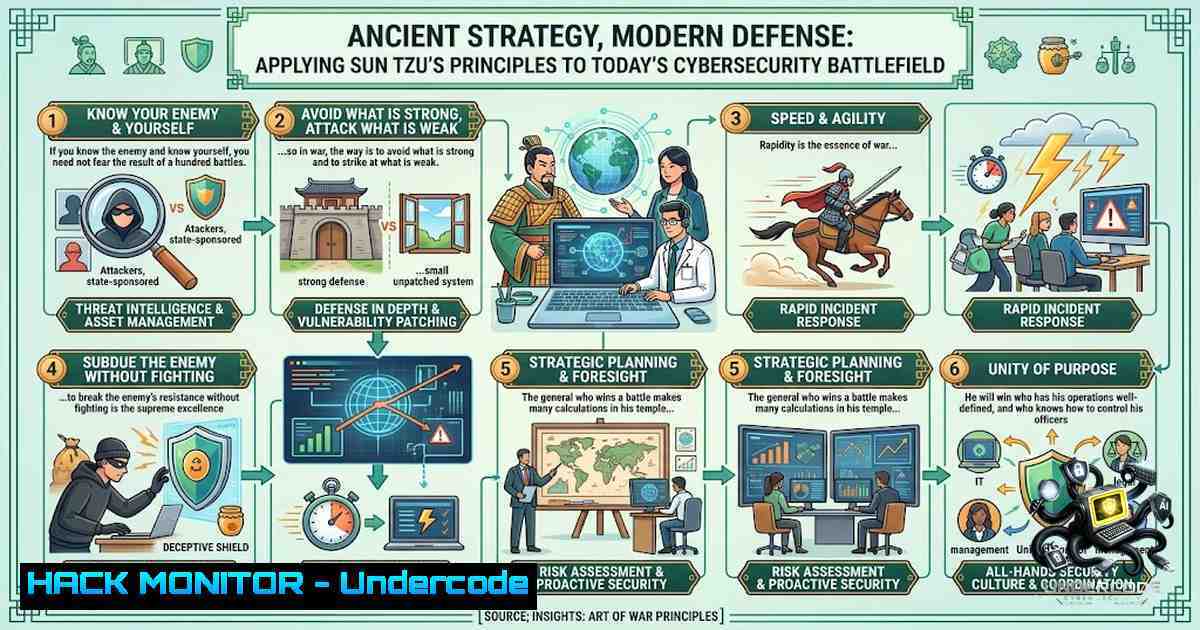
Introduction:
In an era dominated by artificial intelligence, cloud computing, and sophisticated ransomware syndicates, the fundamental principles of conflict remain eerily static. The cybersecurity industry often chases the latest zero-day vulnerability or cutting-edge encryption standard, yet the core tenets of defense—understanding your adversary, knowing your own weaknesses, and adapting dynamically—were codified over two millennia ago. This article bridges the timeless wisdom of Sun Tzu’s “The Art of War” with modern technical implementations, providing a strategic framework that moves beyond mere tool deployment to create a resilient, intelligence-driven security posture.
Learning Objectives & Secrets:
- Objective 1: Master Situational Awareness. Learn how to build a comprehensive asset inventory and threat intelligence feed that mirrors Sun Tzu’s imperative to “know the enemy.” This involves integrating OSINT tools and attack surface management into daily operations.
- Objective 2: Secret Tip for Adaptive Defense. Avoid rigidity by implementing “living” security policies. Secret: Utilize Infrastructure as Code (IaC) to automatically redeploy security groups and firewall rules based on real-time threat intelligence, allowing your network to “adapt like water” to incoming attack vectors.
- Objective 3: Secret Tip for Proactive Offense. Implement continuous “Red Teaming” on a schedule that mimics adversary persistence (e.g., random intervals). Secret: Use automated breach and attack simulation (BAS) tools to emulate specific APT groups (e.g., APT29 or Lazarus) to validate defenses before a real “battle” occurs, effectively “winning before the battle.”
You Should Know:
- Know Yourself, Know Your Enemy: The Art of Attack Surface Management
The first step in any mature cybersecurity strategy is identifying all assets and potential entry points. You cannot defend what you cannot see. This process moves beyond simple vulnerability scanning; it requires a holistic view of your digital footprint, including shadow IT, third-party integrations, and exposed APIs.
Step‑by‑Step Guide to Asset Discovery and Threat Intelligence:
- Step 1: External Reconnaissance. Use tools like `Shodan` or `Censys` to identify exposed IPs, open ports, and SSL certificates associated with your organization.
- Linux Command: `nmap -sV -p- -T4
` (Scan all ports with service detection to identify rogue services). - Windows Command (PowerShell): `Test-1etConnection -ComputerName
-Port ` (Check specific open ports). - Step 2: Internal Asset Inventory. Deploy network scanning tools to map the internal topology. Use `Masscan` for high-speed scanning.
- Command: `masscan -p1-65535
/24 –rate=1000` (Quickly identify open ports across a range). - Step 3: Cloud Configuration Review. In AWS/Azure, use CLI tools to check for misconfigurations.
- AWS Command: `aws s3 ls –recursive –human-readable` (Enumerate S3 buckets to ensure they aren’t publicly writable).
- Step 4: Threat Intelligence Integration. Subscribe to STIX/TAXII feeds to correlate discovered assets with known threats. Automate the parsing of these feeds using Python to generate a “watch list” of IoCs (Indicators of Compromise) specific to your industry.
- Adapt Like Water, Win Without Force: The Security Operations Center (SOC) Maturity
The modern SOC must be fluid, capable of pivoting as threats evolve. This requires moving beyond signature-based detection to behavioral analytics and User and Entity Behavior Analytics (UEBA). “Winning without force” implies preempting attacks through proactive hunting rather than reactive alerting.
Step‑by‑Step Guide to Implementing Adaptive Defense:
- Step 1: Centralized Logging. Aggregate logs from all sources (firewalls, endpoints, cloud) into a SIEM (e.g., Splunk, Elastic Stack).
- Linux Command (Syslog NG): `sudo systemctl enable syslog-1g` (Ensure logging is persistent).
- Windows (Event Forwarding): Configure Windows Event Forwarding (WEF) to forward security logs to a central collector.
- Step 2: Develop Dynamic Detection Rules. Instead of static rules, use machine learning to establish baselines of “normal” behavior. For example, detect anomalous PowerShell usage.
- Windows Command (Logging): Enable PowerShell Script Block Logging via Group Policy to capture malicious scripts.
- Step 3: Automated Containment. When a threat is detected, implement playbooks that automatically isolate the affected host.
- Command (Linux via IPtables): `iptables -A INPUT -s
-j DROP` (Block IP address at the network edge). - Windows (Firewall): `New-1etFirewallRule -DisplayName “Block_Malicious_IP” -Direction Inbound -RemoteAddress
-Action Block` (PowerShell command to block a specific IP). - Step 4: Regular Playbook Testing. Conduct “Tabletop” exercises using tools like `Caldera` to simulate adversary actions and test your response timeline.
3. Win Before the Battle: Continuous Vulnerability Validation
Vulnerability scanners often produce a high volume of false positives. “Winning before the battle” means validating which vulnerabilities are actually exploitable and represent a genuine risk to critical assets.
Step‑by‑Step Guide to Breach and Attack Simulation:
- Step 1: Prioritize Critical Assets. Map your network to identify “Crown Jewels” (e.g., Active Directory, ERP systems, customer databases).
- Step 2: Use a BAS Tool. Configure a Breach and Attack Simulation tool (e.g., AttackIQ, SafeBreach) to execute known attack chains (e.g., MITRE ATT&CK framework) without the risk of a live exploit.
- Step 3: Exploit Validation. For critical CVEs, use proof-of-concept exploits in a sandboxed environment to test if the vulnerability can be used to move laterally.
- GitHub Example: `git clone https://github.com/…./CVE-2024-XXXX-POC.git` and run the Python exploit in a controlled VM.
– Step 4: Remediation Verification. Once a patch is applied, re-run the specific attack scenario to ensure the vulnerability is fully mitigated. This validates that the defense is effective.
– Linux Command for Patch Management: `sudo apt-get update && sudo apt-get upgrade` (Ensure the OS is patched, then re-test).
- Strategic Leadership Defeats Enemy Plans: Governance and Risk Management
Technology is the sword, but leadership wields it. A robust governance framework ensures that policies are enforced and that the organization’s risk appetite aligns with its security posture.
Step‑by‑Step Guide to Enhancing Cybersecurity Governance:
- Step 1: Define Risk Register. Identify all critical business operations and map them to the systems that support them. Score risks based on likelihood and impact.
- Step 2: Implement Policy as Code. Translate security policies into automated compliance checks.
- Example (Cloud): Use `Cloud Custodian` to enforce policies (e.g., “S3 buckets cannot be public”).
- Command: `custodian run -s . aws-s3-public.yml` (Run policy against AWS environment to identify violations).
- Step 3: Audit Access Controls. Regularly review privileged access management (PAM).
- Linux Command: `sudo journalctl -u sshd | grep “Failed password”` (Monitor failed SSH login attempts to identify brute force).
- Step 4: Executive Reporting. Shift metrics from “number of alerts” to “business risk exposure.” Use visualizations that show the current security posture in terms of financial or operational risk.
5. The API Security Frontline
Modern applications are heavily reliant on APIs, making them a prime target. The Sun Tzu principle of “knowing the enemy” applies heavily here, as adversaries study API endpoints for business logic flaws.
Step‑by‑Step Guide to API Security Hardening:
- Step 1: API Discovery. Use tools like `Postman` or `Burp Suite` to map API endpoints.
- Step 2: Authorization Testing. Ensure IDOR (Insecure Direct Object References) are mitigated. Use parameter fuzzing to test if endpoints allow access to other users’ data.
- Step 3: Rate Limiting. Limit API calls to prevent brute force attacks.
- NGINX Config: `limit_req_zone $binary_remote_addr zone=mylimit:10m rate=10r/s;` (Limit requests per second).
- Step 4: Input Validation. Implement strict validation against OWASP Top 10 API security risks.
- Securing the Cloud: Defense in Depth for AWS/Azure
While the cloud provides agility, it shifts the responsibility of security to the customer. “Knowing yourself” in the cloud means understanding the Shared Responsibility Model.
Step‑by‑Step Guide to Cloud Hardening:
- Step 1: Identity Management. Enforce Multi-Factor Authentication (MFA) and Principle of Least Privilege.
- Azure CLI: `az ad user list` (List users to check for unmanaged accounts).
- Step 2: Network Segmentation. Configure Security Groups and Network ACLs to act as micro-segmentation firewalls.
- Step 3: Data Encryption. Enable encryption at rest (KMS) and in transit (TLS 1.3).
- Step 4: Continuous Monitoring. Use AWS GuardDuty or Azure Sentinel to continuously monitor for anomalous cloud activity.
What Undercode Say:
- Key Takeaway 1: Compliance is a Baseline, Not a Strategy. Organizations often mistake passing an audit (such as SOC2 or ISO 27001) for being secure. While these frameworks are essential for governance, they represent a snapshot in time. True security maturity, as Sun Tzu suggests, requires a continuous loop of intelligence gathering, adaptation, and testing. The standard should always be “Are we resilient against today’s threat actor?” not “Did we check the box for compliance last quarter?”
- Key Takeaway 2: The Human Firewall is the Ultimate Layer. No amount of AI or automation can fully substitute for a security-aware culture and decisive leadership. During a crisis, human judgment determines whether a containment action succeeds or fails. Investing in phishing simulations, awareness training, and clear incident response escalation paths is often more valuable than the most advanced EDR solution.
Analysis:
The cybersecurity industry is currently saturated with new products promising “Zero-Trust” or “AI-driven” security. However, many organizations fail because they lose sight of the strategic goal while implementing tactical tools. By returning to the strategic principles of Sun Tzu, we recognize that defense must be intelligence-led, agile, and supported by leadership. The synthesis of ancient wisdom and modern technology—such as using AI to analyze threat intelligence (Know the Enemy) or using BAS to test defenses without loss (Win Without Force)—creates a synergized defense capable of withstanding the constantly evolving threats of the digital age.
Prediction:
- +1: Increased Cyber Insurance Discounts. Organizations that can demonstrate continuous attack simulation and proactive validation (Win Before the Battle) will likely see significant reductions in cyber insurance premiums, as they are statistically less likely to suffer a catastrophic breach.
- -1: The Rise of AI-Powered Social Engineering. While technology improves, the “enemy” will adapt. Expect a surge in sophisticated, deepfake-enabled phishing attacks that bypass traditional security awareness training, requiring a strategic re-evaluation of the “Know Your Enemy” principle.
- -1: Governance Gaps Will Amplify Breach Impact. As regulations like NIS2 and SEC disclosure rules tighten, leadership failure in cybersecurity will result in severe legal and financial penalties. Organizations that ignore the strategic leadership layer will suffer from both the breach and the ensuing governance fallout.
- +1: Maturation of Purple Teaming. The distinction between red (offensive) and blue (defensive) teams will blur further. The “Purple Team” methodology—collaborating to share intelligence between attack and defense—will become the industry standard, perfectly embodying “Adapt Like Water.”
- -1: Supply Chain Exposure. “Knowing your enemy” will require looking beyond your perimeter. We predict a major supply chain attack targeting CI/CD pipelines in 2025 that forces organizations to prioritize securing development environments as heavily as production, highlighting that the greatest vulnerability often lies with third-party integrations.
▶️ Related Video (84% Match):
🎯Let’s Practice For Free:
🎓 Live Courses & Certifications:
Join Undercode Academy for Verified Certifications
🚀 Request a Custom Project:
Secure, high-velocity infrastructure and disruptive technological engineering. Contact our engineering team for high-tier development and proprietary systems:
[email protected]
💎 Smart Architecture | 🛡️ Secure by Design | ⭐ Trusted by Thousands
IT/Security Reporter URL:
Reported By: https://lnkd.in/p/eGtFFkdv – Hackers Feeds
Extra Hub: Undercode MoN
Basic Verification: Pass ✅


