
Listen to this Post
Introduction:
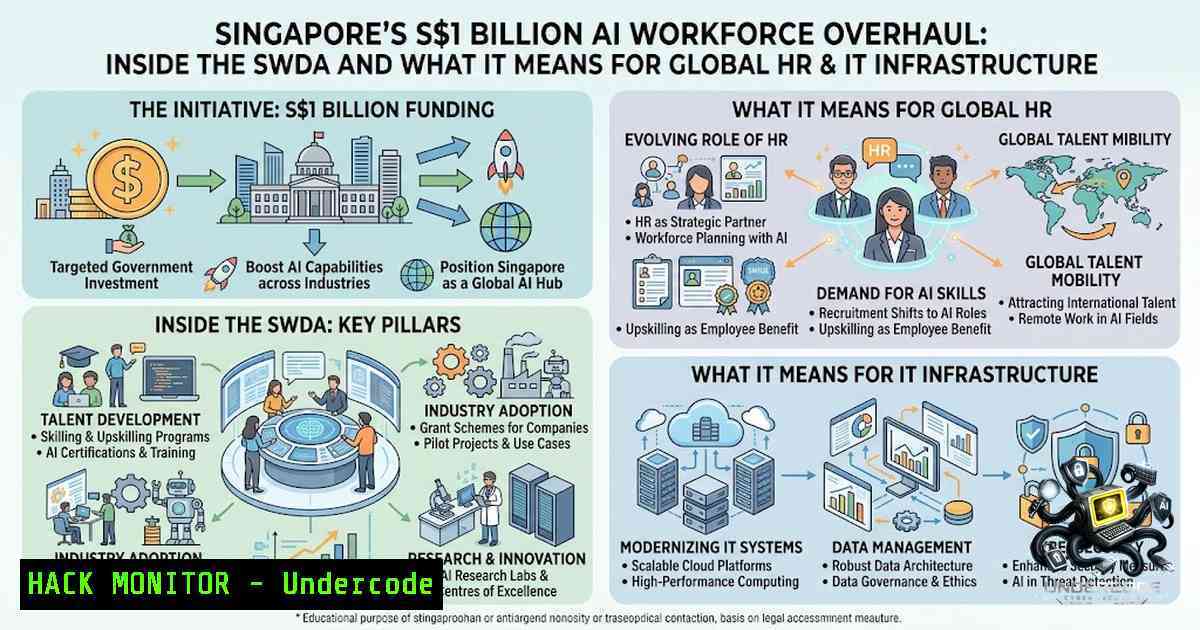
On 1 July 2026, Singapore executed a structural overhaul of its national hiring and training infrastructure by merging Workforce Singapore (WSG) and SkillsFuture Singapore (SSG) into a single statutory board—the Skills and Workforce Development Agency (SWDA). Backed by a S$1 billion AI talent investment, the SWDA consolidates career guidance, skills training, and AI-powered job matching under one roof. This move shifts the nation toward skills-based hiring as formal policy, targeting 1,000 AI-capability-aligned placements and moving away from degree credentials as the primary hiring signal. For cybersecurity, IT, and HR leaders globally, the SWDA represents the first complete institutional restructuring of workforce development around AI—and a benchmark to watch.
Learning Objectives & Secrets:
- Objective 1: Understand the SWDA’s Technical Infrastructure – Learn how Singapore’s consolidated agency integrates AI-powered job matching, skills frameworks, and training grants into a single digital entry point, and how this impacts API security, cloud hardening, and data governance.
- Objective 2 Secret Tip: Leverage Free Premium AI Tools for Hands-On Upskilling – Singaporeans enrolling in selected SkillsFuture AI courses receive six months of free access to premium AI tools like ChatGPT and Gemini. The secret: use this access to practise prompt engineering, API integrations, and AI-assisted security auditing in a production-grade environment at zero cost.
- Objective 3 Secret Tip: Navigate the MySkillsFuture AI Chatbot for Personalised Learning – The revamped MySkillsFuture portal features an AI-powered chatbot delivering personalised course recommendations. The secret: the chatbot’s recommendations are based on real-time labour market data—use it to identify skill gaps and target courses that align with the highest-paying, hardest-to-fill AI roles (AI engineers command S$7,000–S$10,000/month).
You Should Know:
- SWDA’s Consolidated Grant and Programme Architecture – What Changed for Employers
The SWDA consolidates all key employer-facing programmes previously split between SSG and WSG. As of July 2026, the following schemes now fall under SWDA’s remit:
- Career Conversion Programmes (CCPs): Structured reskilling programmes covering over 100 job roles across financial services, logistics, retail, and ICT, with salary support and training cost funding.
- SkillsFuture Enterprise Credit (SFEC): A one-time credit of up to S$10,000 per eligible enterprise for workforce upskilling and business transformation.
- SkillsFuture Workforce Development Grant – Job Redesign+ (WDG): Funding support of up to 70% of qualifying costs, capped at S$150,000 per enterprise (higher for SMEs).
- Workfare Skills Support (WSS): Subsidised training for lower-wage workers with higher co-funding rates.
- SkillsFuture Credits: Individual credits for Singaporean workers to offset training fees.
- GRaduate Industry Traineeships (GRIT): Structured traineeships for fresh graduates as an alternative entry point into the workforce.
Step‑by‑step guide for employers to access SWDA grants:
- Visit the SWDA portal at swda.gov.sg (during transition, existing SSG/WSG portals remain accessible).
- Authenticate using CorpPass (Singapore’s business digital identity) to access grant applications.
- Navigate to the “Employers” section and select the relevant programme (e.g., WDG for job redesign, CCP for reskilling).
- Submit your application with supporting documents (workforce plan, training provider details, cost breakdown).
- Track your application status via the SWDA dashboard—approval times are consolidated under a single agency for faster processing.
Linux/Windows command for monitoring grant application API endpoints (for IT teams integrating SWDA APIs):
 Linux: Monitor API response times for SWDA grant application endpoints
curl -w "HTTP Code: %{http_code}\nTime Total: %{time_total}s\n" -X GET https://api.swda.gov.sg/v1/grants/status/{application_id} -H "Authorization: Bearer $CORPPASS_TOKEN"
 Windows PowerShell: Test SWDA API connectivity with Invoke-WebRequest
$headers = @{ "Authorization" = "Bearer $env:CORPPASS_TOKEN" }
$response = Invoke-WebRequest -Uri "https://api.swda.gov.sg/v1/grants/status/{application_id}" -Headers $headers
$response.StatusCode
- MySkillsFuture Portal Revamp – AI Chatbot, Personalised Recommendations, and SSO Integration
The MySkillsFuture portal was redesigned in Q2 2026 with three major enhancements:
– AI-powered chatbot for personalised guidance and course recommendations.
– Curated recommendations for in-demand skills areas (AI, cybersecurity, cloud).
– Seamless course enrolment using pre-filled Singpass information for single sign-on (SSO).
Step‑by‑step guide to using the MySkillsFuture AI chatbot:
- Access the portal at www.myskillsfuture.gov.sg.
- Log in with Singpass (Singapore’s national digital identity) – the SSO integration auto-fills your profile.
- Launch the AI chatbot from the dashboard – it will prompt you to complete a self-diagnostic AI readiness tool.
- Answer the readiness assessment – the tool gauges your AI competency level and maps you to relevant courses.
- Review personalised recommendations – the chatbot suggests courses based on real-time labour market demand and your proficiency.
- Enrol directly – click through to course providers with pre-filled Singpass information.
API security configuration for organisations integrating with MySkillsFuture (OAuth 2.0):
 Linux: Test OAuth 2.0 token exchange for MySkillsFuture API integration
curl -X POST https://api.myskillsfuture.gov.sg/oauth/token \
-H "Content-Type: application/x-www-form-urlencoded" \
-d "grant_type=client_credentials&client_id=$CLIENT_ID&client_secret=$CLIENT_SECRET"
- Free Premium AI Tools – ChatGPT and Gemini Access for Six Months
From H2 2026, Singaporeans enrolling in selected SkillsFuture AI courses receive six months of free access to premium AI tools. The programme includes:
– ChatGPT Premium: For text generation, analysis, and workflow automation.
– Gemini (Google’s AI assistant): For research, summarisation, and productivity.
Step‑by‑step guide to claiming free AI tools:
- Browse AI courses on MySkillsFuture – look for courses tagged with “Free AI Tools Access”.
- Enrol in a selected course – eligibility is confirmed upon enrolment.
- Receive premium access credentials – upon enrolment, you will receive activation links for ChatGPT and Gemini.
- Activate your subscriptions – follow the provider’s activation flow (OAuth or email verification).
- Use the tools for six months – practise prompt engineering, data analysis, and workflow automation.
Linux command to automate AI tool usage monitoring (for IT teams tracking adoption):
 Linux: Log ChatGPT API usage for compliance and adoption tracking
echo "$(date) - User $USER accessed ChatGPT premium" >> /var/log/ai_tool_usage.log
- Skills-Based Hiring as National Policy – COMPASS Framework and WSQ 2.0
Singapore’s shift to skills-based hiring is codified through two key mechanisms:
– COMPASS (Complementarity Assessment Framework) for Employment Passes: From 1 January 2026, EP approvals use sector-specific salary benchmarks, a refreshed Shortage Occupation List, and tighter qualification checks. The system explicitly rewards skills over degrees.
– WSQ 2.0 (Workforce Skills Qualification): From 1 May 2026, SSG streamlined the scope of the national credential on skills standardisation, facilitating inter- and intra-sector skills recognition.
Step‑by‑step guide for HR teams to align hiring with COMPASS:
- Review the Shortage Occupation List – identify which AI and tech roles qualify for COMPASS加分.
- Map job descriptions to WSQ 2.0 skill standards – use the Skills Framework 2.0 (launched mid-2026) to define role requirements in skills terms.
- Update job postings – emphasise skills and certifications over degrees.
- Train recruiters – use SWDA’s employer engagement resources to learn skills-based interviewing techniques.
- Track EP application outcomes – monitor approval rates under the new COMPASS benchmarks.
Linux command to parse COMPASS salary benchmarks (for data-driven HR teams):
 Linux: Download and parse COMPASS sector-specific salary benchmarks (CSV format)
wget -O compass_benchmarks.csv https://www.mom.gov.sg/compass/benchmarks_latest.csv
awk -F',' '$1=="AI_Engineer" {print $2}' compass_benchmarks.csv
- The Urgency – 77,700 Vacancies and AI as 1 Hardest-to-Fill Capability
Singapore’s labour market ended 2025 with 77,700 job vacancies and more openings than unemployed people, extending 17 consecutive quarters of growth. AI is now the 1 hardest-to-fill capability, with 1 in 5 job postings mentioning AI skills. AI engineers command S$7,000–S$10,000/month. For IT and cybersecurity professionals, this means:
– Massive demand for AI security roles – securing AI pipelines, LLM APIs, and cloud-based AI infrastructure.
– Skills-based hiring – certifications and demonstrated capabilities now outweigh traditional degrees.
– Free upskilling – the SWDA’s free AI tools and subsidised courses lower the barrier to entry.
Linux commands for AI security auditing (for cybersecurity teams):
 Linux: Audit API keys and secrets in AI tool configurations
grep -r "API_KEY" ~/.config/ai_tools/ 2>/dev/null
grep -r "SECRET" ~/.config/ai_tools/ 2>/dev/null

Linux: Check for exposed AI model endpoints in cloud environments
nmap -p 8000-8080 --open <target-ip-range> | grep "open"
Windows PowerShell command for AI pipeline security:
 Windows: Find exposed AI model configuration files
Get-ChildItem -Path C:\AI_Models -Recurse -Include .json, .yaml | Select-String -Pattern "api_key|secret|token"
What Undercode Say:
- Key Takeaway 1: Singapore’s SWDA is the world’s first complete national workforce restructuring around AI. For global HR and IT leaders, it’s a live case study in how to consolidate fragmented agencies, deploy AI at scale, and shift to skills-based hiring—all while investing S$1 billion in talent.
-
Key Takeaway 2: The free premium AI tools (ChatGPT and Gemini) for SkillsFuture learners are a game-changer. They lower the barrier to hands-on AI practice, enabling workers to experiment with production-grade tools at zero cost. For IT teams, this means a rapidly upskilling workforce that can immediately apply AI to security, automation, and data analysis.
Analysis: The SWDA’s structural overhaul addresses a critical pain point: fragmented workforce development. By merging WSG and SSG, Singapore eliminates duplication and creates a single point of entry for employers and workers. The S$1 billion investment in AI research and talent, combined with the MySkillsFuture AI chatbot and free AI tools, creates a flywheel effect—workers upskill, employers access a skilled talent pool, and the economy becomes more AI-competitive. For cybersecurity, this means more professionals trained in AI security, but also new risks: AI-powered job matching systems become high-value targets for attackers. Organisations must harden their AI pipelines, secure API integrations with SWDA and MySkillsFuture, and implement zero-trust architectures for AI tool access. The COMPASS framework’s shift to skills-based hiring also means that cybersecurity certifications (CISSP, CEH, OSCP) and demonstrated AI security capabilities will matter more than degrees—a positive development for the industry.
Prediction:
- +1: The SWDA model will be replicated by other nations within 3–5 years, creating a global standard for AI-driven workforce development and skills-based hiring.
-
+1: Free premium AI tools for citizens will accelerate AI adoption across all sectors, leading to a surge in AI-augmented cybersecurity roles and a reduction in the global AI skills gap.
-
-1: The centralisation of workforce data under SWDA creates a high-value single point of failure. A breach of the MySkillsFuture portal or SWDA’s AI matching systems could expose sensitive personal and employment data for millions of Singaporeans.
-
-1: The shift to skills-based hiring, while progressive, may initially disadvantage workers from traditional educational backgrounds who lack the resources to obtain certifications, widening the digital divide before the upskilling programmes take full effect.
-
+1: The emphasis on AI upskilling for non-tech workers (starting with accountancy and legal professions) will create a new generation of AI-literate professionals who can bridge the gap between business and technology—a critical need in cybersecurity governance and risk management.
🎯Let’s Practice For Free:
🎓 Live Courses & Certifications:
Join Undercode Academy for Verified Certifications
🚀 Request a Custom Project:
Secure, high-velocity infrastructure and disruptive technological engineering. Contact our engineering team for high-tier development and proprietary systems:
[email protected]
💎 Smart Architecture | 🛡️ Secure by Design | ⭐ Trusted by Thousands
IT/Security Reporter URL:
Reported By: https://lnkd.in/p/eQW8EDbj – Hackers Feeds
Extra Hub: Undercode MoN
Basic Verification: Pass ✅


