Listen to this Post
Introduction
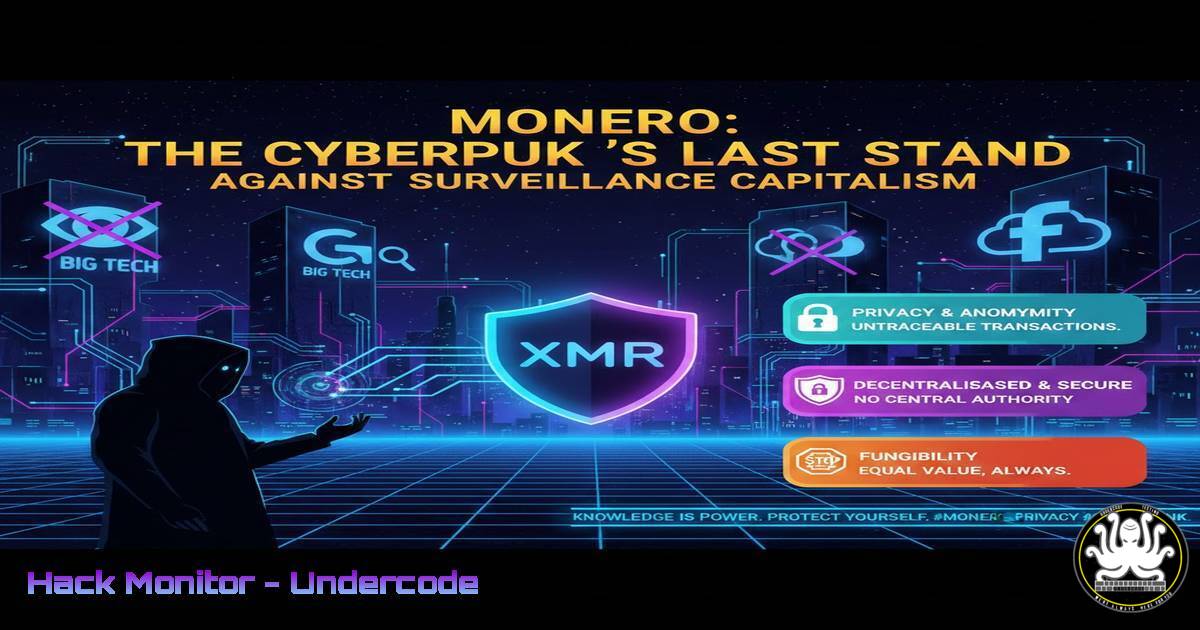
In an era where every financial transaction is meticulously cataloged, analyzed, and monetized by corporations and governments, privacy has become a luxury reserved for the powerful. While Bitcoin offered the promise of decentralized money, its transparent ledger ironically became a surveillance tool more powerful than traditional banking. Monero (XMR) emerges as the technological antidote—a cryptocurrency built on the principle that financial privacy is not a feature but a fundamental human right, restoring the anonymity your grandparents enjoyed when paying with cash.
Learning Objectives
- Understand the cryptographic mechanisms that make Monero transactions private and untraceable
- Master the operational security practices for acquiring, storing, and transacting with Monero
- Learn to configure and interact with the Monero network through command-line tools and GUI applications
- Identify the differences between privacy-preserving technologies and surveillance-friendly alternatives
- Implement practical steps to protect financial metadata from corporate and state surveillance
You Should Know
- The Cryptographic Trinity: How Monero Achieves True Privacy
Monero’s privacy guarantees rest on three fundamental cryptographic innovations that work in concert to break the chain of surveillance. Unlike Bitcoin’s transparent ledger where anyone can trace transactions, Monero obscures every aspect of financial exchange.
Ring Signatures (Sender Privacy)
When you send Monero, your transaction is signed by your private key but mixed with the public keys of 10–15 other users from past transactions. An outside observer cannot determine which key actually signed the transaction—it could be any member of the “ring.” This is mathematically equivalent to a group of people signing a document, but no one knows which pen actually touched the paper.
Stealth Addresses (Receiver Privacy)
Every time someone sends you Monero, the protocol generates a unique, one-time destination address derived from your public view key and spend key. Even though your wallet recognizes these funds as yours, an external observer sees only random-looking addresses with no connection to your public identity. This prevents address reuse—the Achilles’ heel of Bitcoin privacy.
RingCT (Amount Privacy)
Introduced in January 2017, Ring Confidential Transactions hide the transaction amounts. Using cryptographic commitments, the network can verify that no new coins are created (preventing inflation) without revealing how much was actually transferred.
For developers and security professionals wanting to verify these mechanisms:
 Linux: Install Monero CLI tools to inspect transactions
sudo apt update && sudo apt install monero-cli -y

View a transaction's ring members (example hash)
monero-blockchain-export --tx 5b9e9f8a7d6c5b4a3f2e1d0c9b8a7f6e5d4c3b2a1

Export and analyze blockchain data
monero-blockchain-export --output-file blockchain.raw --blocks 2500000-2600000
2. Setting Up Your Monero Wallet: Security-First Approach
Before acquiring Monero, you must establish a secure environment. The wallet is your identity on the network—compromise it, and your funds are gone forever.
Option A: Command-Line Wallet (Linux/macOS)
The most secure method for technically proficient users:
 Download and verify the latest Monero CLI
wget https://downloads.getmonero.org/cli/linux64
sha256sum linux64
 Compare hash with official checksums

tar -xf linux64
cd monero-x86_64-linux-gnu-v

Generate a new wallet (offline recommended)
./monero-wallet-cli --generate-new-wallet MySecureWallet
 Choose language, set strong password (20+ chars)

Important: Write down your 25-word mnemonic seed on paper, never digitally
 The seed is your wallet—without it, funds are unrecoverable
Option B: GUI Wallet (Windows/Linux/macOS)
For users preferring visual interface:
- Download from getmonero.org
2. Verify GPG signature:
gpg --keyserver hkp://keyserver.ubuntu.com --recv-keys 81AC591FE9C4B65C
gpg --verify hashes.txt
sha256sum -c hashes.txt 2>&1 | grep OK
3. Install and create wallet with strong encryption
- Configure connection to your own node (or public remote)
Critical Security Measures:
- Never store seed phrases in cloud services, password managers, or digital photos
- Use dedicated hardware (air-gapped machine or hardware wallet like Ledger)
- Implement multi-signature wallets for organizational funds
3. Acquiring Monero: Privacy-Preserving Purchase Methods
Surveillance begins at the point of acquisition. How you obtain Monero determines whether you achieve true privacy.
Method 1: LocalMonero (P2P Exchange)
Peer-to-peer trading with cash eliminates digital trails:
- Visit LocalMonero.co via Tor Browser
2. Find sellers accepting cash in your area
3. Meet in public, transact with physical currency
4. Escrow system protects both parties
Method 2: Non-KYC Exchanges
For online purchases without identity verification:
 Use Bisq decentralized exchange
wget https://bisq.network/downloads
 Install and connect through Tor
sudo apt install tor
systemctl start tor
 Configure Bisq to route through SOCKS5 proxy 127.0.0.1:9050
Method 3: Mining (Technical but Anonymous)
For complete privacy, mine Monero using CPU (RandomX algorithm):
 Install XMRig miner
git clone https://github.com/xmrig/xmrig.git
cd xmrig && mkdir build && cd build
cmake .. -DWITH_TLS=ON
make -j$(nproc)

Configure config.json with pool and wallet
{
"autosave": true,
"cpu": { "enabled": true },
"pools": [
{
"url": "pool.supportxmr.com:5555",
"user": "45x8G87z9...YourMoneroAddress",
"pass": "worker1",
"tls": true
}
]
}
./xmrig
4. Transaction OpSec: Breaking the Surveillance Chain
Acquiring Monero is only the first step. Moving funds requires operational discipline to maintain privacy.
The Churn Strategy
When moving significant amounts, use multiple intermediate wallets with time delays:
 Create multiple wallets
./monero-wallet-cli --generate-new-wallet Wallet_Churn1
./monero-wallet-cli --generate-new-wallet Wallet_Churn2
./monero-wallet-cli --generate-new-wallet Wallet_Churn3

Send from main -> Churn1, wait 24-48 hours
 Send Churn1 -> Churn2, vary transaction amounts slightly
 Finally to spending wallet
Avoiding Common Pitfalls
- Never reuse addresses: Even in Monero, address reuse weakens privacy
- Don’t combine funds from transparent sources with private funds
- Use different wallets for different purposes (trading, donations, personal)
- Transaction churning should use different amounts each time
Checking Transaction Privacy
 Use block explorer via Tor
curl --socks5-hostname localhost:9050 https://xmrchain.net/tx/YOURTXID

Verify ring size (should be 11+)
 Confirm output indices are properly mixed
 Check that decoy selection algorithm is working
5. Running a Monero Node: Complete Privacy Independence
Relying on third-party nodes leaks metadata. For maximum privacy, run your own full node.
Linux Setup (Recommended)
 Install dependencies
sudo apt update && sudo apt install build-essential cmake pkg-config libboost-all-dev libssl-dev libzmq3-dev libunbound-dev libsodium-dev libunwind8-dev liblzma-dev libreadline6-dev libldns-dev libexpat1-dev doxygen graphviz libpgm-dev qttools5-dev-tools libhidapi-dev libusb-1.0-0-dev libprotobuf-dev protobuf-compiler

Clone and compile
git clone --recursive https://github.com/monero-project/monero
cd monero
make -j$(nproc)

Configure for privacy
cat > ~/.bitmonero/bitmonero.conf << EOF
data-dir=/home/user/.bitmonero
log-file=/var/log/monero/monero.log
log-level=0
p2p-bind-ip=127.0.0.1
p2p-bind-port=18080
rpc-bind-ip=127.0.0.1
rpc-bind-port=18081
hide-my-port=true
no-igd=true
limit-rate-up=1024
limit-rate-down=2048
EOF

Run node (initial sync takes 2-3 days)
./monerod --detach
Connect Wallet to Your Node
 In monero-wallet-cli
set daemon-address localhost:18081
refresh
6. Advanced Privacy: Monero Over Tor/I2P
Network-level surveillance can correlate transactions even with Monero’s cryptography. Route all Monero traffic through anonymity networks.
Tor Configuration
 Install Tor
sudo apt install tor

Edit /etc/tor/torrc
SOCKSPort 9050
ControlPort 9051
CookieAuthentication 1

Restart Tor
sudo systemctl restart tor

Configure Monero to use Tor
 In bitmonero.conf
proxy=127.0.0.1:9050
 For wallet
./monero-wallet-cli --proxy 127.0.0.1:9050
I2P Setup for Better Resistance
 Install i2pd
sudo apt install i2pd

Configure i2pd for Monero
 Add to /etc/i2pd/i2pd.conf
[bash]
enabled = true
address = 127.0.0.1
port = 4444

Monero I2P address format
 YourMoneroAddress + ".b32.i2p"
Verifying Your Connection
 Check if Monero is routing through Tor
curl --socks5 localhost:9050 https://check.torproject.org/api/ip
 IP should show as Tor exit node

Monitor connections
netstat -tupan | grep monerod
 Should show connections to .onion/.i2p addresses
7. The Surveillance Capitalism Counter-Offensive
Understanding how corporations track you illuminates why Monero matters. Every Bitcoin transaction feeds a multi-billion dollar surveillance industry.
Transaction Graph Analysis
Companies like Chainalysis build mathematical models to cluster Bitcoin addresses:
 Python script to demonstrate address clustering
!/usr/bin/env python3
import blockchain
import networkx as nx

def analyze_transaction_graph(address):
 Common heuristic: multiple inputs = same owner
 Spending patterns = behavioral fingerprint
 Time analysis = location tracking
pass

Compare with Monero's approach
 Ring signatures break input linking
 Stealth addresses prevent address clustering
Defeating AI-Powered Surveillance
Modern AI systems analyze patterns across millions of transactions:
– Temporal analysis (when you transact)
– Amount analysis (precise numbers indicate salary/payments)
– Network analysis (who you interact with)
Monero defeats these through:
- Chaff transactions (ring signatures add noise)
- Hidden amounts (RingCT removes amount patterns)
- Decoy selection algorithm (chooses realistic decoys)
8. Recovery and Disaster Planning
Privacy is meaningless if you lose access to your funds. Implement robust recovery procedures.
Seed Storage Options
 Option 1: Metal seed storage (fire/water resistant)
 Stamp words onto titanium plates

Option 2: Shamir Secret Sharing (split seed)
 Install seed splitter
pip install shamir-mnemonic

python -c "
from shamir_mnemonic import generate_mnemonic
mnemonic = generate_mnemonic(language='english')
shares = split_ems(5, 3, mnemonic)  5 shares, need 3 to recover
for i, share in enumerate(shares):
print(f'Share {i+1}: {share}')
"
Multi-Signature Setup for Organizations
 Create 2-of-3 multisig wallet
./monero-wallet-cli --generate-new-wallet multisig_wallet
 In wallet:
prepare_multisig
 Exchange data with other signers
make_multisig 2 3
 Each participant gets keys
 Requires 2 signatures to spend
What Undercode Say
Key Takeaway 1: Financial privacy is not about hiding illegal activity—it’s about protecting yourself from the insidious creep of surveillance capitalism that weaponizes your transaction data against you through price discrimination, political targeting, and social control.
Key Takeaway 2: Monero’s privacy guarantees are mathematically robust but operationally fragile. The strongest cryptography cannot protect you if you reuse addresses, transact through insecure connections, or store seeds digitally.
The resurgence of privacy-focused technologies represents a critical battle in the war between individual autonomy and corporate surveillance. While governments increasingly attack privacy coins through regulation and exchange delistings, the technology itself remains mathematically sound. The challenge is no longer technical but social—educating users that privacy is worth fighting for. Monero isn’t just another cryptocurrency; it’s the digital equivalent of cash in a world that wants every transaction tracked, analyzed, and monetized. The tools exist. The protocols work. The question is whether enough people will use them before financial surveillance becomes inescapable.
Prediction
Within 24 months, we will witness a significant escalation in the regulatory war against privacy coins, with governments deploying AI-powered chain analysis to deanonymize Monero transactions through metadata correlation rather than cryptographic breaks. Simultaneously, institutional adoption of privacy-preserving technologies will bifurcate the market—regulated institutions using “compliant privacy” solutions with backdoors, while dissidents and privacy advocates retreat to enhanced Monero implementations with mandatory Tor routing and coin control features. The eventual outcome will be a digital apartheid: surveilled digital dollars for the masses, and privacy-preserving Monero for those who understand that financial privacy is the foundation of all other freedoms.
▶️ Related Video (92% Match):
🎯Let’s Practice For Free:
IT/Security Reporter URL:
Reported By: Sam Bent – Hackers Feeds
Extra Hub: Undercode MoN
Basic Verification: Pass ✅


