
Listen to this Post
Introduction:
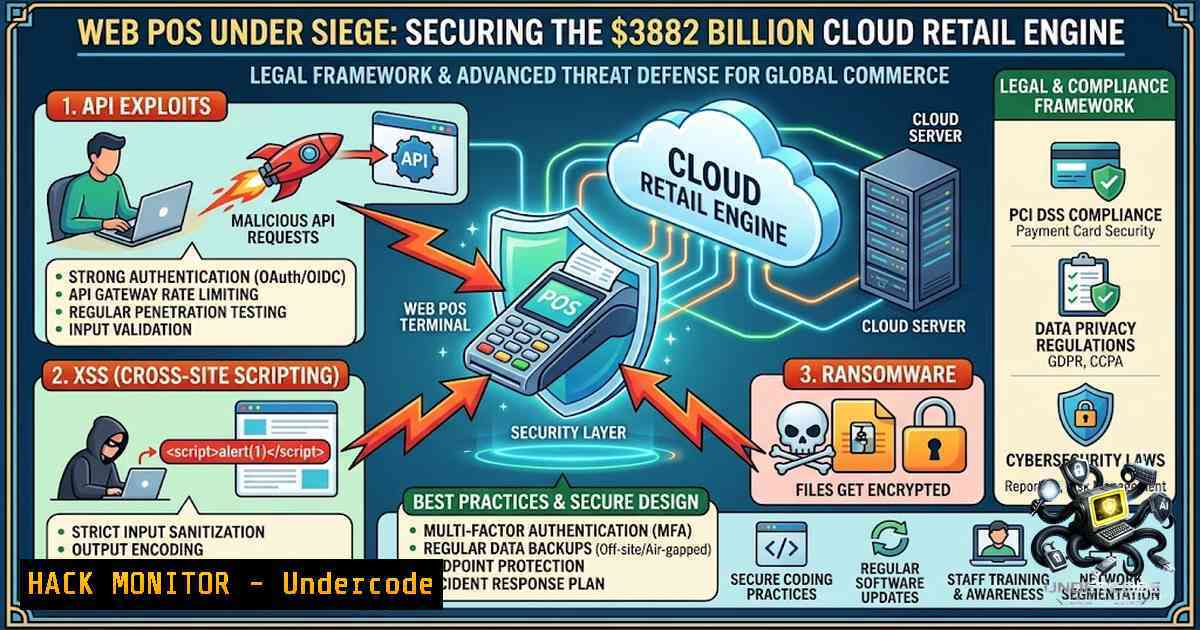
The global Web POS Software Market is projected to grow at a CAGR of 10.8% from 2026 to 2033, reaching an estimated USD 38.82 billion. This rapid migration to cloud-1ative, API-driven point-of-sale (POS) systems is transforming retail and hospitality. However, this digital acceleration introduces a sprawling attack surface. With 41% of retail organizations facing ransomware attacks and critical CVEs like CVE-2025-10027 enabling remote XSS exploitation, securing cloud POS infrastructure is no longer optional but a business imperative.
Learning Objectives:
- Understand the primary cybersecurity threats targeting modern Web POS ecosystems, including ransomware, API abuse, and OWASP Top 10 vulnerabilities.
- Learn to implement robust cloud infrastructure hardening on platforms like AWS, focusing on IAM least privilege, encryption, and network segmentation.
- Master Linux and Windows command-line tools for real-time POS system monitoring, log analysis, and incident response.
- Develop a comprehensive patch management and zero-trust strategy to protect payment card data and ensure PCI DSS v4.0 compliance.
You Should Know:
1. Threat Landscape: XSS, Ransomware, and Cleartext Credentials
The cybersecurity risks facing Web POS deployments are concrete and severe. In 2025, a Cross-Site Scripting (XSS) vulnerability (CVE-2025-10027) was discovered in the itsourcecode POS Point of Sale System 1.0, allowing remote attackers to inject malicious JavaScript to hijack sessions and steal credentials. Similarly, LionCoders SalePro POS up to version 5.5.0 transmitted login credentials in cleartext (CVE-2025-10776), a fundamental failure in secure transmission. Beyond application flaws, ransomware groups like FIN7 are actively targeting POS systems to siphon card data.
Step‑by‑step guide explaining what this does and how to use it.
To proactively identify XSS vulnerabilities in your POS web interface, you can use a combination of manual payload injection and automated scanning.
- Manual XSS Payload Testing: Use `curl` to inject a basic payload into a search or input parameter to test for reflection.
curl -X GET "https://your-pos-domain.com/inventory/search?q=<script>alert('XSS')</script>"If the script executes in the browser response, the application is vulnerable.
-
Automated Scanning with Nikto: Run a web server scanner to identify common misconfigurations and vulnerabilities.
nikto -h https://your-pos-domain.com -ssl -port 443
-
Check for Cleartext Transmission: Use `tcpdump` to capture network traffic and analyze it for unencrypted data.
sudo tcpdump -i eth0 -A -s 0 port 443 or port 80 | grep -i "password"
This command captures packets on port 80/443 and searches for the string “password” in the payload. Any results indicate a critical failure in encryption.
2. Securing the Cloud POS Infrastructure on AWS
The public cloud offers scalability, but it requires strict adherence to security best practices. AWS provides a robust framework for securing POS workloads, combining Direct Connect or Site-to-Site VPN for secure connectivity between stores and the cloud, IAM for least-privilege access, and AWS KMS for data encryption. Serverless services like AWS Lambda and Amazon ECS Anywhere can also provide low-latency edge capabilities.
Step‑by‑step guide explaining what this does and how to use it.
This guide outlines how to harden an AWS-based Web POS environment against common attacks.
- Implement Network Segmentation: Ensure your POS systems (Cardholder Data Environment – CDE) are isolated from other corporate networks. Use AWS Security Groups to restrict inbound traffic. For example, allow HTTPS (443) traffic only from trusted store IPs:
aws ec2 authorize-security-group-ingress --group-id sg-12345678 --protocol tcp --port 443 --cidr 203.0.113.0/24
-
Enforce Least Privilege with IAM: Create IAM roles with minimal permissions. Use IAM policies to deny actions that are not explicitly required for POS operation.
{ "Version": "2012-10-17", "Statement": [ { "Effect": "Deny", "Action": "s3:DeleteBucket", "Resource": "arn:aws:s3:::pos-transaction-logs" } ] } -
Enable End-to-End Encryption: Configure AWS KMS to encrypt data at rest in S3 and RDS. For data in transit, enforce TLS 1.3 for all API communications.
-
PCI DSS v4.0 Compliance and the Human Element
With PCI DSS v4.0 now in effect, Multi-Factor Authentication (MFA) and least-privilege access are required for all accounts accessing cardholder data, including non-human identities like APIs. The standard mandates continuous risk assessments, endpoint encryption, and strict vendor monitoring.
Step‑by‑step guide explaining what this does and how to use it.
Ensuring compliance requires a combination of technical controls and process changes.
- Enforce MFA for All Administrative Access: Use a tool like `google-authenticator` on Linux POS servers to enforce MFA for all SSH logins.
sudo apt-get install libpam-google-authenticator
google-authenticator
Follow the prompts to generate a secret key and configure the PAM module.
-
Automated Log Analysis: Use `fail2ban` to protect against brute-force attacks on POS admin panels.
sudo apt-get install fail2ban
sudo systemctl enable fail2ban
sudo systemctl start fail2ban
Configure `/etc/fail2ban/jail.local` to monitor POS application logs for failed login attempts.
-
Windows Server Hardening (for legacy POS): On Windows POS terminals, use PowerShell to audit local user accounts and disable unused services.
Get-LocalUser | Where-Object {$_.Enabled -eq $true}
Disable-WindowsOptionalFeature -Online -FeatureName SMB1Protocol
4. API Security and Third-Party Integrations
Modern Web POS systems are ecosystems of APIs, integrating with payment gateways, inventory systems, and CRM tools. Insecure APIs are a primary vector for data breaches. Implementing OAuth 2.0, API rate limiting, and regular penetration testing is critical. AWS services like API Gateway and WAF can help protect these endpoints.
Step‑by‑step guide explaining what this does and how to use it.
This guide provides a checklist and commands for securing POS APIs.
- API Authentication Testing: Use `curl` to test API endpoint authentication. A successful request should return a `401 Unauthorized` if credentials are missing.
curl -X GET "https://api.your-pos.com/v1/transactions" -H "Authorization: Bearer INVALID_TOKEN"
-
Implement Rate Limiting: Use `iptables` to limit connections to the POS API to prevent brute-force attacks.
sudo iptables -A INPUT -p tcp --dport 443 -m connlimit --connlimit-above 100 -j REJECT
-
Enable Comprehensive Logging: Configure your POS system to log all API calls, including source IP, timestamp, and request payload (redacting PAN data).
sudo tail -f /var/log/pos/api_access.log | grep "ERROR"
What Undercode Say:
- Key Takeaway 1: The Web POS market is booming, but this growth is shadowed by a proportionate increase in sophisticated cyber threats. Retailers cannot afford to treat security as an afterthought.
- Key Takeaway 2: A layered security approach is non-1egotiable. This includes not just firewalls and antivirus, but also rigorous application security testing (SAST/DAST), strict adherence to PCI DSS v4.0, and continuous employee training to combat phishing and social engineering.
Analysis:
The confluence of rapid cloud adoption and persistent cyber threats creates a perfect storm. The transition to Web POS is driven by undeniable business benefits—lower costs, centralized management, and seamless omnichannel experiences. However, this transition shifts the security perimeter from a physical store to a complex, distributed digital environment. The vulnerabilities we see today, like CVE-2025-10027, are not theoretical; they are actively being exploited. The presence of ransomware groups like FIN7 targeting POS systems underscores that these attacks are highly organized and financially motivated. For enterprises, this means that security must be “baked in,” not “bolted on.” It requires a cultural shift where developers, operations, and security teams (DevSecOps) work collaboratively to identify and remediate risks continuously. The “blast radius” must be limited; if one POS system is compromised, it must not lead to a total network takeover.
Prediction:
- -1: The increasing complexity of Web POS ecosystems will lead to a surge in supply chain attacks. Attackers will target third-party API integrations and open-source libraries used by POS vendors, leading to widespread, simultaneous compromises.
- -1: As AI-powered analytics become more integrated into POS systems, we will see a rise in “data poisoning” attacks, where adversaries manipulate transaction data to skew business intelligence and cause financial damage.
- +1: The demand for security will drive innovation, leading to the widespread adoption of Zero-Trust Architecture (ZTA) and confidential computing in the POS space. This will create a new market for specialized POS security solutions, potentially slowing the growth of generic POS platforms but increasing overall resilience.
- +1: Regulatory bodies will likely introduce more stringent, industry-specific cybersecurity frameworks for retail, similar to GDPR for data privacy. While initially burdensome, this will create a baseline standard of security that protects both businesses and consumers, ultimately boosting trust in digital payments.
▶️ Related Video (74% Match):
🎯Let’s Practice For Free:
🎓 Live Courses & Certifications:
Join Undercode Academy for Verified Certifications
🚀 Request a Custom Project:
Secure, high-velocity infrastructure and disruptive technological engineering. Contact our engineering team for high-tier development and proprietary systems:
[email protected]
💎 Smart Architecture | 🛡️ Secure by Design | ⭐ Trusted by Thousands
IT/Security Reporter URL:
Reported By: Webpossoftwaremarket Cloudpos – Hackers Feeds
Extra Hub: Undercode MoN
Basic Verification: Pass ✅


