
Listen to this Post
Introduction
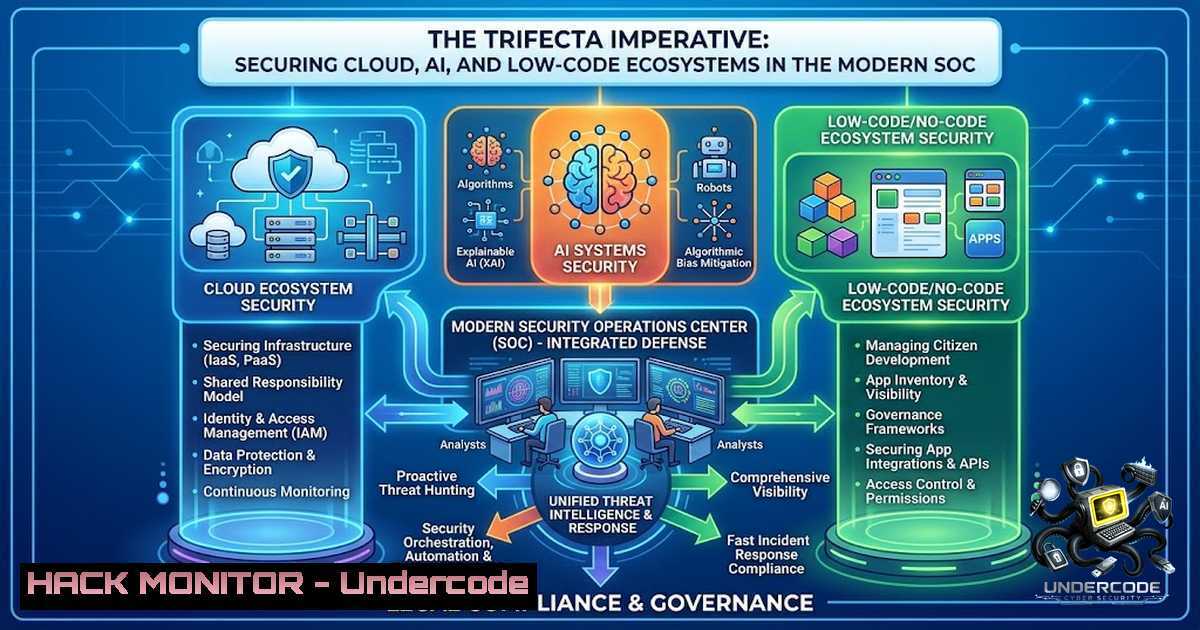
The modern Security Operations Center (SOC) is no longer a siloed fortress guarding static on-premises infrastructure. It has evolved into a dynamic, multi-faceted entity that must secure a sprawling attack surface encompassing hybrid cloud architectures, rapidly deployed Artificial Intelligence (AI) models, and democratized development platforms like Microsoft Power Apps. The integration of these technologies presents a critical paradox: they accelerate business agility but introduce complex, interwoven vulnerabilities that traditional security tools cannot adequately address. This article dissects the technical rigor required for the “Senior Cyber Security Engineer” of today—a professional who must not only architect secure cloud foundations but also embed security into the AI lifecycle and govern the explosive growth of citizen-developed applications.
Learning Objectives
- Understand the layered security controls required to harden cloud infrastructure against sophisticated identity-based and container-focused attacks.
- Master the principle of “Secure AI by Design,” including the mitigation of prompt injection, data leakage, and model poisoning in MLOps pipelines.
- Develop a governance framework for low-code/no-code platforms (specifically the Microsoft Power Platform) to prevent data exfiltration and privilege escalation.
- Acquire actionable command-line and API-driven techniques to audit, monitor, and harden these integrated environments.
You Should Know:
1. Hardening the Cloud-1ative Foundation: Beyond IAM Basics
In a cloud architecture, identity is the new perimeter. A Senior Cyber Security Engineer must assume that credentials will be compromised. The objective is to minimize the blast radius. This begins with a strict implementation of the Principle of Least Privilege (PoLP), but extends to proactive threat hunting and misconfiguration detection. For instance, open storage buckets, overly permissive service accounts, and misconfigured Kubernetes (K8s) RBAC remain the top vectors for data breaches.
Step-by-step guide for Azure/AWS IAM and K8s Hardening:
- Audit Service Principal Permissions: Regularly review and prune service principal permissions. Use Azure CLI to list all service principals with high privileges.
Azure CLI: List all service principals and filter for 'Contributor' or 'Owner' roles
az role assignment list --include-inherited --include-groups --output table | grep -E 'Contributor|Owner'
- Implement Conditional Access Policies: Move beyond static IP whitelisting. Use risk-based conditional access policies that evaluate sign-in risk, device compliance, and user location in real-time.
- Harden Kubernetes API Server: Ensure that the `–anonymous-auth` flag is set to `false` and `–authorization-mode` is set to `RBAC` and
Node. Restrict access to the Kubelet API.Check Kubelet configuration for anonymous access (Linux - Worker Node) ps -ef | grep kubelet | grep anonymous-auth
Remediation: Modify the kubelet config file (typically
/var/lib/kubelet/config.yaml) to setauthentication: anonymous: enabled: false. - Network Segmentation: Implement micro-segmentation using Network Policies in Kubernetes. By default, all pods can communicate. Lock this down to a default-deny policy.
Default Deny Network Policy for K8s apiVersion: networking.k8s.io/v1 kind: NetworkPolicy metadata: name: default-deny-all spec: podSelector: {} policyTypes:</li> </ol> - Ingress - Egress- Securing the AI/ML Pipeline: The OWASP Top 10 for LLMs
The deployment of AI models, particularly Large Language Models (LLMs), introduces a novel class of vulnerabilities. These include prompt injection (where an attacker manipulates the model output), insecure output handling, and data poisoning (corrupting the training data). The security engineer’s role is to integrate security gates into the MLOps pipeline, shifting security left from the deployment phase to the data preparation and model training phases.
Step-by-step guide for AI Pipeline Security and Prompt Hardening:
- Validate Training Data Sources: Ensure provenance and integrity of training data. Use cryptographic hashing to verify that datasets loaded for training are legitimate and tamper-free.
Generate SHA-256 checksum for a training dataset
sha256sum training_data_v1.csv
Compare this against a secure baseline stored in an immutable ledger or secure vault.
- Implement Input Sanitization/Filtering: Design a validation layer between the user and the AI model. This layer should strip or escape potentially malicious characters or patterns that could lead to prompt injection.
- Rate Limiting and Anomaly Detection: Deploy rate limiting on API endpoints that serve the AI model to prevent DoS attacks. Couple this with an Anomaly Detection System (ADS) that monitors input patterns for deviations—such as a sudden influx of requests with high-entropy characters.
- Secure the MLOps Environment: Ensure that the development environment (e.g., Jupyter Notebooks) is not exposed to the internet. Use environment variables for API keys, and never hardcode them in the notebook.
Python secure practice for API key retrieval import os API_KEY = os.environ.get('OPENAI_API_KEY') if not API_KEY: raise ValueError("API Key not found in environment variables") -
Governance and Security of the Power Platform (Low-Code/No-Code)
The Power Platform empowers business users to build applications and automations (RPA) with low-code tools. While this drives innovation, it also creates a shadow IT security nightmare. A “citizen developer” might inadvertently create a Power App that exposes sensitive customer data or a Power Automate flow that grants excessive permissions. The security engineer must implement Data Loss Prevention (DLP) policies and govern connectors.
Step-by-step guide for Power Platform Data Loss Prevention (DLP) and Environment Management:
- Connect to Power Platform Admin Center: Use PowerShell or the Admin Center web UI. PowerShell allows for scalable automation.
PowerShell: Install the Power Apps Admin Module
Install-Module -1ame Microsoft.PowerApps.Administration.PowerShell -Force
- Create DLP Policies: Define policies that classify connectors into Business, Non-Business, or Blocked. Block connectors that have known security risks (e.g., personal email connectors).
PowerShell: Create a DLP policy Add-AdminDlpPolicy -DisplayName "StandardCorporateDLP" -1onBusinessConnectors @("shared_msnweather", "shared_bing") - Audit Environments: Review all active environments. Ensure that Developer environments are not shared with Production data sources. Regularly audit the “Everyone” permissions for environment access.
- Monitor and Log: Enable audit logging for the Power Platform. This includes logging for app creation, flow modification, and user access. Integrate these logs into the SIEM for correlation with other security events.
PowerShell: Get audit logs for Power Platform
Get-AdminPowerAppsAuditLog -StartDate (Get-Date).AddDays(-7) -EndDate (Get-Date)
4. API Security and Supply Chain Integrity
APIs are the glue connecting these pillars. They are the primary attack vector for data exfiltration. Securing them involves authentication (OAuth2, OIDC), authorization (scope-based), and input validation. Furthermore, supply chain security ensures that the open-source packages used in AI and microservices are free from known vulnerabilities (CVEs).
Step-by-step guide for API Gateway Configuration and Software Composition Analysis (SCA):
- Implement API Gateway Rate Limiting: Configure your API Gateway (e.g., AWS API Gateway, Azure API Management) to implement burst and rate limits to prevent abuse.
- Enforce API Authentication: Reject requests that lack valid OAuth2 tokens. Validate the JWT signature and claims using the public key from the issuer.
- Conduct SCA Scans: Integrate a SCA tool (e.g., Snyk, Trivy, OWASP Dependency-Check) into the CI/CD pipeline.
Linux: Run Trivy to scan file system for vulnerabilities (e.g., Docker, Python packages)
trivy fs --severity HIGH,CRITICAL --scanners vuln,secret /path/to/your/project
- Vulnerability Mitigation: Upon discovery, update vulnerable dependencies to patched versions. If no patch exists, evaluate the risk and consider implementing a Web Application Firewall (WAF) rule to block exploit attempts until a fix is developed.
What Undercode Say:
- The demand for a single “Senior Cyber Security Engineer” who can bridge Cloud, AI, and Low-Code is a testament to the convergence of these technologies in the enterprise. It signals that organizations are treating security as a non-1egotiable feature of innovation, not a roadblock.
- The inclusion of “Power platforms” in the original callout is particularly telling. It indicates that enterprises are no longer asking “if” low-code is a threat, but “how” to manage it. The role is less about policing it and more about enabling secure development through DLP and governance.
Analysis of the Hiring Trend:
The specific combination of skills requested—Cloud, AI, and Power Platforms—points towards a future where the security architect is fundamentally a risk enabler. They are not just a firewall engineer; they are a bridge between the DevOps, Data Science, and Business teams. This role requires a “builder” mindset to embed security seamlessly into the fabric of the development lifecycle (DevSecOps), ensuring that the speed of business is not compromised by security bottlenecks. The call for “ASAP” hiring suggests a high-pressure environment, likely a major digital transformation project, where security is now a critical path item. The ideal candidate is an SRE who understands K8s orchestration, an AI ethicist who understands data poisoning, and a compliance officer who understands DLP, all rolled into one.
Prediction:
- +1 Over the next 2-3 years, we will see the rise of the “AI Security Engineer” as a distinct role, moving away from the “Cloud + AI” generalist due to the hyper-specialization required for adversarial ML resilience.
- -1 Organizations that fail to integrate governance into their Power Platform expansion will face a significant data breach incident within the next 18 months, as the gap between security’s understanding of the platform and the citizen developer’s usage widens.
- +1 The adoption of “Policy as Code” (OPA, Rego) will become the standard for enforcing cross-platform security controls (Cloud, Kubernetes, and API Gateways), enabling engineers to secure heterogeneous environments with a single, declarative governance framework.
- -1 Traditional SIEM solutions will struggle to correlate logs from these three distinct data streams (Cloud, AI, Low-Code), leading to a short-term increase in “alert fatigue” before AI-driven SOAR tools catch up to provide automated correlation and response.
▶️ Related Video (82% Match):
🎯Let’s Practice For Free:
🎓 Live Courses & Certifications:
Join Undercode Academy for Verified Certifications
🚀 Request a Custom Project:
Secure, high-velocity infrastructure and disruptive technological engineering. Contact our engineering team for high-tier development and proprietary systems:
[email protected]
💎 Smart Architecture | 🛡️ Secure by Design | ⭐ Trusted by ThousandsIT/Security Reporter URL:
Reported By: Raveendraseetharam Looking – Hackers Feeds
Extra Hub: Undercode MoN
Basic Verification: Pass ✅🔐JOIN OUR CYBER WORLD [ CVE News • HackMonitor • UndercodeNews ]
📢 Follow UndercodeTesting & Stay Tuned:


