
Listen to this Post
Introduction:
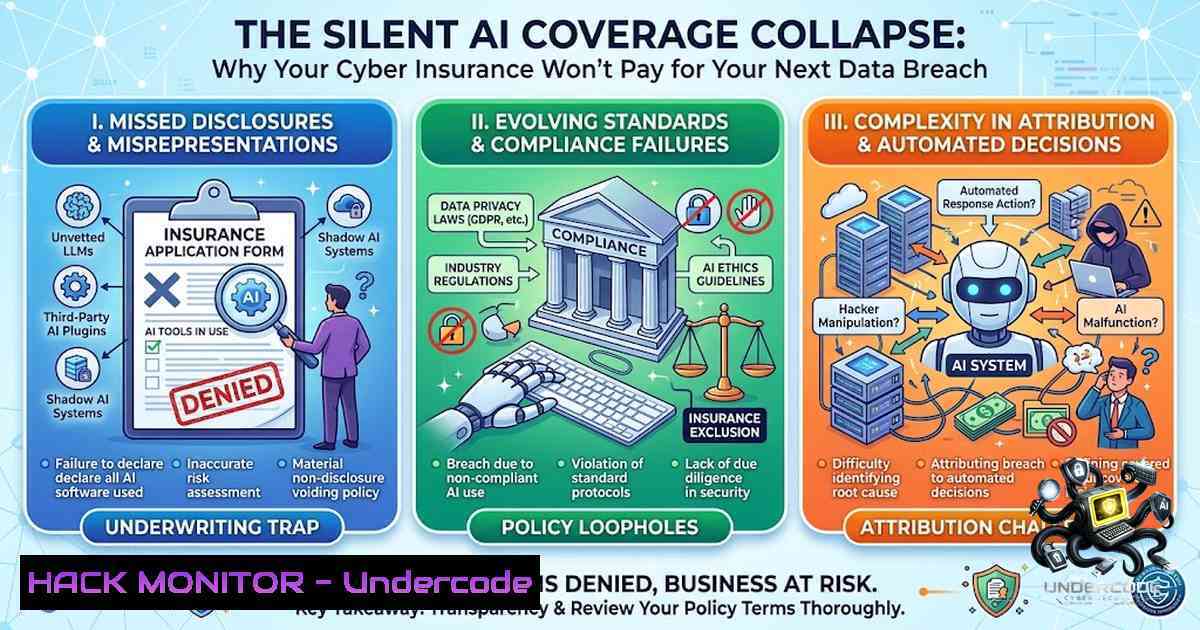
The insurance industry has officially ended the era of “silent AI” coverage. Effective January 1, 2026, the Insurance Services Office (ISO) introduced three generative AI exclusion endorsements—CG 40 47, CG 40 48, and CG 35 08—that allow carriers to exclude AI-related claims from commercial general liability policies. With 42% of companies now carrying AI-related exclusions in their cyber policies and major carriers like Berkley, Chubb, and Travelers securing approval to strip AI-related damages from corporate policies entirely, organizations that assume their data is insured against AI-enabled theft or exposure are operating under a dangerous illusion. If your business data appears in a public AI search or is exfiltrated through an AI-powered attack, your cyber, general liability, and D&O policies may offer zero protection.
Learning Objectives:
- Understand the specific ISO exclusion endorsements (CG 40 47, CG 40 48, CG 35 08) and how they redefine coverage for AI-related data breaches.
- Identify the coverage gaps across Cyber, D&O, E&O, and EPLI policies created by the fragmentation of AI risk allocation.
- Implement technical controls—including AI inventory documentation, red-teaming, and data provenance audits—required by insurers for continued coverage.
- Apply Linux and Windows security commands to harden AI infrastructure and demonstrate compliance with NIST AI RMF and ISO/IEC 42001 standards.
- Develop a renewal-ready evidence package that maps organizational AI governance to insurer underwriting requirements.
You Should Know:
- ISO Exclusion Endorsements: The Technical Fine Print That Kills Coverage
The ISO’s January 2026 filing introduced three endorsements that fundamentally alter the liability landscape:
- CG 40 47 (Broad Exclusion): Excludes bodily injury, property damage, and personal/advertising injury arising out of or attributable to generative AI. The trigger language—”arising out of”—is broad enough to reach embedded AI in everyday SaaS applications, not just custom-trained models.
- CG 40 48 (Limited Exclusion): A narrower version that may preserve some coverage but still carves out significant AI-related exposures.
- CG 35 08 (Products/Completed Operations): Targets AI-related claims stemming from products or services after they have been completed or sold.
These endorsements are not optional add-ons; they are attachable at every CGL renewal. For security practitioners, this means that a data breach caused by an AI-powered vulnerability—whether through prompt injection, model poisoning, or training data leakage—may fall entirely outside policy coverage.
Step-by-Step Guide: Auditing Your Policy for AI Exclusions
- Locate your current CGL, Cyber, and D&O policy documents. Request the full policy wording, including all endorsements and riders.
- Search for the following form numbers: CG 40 47, CG 40 48, CG 35 08. If present, determine which version applies.
- Examine the “Definitions” section. Look for definitions of “Artificial Intelligence,” “Generative AI,” or “Machine Learning.” If these terms are absent, the exclusion may still apply through broad “arising out of” language.
- Review “Exclusions” for any mention of AI, algorithms, or automated decision-making. Pay particular attention to “absolute AI exclusions” that bar coverage for “any actual or alleged use, deployment, or development of AI”.
- Check for sublimits. Some carriers, including Beazley and QBE, are introducing AI sublimits near 10% of the policy limit. A $10 million policy may only provide $1 million for AI-related claims.
- Document all AI tools and models in use. Create an inventory that includes model names, versions, deployment dates, and data sources. Insurers now require this before a claim, not after.
-
Agentic AI and the Breach-Trigger Problem: When There Is No Attacker
The most dangerous coverage gap involves agentic AI—systems that act with limited or no human intervention. Traditional cyber policies hinge on a “breach trigger”: unauthorized access, data compromise, or ransomware事件. But what happens when an AI agent deletes records, alters a database, or authorizes a payment without any external attacker?
Researchers at NYU Tandon describe this as a sliding scale:
- Level 1: AI drafts text or recommendations (human reviews and approves).
- Level 2: AI automates routine tasks with human oversight.
- Level 3: AI executes changes autonomously with limited human intervention.
- Level 4: AI operates fully independently, modifying systems and making decisions without human input.
The more independently an AI executes, the less likely a breach-triggered policy is to respond. If an autonomous system exposes proprietary data to a public AI model through an API misconfiguration, there is no “unauthorized access” by a threat actor—only an internal system failure. Insurers are increasingly treating this as an uninsurable operational risk.
Step-by-Step Guide: Hardening AI Infrastructure Against Autonomous Data Exposure
Linux Commands for AI API Security:
 Audit all outbound API calls from AI services
sudo tcpdump -i any -1 'host api.openai.com or host api.anthropic.com or host api.cohere.ai'

Monitor for sensitive data in logs (PCI, PII, PHI patterns)
sudo grep -E -r "\b([0-9]{4}-[0-9]{4}-[0-9]{4}-[0-9]{4})\b" /var/log/ai/  Credit card patterns
sudo grep -E -r "\b[A-Za-z0-9._%+-]+@[A-Za-z0-9.-]+.[A-Z|a-z]{2,}\b" /var/log/ai/  Email addresses

Implement eBPF-based monitoring for unauthorized data egress
sudo bpftrace -e 'kprobe:__sys_sendto { printf("Sending data from PID %d\n", pid); }'

Restrict AI model access to production databases using iptables
sudo iptables -A OUTPUT -d 10.0.0.0/8 -m owner --uid-owner ai-service -j DROP
sudo iptables -A OUTPUT -d 172.16.0.0/12 -m owner --uid-owner ai-service -j DROP
Windows PowerShell Commands for AI Security:
 Audit AI service accounts and permissions
Get-ADUser -Filter {Enabled -eq $true} | Where-Object {$_.SamAccountName -match "ai|ml|bot"} | Select-Object Name, SamAccountName, Enabled

Monitor Azure OpenAI API usage and data transfer
Get-AzActivityLog -ResourceGroup "AI-Production" -StartTime (Get-Date).AddDays(-30) | Where-Object {$_.OperationName -match "openai"}

Implement Windows Defender Application Control for AI binaries
Set-CIPolicy -FilePath "C:\Policies\AI-Whitelist.xml" -RuleFilePath "C:\Policies\AI-Rules.xml"

Restrict PowerShell execution for AI automation scripts
Set-ExecutionPolicy -ExecutionPolicy Restricted -Scope Machine -Force
- Data Provenance and Model Poisoning: The Uninsured Attack Vector
AI-specific attack vectors—data poisoning, prompt injection, and model inversion—are explicitly excluded or poorly covered under most current policies. If an attacker poisons your training data, causing your AI model to leak sensitive customer information, the resulting breach may not be covered because the loss originated from AI operations rather than a traditional network intrusion.
The Hasbro Q1 2026 incident, now sitting on every AI underwriting file, involved approximately $20 million in remediation costs plus $40-60 million in delayed revenue—all stemming from an AI-generated output that violated regulatory compliance. Similarly, the Bartz v. Anthropic case (~$1.5 billion) centers on data provenance and copyright infringement in AI training.
Step-by-Step Guide: Implementing Data Provenance Controls
- Classify all training data by sensitivity level. Use automated tools to scan datasets for PII, PCI, PHI, and trade secrets.
 Linux: Scan CSV/JSON datasets for sensitive patterns
for file in /data/training/.csv; do
echo "Scanning $file"
grep -E -c "\b[0-9]{3}-[0-9]{2}-[0-9]{4}\b" "$file"  SSN pattern
done
- Implement data lineage tracking. Use tools like Apache Atlas or Amundsen to map data flow from source systems to AI models.
-
Deploy model monitoring for drift and poisoning detection.
 Python: Monitor model input distribution for anomalies
import numpy as np
from scipy.stats import ks_2samp

def detect_data_drift(reference_data, current_data, threshold=0.05):
statistic, p_value = ks_2samp(reference_data, current_data)
if p_value < threshold:
print(f"ALERT: Data drift detected (p={p_value})")
return True
return False
- Document all data sources, transformation steps, and model versions. Insurers require this evidence before extending coverage.
-
The Defensive AI Discount: How to Turn AI into an Insurance Asset
Not all AI is treated equally. Some 86% of organizations report premium discounts for AI-based security tools, and firms pairing AI-powered threat detection with phishing-resistant MFA and EDR are seeing premium cuts of 20% to 50%. The market is effectively pricing two different things under one label: a governed defensive asset that earns a discount, or an unmanaged liability that earns an exclusion.
Step-by-Step Guide: Building an Insurable AI Security Posture
- Deploy AI-powered threat detection. Implement tools that use machine learning for anomaly detection, user behavior analytics, and automated incident response.
- Implement phishing-resistant MFA. Use FIDO2 security keys or certificate-based authentication for all administrative access.
- Deploy EDR/XDR across all endpoints. Ensure telemetry feeds into a SIEM for correlation and AI-driven analysis.
- Document all security controls. Create a comprehensive map showing how AI is used defensively, including specific tools, configurations, and incident response procedures.
- Conduct adversarial testing (red-teaming). Insurers in 2026 require proof of red-teaming and documented risk assessments before extending AI coverage.
Linux Command for EDR Configuration Verification:
 Check if CrowdStrike Falcon or SentinelOne is running
ps aux | grep -E "falcon|sentinelone"

Verify auditd is configured for AI service monitoring
sudo auditctl -l | grep -E "ai|ml|tensorflow|pytorch"

Test SIEM log forwarding
logger -p local0.info "AI Security Test Event - $(date)"
Windows Command for Security Control Verification:
 Check Windows Defender ATP status
Get-MpComputerStatus | Select-Object AntivirusEnabled, RealTimeProtectionEnabled

Verify Azure Sentinel data connector status
Get-AzSentinelDataConnector -ResourceGroupName "Security" -WorkspaceName "Sentinel"

Test syslog forwarding to SIEM
Write-EventLog -LogName "Application" -Source "AISecurity" -EventId 1001 -Message "AI Security Test Event"
- The Six Controls Insurers Now Require for AI Coverage
Based on interviews with six major insurance carriers, underwriters now cluster on six controls that determine whether AI coverage is granted or excluded:
| Control | Description | Technical Implementation |
||-|–|
| Human Kill Switch | Documented process to immediately halt AI operations | Implement API gateway circuit breakers; configure timeout policies |
| Human-in-the-Loop Inventory | Mapping of all AI systems requiring human review | Maintain CMDB with AI service dependencies |
| Data Provenance Audit | Classification and lineage of all training data | Use Apache Atlas, Amundsen, or similar |
| Named Accountable AI Executive | Designated executive responsible for AI governance | Document in corporate governance policies |
| Deepfake-Resistant Authentication | Out-of-band authentication for sensitive actions | Implement FIDO2, biometrics, or hardware tokens |
| Enforcement Evidence | Proof that security controls are actively enforced | SIEM logs, audit trails, compliance reports |
Step-by-Step Guide: Generating Insurer-Ready Evidence
- Create an AI inventory spreadsheet listing every AI model, tool, and service in use, including vendor, version, deployment date, data sources, and human oversight level.
- Document the human kill switch procedure. Include specific steps, responsible parties, and testing schedules.
- Conduct a data provenance audit. Map all training data to its original source, classification level, and consent/usage rights.
- Designate a named AI executive. Update corporate governance documents to assign accountability.
- Implement and test deepfake-resistant authentication. Use FIDO2 security keys for all privileged access.
- Collect enforcement evidence. Export SIEM logs, audit trails, and compliance reports covering the last 12 months.
What Undercode Say:
- Key Takeaway 1: The era of “silent AI” coverage ended on January 1, 2026. ISO endorsements CG 40 47, CG 40 48, and CG 35 08 allow carriers to exclude AI-related claims from CGL policies, and 42% of companies now have AI-related exclusions in their cyber policies. Organizations that haven’t reviewed their renewals are operating with a false sense of security.
-
Key Takeaway 2: Agentic AI creates a fundamental coverage gap because traditional cyber policies require a breach trigger—unauthorized access or data compromise. When an autonomous system exposes data or authorizes errant transactions without external involvement, there is no breach to trigger the policy. The more independently an AI operates, the less likely insurance will respond.
Analysis:
The insurance industry’s move to exclude AI-related claims mirrors the “silent cyber” crisis of the last decade, when insurers discovered they were covering enormous cyber-related losses under policies never designed for ransomware or nation-state attacks. Today, the same pattern is repeating with AI, but at an accelerated pace because the playbook already exists. The result is a fragmentation of coverage across Cyber, Tech E&O, D&O, and EPLI lines, creating “gap risk” where no single policy provides comprehensive protection.
For security practitioners, this means shifting from a compliance mindset to an evidence-based governance framework. Insurers are no longer accepting self-attestations; they require documented controls, adversarial testing results, and real-time enforcement evidence. The six controls identified by underwriters—human kill switch, human-in-the-loop inventory, data provenance, named AI executive, deepfake-resistant authentication, and enforcement evidence—are not software purchases but evidence organizations must produce.
The market is also bifurcating: defensive AI that strengthens security posture earns premium discounts of 20% to 50%, while unmanaged AI liabilities earn outright exclusions. Organizations that proactively document their AI governance, implement technical controls, and demonstrate compliance with NIST AI RMF and ISO/IEC 42001 will secure coverage; those that don’t will find themselves self-insuring against AI-related data breaches.
Prediction:
- +1 The affirmative AI-coverage market—including Munich Re/Mosaic aiSure, Armilla at Lloyd’s, and Counterpart—will mature rapidly, offering standalone policies for organizations that can demonstrate robust governance. This will create a competitive market for AI-specific insurance products.
-
-1 Small and medium businesses without dedicated security teams will be disproportionately affected, as they lack the resources to document the six controls insurers now require. Many will discover their coverage gaps only at the moment of claim.
-
-1 The rise of agentic AI will trigger a wave of denied claims in 2026-2027, as organizations discover that autonomous system failures are not covered under traditional breach-triggered policies. This will lead to significant financial losses and potential litigation against insurers.
-
+1 Enterprises that invest in AI red-teaming, data provenance tools, and automated governance frameworks will gain a competitive advantage, securing both insurance coverage and customer trust. The premium discounts for defensive AI will incentivize broader adoption of AI-powered security tools.
-
-1 Regulatory scrutiny will intensify as uncovered AI breaches expose gaps in data protection frameworks. The EU AI Act and similar regulations may impose direct liability on organizations, further compounding the insurance gap.
▶️ Related Video (76% Match):
https://www.youtube.com/watch?v=0YW63QKwIKA
🎯Let’s Practice For Free:
🎓 Live Courses & Certifications:
Join Undercode Academy for Verified Certifications
🚀 Request a Custom Project:
Secure, high-velocity infrastructure and disruptive technological engineering. Contact our engineering team for high-tier development and proprietary systems:
[email protected]
💎 Smart Architecture | 🛡️ Secure by Design | ⭐ Trusted by Thousands
IT/Security Reporter URL:
Reported By: Christopher Haydon – Hackers Feeds
Extra Hub: Undercode MoN
Basic Verification: Pass ✅


