Listen to this Post
Introduction:
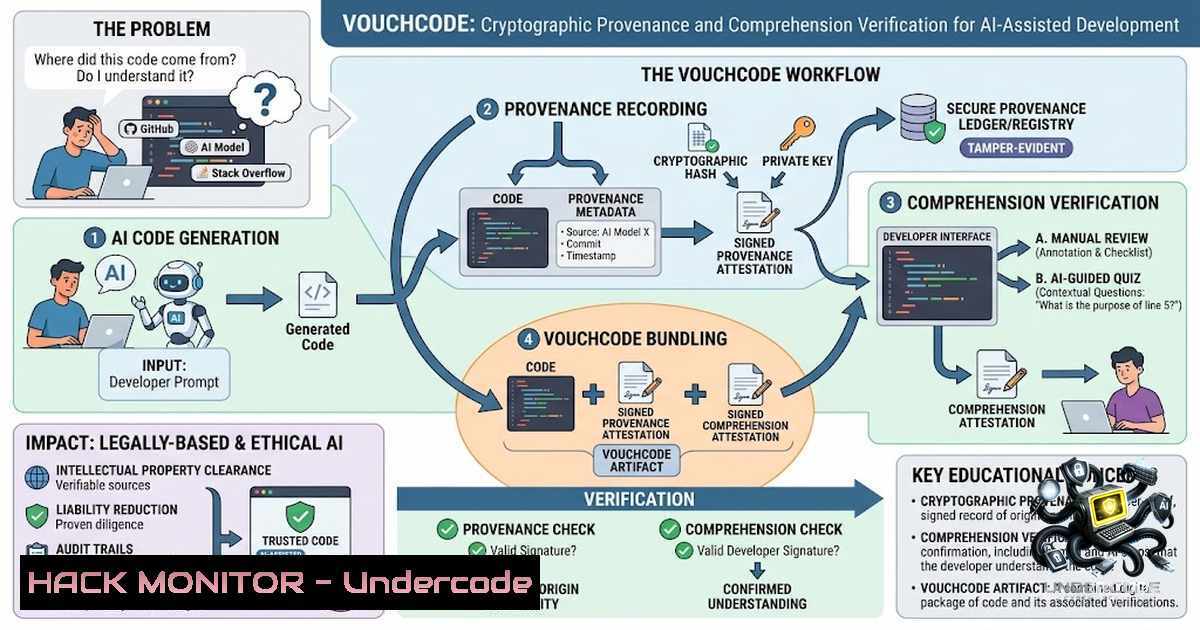
The proliferation of AI-generated code has created an accountability crisis that existing provenance tools fail to address. While every attribution tool answers who wrote a line of code, none answer whether the person committing it actually understands what it does. Vouchcode, a local-first CLI tool built by Sudais Khalid for the AI Builders Hackathon 2026, fills this critical gap by tracking AI versus human authorship at the commit level through AST diffing and requiring developers to demonstrate comprehension before code is sealed into a cryptographically signed, tamper-evident ledger. With Merriam-Webster naming “AI slop” as 2025’s word of the year and curl shutting down its bug bounty program over AI-generated submissions, the timing for such verification infrastructure has never been more urgent.
Learning Objectives & Secrets:
- Objective 1: Implement Cryptographic Code Provenance – Learn to deploy a hash-chained, Ed25519-signed ledger that makes tampering mathematically detectable, not merely inconvenient. Every commit’s attribution and comprehension outcome is sealed into an immutable chain where a tampered entry’s damage propagates forward, ensuring integrity.
-
Objective 2: Master AST-Based Diffing for Accurate Attribution – Unlike line-based diffing that mistakes renamed functions for rewritten ones, Vouchcode segments diffs by abstract syntax tree. A function renamed and internally edited forces the segmentation logic to correctly separate the two effects rather than collapsing them into one signal.
-
Objective 3: Secret Tip – Build Adversarial Test Suites – The tool’s robustness comes from hard adversarial exit criteria, not happy-path tests. The development team tested keyword-stuffed fake answers against the comprehension scorer to prove it discriminates on reasoning rather than vocabulary overlap. They also proved a forged, re-signed ledger passes internal verification cleanly—demonstrating that only an independently published key fingerprint catches the forgery.
You Should Know:
1. Installation and Initialization: The Complete Setup Guide
Vouchcode runs entirely on the developer’s machine with zero external AI or LLM API calls. Here’s the complete installation workflow:
Prerequisites:
python --version  Requires Python 3.10 or newer
git --version  Git must be installed
Installation:
git clone https://github.com/sudais-khalid/vouchcode.git
cd vouchcode
pip install -e ".[bash]"
vouchcode about  Confirm installation - should show version 0.1.0
Repository Initialization:
cd /path/to/your-repository
vouchcode init
This installs three Git hooks (pre-commit, post-commit, post-merge), creates the `.vouchcode/` ledger, and generates a local Ed25519 signing key. Add `.vouchcode/` to your `.gitignore` to keep the ledger out of version control.
2. The Commit Workflow: How Comprehension Verification Works
When you commit code containing AI-generated content, Vouchcode intercepts the commit and prompts you to demonstrate understanding:
git add .
git commit -m "Add record normalizer"
The tool displays the AI-attributed code and asks targeted comprehension questions derived from the actual control flow:
+- records.py: normalize_records -+
| def normalize_records(records, strict): |
| if records is None: |
| raise ValueError("records required") |
| for key, value in records.items(): |
| if value is None and strict: |
| return None |
+-- attributed ai via tool_signal, confidence 1.00 -+
question 1 of 3: When records is None, what does this code do and why?
answer: raises ValueError because it cannot work without records
correct, score 0.94: answer relates the condition to the outcome the code produces
Answer poorly and the commit is refused. Use `git commit –1o-verify` to bypass, but the commit is recorded as explicitly unverified rather than blocked. Commits made without a terminal are recorded as skipped and never as passed.
3. Ledger Verification and Cryptographic Integrity
The ledger is a hash-chained, signed record of every commit’s attribution and comprehension outcome. Verify its integrity with:
vouchcode verify  Rechecks every hash and signature, reporting per entry
vouchcode log --limit 3  View recent ledger entries
vouchcode log --json  Machine-readable output for automation
The signing key fingerprint must be published independently of the repository it authenticates:
vouchcode key Print the signing key fingerprint for out-of-band publishing
Critical Security Note: A fingerprint a verifier only ever sees inside the report it is meant to authenticate proves nothing—a forged report carries a forged key and a fingerprint matching it perfectly. Always obtain the fingerprint through an independent channel.
4. Report Generation and Offline Verification
Generate portable, signed reports that anyone can verify without installing Vouchcode:
vouchcode report -o out
 Produces: out/vouchcode-report.json and out/vouchcode-report.pdf
The JSON is machine-readable and signed with Ed25519. Verify a report using only a standard Ed25519 implementation:
vouchcode verify-report reports/vouchcode-self-report.json \
--expect-fingerprint "7D7C BBC8 6885 009B B043 59D0 F26E E03E"
The comparison is the point—a report can be verified offline with no account and no installation.
5. CI/CD Integration: Gating Pull Requests
Run the gate locally before touching CI:
vouchcode gate --base-ref main
Exit code 1 means AI-attributed code in the range has no passing comprehension record. Exit code 0 means it does, or there was nothing to gate. Copy `.github/workflows/vouchcode-gate.yml` from the repository to run it on every pull request. The gate fails a build if AI-attributed code lacks a passing comprehension record.
6. The Honest Badge: Self-Reporting Without Spin
Vouchcode generates a README badge by running `vouchcode badge` against the repository’s own ledger. The badge shows the AI-attributed share of changed logic and the comprehension pass rate. Crucially, it says “comprehension not evaluated” when nothing was evaluated rather than implying otherwise, and carries its generation date in the SVG title attribute so a stale badge can be dated. This honesty extends to Vouchcode’s own development history—running the tool on its 61-commit history returned 43.4 percent AI-attributed, reported at a mean confidence of 0.245, explicitly flagged as a probable undercount because the stylometric baseline is drawn from the very code it’s scoring against.
What Undercode Say:
- Key Takeaway 1: Attribution Is Not Accountability – Every AI-provenance tool available today answers who wrote the code, but none answer whether the person committing it understands it. A developer can accept generated code, never read it, commit it under their own name, and pass every attribution check in existence. Vouchcode introduces verifiable comprehension as the missing second condition.
-
Key Takeaway 2: Build for the Adversary, Not the Happy Path – The tool’s robustness comes from testing against hard adversarial exit criteria. The hardest bug wasn’t a feature gap but a hash-chain implementation that compared each entry against its stored predecessor hash instead of its recomputed one—a tampered entry’s damage stayed confined to itself instead of propagating, which would have made the entire tamper-evidence claim silently false. Only rigorous adversarial testing surfaced this vulnerability.
The accountability gap in AI-assisted development isn’t about detection—it’s about verification. A peer-reviewed study of over a thousand developer discussions on AI-generated code concluded that tool builders should shift focus from generation to verification, specifically through uncertainty indicators and provenance information. Vouchcode built toward that conclusion without having read the research first, validating the market need through independent discovery.
The tool’s architecture—six layers of Capture (Git hooks plus direct tool signals), Segment (AST-based diffing), Verify (comprehension engine), Seal (cryptographic ledger), Report (signed JSON and PDF), and Integrate (CI gate and badge)—represents a comprehensive approach to a problem that has been largely ignored. Multi-language support beyond Python via tree-sitter is planned for future releases.
Prediction:
- +1 Vouchcode’s approach will become the industry standard for AI code governance within 18-24 months, as enterprises face increasing liability from unverified AI-generated code in production systems.
-
+1 The distinction between “who wrote it” and “who understands it” will drive a new category of developer tooling, with major platforms (GitHub, GitLab) integrating comprehension verification natively.
-
-1 Organizations that fail to implement comprehension verification will face increased security incidents from AI-generated code that developers blindly commit, as the volume of AI-generated contributions continues to outpace human review capacity.
-
-1 The backlash against AI slop will intensify, with maintainers of critical open-source projects implementing Vouchcode-like gates as mandatory requirements for contributions, potentially slowing contribution velocity before automation catches up.
-
+1 The cryptographic ledger approach provides a defensible audit trail for regulatory compliance, positioning Vouchcode as essential infrastructure for organizations subject to AI governance frameworks expected to emerge by 2027.
▶️ Related Video (90% Match):
https://www.youtube.com/watch?v=2xclN7aZ3Cg
🎯Let’s Practice For Free:
🎓 Live Courses & Certifications:
Join Undercode Academy for Verified Certifications
🚀 Request a Custom Project:
Secure, high-velocity infrastructure and disruptive technological engineering. Contact our engineering team for high-tier development and proprietary systems:
[email protected]
💎 Smart Architecture | 🛡️ Secure by Design | ⭐ Trusted by Thousands
IT/Security Reporter URL:
Reported By: https://lnkd.in/p/ewuVye7P – Hackers Feeds
Extra Hub: Undercode MoN
Basic Verification: Pass ✅


