Listen to this Post
Introduction:
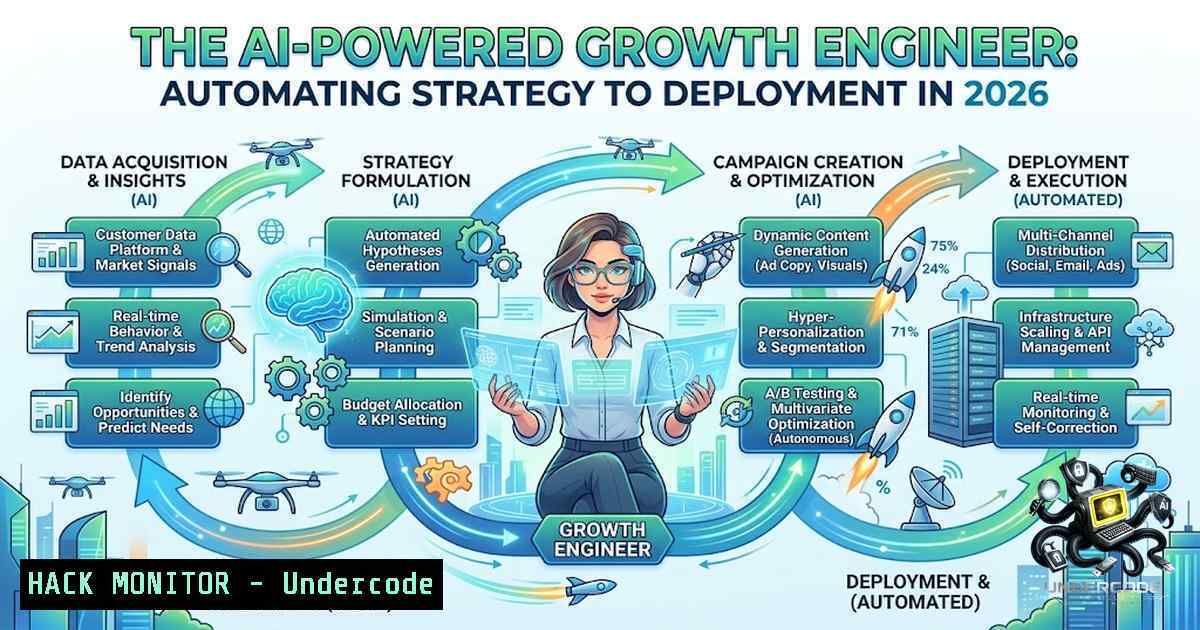
The “growth hacker” archetype—a mythical solo operator capable of single-handedly driving exponential business growth through code and cunning—was largely dismissed as a fantasy by the growth community. The consensus was that sustainable growth is a team sport, requiring diverse skills in strategy, design, and data analysis. However, the landscape has been fundamentally altered by the advent of sophisticated AI tools. In 2026, a new role is emerging, the Growth Engineer, which leverages AI to bridge the gap between strategy and execution, effectively allowing a single individual to automate the entire growth lifecycle, from ideation to deployment and analysis.
Learning Objectives & Secrets:
- Objective 1: Master the End-to-End AI Automation Pipeline. Learn how to integrate AI tools to handle coding, design, and deployment, effectively reducing the need for a full team and enabling rapid iteration.
- Objective 2 (Secret Tip): Implement Serverless and API-First Architectures. Speed is critical. Secret to success is building with serverless functions and microservices that can be deployed instantly, allowing you to test hypotheses without infrastructure bottlenecks. Use AWS Lambda or Google Cloud Functions to run code in response to events, paying only for compute time.
- Objective 3 (Secret Tip): Automate Data Analysis and A/B Testing. Instead of manual analysis, embed AI agents to analyze user behavior and automatically adjust test parameters. Tools like VWO or Optimizely can be enhanced with custom scripts to automate test conclusion and deployment of winning variations.
You Should Know:
1. Setting Up the AI-Powered Development Environment
A Growth Engineer needs a workspace that bridges code, data, and deployment. The foundation is a modern IDE (like VS Code) integrated with AI coding assistants (like GitHub Copilot or Cursor) and a robust version control system (Git).
Step‑by‑step guide:
- Install Git and Node.js: On Linux (Ubuntu/Debian), run
sudo apt update && sudo apt install git nodejs npm. On Windows, download and run the installers from the official websites. - Set up a React/Next.js Boilerplate: Run `npx create-1ext-app@latest growth-engine-app` to set up a project. This provides a foundation for a fast, server-rendered user interface.
- Integrate an AI Assistant: Install the GitHub Copilot extension in VS Code. Authenticate with your GitHub account and enable it. This AI will generate code snippets, functions, and even entire components based on natural language prompts, drastically cutting development time.
- Configure Pre-commit Hooks: Install `husky` and `lint-staged` to ensure code quality before deployment. Run `npm install husky –save-dev` and
npx husky install. This automates linting and formatting, preventing common errors from reaching production.
2. Building and Securing the API Gateway
The Growth Engineer needs to connect frontend experiments with backend data and AI models. This often requires creating a secure API gateway. Securing this endpoint is critical to prevent data breaches and unauthorized access.
Step‑by‑step guide:
- Create a Cloud Function: Use Google Cloud Platform (GCP). Install the gcloud CLI. After authentication, run `gcloud functions deploy growth-api –runtime nodejs18 –trigger-http –allow-unauthenticated` (for initial testing).
- Implement API Key Authentication: Never rely solely on unauthenticated endpoints. In your cloud function, check for an API key in the request headers.
// Node.js example for a cloud function exports.growthApi = (req, res) => { const apiKey = req.headers['x-api-key']; if (apiKey !== process.env.GROWTH_API_KEY) { res.status(403).send('Forbidden'); return; } // Process the request res.status(200).send('Success'); }; - Use Environment Variables: Set `GROWTH_API_KEY` as a secret environment variable in your cloud provider. On Linux, you can test locally with
export GROWTH_API_KEY="your-secure-key". - Rate Limiting (Linux/Cloud): Use a middleware like `express-rate-limit` on an Express server or use Cloud Armor on GCP to prevent brute-force attacks and abuse of your growth experimentation endpoints.
3. Automating Deployment with CI/CD Pipelines
A key advantage of the Growth Engineer is speed. To fully leverage this, continuous deployment is non-1egotiable.
Step‑by‑step guide:
- Create a GitHub Repository: Push your code to a new repository. This will act as the source of truth for your application.
- Set up GitHub Actions: Create a `.github/workflows/deploy.yml` file. This workflow will automatically build and deploy your app when you push to the `main` branch.
name: Deploy Growth App on: push: branches: [ main ] jobs: build-and-deploy: runs-on: ubuntu-latest steps:</li> <li>uses: actions/checkout@v3</li> <li>name: Use Node.js uses: actions/setup-1ode@v3 with: node-version: '18'</li> <li>run: npm install</li> <li>run: npm run build</li> <li>name: Deploy to Vercel uses: amondnet/vercel-action@v20 with: vercel-token: ${{ secrets.VERCEL_TOKEN }} vercel-org-id: ${{ secrets.ORG_ID}} vercel-project-id: ${{ secrets.PROJECT_ID}} - Linux/Windows Commands for Monitoring: On a Linux server, you can test the health of the deployment using
curl -I https://your-growth-app.com`. On Windows (PowerShell), useTest-1etConnection your-growth-app.com -Port 443`. This verifies the service is live and secure (using HTTPS).
4. Hardening Cloud Infrastructure for Experimentation
Experiments often involve tracking user data, making cloud security paramount.
Step‑by‑step guide:
- Implement IAM Roles: On AWS, create a dedicated IAM role for your Growth Engineer service with the “Principle of Least Privilege.” Ensure it only has access to necessary S3 buckets and DynamoDB tables. Never use root account keys.
- Manage Secrets with Vault/HashiCorp: For local development, store secrets in a `.env` file (ensure it’s in
.gitignore). For production, use a secrets manager. On Linux, you can use `pass` (the standard unix password manager) as a lightweight alternative:pass insert growth/api-key. - Network Security: Configure Cloudflare or AWS WAF in front of your application. Create a rule to block requests from geolocations where you don’t operate to reduce the attack surface. This is done via the cloud provider’s dashboard or by using `aws wafv2 create-web-acl` commands.
5. AI-Driven Strategy Execution: The Engineering Feedback Loop
The “Growth Engineer” role is defined by using AI to learn and react. This involves coding an internal feedback loop where user data is processed by an AI model that suggests next actions.
Step‑by‑step guide:
- Collect User Events: Send user interactions (clicks, time on page) to your secure API gateway.
- Process with a Cloud AI Service: Use a cloud service like AWS Comprehend or Google Natural Language API to analyze sentiment from user feedback or support tickets.
- Automate Hypotheses: Write a script (Python or Node.js) that takes the output of this analysis and generates a new experiment configuration (e.g., “Users in segment X are complaining about feature Y, so we should display a tutorial”). This script can then automatically push a new configuration to a feature flag service like LaunchDarkly.
- Command for Windows/Linux: If you’re using local AI models, set up a GPU instance. On Ubuntu, install the NVIDIA drivers with
sudo ubuntu-drivers autoinstall && sudo reboot. Then, set up a simple Flask API to host your model. On Windows, use WSL2 to emulate a similar environment.
What Undercode Say:
- Key Takeaway 1: The “Growth Engineer” is a validation of the original growth hacker vision, but enabled by a new generation of AI and serverless tools that automate the executional complexity of the past.
- Key Takeaway 2: While the role empowers an individual, it introduces a new layer of risk centered around AI dependencies, API security, and the potential for automated mistakes to cascade rapidly.
Analysis: Andrew Capland’s insights pinpoint a crucial evolution in the growth sector. The failure of the growth hacker was not a failure of strategy, but a failure of tooling to match ambition. Today, AI serves as the “great equalizer,” allowing a skilled individual to overcome the execution bottleneck. This shift is significant for the cybersecurity community because it creates a new, highly privileged attack vector: the Growth Engineer’s pipeline. Their integrated nature means a compromised CI/CD pipeline or API key could lead to a near-instantaneous, widespread deployment of malicious code across an entire user base, making the security of these automated systems a top-tier concern.
Prediction:
- +1: The democratization of growth tools will lower barriers to entry for startups, leading to a surge in innovation as founders can now build and iterate on experiments at a velocity previously reserved for large tech giants.
- +1: We will see the development of new SaaS verticals explicitly dedicated to “Security for Growth Engineers,” offering automated scanning of CI/CD pipelines, API gateways, and cloud configurations for vulnerabilities, creating a new market segment.
- -1: The pressure on a single Growth Engineer to control this entire pipeline will lead to significant burnout and a “single point of failure” risk for companies, where the departure of this individual could halt a company’s primary growth engine.
- -1: The increased reliance on AI-generated code will introduce new, subtle vulnerabilities. The AI might produce insecure code that bypasses standard security checks, leading to data leaks that are difficult to trace back to a specific error, as the “developer” is an algorithm.
- -1: The potential for malicious actors to compromise an AI coding assistant or an experiment management platform is high. A supply chain attack on the underlying AI models could manipulate the Growth Engineer’s decision-making process, effectively giving attackers a backdoor into the company’s growth strategy and execution.
▶️ Related Video (88% Match):
🎯Let’s Practice For Free:
🎓 Live Courses & Certifications:
Join Undercode Academy for Verified Certifications
🚀 Request a Custom Project:
Secure, high-velocity infrastructure and disruptive technological engineering. Contact our engineering team for high-tier development and proprietary systems:
[email protected]
💎 Smart Architecture | 🛡️ Secure by Design | ⭐ Trusted by Thousands
IT/Security Reporter URL:
Reported By: https://lnkd.in/p/emQBhA9b – Hackers Feeds
Extra Hub: Undercode MoN
Basic Verification: Pass ✅


