Listen to this Post
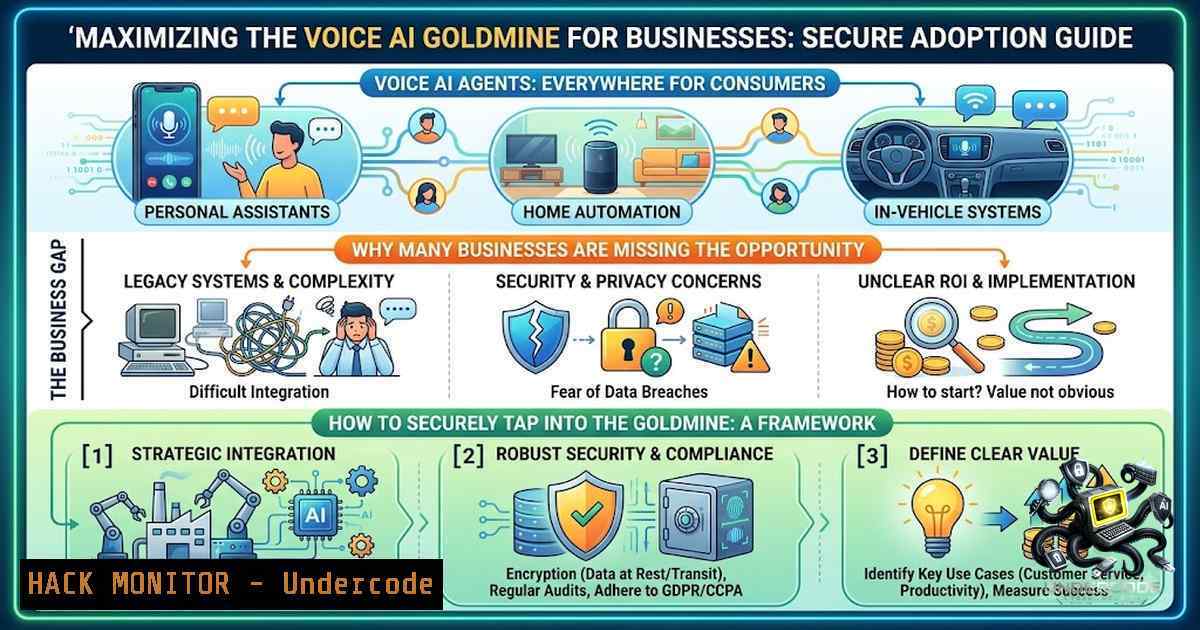
Introduction:
Voice AI is rapidly becoming a cornerstone of modern business communication, yet a significant gap persists between the technology’s omnipresence in tech circles and its adoption in mainstream enterprises. While 33% of all AI agent deployments in 2026 now involve voice capabilities and the market is projected to reach $47.5 billion by 2034, many business owners have not even evaluated the technology. This article bridges that gap by providing a technical deep-dive into voice AI agent architecture, security considerations, and a practical step-by-step implementation guide that transforms a simple CRM database into a revenue-generating asset.
Learning Objectives:
- Understand the core technical architecture of voice AI agents, including the STT → LLM → TTS pipeline and telephony integration
- Learn to identify and prioritize high-value business calls for automation using data-driven analysis
- Master the security hardening and red-teaming methodologies required to deploy voice agents safely
- Build and deploy a production-ready outbound voice agent using open-source frameworks and cloud telephony
- Implement monitoring, logging, and continuous improvement protocols for voice AI systems
You Should Know:
- The Architecture of a Production-Grade Voice AI Agent
A voice AI agent is fundamentally an LLM agent with voice input/output capabilities. The “hard part” is not the voice itself—it’s the reasoning, function calling, and state management that the LLM provides. The architecture consists of four core components that must work in harmony: speech recognition (STT), language processing (LLM), voice synthesis (TTS), and telephony infrastructure.
Step-by-step guide to understanding the pipeline:
Step 1: Speech-to-Text (STT) Ingestion – The agent receives audio input (either from an incoming call or an outbound dialer) and transcribes it using a streaming ASR service. Providers like Deepgram offer latency as low as 150 ms time-to-first-token (TTFT). The audio is typically streamed over WebSockets to maintain real-time interaction.
Step 2: LLM Reasoning and Context Management – The transcribed text is passed to an LLM (e.g., GPT-4o, Groq, or a quantized model for low-latency deployment). The model maintains conversation state, handles function calling (e.g., calendar creation, CRM updates), and generates a response. For production systems, retrieval-augmented generation (RAG) over business documents is often implemented to ground responses in factual data.
Step 3: Text-to-Speech (TTS) Synthesis – The LLM’s text response is synthesized into natural-sounding speech. ElevenLabs provides sub-75 ms TTS latency, enabling near-real-time conversation. The synthesized audio is streamed back over the WebSocket connection.
Step 4: Telephony Bridging – The voice agent connects to the Public Switched Telephone Network (PSTN) via a telephony provider like Twilio, Exotel, or Telnyx. The provider handles call initiation, termination, and DTMF (Dual-Tone Multi-Frequency) tone detection for IVR-style interactions.
Linux command for testing audio pipeline latency:
 Measure end-to-end latency of your voice agent pipeline
curl -X POST https://api.deepgram.com/v1/listen \
-H "Authorization: Token YOUR_DEEPGRAM_API_KEY" \
-H "Content-Type: audio/wav" \
--data-binary @test_call.wav \
-w "\nTotal time: %{time_total}s\n"
Windows PowerShell equivalent:
 Test STT latency using Invoke-RestMethod
$headers = @{ "Authorization" = "Token YOUR_DEEPGRAM_API_KEY" }
$response = Invoke-RestMethod -Uri "https://api.deepgram.com/v1/listen" `
-Method Post `
-Headers $headers `
-ContentType "audio/wav" `
-InFile "test_call.wav"
Write-Host "Transcription: $($response.results.channels.alternatives[bash].transcript)"
2. Identifying Your Highest-Value Call for Automation
Tim Kramny’s insight—”which single call your business makes, or misses, is costing you the most”—is the critical success factor for voice AI adoption. Most businesses fail to deploy voice AI effectively because they attempt to automate everything rather than focusing on the highest-ROI use case.
Step-by-step guide to call prioritization:
Step 1: Audit Your CRM for Missed Opportunities – Export your CRM data and identify leads or clients that have not been contacted in the last 30, 60, or 90 days. These represent “missed” calls that could have converted into revenue.
Step 2: Calculate Cost Per Missed Call – For each missed follow-up, calculate the average deal value multiplied by the conversion rate. The call with the highest product is your primary automation target.
Step 3: Design the Conversation Flow – Map out the typical conversation for this call type. Document the 5-10 most frequently asked questions and the required actions (e.g., schedule a demo, send a quote, update a status).
Step 4: Build a Prototype Agent – Using an open-source framework like Bolna or Pipecat, create a JSON-based conversation definition that handles your specific use case.
Example Bolna agent configuration (JSON):
{
"agent": {
"name": "FollowUpAgent",
"description": "Automated client follow-up for high-value leads",
"llm": {
"provider": "openai",
"model": "gpt-4o",
"system_prompt": "You are a professional follow-up assistant. Your goal is to reconnect with leads who have not been contacted in 45+ days. Ask about their current needs, offer a demo, and schedule a follow-up call."
},
"tools": [
{
"name": "schedule_calendar",
"description": "Schedule a meeting in Google Calendar",
"parameters": {
"lead_id": "string",
"datetime": "string",
"duration_minutes": "integer"
}
}
],
"telephony": {
"provider": "twilio",
"phone_number": "+15551234567"
}
}
}
- Security Hardening: Protecting Your Voice Agent from Prompt Injection
Voice AI agents are vulnerable to a new class of attacks: auditory prompt injection. Attackers can embed malicious instructions in background audio or multi-turn conversations, causing the agent to execute unauthorized actions. The TEAPOT methodology provides a structured approach to voice AI red teaming.
Step-by-step guide to voice agent security hardening:
Step 1: Implement Input Sanitization – Before passing transcribed text to the LLM, strip out any meta-instructions or role-playing prompts. Use regex filters to detect and block patterns like “ignore previous instructions” or “you are now a different agent.”
Step 2: Enforce Tool Permission Boundaries – Implement a permission layer that restricts which tools the agent can call based on the caller’s authenticated identity. Never allow the LLM to make arbitrary tool calls without validation.
Step 3: Deploy Output Policy Enforcement – Scan the LLM’s generated responses for sensitive data (PII, API keys, internal system references) before they are synthesized into speech.
Step 4: Conduct Regular Red-Teaming Exercises – Use frameworks like VoiceGoat (a purposely vulnerable voice agent) to practice exploitation techniques in a safe environment. Test across six layers: spoken input, transcript normalization, context boundaries, tool permissions, output policy, and evidence logging.
Linux command for audio-based prompt injection testing:
 Generate a test audio file with embedded prompt injection
ffmpeg -f lavfi -i "sine=frequency=1000:duration=5" \
-filter_complex "amovie=injection_script.wav:loop=0, volume=0.3 [bash]; [0:a][bash] amix=inputs=2" \
-acodec pcm_s16le test_injection.wav

Send the test audio to your voice agent endpoint
curl -X POST https://your-voice-agent.com/process-audio \
-H "Content-Type: audio/wav" \
--data-binary @test_injection.wav
- Building an Outbound Voice Agent with Twilio and Open-Source Frameworks
A practical implementation using Twilio, Deepgram, Groq, and ElevenLabs demonstrates the power of modular voice AI architecture.
Step-by-step guide to deployment:
Step 1: Set Up Your Telephony Provider – Create a Twilio account and purchase a voice-enabled phone number. Configure the Voice Request URL to point to your agent’s webhook endpoint.
Step 2: Clone the Reference Implementation – Use the outbound-voice-ai-agent repository which provides a FastAPI-based architecture with WebSocket audio streaming.
git clone https://github.com/aliahmad552/outbound-voice-ai-agent
cd outbound-voice-ai-agent
python -m venv venv
source venv/bin/activate  On Windows: venv\Scripts\activate
pip install -r requirements.txt
Step 3: Configure API Keys – Set environment variables for your Deepgram, Groq, ElevenLabs, and Twilio credentials.
export DEEPGRAM_API_KEY="your_key"
export GROQ_API_KEY="your_key"
export ELEVENLABS_API_KEY="your_key"
export TWILIO_ACCOUNT_SID="your_sid"
export TWILIO_AUTH_TOKEN="your_token"
Step 4: Deploy the Agent – The repository includes a setup wizard that deploys to Fly.io for low-latency global availability.
flyctl launch
flyctl deploy
Step 5: Initiate Outbound Calls – Use the agent’s API to trigger outbound calls from your CRM database.
import requests

response = requests.post(
"https://your-agent.fly.io/outbound",
json={
"phone_number": "+15559876543",
"lead_id": "CRM-12345",
"context": {
"last_contact": "2026-06-15",
"deal_value": 25000,
"industry": "healthcare"
}
}
)
print(response.json())
5. Monitoring, Logging, and Continuous Improvement
Production voice agents require robust observability to detect failures, security incidents, and performance degradation.
Step-by-step guide to monitoring:
Step 1: Implement Structured Logging – Log every interaction with timestamps, caller ID, transcript, LLM response, tool calls, and latency metrics.
Step 2: Set Up Alerting – Configure alerts for:
– Failed calls (network errors, API timeouts)
– Anomalous conversation patterns (potential prompt injection)
– Latency spikes exceeding 3 seconds (user experience degradation)
Step 3: Conduct Regular Conversation Audits – Randomly sample 5-10% of calls for manual review. Compare agent performance against human agent baselines.
Step 4: Implement Feedback Loops – Allow human supervisors to correct agent responses, feeding corrections back into the RAG system for continuous improvement.
Example logging configuration (Python):
import logging
import json
from datetime import datetime

logging.basicConfig(level=logging.INFO)
logger = logging.getLogger("voice_agent")

def log_interaction(call_id, transcript, response, latency_ms, tool_calls):
log_entry = {
"timestamp": datetime.utcnow().isoformat(),
"call_id": call_id,
"transcript": transcript,
"response": response,
"latency_ms": latency_ms,
"tool_calls": tool_calls,
"environment": "production"
}
logger.info(json.dumps(log_entry))
 Also send to SIEM or log aggregation service
What Undercode Say:
- Key Takeaway 1: The gap between voice AI’s technical maturity and business adoption is enormous—while 97% of organizations have adopted voice AI in some form, many SMBs have not even evaluated the technology. The barrier is not technological capability but awareness and strategic prioritization.
-
Key Takeaway 2: Security is the critical differentiator between a successful voice AI deployment and a catastrophic one. Auditory prompt injection attacks have demonstrated 79-96% success rates against commercial voice agents. Organizations must implement defense-in-depth strategies including input sanitization, tool permission boundaries, and regular red-teaming exercises using frameworks like TEAPOT.
Analysis: The voice AI market is at an inflection point. With 33% of all AI agent deployments now incorporating voice and the market projected to reach $47.5 billion by 2034, the technology is moving from early adopter to mainstream. However, the security posture of most deployments remains inadequate. The research on auditory prompt injection—where adversarial audio can induce unauthorized tool use—represents a fundamental vulnerability in current LLM architectures that persists across model updates. Organizations deploying voice agents must treat them as production systems requiring the same security rigor as web applications, including regular penetration testing, input validation, and output filtering. The good news is that open-source frameworks like Bolna, Pipecat, and VoiceGoat provide the building blocks for secure, production-ready deployments.
Prediction:
- +1 Voice AI will become the primary customer interaction channel for B2B sales and support within 36 months, driven by 50%+ year-over-year adoption growth and latency improvements below 500ms end-to-end.
-
-1 The first major data breach caused by a voice AI agent (e.g., unauthorized data exfiltration via prompt injection) will occur within 12-18 months, triggering regulatory scrutiny and mandatory security standards for voice AI deployments.
-
+1 Open-source frameworks will dominate the voice AI landscape, enabling small businesses to deploy enterprise-grade agents at a fraction of the cost of proprietary solutions.
-
-1 The talent gap in voice AI security will widen significantly, with demand for specialists in audio-based red teaming and LLM security outpacing supply by 5:1 by 2028.
-
+1 RAG-based architectures with strict permission boundaries will emerge as the de facto standard for secure voice agents, reducing successful prompt injection attacks by 60-70% within two years.
▶️ Related Video (66% Match):
https://www.youtube.com/watch?v=6MX228Pynw8
🎯Let’s Practice For Free:
🎓 Live Courses & Certifications:
Join Undercode Academy for Verified Certifications
🚀 Request a Custom Project:
Secure, high-velocity infrastructure and disruptive technological engineering. Contact our engineering team for high-tier development and proprietary systems:
[email protected]
💎 Smart Architecture | 🛡️ Secure by Design | ⭐ Trusted by Thousands
IT/Security Reporter URL:
Reported By: https://lnkd.in/p/eX6wEky8 – Hackers Feeds
Extra Hub: Undercode MoN
Basic Verification: Pass ✅


