Listen to this Post
Introduction
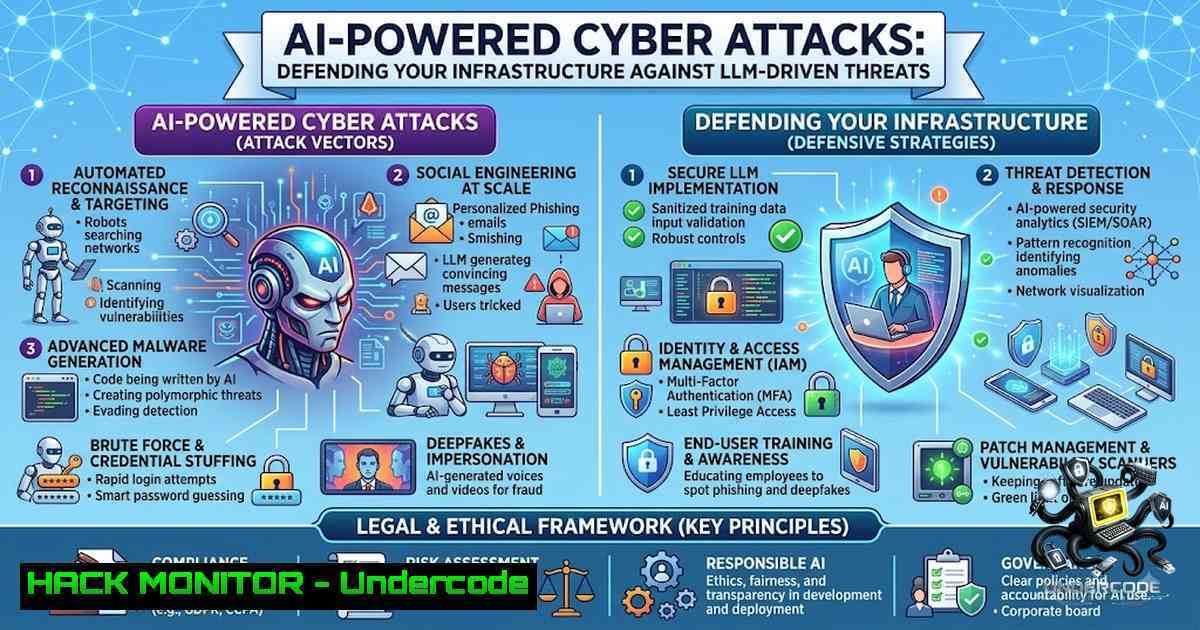
The convergence of artificial intelligence and cybersecurity has created an unprecedented threat landscape where large language models (LLMs) are being weaponized by malicious actors to automate and scale sophisticated attacks. Recent findings indicate that AI-driven phishing campaigns have increased by 1,265% in the past year, with threat actors leveraging generative AI to craft highly convincing social engineering attacks that bypass traditional security controls. Organizations must urgently adapt their security frameworks to counter these evolving threats, implementing AI-specific defenses while hardening existing infrastructure against both traditional and emerging attack vectors.
Learning Objectives
- Master the identification and mitigation of AI-powered attack vectors including prompt injection, model poisoning, and automated vulnerability discovery
- Implement robust security controls for AI infrastructure, including API security, access management, and data protection
- Develop incident response procedures specifically designed for AI-related security breaches
- Configure network and endpoint defenses to detect and block AI-generated malicious traffic
- Understand compliance requirements and ethical considerations in AI security implementation
You Should Know
1. Understanding AI Attack Vectors and Threat Modeling
Modern cyber attackers are exploiting AI systems through multiple sophisticated techniques. Prompt injection attacks allow malicious actors to manipulate LLM outputs by embedding hidden instructions within user inputs, potentially exposing sensitive training data or causing the model to generate harmful content. Model poisoning involves corrupting training data to introduce backdoors or bias, while inference attacks can extract proprietary information through carefully crafted queries.
To defend against these threats, organizations must implement comprehensive threat modeling frameworks. The MITRE ATLAS framework provides an excellent starting point for understanding AI-specific threat vectors. Begin by mapping your AI infrastructure components and identifying potential attack surfaces:
For Linux systems, implement monitoring of AI model access patterns:
 Monitor API access logs for suspicious patterns
sudo tail -f /var/log/nginx/access.log | grep -E "POST|GET" | while read line; do
if echo "$line" | grep -q "model"; then
echo "[bash] Model API accessed at $(date): $line" >> /var/log/ai-monitor.log
fi
done

Audit model file integrity
sudo find /opt/ai-models -type f -1ame ".h5" -o -1ame ".pt" -exec sha256sum {} \; > /root/model-integrity-baseline.txt
For Windows environments, implement PowerShell monitoring:
 Monitor AI service endpoints
Get-WinEvent -LogName Security | Where-Object { $_.Message -match "AI|model|inference" } |
Select-Object TimeCreated, Message | Export-Csv -Path "C:\Logs\ai-access-audit.csv"

Implement file integrity monitoring for model directories
$watcher = New-Object System.IO.FileSystemWatcher
$watcher.Path = "C:\AI-Models"
$watcher.Filter = ".onnx"
$watcher.EnableRaisingEvents = $true
Register-ObjectEvent $watcher "Changed" -Action {
Write-Host "[bash] Model file modified at $(Get-Date)"
}
2. Securing AI APIs and Endpoints
AI systems typically expose APIs that become prime targets for attackers. Implementing robust API security requires multiple layers of defense. Begin by enforcing strict authentication and authorization mechanisms using OAuth 2.0 or API keys with granular permissions.
Rate limiting and throttling are essential to prevent brute force attacks and denial of service attempts. Configure Web Application Firewalls (WAF) with AI-specific rules to detect malicious patterns:
 Nginx rate limiting configuration for AI endpoints
sudo nano /etc/nginx/conf.d/ai-rate-limit.conf
 Add:
limit_req_zone $binary_remote_addr zone=ai_apis:10m rate=10r/m;
server {
location /api/v1/model/ {
limit_req zone=ai_apis burst=5 nodelay;
proxy_pass http://ai-backend;
}
}
 Windows Firewall advanced rule for AI API protection
New-1etFirewallRule -DisplayName "Block-Malicious-AI-Traffic" `
-Direction Inbound `
-Action Block `
-RemoteAddress (Get-Content "C:\Security\blocklist.txt")
Implement input validation to prevent injection attacks. For API gateways like Kong or Tyk, add custom plugins that sanitize AI prompts:
 Example Python middleware for prompt sanitization
def sanitize_prompt(prompt):
suspicious_patterns = [
r'ignore previous instructions',
r'you are now acting as',
r'system:',
r'developer:',
r'[^\w\s.,!?-]'  Special characters filter
]

import re
for pattern in suspicious_patterns:
if re.search(pattern, prompt, re.IGNORECASE):
raise ValueError(f"Potential prompt injection detected: {pattern}")

 Limit prompt length
if len(prompt) > 2000:
raise ValueError("Prompt exceeds maximum length")

return prompt.strip()
3. Cloud Hardening for AI Workloads
Cloud environments hosting AI workloads require specific hardening measures. Implement Zero Trust Architecture principles across your AI infrastructure stack. Configure cloud security groups and network ACLs to restrict access:
AWS Security Configuration:
 AWS CLI commands for securing AI services
aws s3api put-bucket-policy --bucket ai-model-storage --policy file://restrict-access.json
aws iam create-policy --policy-1ame AISecurityPolicy --policy-document file://ai-policy.json
aws guardduty create-detector --enable
Azure Security Configuration:
 Azure CLI commands
az storage container set-permission --1ame ai-models --public-access off
az monitor log-analytics workspace create --workspace-1ame ai-security-workspace
az security atp storage update --enable true
Google Cloud Platform:
gcloud projects add-iam-policy-binding PROJECT_ID \
--member="user:[email protected]" \
--role="roles/aiplatform.admin"
gcloud config set compute/zone us-central1-a
gcloud compute firewall-rules create restrict-ai-access \
--allow tcp:8080 \
--source-ranges 192.168.1.0/24
Implement data encryption both at rest and in transit. For sensitive model weights and training data, implement key management services:
 Encrypt model files with GPG
gpg --symmetric --cipher-algo AES256 model-weights.h5
gpg --decrypt model-weights.h5.gpg > decrypted-model.h5

 Set immutable attribute to prevent deletion
sudo chattr +i /opt/ai-models/production-model.pt
4. Incident Response for AI Security Breaches
Developing AI-specific incident response procedures requires understanding of unique threat scenarios. Create runbooks for events like model poisoning, data extraction, and prompt injection attacks:
Establish real-time monitoring dashboards:
 Elasticsearch query for AI security incidents
curl -X GET "localhost:9200/ai-security/_search?pretty" -H 'Content-Type: application/json' -d'
{
"query": {
"bool": {
"must": [
{ "match": { "event_type": "suspicious_prompt" } },
{ "range": { "timestamp": { "gte": "now-1h" } } }
]
}
}
}'
Automated response with Falco for containerized AI workloads:
 Falco rules for AI container monitoring
- rule: Suspicious Model Access
desc: Detect unauthorized access to AI models
condition: (fd.name contains "/opt/ai-models" and proc.cmdline contains "cat")
output: "Model access detected (user=%user.name command=%proc.cmdline)"
priority: WARNING
Windows Event Log monitoring for AI incidents:
 Query for AI-related security events
Get-WinEvent -FilterHashtable @{
LogName='Security'
ID=4624,4625
} | Where-Object { $_.Message -match "AI|model|inference" } |
ForEach-Object {
$event = [bash]$_.ToXml()
$event.EventData.Data | ForEach-Object {
if ($_.Name -eq "TargetUserName" -or $_.Name -eq "WorkstationName") {
Write-Output "$($_.Name): $($_.'text')"
}
}
}
5. Training and Employee Awareness
Employee training programs must evolve to address AI-powered social engineering attacks. AI-generated phishing emails are nearly indistinguishable from legitimate communications, requiring enhanced security awareness:
Implement mandatory AI security training:
1. Regular phishing simulation campaigns using AI-generated content
2. Identifying AI-generated text characteristics (patterns, repetition, unusual phrasing)
3. Reporting procedures for suspected AI-driven attacks
Technical controls to support human awareness:
 Configure email filters to flag potential AI-generated content
 SpamAssassin custom rules
echo "header AI_GENERATED Subject =~ /\\b(your account|verify|urgent action)\\b/i" >> /etc/spamassassin/local.cf
echo "score AI_GENERATED 5.0" >> /etc/spamassassin/local.cf
service spamassassin restart
Microsoft 365 Defender configuration:
 Configure anti-phishing policies
Set-AntiPhishPolicy -Identity "AI Protection" `
-EnableMailboxIntelligence $true `
-EnableMailboxIntelligenceProtection $true `
-EnablePhishingThreshold $true
6. Compliance and Ethical Implementation
Ensure your AI security measures align with regulatory frameworks like GDPR, CCPA, and emerging AI-specific regulations. Implement data governance policies that address:
- Data minimization for AI training
- Purpose limitation requirements
- User consent and transparency
- Right to explanation and challenge AI decisions
Documentation and audit trails:
 Create audit trail for model access and changes
echo "$(date) - User $USER accessed model $MODEL_NAME" >> /var/log/ai-audit.log
What Undercode Say:
- AI-powered cyber attacks are evolving faster than traditional security defenses, requiring organizations to implement AI-specific security measures alongside existing controls.
- The integration of AI into security operations can both enhance defense capabilities and create new vulnerabilities, necessitating a balanced approach to AI adoption.
- Security teams must develop hybrid expertise combining traditional cybersecurity knowledge with understanding of machine learning attack surfaces.
- Proactive threat intelligence sharing and collaboration across organizations are essential to staying ahead of AI-driven attack vectors.
Analysis: The threat landscape has fundamentally shifted with the democratization of AI tools. Attackers are now leveraging LLMs to automate reconnaissance, develop exploits, and craft social engineering at unprecedented scale. Organizations must invest in AI-specific security tools while ensuring their incident response teams understand both traditional and AI-powered attack vectors. The most effective defense combines automated detection systems with human expertise, creating a layered security approach that can adapt to rapidly evolving threats. Training and awareness programs must be continuously updated to address new AI capabilities, and regular security assessments should specifically test AI infrastructure vulnerabilities.
Prediction:
-1 The proliferation of AI-powered cyber attacks will likely overwhelm unprepared organizations, leading to a surge in successful breaches exploiting model vulnerabilities.
+1 Organizations that invest early in AI security frameworks and employee training will gain competitive advantages through enhanced resilience and customer trust.
-1 The skills gap in AI security will widen as traditional cybersecurity professionals struggle to adapt to machine learning-specific threats.
+1 Collaborative efforts between security vendors and AI developers will accelerate the development of standardized security protocols and defense mechanisms.
-1 AI-assisted automated attacks will reduce the barrier to entry for cybercriminals, increasing the frequency and scale of attacks against organizations of all sizes.
+1 Regulatory frameworks will evolve to mandate AI security standards, driving accountability and improving overall industry security posture.
-1 The speed of AI-driven attacks will outpace traditional manual incident response procedures, requiring organizations to automate their defense mechanisms comprehensively.
▶️ Related Video (90% Match):
🎯Let’s Practice For Free:
🎓 Live Courses & Certifications:
Join Undercode Academy for Verified Certifications
🚀 Request a Custom Project:
Secure, high-velocity infrastructure and disruptive technological engineering. Contact our engineering team for high-tier development and proprietary systems:
[email protected]
💎 Smart Architecture | 🛡️ Secure by Design | ⭐ Trusted by Thousands
IT/Security Reporter URL:
Reported By: https://lnkd.in/p/e-dN8ZGN – Hackers Feeds
Extra Hub: Undercode MoN
Basic Verification: Pass ✅


