Listen to this Post
Introduction:
The $2.4 billion acquisition of BioCatch by Visa marks a pivotal moment in payment network architecture, signaling the definitive end of static authentication in an era of generative AI-driven fraud. As deepfakes, account takeover (ATO) attacks, and authorized push payment (APP) scams become increasingly sophisticated, traditional defenses like SMS OTPs and static passwords are no longer sufficient. This deal represents a fundamental shift toward continuous, passive behavioral intelligence embedded directly into the core transaction layer, transforming how financial institutions authenticate identity and prevent fraud before it reaches the point of payment.
Learning Objectives:
- Understand how behavioral biometrics technology works and why it is critical for combating AI-powered fraud.
- Learn to implement continuous authentication strategies using behavioral signals within existing security architectures.
- Master the configuration and deployment of behavioral biometrics SDKs for real-time fraud detection in banking applications.
You Should Know:
- The Behavioral Biometrics Arsenal: How BioCatch Reads the Human Signature
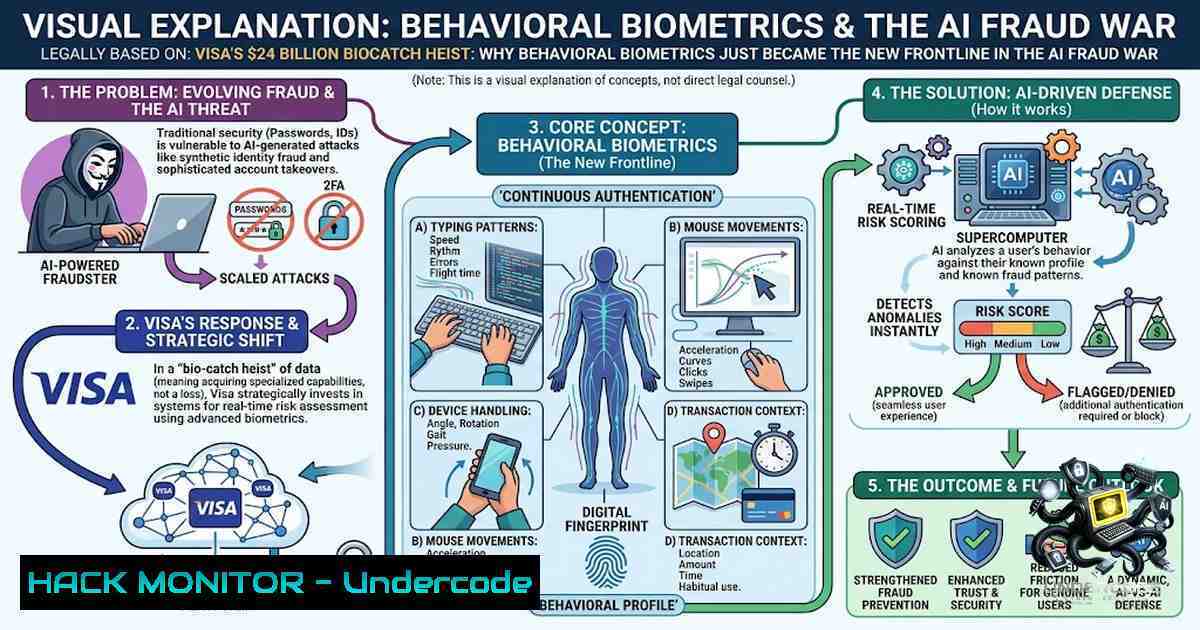
BioCatch’s platform operates on a simple but powerful premise: how you interact with your device is as unique as your fingerprint. The technology continuously collects over 3,000 anonymized data points, including keystroke timing and pressure, touchscreen gestures, mouse movements, device angle and orientation, and even hand-eye coordination and micro-tremors. These signals are fed into AI and machine learning models that build a dynamic behavioral profile for each user, distinguishing legitimate account holders from fraudsters, bots, or AI agents in real time. This continuous authentication happens passively in the background, introducing zero friction for the genuine user while providing a formidable barrier against unauthorized access.
Step‑by‑step guide to understanding the behavioral data flow:
- Data Collection: The BioCatch JavaScript SDK or mobile SDK is embedded in the client application. It begins collecting behavioral telemetry from the moment the user interacts with the interface.
- Signal Processing: Over 3,000 parameters are captured per session, including typing cadence, swipe patterns, and device handling.
- Profile Building: Machine learning models create a unique behavioral baseline for each user over time.
- Real-time Risk Scoring: During each session, current behavior is compared against the baseline and known fraud patterns. Anomalies generate an instant risk score.
- Action: Based on the risk score, the system can trigger step-up authentication, block a transaction, or alert the fraud team—all within milliseconds.
Linux/Windows Command for Behavioral Biometrics Simulation (Educational Use Only):
For security researchers looking to simulate behavioral patterns for testing, tools like `xdotool` (Linux) or `AutoHotkey` (Windows) can automate mouse movements and keystrokes. Note: This is for educational testing in isolated environments only.
 Linux - Simulate human-like typing with random delays
!/bin/bash
typing_simulation() {
local text="$1"
for (( i=0; i<${text}; i++ )); do
char="${text:$i:1}"
xdotool key "$char"
sleep $(echo "scale=2; 0.05 + $RANDOM/32768  0.15" | bc -l)  Random delay 50-200ms
done
}
typing_simulation "YourPassword123"
2. Continuous Authentication in Practice: Integrating Behavioral Biometrics
Traditional authentication is a one-time event; behavioral biometrics makes it a continuous process. This is a paradigm shift from “verify once, trust always” to “never trust, always verify”. By continuously validating the user throughout the session, even after login, the system can detect session hijacking or account takeover attempts in real time, often before the attacker can execute a fraudulent transaction.
Step‑by‑step guide to integrating behavioral biometrics into a CIAM platform (Conceptual):
- SDK Integration: Embed the BioCatch JavaScript SDK (or mobile equivalent) into your application’s login and transaction pages.
- Session Initialization: Upon user login, generate a unique client session ID and pass it to the BioCatch SDK.
- Passive Data Streaming: The SDK begins sending behavioral data to the BioCatch platform in the background, using the session ID for correlation.
- Risk API Integration: Your application’s backend integrates with BioCatch’s risk API. For each critical transaction (e.g., a funds transfer), your backend queries the API for the current session’s risk score.
- Policy Enforcement: Based on the risk score, your application enforces a policy: allow, block, or challenge the user with additional authentication (e.g., MFA).
- Feedback Loop: Fraud outcomes are fed back into the system to continuously refine the machine learning models.
API Security Configuration Example (Conceptual Python snippet):
import requests

Example: Querying a behavioral biometrics risk API
def check_session_risk(session_id, api_key):
url = "https://api.biocatch.example.com/v1/risk/score"
headers = {"Authorization": f"Bearer {api_key}"}
payload = {"sessionId": session_id, "transactionType": "PAYMENT"}

response = requests.post(url, json=payload, headers=headers)
if response.status_code == 200:
risk_score = response.json().get("riskScore")
if risk_score > 80:
return "BLOCK"
elif risk_score > 50:
return "CHALLENGE"
else:
return "ALLOW"
return "ERROR"
- The $1 Trillion Problem: Fighting AI-Generated Scams and ATOs
Account takeovers and scams now cost the global economy over $1 trillion annually. Generative AI has accelerated this problem by enabling fraudsters to create convincing deepfakes, automate social engineering at scale, and deploy AI agents that mimic human behavior to bypass traditional controls. BioCatch’s behavioral intelligence is uniquely positioned to counter these threats because it doesn’t rely on what the user knows (passwords) or has (OTP tokens)—it relies on how the user behaves. This makes it resilient against credential theft, SIM swaps, and even deepfake-based social engineering, as the attacker’s physical and cognitive interaction patterns will inevitably differ from the legitimate user’s.
4. Cloud Hardening for Behavioral Data Pipelines
Deploying a behavioral biometrics solution at scale requires a robust, low-latency cloud infrastructure capable of processing billions of data points in real time. BioCatch, for instance, migrated its architecture to Aerospike to achieve predictable, near-in-memory performance for its real-time risk scoring engine. For organizations building similar capabilities, cloud hardening is critical.
Key cloud hardening considerations:
- Data Encryption: Encrypt behavioral data both in transit (TLS 1.3) and at rest (AES-256).
- Micro-segmentation: Isolate the behavioral analytics pipeline from other application components using network policies and service meshes.
- Zero-Trust Architecture: Apply zero-trust principles to all API calls between the SDK, backend, and analytics engine.
- Immutable Infrastructure: Deploy analytics nodes as immutable instances to prevent persistent compromise.
- Real-time Monitoring: Implement comprehensive logging and monitoring for all data pipeline components to detect anomalies and potential data exfiltration.
5. Interbank Intelligence Sharing: The Network Effect
Beyond individual institution protection, BioCatch operates an interbank intelligence-sharing network called BioCatch Trust. This network allows participating banks to share real-time behavioral intelligence about suspicious accounts and mule activities. For example, if one bank identifies a mule account based on behavioral anomalies, that intelligence can be shared to warn other banks in real time, enabling them to block transfers to that account before money moves. This network effect amplifies the power of behavioral intelligence exponentially. The recent FinCEN guidance in June 2026 has lowered the legal barriers for such information sharing in the U.S., potentially paving the way for a nationwide behavioral fraud intelligence network.
6. Defensive Measures: Detecting and Mitigating Mule Accounts
Mule accounts—legitimate-looking accounts used to launder proceeds of fraud—are a critical component of the financial crime ecosystem. BioCatch detects mule activity by identifying subtle behavioral shifts that signal when an account is being used for money laundering, even when the customer, credentials, and devices appear legitimate. This proactive detection allows financial institutions to identify and disrupt mule networks before inbound money transfers occur, significantly reducing financial, operational, and regulatory risk.
- The Vendor Consolidation Dilemma: Strategic Implications for Banks
The Visa-BioCatch deal creates a new dynamic for major banks that are already BioCatch customers. Three of the four largest U.S. banks by assets currently run BioCatch software. After the deal closes, these banks will be purchasing their fraud detection from the same company with which they negotiate card network terms. While this bundling may simplify vendor management and potentially reduce costs, it also reduces banks’ negotiating leverage, as noted by Eric Grover of Intrepid Ventures. For CISOs and fraud prevention heads, this underscores the importance of maintaining architectural flexibility and avoiding over-reliance on a single vendor for critical security functions.
What Undercode Say:
- Behavioral biometrics is the new authentication frontier. Passwords and OTPs are no longer sufficient against AI-driven threats. Continuous, passive behavioral authentication is becoming a non-1egotiable layer for any organization handling sensitive financial transactions.
- The arms race has escalated. Visa’s acquisition of BioCatch and Mastercard’s acquisition of Recorded Future signal a broader industry trend where payment networks are not just transaction processors but also cybersecurity powerhouses, embedding intelligence directly into their core infrastructure.
- The network effect will define the next generation of fraud prevention. The real power of behavioral intelligence is amplified when shared across institutions. As legal and regulatory frameworks evolve to facilitate this sharing, we can expect to see a dramatic increase in the effectiveness of fraud prevention networks.
- Banks face a strategic vendor management challenge. While the acquisition brings powerful capabilities under the Visa umbrella, it also creates dependencies that banks must carefully manage to maintain leverage and operational resilience.
- The future is continuous and invisible. The ultimate goal is to make security seamless. Behavioral biometrics, operating in the background, moves us closer to a world where security is an invisible layer that protects users without burdening them.
Prediction:
- +1 Visa’s deep integration of BioCatch’s behavioral intelligence will set a new industry standard, forcing other payment networks and fintechs to acquire or build similar capabilities, accelerating innovation in AI-driven fraud prevention.
- +1 The expansion of interbank intelligence-sharing networks, potentially reaching the U.S. market, will create a powerful collective defense mechanism that significantly reduces the success rate of APP scams and mule account transactions.
- -1 The vendor consolidation trend, exemplified by this acquisition, may lead to reduced competition and choice in the fraud prevention market, potentially stifling innovation from smaller vendors and increasing costs for financial institutions in the long run.
- -1 The reliance on a single card network for both transaction processing and fraud detection creates a systemic concentration risk. A security incident or service disruption at Visa could have cascading effects across the entire ecosystem.
- +1 Behavioral biometrics will expand beyond banking into other sectors, including healthcare, government services, and e-commerce, as the need for continuous, frictionless authentication becomes universal.
- -1 The sophistication of AI-driven fraud will continue to evolve in response. Adversarial AI could potentially learn to mimic behavioral patterns, necessitating constant innovation and adaptation from defenders.
▶️ Related Video (72% Match):
🎯Let’s Practice For Free:
🎓 Live Courses & Certifications:
Join Undercode Academy for Verified Certifications
🚀 Request a Custom Project:
Secure, high-velocity infrastructure and disruptive technological engineering. Contact our engineering team for high-tier development and proprietary systems:
[email protected]
💎 Smart Architecture | 🛡️ Secure by Design | ⭐ Trusted by Thousands
IT/Security Reporter URL:
Reported By: Israeldaniel Visas – Hackers Feeds
Extra Hub: Undercode MoN
Basic Verification: Pass ✅


