Listen to this Post
Introduction:
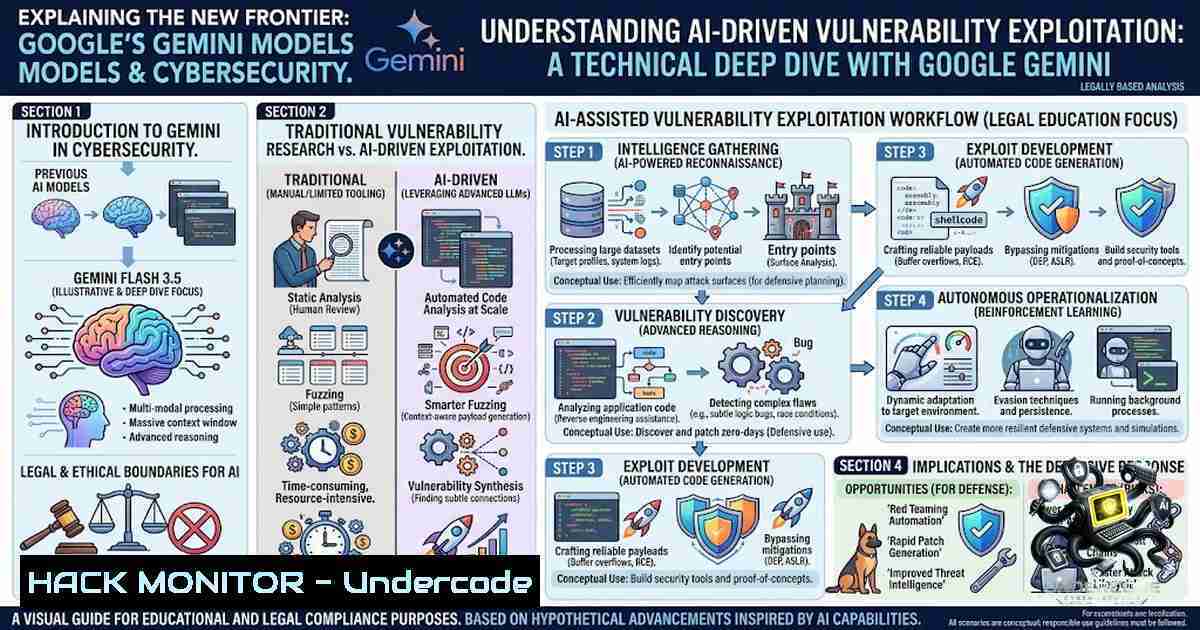
Google’s July 2026 release of three new Gemini models—Gemini 3.6 Flash, Gemini 3.5 Flash-Lite, and the gated Gemini 3.5 Flash Cyber—marks a pivotal shift in how AI is applied to both agentic workflows and cybersecurity. While 3.6 Flash and Flash-Lite target cost efficiency and high-throughput performance, the introduction of 3.5 Flash Cyber represents a dual-use breakthrough: an AI model fine-tuned not just to find vulnerabilities, but to autonomously verify and patch them. This article provides a technical roadmap for security engineers, AI developers, and IT architects to understand, integrate, and defend against the capabilities of these new models.
Learning Objectives:
- Understand the architectural and performance differences between Gemini 3.6 Flash, 3.5 Flash-Lite, and 3.5 Flash Cyber.
- Learn how to integrate Gemini 3.6 Flash and Flash-Lite into CI/CD pipelines and agentic workflows using the Gemini API and Google AI Studio.
- Master the operational mechanics of CodeMender and Gemini 3.5 Flash Cyber for automated vulnerability discovery and patching.
- Implement defensive monitoring strategies to detect and respond to AI-generated exploits in your environment.
- Gemini 3.6 Flash: The Cost-Optimized Workhorse for Agentic Workloads
Gemini 3.6 Flash is positioned as the new主力 model for production AI agents, delivering a 17% reduction in output token usage compared to its predecessor, according to the Artificial Analysis Index. This efficiency translates directly to lower operational costs—priced at $1.50 per million input tokens and $7.50 per million output tokens. Beyond cost, 3.6 Flash shows significant performance gains: a 49% success rate on DeepSWE (vs. 37% for 3.5 Flash) and a 63.9% score on MLE Bench (vs. 49.7%). For security teams, this model can be leveraged to automate code migration, log analysis, and even fuzzing orchestration at scale.
Step‑by‑step: Integrating Gemini 3.6 Flash into a CI/CD Security Pipeline
- Obtain API Credentials: Access the Gemini API via Google AI Studio or your Google Cloud project. Ensure billing is enabled for the `gemini-3.6-flash` model.
2. Install the Gemini Python SDK:
pip install google-generativeai
3. Authenticate and Configure:
import google.generativeai as genai
genai.configure(api_key="YOUR_API_KEY")
model = genai.GenerativeModel('gemini-3.6-flash')
4. Automate Code Review: Create a script that feeds pull request diffs to the model for security and logic analysis.
response = model.generate_content(f"Review this code for OWASP Top 10 vulnerabilities: {code_diff}")
print(response.text)
5. Integrate into GitHub Actions: Add a step that blocks merges if critical vulnerabilities are detected, using the model’s output to flag issues.
- Gemini 3.5 Flash-Lite: High-Throughput, Low-Latency AI for Security Telemetry
Gemini 3.5 Flash-Lite is engineered for tasks requiring massive throughput and minimal latency, delivering 350 output tokens per second. At just $0.30 per million input tokens and $2.50 per million output tokens, it is ideal for processing large volumes of security logs, translating threat intelligence feeds, and performing real-time classification of network events. Its performance on Terminal-Bench 2.1 jumped from 31% to 54%, making it a viable option for sub-agent tasks in a multi-agent security framework.
Step‑by‑step: Deploying Flash-Lite for Real-Time Log Analysis
- Set Up a Streaming Pipeline: Use Apache Kafka or Google Pub/Sub to stream security logs (e.g., firewall, IDS, cloud audit logs).
- Create a Consumer Script: Use the Gemini SDK to process each log entry.
model = genai.GenerativeModel('gemini-3.5-flash-lite') for log in log_stream: response = model.generate_content(f"Classify this log as benign or malicious: {log}") Send result to SIEM - Optimize for Cost: Batch requests where possible. Flash-Lite’s low cost allows for scanning millions of events daily without budget exhaustion.
- Deploy as a Cloud Function: Use Google Cloud Functions or AWS Lambda to trigger the model on new log entries, ensuring auto-scaling.
-
Gemini 3.5 Flash Cyber: The Gated Vulnerability Hunter
Gemini 3.5 Flash Cyber is a specialized model fine-tuned on top of 3.5 Flash, designed to find, validate, and patch software vulnerabilities. Unlike general-purpose models, it is optimized for the “search space problem”—exploring vast execution paths in code to discover deep-seated flaws. In testing, it discovered 55 confirmed vulnerabilities in the V8 JavaScript engine, outperforming Claude Opus 4.6 (36) and the mainline 3.5 Flash (47). It also identified 10 unique vulnerabilities that other models missed.
Step‑by‑step: How CodeMender Orchestrates Flash Cyber for Automated Patching
- Initiate a Scan: CodeMender, Google’s code security agent, invokes 3.5 Flash Cyber up to five times per report.
- Sub‑agent Exploration: Each invocation analyzes different codepaths. The model generates proof-of-concept exploits to verify findings.
- Report Aggregation: Sub-agents produce a single, high-quality report summarizing verified vulnerabilities.
- Automated Patching: The system writes patches and submits them for review, as demonstrated by Google’s internal use on Chrome, Android, and Cloud codebases.
4. Defensive Measures: Detecting and Mitigating AI-Generated Exploits
With the public release of cost-effective models like 3.6 Flash and the gated availability of 3.5 Flash Cyber to governments, defenders must prepare for an increase in AI-assisted attacks. The same models that find vulnerabilities can be used by adversaries to craft exploits faster than humans can respond.
Step‑by‑step: Building a Defensive AI Monitoring Stack
- Deploy Anomaly Detection: Use Gemini 3.6 Flash to analyze outbound network traffic for unusual patterns indicative of exploit attempts.
Example: Monitor for unusual outbound connections
ss -tunap | grep ESTABLISHED
- Implement AI‑Driven Log Analysis: Use Flash-Lite to correlate events across cloud providers (AWS, GCP, Azure) in real-time.
- Honeypot Integration: Deploy honeypots that generate alerts when probed; use 3.6 Flash to classify probe types.
- Patch Automation: Adopt tools like CodeMender (when generally available) to automatically patch known vulnerabilities, reducing the window of exposure.
5. Cloud Hardening with Gemini API Security Controls
When integrating any Gemini model, security controls must be enforced at the API level to prevent data leakage and ensure compliance.
Step‑by‑step: Hardening Gemini API Integrations
- Use Service Accounts: Avoid using API keys directly; instead, use IAM roles and service accounts with least privilege.
gcloud iam service-accounts create gemini-sa --display-1ame="Gemini Service Account"
- Enable VPC‑SC: Use VPC Service Controls to restrict API calls to trusted networks.
- Audit Logging: Enable Cloud Audit Logs for all Gemini API calls.
gcloud logging read "resource.type=aiplatform.googleapis.com"
- Data Redaction: Sanitize inputs to the model to remove PII or sensitive internal data before sending.
-
NOAA Partnership: AI for Physical Security and Disaster Response
Google also announced a partnership with NOAA to use AI for hurricane and tropical weather forecasting. While not a cybersecurity model, this partnership highlights AI’s role in critical infrastructure protection. The near-real-time AI forecasts are integrated into NOAA’s National Hurricane Center to enable life-saving actions.
Step‑by‑step: Leveraging AI for Infrastructure Risk Assessment
- Access NOAA Data: Use NOAA’s open APIs to retrieve forecast data.
- Integrate with Gemini: Use 3.6 Flash to analyze forecast data and generate risk assessments for data centers in hurricane zones.
- Automate Alerts: Trigger automated failover procedures for cloud regions at risk.
-
Windows and Linux Commands for AI Security Monitoring
To complement AI-driven analysis, security teams should deploy traditional monitoring tools.
Linux Commands:
– `journalctl -f -u sshd` – Monitor SSH logs for brute-force attempts.
– `tcpdump -i any -w capture.pcap` – Capture network traffic for AI analysis.
– `auditctl -w /etc/passwd -p wa -k identity` – Monitor file integrity.
Windows Commands:
– `Get-WinEvent -LogName Security | Where-Object { $_.Id -eq 4625 }` – Audit failed logins.
– `netstat -an | findstr ESTABLISHED` – View active connections.
– `Get-Process | Where-Object { $_.CPU -gt 50 }` – Detect resource-intensive processes that may indicate mining or exploitation.
What Undercode Say:
- Key Takeaway 1: Gemini 3.5 Flash Cyber is a game-changer for automated vulnerability discovery, but its gated nature creates a two-tier security landscape—governments and trusted partners get a significant advantage, while others must rely on less capable models.
- Key Takeaway 2: The cost reductions of 3.6 Flash and Flash-Lite democratize AI-powered security analysis, enabling even small teams to integrate advanced threat detection into their pipelines at scale.
Analysis: The release of these models signals a future where AI agents are not just assistants but autonomous actors in both offensive and defensive security. The 17% token reduction in 3.6 Flash is not merely an efficiency gain—it lowers the barrier to running complex, multi-step agentic workflows that can outpace human analysts. Meanwhile, Flash Cyber’s ability to generate working exploits (as noted by WIONews) raises ethical and practical concerns. Organizations must invest in AI-1ative security operations centers (SOCs) that can leverage these models defensively, while also hardening their infrastructure against AI-generated attacks. The NOAA partnership underscores that AI’s impact extends beyond digital security to physical infrastructure resilience, making it a C-level priority across all sectors.
Expected Output:
Prediction:
- +1 Democratization of Security AI: The low cost of 3.6 Flash and Flash-Lite will enable widespread adoption of AI-driven code review and log analysis, reducing the average time to detect breaches from days to minutes.
- -1 Escalation of AI‑Driven Attacks: As Flash Cyber becomes more accessible (even if gated), nation-state actors and advanced persistent threats (APTs) will leverage similar capabilities to discover zero-day vulnerabilities at machine speed, outpacing traditional patching cycles.
- +1 Integration with Critical Infrastructure: The NOAA partnership will pave the way for AI models to be integrated into other critical infrastructure sectors (energy, transportation), improving resilience against natural disasters and physical threats.
- -1 Skill Gap Widening: The complexity of deploying and securing these AI agents will widen the cybersecurity skills gap, leaving smaller organizations vulnerable.
▶️ Related Video (78% Match):
🎯Let’s Practice For Free:
🎓 Live Courses & Certifications:
Join Undercode Academy for Verified Certifications
🚀 Request a Custom Project:
Secure, high-velocity infrastructure and disruptive technological engineering. Contact our engineering team for high-tier development and proprietary systems:
[email protected]
💎 Smart Architecture | 🛡️ Secure by Design | ⭐ Trusted by Thousands
IT/Security Reporter URL:
Reported By: 17 Ai – Hackers Feeds
Extra Hub: Undercode MoN
Basic Verification: Pass ✅


