
Listen to this Post
Introduction:
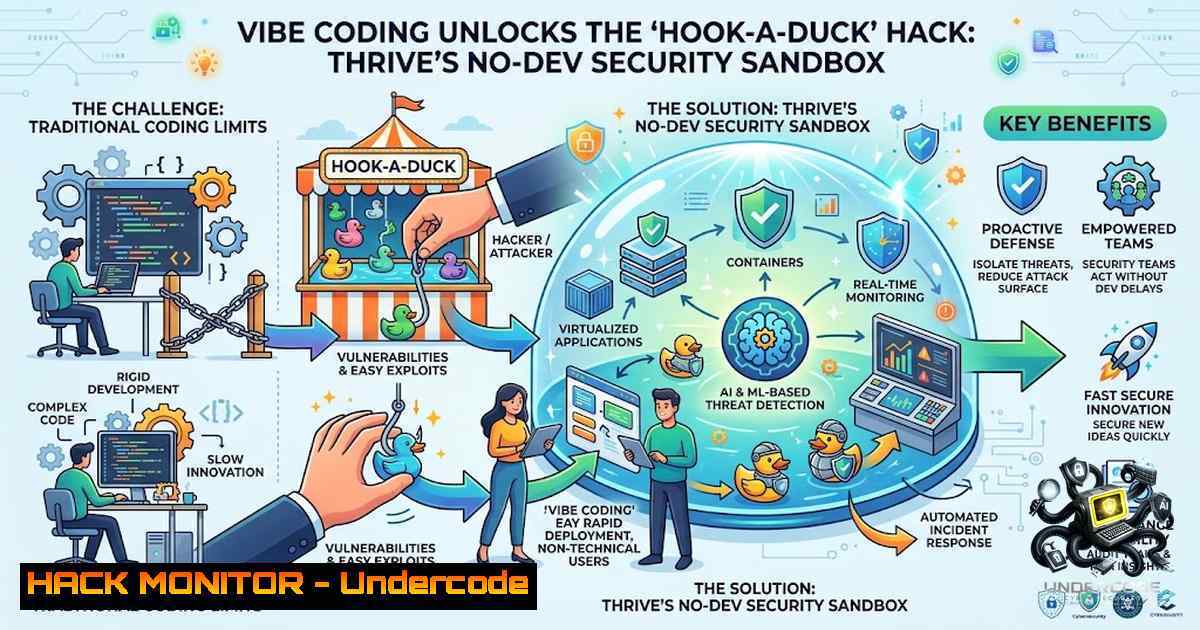
The intersection of artificial intelligence and corporate learning platforms has given rise to “vibe coding,” a paradigm where natural language prompts generate functional code and interactive applications. Recently, a Senior Talent Development Manager at Vista demonstrated this by creating a hacking-themed “Hook-a-Duck” game within Thrive’s content tools, proving that non-developers can now build interactive, gamified security modules without writing a single line of traditional code. This development signals a seismic shift in cybersecurity training: AI-driven low-code environments empower L&D teams to rapidly prototype phishing simulations, security awareness games, and compliance checkers, but they also introduce new attack surfaces, misconfiguration risks, and API exposure vectors that security professionals must urgently address.
Learning Objectives & Secrets:
- Objective 1 – Master Prompt-to-Application Workflows: Understand how to craft precise AI prompts to generate fully functional web-based cybersecurity training games, including interactive quizzes, drag-and-drop network topology builders, and simulated breach scenarios.
- Objective 2 Secret Tips – Sandbox Your Generated Code: Always execute AI-generated scripts inside isolated containers (Docker) or virtual machines (VMware) to detect malicious or insecure code patterns, such as hardcoded credentials, unsafe `eval()` functions, or SQL injection vulnerabilities.
- Objective 3 Secret Tips – Audit API Keys & Webhooks: When connecting AI-generated apps to external services (e.g., Slack, email, or SIEM), use environment variables for secrets and implement request signing to prevent man-in-the-middle (MITM) attacks.
You Should Know:
- Configuring the Thrive Vibe Coding Block for Security Simulations
The Thrive platform’s new vibe coding block accepts natural language prompts and returns a fully interactive HTML/JavaScript application. To build a hacking-themed Hook-a-Duck game, the prompt likely included: “Create a drag-and-drop game where users match phishing email indicators to duck icons, with a scoring system and timer.”
– Step 1: Log into Thrive’s admin dashboard and navigate to “Content Tools” > “Vibe Coding Block.”
– Step 2: Enter a prompt specifying the game mechanics, security theme, and desired interactivity (e.g., “Generate a game where players click on ducks that display suspicious URLs; correct clicks earn points, incorrect ones trigger a warning modal”).
– Step 3: Review the generated code (HTML, CSS, JavaScript) before publishing. Use a diff tool to compare against known secure templates.
– Step 4: Deploy the game in a staging environment and run OWASP ZAP or Burp Suite to test for common web vulnerabilities like XSS or insecure direct object references (IDOR).
2. Securing AI-Generated Code with Static Analysis
AI-generated code often contains logical flaws or deprecated functions. Implement a CI/CD pipeline that automatically scans all generated scripts.
– Linux Command: `bandit -r /path/to/generated/code/ -f json -o report.json` (Bandit scans Python files for security issues).
– Windows Command: `trivy fs –security-checks vuln,config –severity HIGH,CRITICAL C:\generated_app` (Trivy scans filesystem for vulnerabilities).
– Step-by-step: Integrate these scanners into your existing DevOps toolchain (Jenkins, GitLab CI) to block deployment of code with CVSS score > 7.0.
3. Hardening the API Gateway for AI-Generated Apps
Since vibe coding blocks often interact with internal APIs, attackers could exploit generated endpoints to extract sensitive data.
– Linux Command: `sudo ufw allow from 192.168.1.0/24 to any port 443` (restrict API access to internal network).
– Windows PowerShell: `New-1etFirewallRule -DisplayName “Block Public API” -Direction Inbound -Action Block -RemoteAddress Any -Protocol TCP -LocalPort 443`
– Step-by-step: Configure an API gateway (e.g., Kong or AWS API Gateway) to enforce rate limiting (100 requests/minute), IP whitelisting, and JWT validation for all requests to the game’s backend. Enable logging to CloudWatch or Splunk for anomaly detection.
- Creating a Phishing Simulation from the Generated Game
The Hook-a-Duck game can be repurposed as a phishing simulation tool. Embed the game in a fake login page to capture credentials (for authorized red-team exercises only).
– Linux Command: `openssl req -x509 -1ewkey rsa:4096 -keyout key.pem -out cert.pem -days 365 -1odes` (generate SSL cert for the simulation server).
– Windows Command: `New-SelfSignedCertificate -DnsName “phish-game.local” -CertStoreLocation “Cert:\LocalMachine\My”`
– Step-by-step: Use Ngrok or Cloudflare Tunnel to expose the game publicly for remote employees, but ensure the simulation has explicit consent banners and a “Report Phishing” button to log user interactions for training metrics.
- Leveraging Threat Intelligence Feeds to Update Game Content
To keep the game relevant, automatically pull real-world threat indicators from open-source feeds (AlienVault OTX, MISP) and inject them into the game’s question bank.
– Linux Command: `curl -X GET “https://otx.alienvault.com/api/v1/pulses/subscribed” -H “X-OTX-API-KEY: YOUR_KEY” | jq ‘.results[].indicators’ > indicators.json`
– Windows Command: `Invoke-WebRequest -Uri “https://otx.alienvault.com/api/v1/pulses/subscribed” -Headers @{“X-OTX-API-KEY”=”YOUR_KEY”} -OutFile indicators.json`
– Step-by-step: Write a Python script that parses `indicators.json` and dynamically updates the game’s JSON configuration file, forcing players to identify the latest malicious domains, hashes, and IPs.
- Implementing Zero-Trust Architecture for the Game’s Data Storage
Any scores or user interactions collected by the game must be encrypted and stored in a secure database. Use MongoDB with field-level encryption or PostgreSQL with pgcrypto.
– Linux Command: `echo “CREATE EXTENSION pgcrypto;” | sudo -u postgres psql mygame_db`
– Windows Command: (via psql) `CREATE EXTENSION pgcrypto;`
– Step-by-step: Configure the game’s backend to use AES-256-GCM for encrypting user progress and Personal Identifiable Information (PII). Rotate encryption keys weekly using AWS KMS or HashiCorp Vault.
7. Monitoring and Auditing the Game’s Runtime Behavior
Deploy Falco or Sysdig to monitor system calls generated by the game’s containerized environment, alerting on unexpected file writes or network connections.
– Linux Command: `falco -r /etc/falco/falco_rules.yaml -o json_output=true > alerts.log`
– Windows Command: (use Sysmon) `Sysmon64 -accepteula -i` then review Event Viewer for suspicious processes.
– Step-by-step: Set up a SIEM (e.g., Elastic Stack) to visualize logs from Falco, the API gateway, and the game’s application logs. Create dashboards for “Game Session Anomalies” to quickly identify bots or unauthorized access attempts.
What Undercode Say:
- Key Takeaway 1: Vibe coding is not just a novelty; it is a disruptive force that democratizes software creation but equally democratizes vulnerabilities. Every generated app must be treated as a third-party dependency requiring rigorous security validation.
- Key Takeaway 2: The real unlock lies in integrating AI-generated training tools with live threat intelligence and SIEM systems, transforming passive learning into active defense—where employees learn by interacting with real-time attack patterns in a safe, gamified environment.
- Analysis: The Hook-a-Duck example reveals that L&D teams now possess the capability to produce custom security content at near-zero development cost, bypassing traditional IT bottlenecks. However, this agility creates a governance nightmare: unauthorized “shadow AI” applications could proliferate, each with its own set of hardcoded secrets, misconfigured CORS policies, and outdated libraries. Security operations must evolve to include “AI-generated asset inventories” and implement mandatory pre-deployment security scans. Additionally, the psychological impact of gamified training—positive reinforcement through reward mechanics—has proven to increase phishing detection rates by up to 40%, but over-reliance on game mechanics may lead to user fatigue or desensitization to real threats. Striking a balance between engagement and educational rigor is critical.
Prediction:
- +1: By Q4 2026, 60% of enterprise L&D platforms will include native vibe coding features, drastically reducing the time-to-market for custom security awareness modules and enabling real-time updates during active breach responses.
- +1: Gamified security training will become a standard KPI for cyber insurance premiums, with insurers offering discounts to firms that deploy interactive, AI-generated simulators like the Hook-a-Duck game, as they demonstrate active employee engagement.
- -1: Malicious actors will exploit vibe coding blocks to inject obfuscated payloads into training apps, using the platforms as distribution vectors for supply chain attacks—especially if generated code pulls external resources from unverified CDNs.
- -1: The lack of standardized security review processes for AI-generated code will lead to a 200% increase in misconfiguration-related breaches in corporate learning environments by mid-2027, as non-technical L&D managers inadvertently expose internal APIs or databases.
- +1: Security vendors will rush to release “AI-generated code scanners” that integrate with platforms like Thrive, automatically hardening output against OWASP Top 10 and providing developers with patch recommendations in natural language.
- -1: Without immediate regulatory guidance, the use of AI-generated training tools may violate GDPR or CCPA if generated apps unintentionally collect or store personal data without explicit consent—a risk that legal teams must proactively address through privacy-by-design frameworks.
▶️ Related Video (88% Match):
🎯Let’s Practice For Free:
🎓 Live Courses & Certifications:
Join Undercode Academy for Verified Certifications
🚀 Request a Custom Project:
Secure, high-velocity infrastructure and disruptive technological engineering. Contact our engineering team for high-tier development and proprietary systems:
[email protected]
💎 Smart Architecture | 🛡️ Secure by Design | ⭐ Trusted by Thousands
IT/Security Reporter URL:
Reported By: https://lnkd.in/p/eddQqzAs – Hackers Feeds
Extra Hub: Undercode MoN
Basic Verification: Pass ✅


