
Listen to this Post
Introduction:
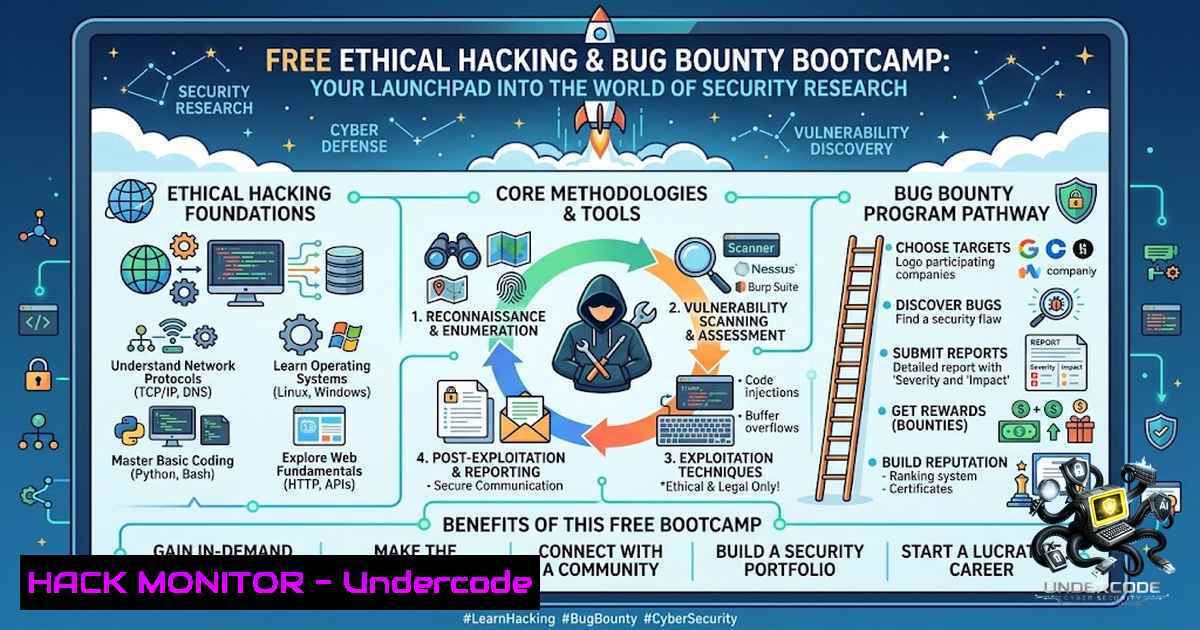
The cybersecurity industry faces a persistent shortage of skilled professionals, yet the barrier to entry often feels insurmountable for beginners. The Free Ethical Hacking & Bug Bounty Bootcamp, hosted by the Center for Cyber Security & Digital Forensics (CCSDF) in partnership with Nexus Defenders and Axeronix Technologies, directly addresses this gap. This 3-hour live online session, scheduled for August 29, 2026, and featuring security researcher Muhammad Saqib Arif, is designed to demystify the bug bounty workflow. It covers everything from cultivating a hacker mindset and mastering reconnaissance to exploiting core vulnerabilities like IDOR and XSS, understanding API security flaws, and writing effective bug reports that command attention—and payouts.
Learning Objectives & Secrets:
- Objective 1: Master the Art of Reconnaissance. Go beyond simple Google searches. Learn to systematically map an organization’s external attack surface using OSINT frameworks like Recon-1g, subdomain enumeration tools, and Shodan for internet-connected asset discovery. The secret is in the methodology—passive enumeration first, then active probing, ensuring you never alert the target prematurely.
-
Objective 2 Secret Tip: Exploit Logic Flaws, Not Just Code. Many beginners focus solely on injection attacks. The real goldmine in bug bounty is broken logic. For IDOR vulnerabilities, the secret is to intercept every request that contains an identifier (user ID, order number, file path) and change it. The fix is literally one line of code: compare the requested ID to the session user ID. Mastering this logic-based testing can lead to $10,000+ payouts.
-
Objective 3 Secret Tip: Elevate Your Bug Reports from “Informative” to “Critical”. A technically valid finding can be marked as low severity if the impact is understated. The secret is to demonstrate impact. Don’t just say “an attacker could access another user’s data.” Show it with a Proof of Concept (PoC) and quantify the potential damage—number of users affected, sensitivity of data exposed, and business impact. This directly correlates with higher severity ratings and larger payouts.
You Should Know:
1. Reconnaissance & Attack Surface Mapping
Reconnaissance is the cornerstone of any successful bug bounty engagement. It’s the process of gathering information about your target before launching any attacks. This phase can be broken down into passive and active reconnaissance. Passive recon involves collecting data from publicly available sources without directly interacting with the target’s systems. Active recon involves directly probing the target’s infrastructure.
Step‑by‑Step Reconnaissance Workflow:
- Passive Subdomain Enumeration: Use tools like `sublist3r` or `amass` to discover subdomains associated with the target domain. Example command:
sublist3r -d example.com. - OSINT Gathering: Leverage frameworks like `Recon-1g` to gather intelligence from social media, search engines, and public databases. Run `recon-1g` and use modules like `use recon/domains-hosts/google_site_web` to find indexed pages.
- Active Subdomain Bruteforcing: Use tools like `ffuf` to brute-force potential subdomains using a wordlist:
ffuf -u https://FUZZ.example.com -w /path/to/wordlist.txt. - Technology Fingerprinting: Identify the technologies used by the target (e.g., web server, programming language, frameworks). Tools like `Wappalyzer` (browser extension) or `whatweb` can be used:
whatweb example.com. - Port Scanning & Service Detection: Use `nmap` to discover open ports and running services:
nmap -sV -p- example.com. This reveals potential attack vectors like outdated software or misconfigured services. -
IDOR (Insecure Direct Object Reference) & Broken Access Control
IDOR, renamed BOLA (Broken Object Level Authorization) in OWASP API1:2023, is the highest-frequency and second-highest-value bug class in modern bug bounty programs. It occurs when an application exposes internal object references (like database keys or file paths) and fails to verify that the user is authorized to access that object. This vulnerability is often as simple as changing a number in a URL from `user_id=123` to user_id=124.
Step‑by‑Step IDOR Testing & Exploitation:
- Identify Object References: Intercept all requests using a proxy like Burp Suite. Look for parameters that contain identifiers such as
id,user,file,order, or `document` in URLs, request bodies, or query strings. - Manipulate the Reference: Change the identifier to a different, predictable value. For example, if you see
GET /api/profile?user_id=1001, change it toGET /api/profile?user_id=1002. - Analyze the Response: If the response returns data belonging to another user, you have found a horizontal privilege escalation (accessing data of a peer).
- Test for Vertical Privilege Escalation: Try changing an identifier to one that might belong to an admin (e.g.,
user_id=1). If you gain admin-level access, this is a critical finding. - Automate the Process: Use Burp Suite’s Intruder or extensions like “Repeater Strike” to automate the testing of multiple ID values. A simple Python script can also be used to iterate through a range of IDs.
- Proof of Concept: Document the exact request and response that demonstrates the vulnerability. Show that you can access, modify, or delete data that doesn’t belong to you.
3. XSS (Cross-Site Scripting) & Client-Side Attacks
XSS allows attackers to inject malicious scripts into web pages viewed by other users. It remains a prevalent vulnerability, with three main types: Reflected, Stored, and DOM-based. The impact ranges from session hijacking and defacement to stealing sensitive credentials.
Step‑by‑Step XSS Testing & Prevention:
- Identify Input Vectors: Find all points where user input is reflected back in the response (search bars, comment fields, URL parameters).
- Inject a Test Payload: Start with a simple, harmless payload like
<script>alert('XSS')</script>. If an alert box appears, the application is vulnerable. - Bypass Filters: If basic payloads are blocked, use more sophisticated vectors. PortSwigger’s XSS cheat sheet contains many vectors that can help bypass WAFs and filters.
- Exploit the Vulnerability: For a reflected XSS, craft a malicious URL and trick a user into clicking it. For a stored XSS, inject a persistent payload that will execute whenever a user visits the compromised page.
5. Mitigation (For Developers):
- Output Encoding: Encode all user-supplied data before rendering it in the browser. Use context-specific encoding (HTML, JavaScript, CSS).
- Input Validation: Implement strict whitelist validation for all user input.
- Content Security Policy (CSP): Deploy a CSP with nonces as a second layer of defense to restrict the sources from which scripts can be loaded.
- Use HttpOnly and Secure Flags: Set the `HttpOnly` flag on cookies to prevent client-side scripts from accessing them. Use `Secure` flag to ensure cookies are only sent over HTTPS.
- Sanitize Rich Content: Use a library like `DOMPurify` to sanitize HTML input, removing any potentially malicious code.
4. API Security & Broken Authentication
APIs are the backbone of modern applications, and they introduce a unique set of security challenges. OWASP API Security Top 10 provides a framework for the most critical API risks, including Broken Object Level Authorization (BOLA), Broken Authentication, and Excessive Data Exposure. Broken authentication can manifest as weaknesses in token handling, session management, or credential recovery mechanisms.
Step‑by‑Step API Security Testing:
- Discover API Endpoints: Use Burp Suite’s API scanning capabilities. It can automatically parse OpenAPI definitions, SOAP WSDLs, Postman Collections, and GraphQL APIs.
- Test for BOLA (IDOR): As described in Section 2, manipulate object identifiers in API requests.
3. Test for Broken Authentication:
- Token Manipulation: Try to manipulate or reuse JWT tokens. Check if the token’s signature is properly verified.
- Brute-Force Attacks: Test for weak password policies or lack of rate limiting on login endpoints.
- Session Hijacking: Check if session tokens are predictable or if they are properly invalidated on logout.
- Check for Excessive Data Exposure: Analyze API responses to see if they return more data than necessary (e.g., returning full user profiles when only a username is needed).
- Automate Testing: Use tools like `Autorize` or `AuthMatrix` in Burp Suite to automate role-based access control testing. Integrate these tests into your CI/CD pipeline for continuous security.
5. Writing Effective Bug Reports & Understanding Severity
A well-written bug report is what separates a good bug bounty hunter from a great one. It’s not enough to find a vulnerability; you must be able to communicate its impact clearly and concisely to the development team. The severity of a vulnerability—and subsequently, the payout—is directly tied to the impact you can demonstrate.
Step‑by‑Step Guide to Writing a Professional Bug Report:
- Use a clear and descriptive title (e.g., “IDOR in `/api/profile` endpoint allows horizontal privilege escalation”).
- Description: Briefly explain the vulnerability in your own words.
3. Steps to Reproduce:
- Provide a clear, step-by-step guide that anyone can follow to reproduce the issue.
- Include specific HTTP requests and responses.
- Proof of Concept (PoC): This is crucial. Show, don’t just tell. Include screenshots, video, or a code snippet that demonstrates the vulnerability.
- Impact: This is where you justify the severity. Explain the real-world consequences of the vulnerability.
– Who is affected? (e.g., all users, admin users)
– What data is exposed? (e.g., PII, financial data, internal documents)
– What is the potential damage? (e.g., account takeover, data breach, financial loss)
6. Remediation: Suggest how to fix the vulnerability (e.g., “Implement server-side authorization checks for the `user_id` parameter”).
7. Severity: Based on the impact, propose a severity rating (e.g., Low, Medium, High, Critical) using a standard like CVSS.
What Undercode Say:
- Key Takeaway 1: The path to becoming a bug bounty hunter is paved with structured learning and hands-on practice. This bootcamp provides the perfect launchpad by compressing years of trial-and-error into a single, intensive 3-hour session.
- Key Takeaway 2: The most valuable skill in bug bounty is not just finding bugs, but understanding the business impact of those bugs. A critical vulnerability with a poor report is often ignored, while a medium-severity bug with a clear, impactful PoC gets rewarded handsomely. The bootcamp’s focus on report writing is a strategic advantage for beginners.
This bootcamp is a rare opportunity to learn from an experienced security researcher for free. It covers the full spectrum of bug bounty hunting, from the initial reconnaissance phase to the final payout negotiation. The inclusion of API security is particularly relevant, as APIs are now the primary attack surface for many organizations. Furthermore, the emphasis on understanding severity and impact is a masterclass in itself, teaching hunters how to maximize their earnings and build a reputation for high-quality reporting. In an industry where practical experience is paramount, this event offers a structured, guided entry point that can significantly accelerate a beginner’s journey.
Prediction:
- +1 The democratization of cybersecurity education through free, high-quality bootcamps like this will continue to lower the barrier to entry, diversifying the talent pool and bringing fresh perspectives to the industry.
- +1 As more hunters master API security testing, organizations will be forced to prioritize fixing BOLA and other API-specific flaws, leading to a more secure internet ecosystem.
- -1 The increasing accessibility of bug bounty training may lead to a surge in low-quality, automated submissions, forcing platforms to refine their triage processes and potentially lower payouts for common, low-hanging fruit.
- +1 The focus on report writing and business impact will produce a new generation of security researchers who are not only technically proficient but also excellent communicators, bridging the gap between security teams and business stakeholders.
▶️ Related Video (78% Match):
🎯Let’s Practice For Free:
🎓 Live Courses & Certifications:
Join Undercode Academy for Verified Certifications
🚀 Request a Custom Project:
Secure, high-velocity infrastructure and disruptive technological engineering. Contact our engineering team for high-tier development and proprietary systems:
[email protected]
💎 Smart Architecture | 🛡️ Secure by Design | ⭐ Trusted by Thousands
IT/Security Reporter URL:
Reported By: https://lnkd.in/p/eMxBPB5z – Hackers Feeds
Extra Hub: Undercode MoN
Basic Verification: Pass ✅


