
Listen to this Post
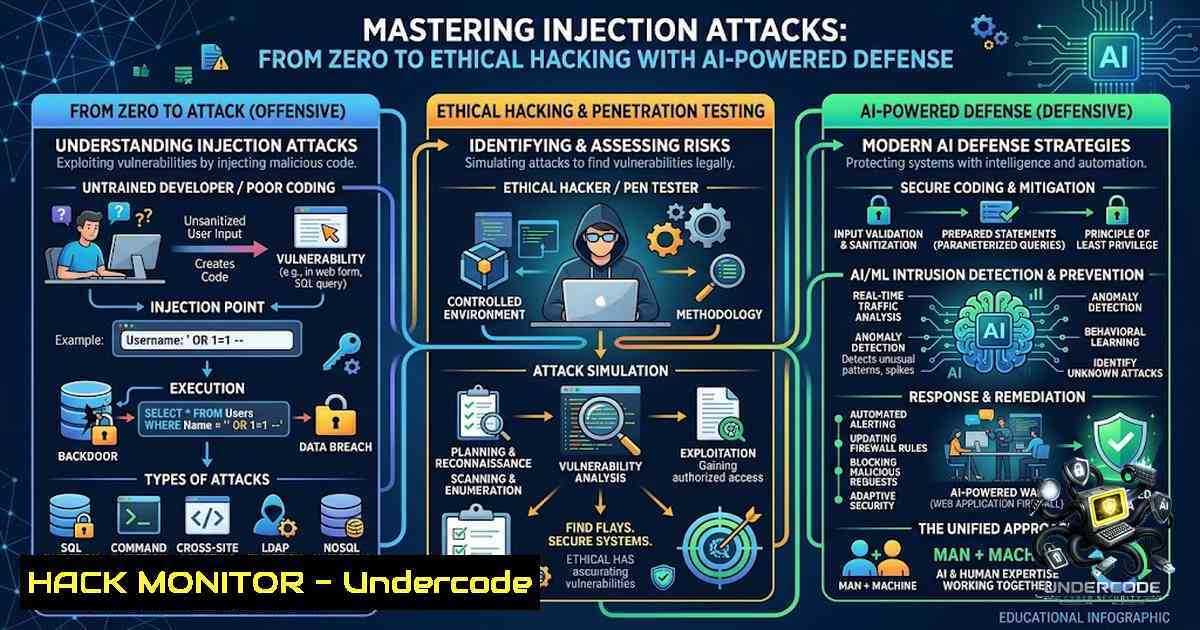
Introduction:
Injection attacks remain one of the most critical and persistent threats in the cybersecurity landscape, consistently ranking among the OWASP Top 10 vulnerabilities. At its core, an injection flaw occurs when an application fails to properly validate, sanitize, or escape user-supplied input, allowing an attacker to send malicious code that is then executed by the system’s interpreter. This seemingly small oversight—a single unsanitized input field—can lead to catastrophic consequences, including unauthorized data access, complete system compromise, and privilege escalation. As highlighted by AiCyber.Guru, an official EC-Council training partner, understanding the mechanics of injection attacks is foundational for any ethical hacker, and the new CEH v13-AI curriculum integrates artificial intelligence across all five phases of ethical hacking to modernize defense strategies.
Learning Objectives & Secrets:
- Objective 1: Identify Injection Vectors – Learn to recognize common injection points, including SQL, NoSQL, OS command, LDAP, XML/XXE, and template injection. Understand how user-controlled parameters (e.g., URL queries, form inputs, HTTP headers) can be manipulated to break out of their intended context.
- Objective 2 (Secret Tip): Exploit with Precision – Move beyond basic `’ OR ‘1’=’1` payloads. Master blind injection techniques (Boolean-based and time-based) to extract data even when no error messages are returned. Use tools like `sqlmap` to automate detection, but always understand the underlying manual process to truly grasp the vulnerability.
- Objective 3 (Secret Tip): Build AI-Augmented Defenses – Leverage AI to automate vulnerability scanning and prioritize remediation. The CEH v13-AI approach teaches you to use AI not just for offense, but to enhance detection of anomalous input patterns that traditional WAFs might miss, boosting efficiency by up to 40%.
You Should Know:
1. Deconstructing the Injection Mechanism: A Step-by-Step Guide
To truly master injection defense, you must think like an attacker. Injection succeeds when untrusted data is sent to an interpreter as part of a command or query. The classic example is SQL Injection (SQLi) in a login form.
Step 1: Identify the Vector. Locate an input field (e.g., a username parameter) that interacts with a database.
Step 2: Test for Breach. Enter a simple payload like `’ OR ‘1’=’1` into the field. If the application returns data or logs you in without valid credentials, the input is vulnerable.
Step 3: Exploit the Flaw. Use a `UNION` query to extract data from other tables. For example, if you know the query is SELECT FROM users WHERE username = '$input', you could input ' UNION SELECT username, password FROM admin_users --.
Step 4: Escalate Privileges. Once you have database access, look for hashed passwords, stored procedures, or even operating system interaction points that could lead to command execution.
Command Injection on Linux:
If an application passes user input directly to the OS shell (e.g., `ping` command), you can chain commands.
 Vulnerable PHP code: system("ping " . $_GET['ip']);
 Attacker submits: 8.8.8.8; whoami
 The server executes: ping 8.8.8.8; whoami
Mitigation: Never use system(), exec(), or `shell_exec()` with unsanitized input. Use `escapeshellarg()` in PHP or, better yet, avoid shell execution entirely.
Windows Command Injection:
 Vulnerable code: system("ping " . $ip);
 Attacker submits: 8.8.8.8 & whoami
Mitigation: Use `escapeshellcmd()` or parameterized APIs.
2. Fortifying Your Applications: Prevention and Hardening
Prevention is always better than cure. The most effective defense against SQL injection is the use of parameterized queries (prepared statements) . This ensures that the SQL structure is defined first, and user input is treated as data, not executable code.
Step 1: Use Parameterized Queries. In languages like Python (with psycopg2), Java (JDBC), or .NET, always use placeholders.
 Vulnerable (String Concatenation)
cursor.execute("SELECT  FROM users WHERE id = " + user_id)

Secure (Parameterized)
cursor.execute("SELECT  FROM users WHERE id = %s", (user_id,))
Step 2: Implement Allowlist Validation. Instead of trying to block all “bad” characters (blacklisting), define exactly what is “good” (allowlisting). For example, if a field expects a number, validate that it is indeed an integer.
Step 3: Apply the Principle of Least Privilege. The database user used by the application should have the minimum permissions necessary. It should not have `DROP TABLE` or `ALTER` privileges.
Step 4: System Hardening (Linux). Use systemd hardening for services to limit the impact of a breach.
 In a service file
ProtectSystem=full
PrivateTmp=true
NoNewPrivileges=true
This restricts the service from writing to the system and prevents privilege escalation.
Step 5: System Hardening (Windows). Run applications with least-privileged service accounts, not as `SYSTEM` or Administrator. Use Windows Defender Application Control (WDAC) or AppLocker to restrict which executables can run.
3. Advanced Exploitation: NoSQL and API Injection
Modern applications often use NoSQL databases (like MongoDB) and REST APIs, introducing new injection vectors.
Step 1: NoSQL Injection. Attackers exploit the JSON structure of queries. For example, in a login request, sending `{“username”: {“$ne”: null}, “password”: {“$ne”: null}}` might bypass authentication in poorly coded MongoDB applications.
Step 2: API Parameter Pollution. Injecting duplicate or malformed parameters can cause the server to interpret the request unexpectedly. For instance, `GET /api/user?id=1&id=2` might return data for user 2 if the server processes the last parameter, bypassing access controls.
Step 3: Testing with Postman. Use Postman to craft and send malicious requests. Look for endpoints that accept JSON or XML and test for XXE (XML External Entity) injection by defining an external entity that reads local files.
- The AI Revolution in Ethical Hacking (CEH v13-AI)
The integration of AI into the CEH v13 curriculum represents a paradigm shift. It’s no longer just about running tools; it’s about augmenting human intelligence.
Step 1: Automating Reconnaissance. AI can analyze massive datasets from OSINT sources to identify potential attack surfaces faster than manual methods.
Step 2: Intelligent Fuzzing. AI-driven fuzzing can generate payloads that adapt based on application responses, finding zero-day vulnerabilities more efficiently.
Step 3: Contextual Remediation. AI can help developers understand not just what the vulnerability is, but how to fix it within the context of their specific codebase.
Step 4: Defending Against AI. As defenders use AI, attackers will too. The CEH v13-AI course covers how to hack and defend AI systems themselves, ensuring you’re prepared for the next generation of threats.
- Building a Career Path: From Beginner to Executive
AiCyber.Guru provides a comprehensive roadmap for cybersecurity professionals. The journey starts with foundational knowledge, moves through certifications like CEH and CPENT, and extends to executive leadership roles. The key is continuous learning and hands-on practice. The CEH v13-AI course offers over 550 attack techniques and 221 practical labs, providing the real-world experience necessary to thrive.
What Undercode Say:
- Key Takeaway 1: The core of injection attacks is a failure to separate data from commands. This fundamental principle of secure coding is timeless and applies across all languages and frameworks.
- Key Takeaway 2: The CEH v13-AI certification is a significant step forward, acknowledging that the future of cybersecurity lies in the synergy between human expertise and artificial intelligence. Embracing AI is not optional; it is essential for staying ahead of sophisticated adversaries.
Analysis:
The discussion around injection attacks highlights a critical gap in many security programs: the over-reliance on perimeter defenses rather than secure coding practices. While firewalls and WAFs can block some attacks, they are not a substitute for secure code. The shift towards integrating AI into training programs like CEH v13-AI is a proactive measure to address the skills gap and the increasing complexity of attacks. However, there is a danger that organizations will view AI as a silver bullet, neglecting the fundamental need for a security-aware culture and robust DevSecOps practices. The most effective defense remains a combination of education, secure design, and continuous monitoring.
Prediction:
- +1 The integration of AI into ethical hacking training will democratize advanced security skills, allowing a broader range of professionals to perform sophisticated penetration testing and threat hunting.
- +1 As AI-powered tools become more prevalent in security operations centers (SOCs), the speed of threat detection and response will improve, potentially reducing the average breach lifecycle significantly.
- -1 The same AI capabilities that empower defenders will be weaponized by attackers, leading to more intelligent, adaptive, and harder-to-detect malware and exploits.
- -1 There is a risk of “AI dependency,” where security professionals may lose their fundamental manual hacking skills, becoming overly reliant on automated tools that can be tricked or bypassed.
- -1 The rapid evolution of AI may outpace the development of regulatory frameworks, creating a “Wild West” scenario in AI security where vulnerabilities are exploited before standards are established.
▶️ Related Video (86% Match):
🎯Let’s Practice For Free:
🎓 Live Courses & Certifications:
Join Undercode Academy for Verified Certifications
🚀 Request a Custom Project:
Secure, high-velocity infrastructure and disruptive technological engineering. Contact our engineering team for high-tier development and proprietary systems:
[email protected]
💎 Smart Architecture | 🛡️ Secure by Design | ⭐ Trusted by Thousands
IT/Security Reporter URL:
Reported By: https://lnkd.in/p/esg9xKbc – Hackers Feeds
Extra Hub: Undercode MoN
Basic Verification: Pass ✅


