
Listen to this Post
Introduction:
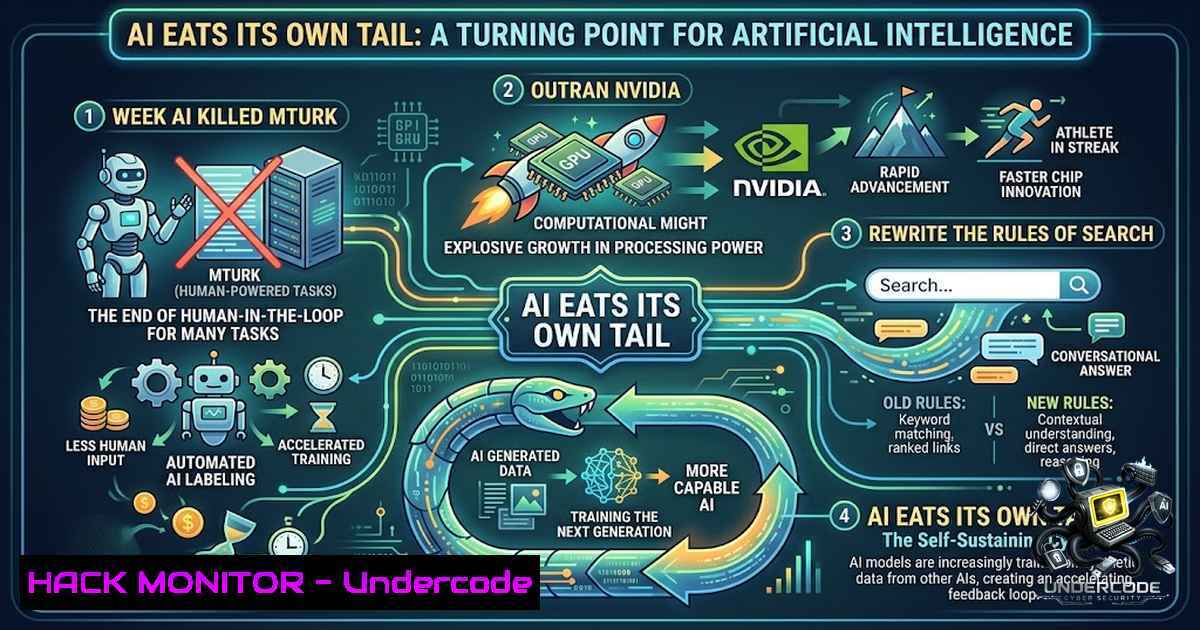
The week of August 31, 2026, may well be remembered as the moment artificial intelligence formally began consuming its own foundational infrastructure. In a development dripping with irony, Amazon announced the shutdown of Mechanical Turk (MTurk)—the crowdsourcing platform Jeff Bezos once christened “artificial artificial intelligence”—citing the very AI revolution the platform helped enable as a primary factor in its obsolescence. Simultaneously, OpenAI unveiled its first in-house inference chip, “Jalapeno,” which reportedly outperformed Nvidia’s leading systems in key benchmarks, while Google rolled out a spam update that wreaked havoc on search rankings. These converging events underscore a pivotal transition: the shift from human-supervised AI training to fully autonomous, AI-driven infrastructure.
Learning Objectives & Secrets:
- Objective 1: Master the Migration from Human-Powered Data Labeling to Automated Pipelines. Understand the technical and strategic reasons behind the decline of platforms like MTurk and learn how to transition data annotation workflows to automated, AI-driven solutions.
-
Objective 2: Optimize AI Inference for Performance and Cost Efficiency (Secret Tip). Learn how to benchmark and tune AI models for inference, focusing on metrics like “work per watt” and latency—the key performance indicators that allowed OpenAI’s Jalapeno chip to surpass Nvidia’s offerings.
-
Objective 3: Navigate and Recover from Major Search Algorithm Updates (Secret Tip). Discover the technical signals that Google’s August 2026 Spam Update targets and learn actionable strategies to audit, recover, and future-proof your website’s SEO performance.
You Should Know:
- The Death of “Artificial Artificial Intelligence” and the Rise of Automated Data Pipelines
Amazon’s decision to shutter MTurk on September 30, 2026, marks the end of an era. Launched in 2005, MTurk was designed to outsource simple digital tasks—labeling data, transcribing audio, answering surveys—that computers of the time found challenging. At its peak, it served over 500,000 workers, or “turkers”. However, the rise of advanced AI models and specialized data-labeling startups like Scale AI, Mercor, and Prolific rendered the platform obsolete. Furthermore, a 2023 study revealed that up to 46% of MTurk workers were using AI models to complete their tasks, creating a feedback loop that degraded data quality. Amazon’s attempt to reposition MTurk as a data-annotation source for its SageMaker service ultimately failed as the company invested fewer resources into the platform.
Step-by-Step Guide: Transitioning from Human to Automated Data Labeling
For organizations still reliant on human-powered data labeling, the shutdown of MTurk is a catalyst for change. Here is a step-by-step guide to building an automated data pipeline:
- Audit Your Existing Data Pipeline: Identify all workflows currently dependent on human annotators.
- Evaluate Automated Labeling Tools: Explore platforms like Scale AI, which offer API-driven, AI-assisted labeling services.
- Implement Active Learning: Use a small, pre-labeled dataset to train a preliminary model. This model can then be used to label new data, with only the most uncertain predictions sent for human review.
- Integrate with AWS SageMaker Ground Truth: For AWS users, leverage SageMaker Ground Truth, which offers built-in workflows for both human and automated labeling, providing a bridge during the transition.
- Monitor Model Drift: Continuously evaluate the performance of your models on newly labeled data to detect and correct for data drift.
Linux Command (for data pipeline monitoring):
 Monitor real-time logs for your data processing pipeline (e.g., using journalctl)
journalctl -u your-data-pipeline.service -f
2. OpenAI’s Jalapeno Chip: Benchmarking AI Inference
OpenAI’s revelation of its custom inference chip, Jalapeno, marks a significant challenge to Nvidia’s dominance. Developed with Broadcom, Jalapeno was tested against Nvidia’s GB200 and GB300 systems using the InferenceX benchmark. The results were striking: Jalapeno delivered 1.5 to 1.9 times the AI work per watt at peak performance and lowered latency by 1.7 to 3.6 times. For highly interactive tasks like AI agents, the performance advantage increased to 2.1 to 4.1 times. This efficiency is partly due to its 700-watt power rating, compared to Nvidia’s 1,400 watts. The chip’s architecture focuses on the two main phases of inference: prefill (compute-heavy) and decode (memory-bandwidth-heavy), storing model data locally to reduce transmission delays.
Step-by-Step Guide: Benchmarking AI Inference Performance
- Select a Benchmarking Tool: Use a public benchmark like SemiAnalysis’s InferenceX to compare performance across different hardware.
- Define Key Performance Indicators (KPIs): Focus on “work per watt” (throughput per unit of power) and end-to-end latency.
- Set Up a Test Environment: Deploy your model on the target hardware (e.g., Nvidia GB300 vs. a test system).
- Run Inference Tests: Execute a series of inference requests using representative models (e.g., GPT-OSS 120B, DeepSeek R1).
- Collect and Analyze Data: Record power consumption, throughput, and latency. Calculate the “work per watt” metric for each system.
- Optimize Model for Inference: Use techniques like quantization and pruning to reduce the model size and improve inference speed on your chosen hardware.
Code Snippet (Python for performance monitoring):
import time
import psutil

def monitor_performance(func):
def wrapper(args, kwargs):
process = psutil.Process()
start_cpu = process.cpu_percent(interval=None)
start_memory = process.memory_info().rss / 1024 / 1024  MB
start_time = time.time()

result = func(args, kwargs)

end_time = time.time()
end_cpu = process.cpu_percent(interval=None)
end_memory = process.memory_info().rss / 1024 / 1024  MB

print(f"Execution Time: {end_time - start_time:.4f} seconds")
print(f"CPU Usage: {end_cpu - start_cpu:.2f}%")
print(f"Memory Usage: {end_memory - start_memory:.2f} MB")
return result
return wrapper

@monitor_performance
def run_inference(model, input_data):
 Your inference code here
return model.predict(input_data)
3. Navigating the August 2026 Google Spam Update
Google began rolling out its third spam update of the year on August 18, 2026. The update, which completed its rollout in just three days, targeted websites that rely on “bad SEO practices”, potentially leading to significant ranking drops. While Google has not announced new spam policies, the update’s swift and impactful nature suggests a refinement in its ability to detect and demote low-quality or manipulative content. A notable side effect of this and other updates has been the dramatic drop in Reddit’s visibility in ChatGPT search citations, falling from 3.83% to 0.52% in a matter of weeks.
Step-by-Step Guide: Recovering from a Google Spam Update
- Perform a Site Audit: Use tools like Google Search Console to identify pages that have dropped in ranking. Focus on the period from August 18 onward.
- Review Google’s Spam Policies: Ensure your site complies with Google’s Webmaster Guidelines. Focus on eliminating thin content, cloaking, and unnatural links.
- Check for Manual Actions: In Google Search Console, look for any manual actions under the “Security & Manual Actions” section.
- Improve Content Quality: Ensure all content is original, comprehensive, and provides genuine value to users.
- Disavow Toxic Backlinks: Use Google’s Disavow Tool to distance your site from low-quality or spammy backlinks that may have been flagged by the update.
- Monitor and Be Patient: Google’s guidance on recovery is often framed in terms of months, not days. Continue to monitor your site’s performance and make iterative improvements.
Useful Tools:
- Google Search Console: For monitoring search performance and manual actions.
- Screaming Frog SEO Spider: For crawling your site to identify technical SEO issues.
- Ahrefs or SEMrush: For backlink analysis and competitor research.
What Undercode Say:
- Key Takeaway 1: The AI Training Paradigm Has Shifted. The shutdown of MTurk is not just the end of a platform; it symbolizes the end of the era where human intelligence was the primary bottleneck for AI training. The focus has irrevocably shifted to building more efficient, automated data pipelines and specialized hardware.
- Key Takeaway 2: Inference is the New Battleground. With the rise of large language models, the ability to run inference efficiently—in terms of cost, speed, and power—is becoming a critical competitive advantage, as demonstrated by OpenAI’s Jalapeno chip.
- Key Takeaway 3: SEO is Becoming a Technical Arms Race. Google’s aggressive spam updates demand a more sophisticated, data-driven approach to SEO. Websites must prioritize high-quality content and technical compliance over manipulative tactics.
Prediction:
- +1 The closure of MTurk will accelerate the consolidation of the data-labeling industry, with major players like Scale AI and Mercor capturing the lion’s share of the market. This will lead to more standardized, higher-quality, and API-accessible training datasets.
- +1 OpenAI’s success with Jalapeno will trigger a wave of investment in custom AI silicon from other major tech companies, leading to a more diversified and competitive hardware landscape. This will ultimately drive down the cost of AI inference.
- -1 The rapid proliferation of custom AI chips will exacerbate the e-waste problem and increase the demand for rare earth minerals, posing significant environmental and geopolitical challenges.
- -1 The increasing sophistication of Google’s spam updates will lead to a “SEO cold war,” where black-hat tactics become more advanced and harder to detect, potentially causing collateral damage to legitimate small businesses.
▶️ Related Video (72% Match):
🎯Let’s Practice For Free:
🎓 Live Courses & Certifications:
Join Undercode Academy for Verified Certifications
🚀 Request a Custom Project:
Secure, high-velocity infrastructure and disruptive technological engineering. Contact our engineering team for high-tier development and proprietary systems:
[email protected]
💎 Smart Architecture | 🛡️ Secure by Design | ⭐ Trusted by Thousands
IT/Security Reporter URL:
Reported By: https://lnkd.in/p/eUXNNGe4 – Hackers Feeds
Extra Hub: Undercode MoN
Basic Verification: Pass ✅


