Listen to this Post
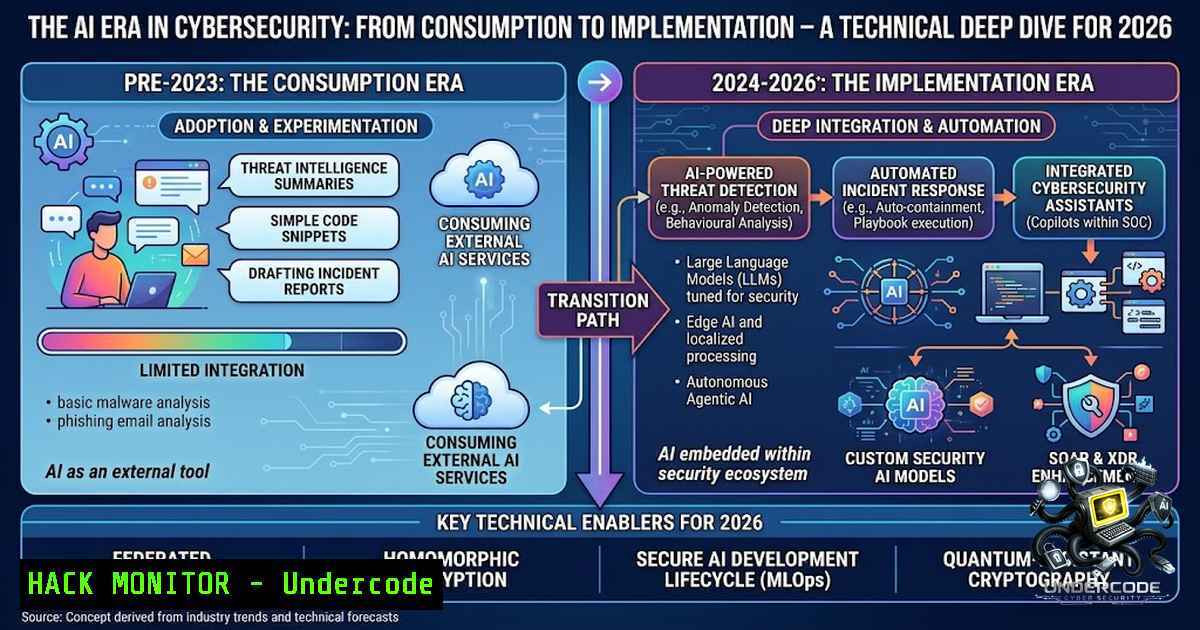
Introduction:
The cybersecurity landscape is undergoing its most profound transformation since the advent of the internet. As AI-powered attacks multiply at an unprecedented rate, security professionals face a critical choice: continue consuming content about what’s changing, or implement the AI-driven defenses that are reshaping the industry. This article bridges the gap between theory and practice, delivering a technical roadmap for integrating AI into security operations, from autonomous penetration testing to agentic defense systems, with actionable commands, configurations, and step-by-step guides for both Linux and Windows environments.
Learning Objectives:
- Master the deployment and configuration of AI-powered security tools, including autonomous penetration testing agents and LLM-based red teaming frameworks.
- Implement AI Security Posture Management (AI-SPM) and zero-trust principles to protect AI models, agents, and the data they process.
- Execute hands-on technical procedures for AI-assisted vulnerability detection, malware analysis, and incident response using verified Linux/Windows commands and open-source tools.
You Should Know:
- Autonomous AI Penetration Testing: Deploying Offensive Security Agents
The era of annual penetration tests is ending. In 2026, organizations are adopting continuous, AI-1ative offensive security that runs autonomously, identifying vulnerabilities in real-time rather than on a scheduled basis. Tools like Snyk’s Evo Continuous Offensive Security represent a paradigm shift, coordinating multiple AI models to perform enterprise-scale penetration testing without human intervention.
For security teams ready to implement AI-driven penetration testing, the open-source ecosystem offers powerful starting points. AIRecon combines a self-hosted Ollama LLM with a Kali Linux Docker sandbox to automate end-to-end security assessments entirely offline, ensuring no data exposure to the cloud. The offsec-ai Python library provides a CLI that combines classic network reconnaissance with modern AI/LLM security testing, covering port scanning, L7/WAF detection, mTLS, certificate analysis, and both OWASP Top 10 and AI/LLM OWASP Top 10 black-box probing.
Step-by-Step Guide: Deploying AIRecon for Offline Autonomous Penetration Testing
Step 1: Install Docker and Kali Linux base image
sudo apt update && sudo apt install docker.io -y
sudo systemctl start docker
sudo docker pull kalilinux/kali-rolling
Step 2: Install Ollama for local LLM inference
curl -fsSL https://ollama.com/install.sh | sh
ollama pull llama3.2  or mistral for lighter resource usage
Step 3: Clone and configure AIRecon
git clone https://github.com/your-org/airecon  replace with actual repo
cd airecon
pip install -r requirements.txt
Step 4: Execute an autonomous scan against a target
python airecon.py --target 192.168.1.0/24 --model llama3.2 --output report.json
This command instructs the AI agent to perform reconnaissance, vulnerability scanning, and exploitation attempts, generating a structured report with prioritized findings.
Windows Alternative: For Windows environments, the PentestGPT tool provides a guided manual testing assistant that runs within PowerShell:
pip install pentestgpt
pentestgpt --target 10.0.0.1 --mode assistant
- AI Security Posture Management (AI-SPM): Hardening the AI Stack
As organizations deploy hundreds of AI agents and models, securing the AI stack has become paramount. AI-SPM represents the next evolution of cloud security posture management, specifically designed to discover, classify, and protect AI assets. Key practices include continuous discovery of sensitive data processed by AI systems, governance of access and identity for AI, and securing the interface between prompts and outputs.
The Five-Eyes Alliance has identified Zero Trust as the best defense against agentic AI threats, emphasizing least privilege, deny-by-default security, application containment, segmentation, and continuous verification. CISA and international partners recommend deploying AI agents initially in low-sensitivity, low-risk environments, avoiding broad or unrestricted system and data access, and integrating agents into existing cybersecurity and risk management frameworks with continuous monitoring.
Step-by-Step Guide: Implementing AI-SPM with Open-Source Tools
Step 1: Deploy Microsoft’s open-source Rampart and Clarity for AI agent safety
Microsoft released these tools to operationalize safety engineering for agentic AI, with Rampart focusing on red teaming and Clarity on analyzing assumptions in AI agents.
git clone https://github.com/microsoft/rampart
cd rampart
pip install -e .
rampart scan --agent-path ./my_agent --output security_report.json
Step 2: Implement prompt firewall and input/output inspection
Using Harness AI Firewall, which ties to the OWASP Top 10 for LLM Applications:
docker run -d -p 8080:8080 harness/ai-firewall
curl -X POST http://localhost:8080/inspect -H "Content-Type: application/json" -d '{"prompt":"Your input here"}'
Step 3: Enforce JWT-based authentication with scoped claims for inference endpoints
 Python example for securing an LLM endpoint
from flask import Flask, request, jsonify
import jwt
import datetime

app = Flask(<strong>name</strong>)
SECRET_KEY = "your-secret-key"

def token_required(f):
def decorated(args, kwargs):
token = request.headers.get('Authorization')
if not token:
return jsonify({'message': 'Token is missing'}), 401
try:
data = jwt.decode(token, SECRET_KEY, algorithms=["HS256"])
except:
return jsonify({'message': 'Token is invalid'}), 401
return f(args, kwargs)
return decorated

@app.route('/inference', methods=['POST'])
@token_required
def inference():
 Process inference request with role-based access control
pass
Enforce role-based access control separating inference consumers, prompt engineers, model administrators, and auditors.
3. AI-Powered Malware Detection and Analysis
Traditional signature-based antivirus is insufficient against evasive, AI-generated malware. AI-powered malware scanners leverage semantic analysis to detect threats without signatures, operating offline to protect sensitive environments. The semantics-av-cli tool provides a free, open-source CLI for Linux that detects evasive threats using AI models.
Step-by-Step Guide: Deploying AI-Powered Malware Scanning
Step 1: Install semantics-av-cli on Linux
git clone https://github.com/metaforensics-ai/semantics-av-cli
cd semantics-av-cli
pip install -r requirements.txt
Step 2: Perform an offline scan of a suspicious file
semantics-av scan /path/to/suspicious.exe
Step 3: Generate a detailed HTML report
semantics-av analyze suspicious.exe --format html -o report.html
This provides a comprehensive analysis including threat classification, confidence scores, and recommended remediation actions.
Step 4: For Windows environments, integrate AI-powered detection into PowerShell
 Using Windows Defender with cloud-delivered protection and AI/ML
Set-MpPreference -CloudBlockLevel High
Set-MpPreference -CloudTimeout 50
Update-MpSignature
Start-MpScan -ScanType QuickScan
4. AI-Assisted Vulnerability Detection and Code Security
Major tech companies are releasing specialized AI models for vulnerability detection. Microsoft’s MAI-Cyber-1-Flash, the first AI model built specifically for software vulnerability analysis, claims to beat Gemini and GPT on detection while cutting operating costs by 50%. Google’s CodeMender detects and fixes weaknesses in software code. These tools coordinate hundreds of specialized AI agents to analyze codebases continuously.
Step-by-Step Guide: Integrating AI Vulnerability Detection
Step 1: Using Microsoft’s open-source security tools
 Clone and set up Microsoft's security scanning tools
git clone https://github.com/microsoft/security-tools
cd security-tools
pip install -e .

Run AI-powered code analysis
python scan_code.py --path ./my_project --output vulnerabilities.json
Step 2: Deploy Snyk with AI-powered continuous offensive security
 Install Snyk CLI
npm install -g snyk
snyk auth
snyk test --severity-threshold=high
Step 3: Integrate AI code review into CI/CD pipeline (GitHub Actions example)
name: AI Security Scan
on: [bash]
jobs:
security-scan:
runs-on: ubuntu-latest
steps:
- uses: actions/checkout@v3
- name: Run AI vulnerability scan
run: |
pip install offsec-ai
offsec-ai scan --path ./src --format json --output scan_results.json
5. AI-Powered Security Monitoring and Incident Response
AI agents are reshaping security operations, supporting complex processes from enriching intelligence and accelerating investigations to prioritizing threats and orchestrating response. For Linux servers and single-board computers, the ai-sbc-security tool provides AI-powered security monitoring.
Step-by-Step Guide: Setting Up AI-Powered Security Monitoring
Step 1: Install ai-sbc-security on a Linux server
curl -sSL https://raw.githubusercontent.com/fahimrahmanbooom/ai-sbc-security/main/install.sh | bash
Step 2: Update and run security monitoring
sudo aisbc -up  Update security definitions
sudo aisbc -scan  Perform AI-powered security scan
Step 3: For enterprise environments, deploy Microsoft’s Project Perception
Project Perception continuously scans an organization’s systems for security risks, coordinating multiple specialized AI agents. Deployment typically requires Azure integration:
 Azure CLI commands for deploying Perception
az login
az perception deploy --resource-group your-rg --1ame perception-instance
Step 4: Implement continuous monitoring with threat intelligence feeds
 Using MISP (Malware Information Sharing Platform) with AI enrichment
docker run -d -p 80:80 -p 443:443 -v /misp-data:/var/www/MISP/app/tmp misp/misp
 Integrate with AI threat intelligence
python misp_ai_enrich.py --event-id 12345 --ai-model llama3.2
6. AI Security Training and Certification Pathways
The demand for AI security expertise has created a robust ecosystem of training programs. CISA offers courses covering AI and ML techniques for cybersecurity challenges. Carnegie Mellon University’s CERT program provides leadership certificates in AI for Cybersecurity, including constructing ML models and applied data science.
Recommended Learning Path:
- Start with foundational courses covering core machine learning techniques used in cyber defense, network security, threat detection, and malware analysis
- Progress to specialized training on securing AI systems, covering AI fundamentals, protection of AI systems and data, and AI-assisted security operations
- Pursue hands-on certifications that include practical labs on AI red teaming, prompt injection defense, and model security
Hands-On Exercise: Building a Simple AI-Based Intrusion Detection System
 Python example using scikit-learn for network intrusion detection
import pandas as pd
from sklearn.ensemble import RandomForestClassifier
from sklearn.model_selection import train_test_split

Load network traffic data (replace with actual dataset)
data = pd.read_csv('network_traffic.csv')
X = data.drop('label', axis=1)
y = data['label']

Train AI model
X_train, X_test, y_train, y_test = train_test_split(X, y, test_size=0.2)
model = RandomForestClassifier(n_estimators=100)
model.fit(X_train, y_train)

Deploy for real-time detection
def detect_intrusion(packet_features):
prediction = model.predict([bash])
return "Intrusion Detected" if prediction[bash] == 1 else "Normal Traffic"
What Undercode Say:
- The gap between AI security awareness and implementation remains the single biggest vulnerability facing organizations today. Information without implementation is merely entertainment.
- The cybersecurity industry is shifting from annual, point-in-time assessments to continuous, AI-driven offensive security that operates autonomously, fundamentally changing how we think about penetration testing and vulnerability management.
- Zero Trust principles—least privilege, deny-by-default, continuous verification—are emerging as the essential framework for securing agentic AI systems, with international cybersecurity agencies providing unified guidance.
- Open-source AI security tools have matured significantly in 2026, enabling organizations of all sizes to deploy sophisticated defenses without relying solely on commercial vendors.
- The convergence of AI and cybersecurity creates both unprecedented defensive capabilities and new attack vectors, demanding continuous learning and adaptation from security professionals.
- Microsoft, Google, and OpenAI are racing to deploy specialized cybersecurity AI models, creating a competitive landscape that benefits defenders through rapid innovation and cost reduction.
- Training programs from CISA, CMU, and other institutions are essential for building the workforce needed to secure the AI era, with emphasis on both theoretical understanding and practical application.
- Organizations must move beyond “reading about” AI security to implementing AI-SPM, prompt firewalls, and continuous monitoring, treating AI security as an operational imperative rather than a theoretical exercise.
- The economic argument for AI security is compelling: Microsoft’s MAI-Cyber-1-Flash cuts operating costs by 50% while improving detection capabilities.
- The future of cybersecurity belongs to those who can bridge the gap between AI theory and implementation, transforming knowledge into operational capability.
Prediction:
- +1 By 2027, autonomous AI penetration testing will become standard practice for enterprises, reducing the average time to detect critical vulnerabilities from weeks to hours.
- +1 The AI security market will consolidate around a few major platforms, with Microsoft, Google, and OpenAI competing to provide comprehensive security suites that integrate vulnerability detection, threat intelligence, and automated remediation.
- -1 The proliferation of AI agents will create new attack surfaces, with prompt injection, model poisoning, and data leakage becoming the most critical security challenges for organizations deploying AI.
- +1 Open-source AI security tools will continue to democratize access to advanced defenses, enabling smaller organizations to compete with enterprise-level security postures.
- -1 The shortage of AI security professionals will worsen before it improves, creating a skills gap that organizations must address through training, automation, and strategic partnerships.
- +1 Regulatory frameworks like the EU AI Act and NIST AI RMF will drive standardization in AI security practices, creating clearer compliance pathways for organizations.
- +1 AI-powered malware detection will render traditional signature-based antivirus obsolete within three years, with semantic analysis becoming the new standard.
- -1 The speed of AI innovation will outpace the development of security controls, creating a window of vulnerability that attackers will exploit aggressively.
- +1 Continuous AI security posture management (AI-SPM) will become as essential as cloud security posture management (CSPM) is today, with integrated solutions emerging across major cloud platforms.
- +1 The integration of AI into security operations centers (SOCs) will reduce mean time to response (MTTR) by over 70%, fundamentally transforming the economics of cybersecurity.
▶️ Related Video (76% Match):
🎯Let’s Practice For Free:
🎓 Live Courses & Certifications:
Join Undercode Academy for Verified Certifications
🚀 Request a Custom Project:
Secure, high-velocity infrastructure and disruptive technological engineering. Contact our engineering team for high-tier development and proprietary systems:
[email protected]
💎 Smart Architecture | 🛡️ Secure by Design | ⭐ Trusted by Thousands
IT/Security Reporter URL:
Reported By: https://lnkd.in/p/ehRjxiub – Hackers Feeds
Extra Hub: Undercode MoN
Basic Verification: Pass ✅


