Listen to this Post
Introduction:
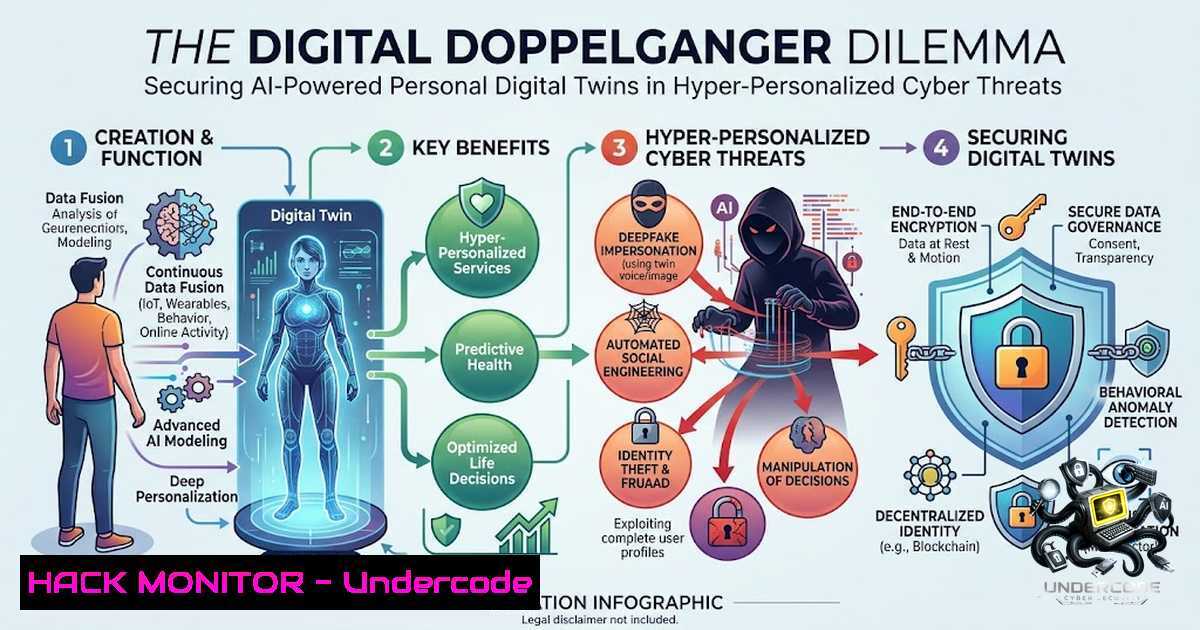
The concept of a digital twin—a virtual replica of a physical system—has evolved dramatically. We are now witnessing the emergence of AI-powered personal digital twins: models fed with years of personal journals, videos, transcripts, and records until they “know” an individual better than they know themselves. While this represents a frontier in AI, it also creates an unprecedented attack surface. This article explores the cybersecurity implications of such hyper-personalized AI models, detailing the specific threats they face and providing actionable technical guidance for their defense.
Learning Objectives:
- Understand the unique security and privacy risks associated with AI-powered personal digital twins, including data poisoning and model inversion.
- Learn to identify and mitigate specific attack vectors such as prompt injection, data exfiltration, and insider threats.
- Acquire practical skills in using Linux and Windows commands, as well as configuration techniques, to audit and harden AI model environments.
You Should Know:
- The Expanded Attack Surface of Personal AI Models
The creation of a personal digital twin involves ingesting massive amounts of sensitive data, creating a rich target for adversaries. The attack surface expands significantly, introducing complex challenges in data security, privacy, and intellectual property. This data is vulnerable to manipulation, poisoning attacks, and unauthorized access or theft. The potential for phishing, business email compromise (BEC), digital extortion, and sensitive data theft on a whole new scale is now a tangible reality.
Step‑by‑step guide to assessing your AI model’s data exposure:
1. Inventory Data Sources: Identify all data sources feeding your model (e.g., cloud storage, local drives, APIs).
2. Map Data Flow: Create a data flow diagram to understand how data moves from source to model and to outputs.
3. Audit Permissions: Review and restrict permissions for data access. On Linux, use `ls -la` to check file permissions and `getfacl` for more detailed ACLs. On Windows, use `icacls` to view and modify file permissions.
4. Monitor for Anomalies: Implement monitoring for unusual data access patterns. On Linux, use `auditd` to track file access; on Windows, enable advanced audit policy in the Local Security Policy.
5. Conduct a Data Minimization Review: Regularly review and purge unnecessary data to reduce the attack surface.
2. Data Poisoning and Model Integrity Attacks
One of the most critical threats is data poisoning, where an attacker injects manipulated data into the model’s training pipeline. This can corrupt model updates, leading to unsafe or biased outputs. For a personal twin, this could mean subtly altering its behavior to manipulate the individual’s decisions or exfiltrate information. This is a primary threat that targets the integrity of the model and its data pipelines.
Step‑by‑step guide to detecting and preventing data poisoning:
- Implement Secure Data Pipelines: Ensure all data ingestion points are authenticated and encrypted. Use TLS for data in transit.
- Validate Input Data: Use checksums (e.g., SHA-256) to verify the integrity of training data before ingestion. A Linux command to generate a checksum is
sha256sum <filename>. - Monitor for Anomalies: Use statistical process control to detect deviations in data patterns.
- Employ Adversarial Training: Incorporate poisoned data examples into your training set to make the model more robust.
- Regularly Audit Model Behavior: Compare model outputs against expected baselines to detect drift. Use A/B testing to compare the performance of new model versions against a trusted baseline.
3. Privacy Attacks: Model Inversion and Extraction
AI models, especially large language models, are vulnerable to attacks that can extract sensitive training data. Model inversion attacks can reconstruct personal information used in training. Furthermore, a threat actor with API access could launch query-based attacks to compile enough input-output pairs to derive a surrogate model, effectively stealing the intellectual property.
Step‑by‑step guide to mitigate model inversion and extraction risks:
1. Limit API Exposure: Restrict API access to authenticated and authorized users only. Implement rate limiting to prevent bulk queries.
2. Apply Differential Privacy: Add noise to model outputs or during training to make it harder to infer individual data points.
3. Monitor Query Patterns: Analyze API logs for suspicious patterns indicative of model extraction attempts. On Linux, use `grep` and `awk` to parse logs for unusual query frequencies. On Windows, use `Select-String` in PowerShell.
4. Implement Output Filtering: Sanitize model outputs to prevent the leakage of sensitive information. Use regular expressions to detect and redact PII (e.g., emails, phone numbers).
5. Use Model Watermarking: Embed a unique identifier into the model to help trace leaked versions.
4. Insider Threats and AI-Powered Social Engineering
Personal digital twins create a new class of insider threat. A compromised twin could be used for social engineering attacks, mimicking the individual with high fidelity to deceive colleagues or access systems. The very nature of these twins—designed to know everything about a person—makes them a powerful tool for malicious actors.
Step‑by‑step guide to defending against insider threats leveraging AI twins:
1. Implement Zero Trust Architecture (ZTA): Adopt a “never trust, always verify” approach. This includes continuous verification of user and device identities.
2. Enforce Least Privilege: Grant users and AI agents only the minimum necessary permissions.
3. Monitor for Anomalous Behavior: Use User and Entity Behavior Analytics (UEBA) to detect unusual activity, such as an AI agent accessing data outside its normal scope.
4. Conduct Red Team Exercises: Simulate attacks where a malicious actor uses a digital twin to test your defenses.
5. Establish Clear Governance: Define who can create, access, and control an AI twin, and under what circumstances.
5. Hardening the AI Model Supply Chain
The security of an AI model depends on the integrity of its entire supply chain, from training data to the libraries and frameworks used. Vulnerabilities in any component can be exploited.
Step‑by‑step guide to securing the AI supply chain:
- Use Verified Artifacts: Verify a signed hash for every model artifact against a trusted registry before it loads.
- Scan Dependencies: Regularly scan all dependencies (Python packages, libraries) for known vulnerabilities. On Linux, tools like `pip-audit` or `safety` can be used. On Windows, use `pip-audit` within a WSL environment or use dependency scanning tools in your CI/CD pipeline.
- Isolate the Model Environment: Run the model in a containerized environment (e.g., Docker) with minimal privileges.
- Implement a Secure Development Lifecycle: Integrate security checks into every stage of model development, from data collection to deployment.
- Conduct Regular Penetration Testing: Use tools like
nmap,nikto, and `sqlmap` to test the security of the infrastructure surrounding the model.
6. API Security and Cloud Hardening
Personal AI twins are often accessed via APIs and deployed in the cloud, making them susceptible to web-based attacks. A recent flaw in Microsoft 365 Copilot demonstrated how a single crafted email could be used to steal sensitive data.
Step‑by‑step guide to securing the API and cloud environment:
1. Harden API Endpoints: Implement strong authentication (e.g., OAuth 2.0) and authorization. Validate all inputs to prevent injection attacks.
2. Use a Web Application Firewall (WAF): Deploy a WAF to protect against common web exploits.
3. Secure Cloud Configurations: Follow cloud provider best practices (e.g., AWS Well-Architected Framework, Azure Security Benchmark). Disable unnecessary services and ports.
4. Encrypt Data at Rest and in Transit: Use strong encryption (e.g., AES-256 for data at rest, TLS 1.3 for data in transit).
5. Monitor Cloud Logs: Actively monitor cloud logs for suspicious activities. On AWS, use CloudTrail and GuardDuty. On Azure, use Azure Monitor and Sentinel.
What Undercode Say:
- Key Takeaway 1: The era of hyper-personalized AI introduces profound security risks that traditional cybersecurity models are ill-equipped to handle. The attack surface has expanded from infrastructure to the very data that defines us.
- Key Takeaway 2: Proactive defense is non-1egotiable. Organizations and individuals must adopt a “zero-trust” mindset for AI, verifying every input, output, and interaction. This includes rigorous data hygiene, continuous monitoring, and robust supply chain security.
Analysis:
The creation of personal AI twins is not just a technological leap; it is a fundamental shift in the nature of identity and trust. These models are not merely tools; they are digital representations of our knowledge, behavior, and personality. Compromising them is akin to stealing a person’s identity. The threats are multifaceted, ranging from technical vulnerabilities like data poisoning and model inversion to sophisticated social engineering attacks that exploit the model’s intimate knowledge of its human counterpart. The urgency to develop and implement robust security frameworks for these systems is paramount. The security community must move beyond reactive patching and embrace proactive, AI-1ative security strategies. This includes developing new standards for AI model verification, establishing clear ethical guidelines for data usage, and fostering a culture of security awareness that extends from developers to end-users. The future of personal AI hinges on our ability to build trust through security, ensuring these powerful tools enhance our lives without compromising our privacy and safety.
Prediction:
- -1 The proliferation of personal AI twins will lead to a new wave of sophisticated, AI-driven social engineering attacks, with a significant increase in successful BEC and identity theft cases within the next 18 months.
- -1 Without standardized security protocols, the rush to develop hyper-personalized AI will result in high-profile data breaches that expose the intimate personal data of millions, leading to severe regulatory and reputational damage.
- +1 The necessity to secure these systems will accelerate the development and adoption of advanced AI security technologies, including federated learning, homomorphic encryption, and AI-driven threat detection, creating a new multi-billion dollar cybersecurity market.
- +1 The focus on AI security will drive the creation of new professional roles and certifications, such as AI Security Architect and AI Red Team Specialist, addressing the critical skills gap in the industry.
▶️ Related Video (80% Match):
🎯Let’s Practice For Free:
🎓 Live Courses & Certifications:
Join Undercode Academy for Verified Certifications
🚀 Request a Custom Project:
Secure, high-velocity infrastructure and disruptive technological engineering. Contact our engineering team for high-tier development and proprietary systems:
[email protected]
💎 Smart Architecture | 🛡️ Secure by Design | ⭐ Trusted by Thousands
IT/Security Reporter URL:
Reported By: https://lnkd.in/p/e5CpFm9X – Hackers Feeds
Extra Hub: Undercode MoN
Basic Verification: Pass ✅


