Listen to this Post
Introduction:
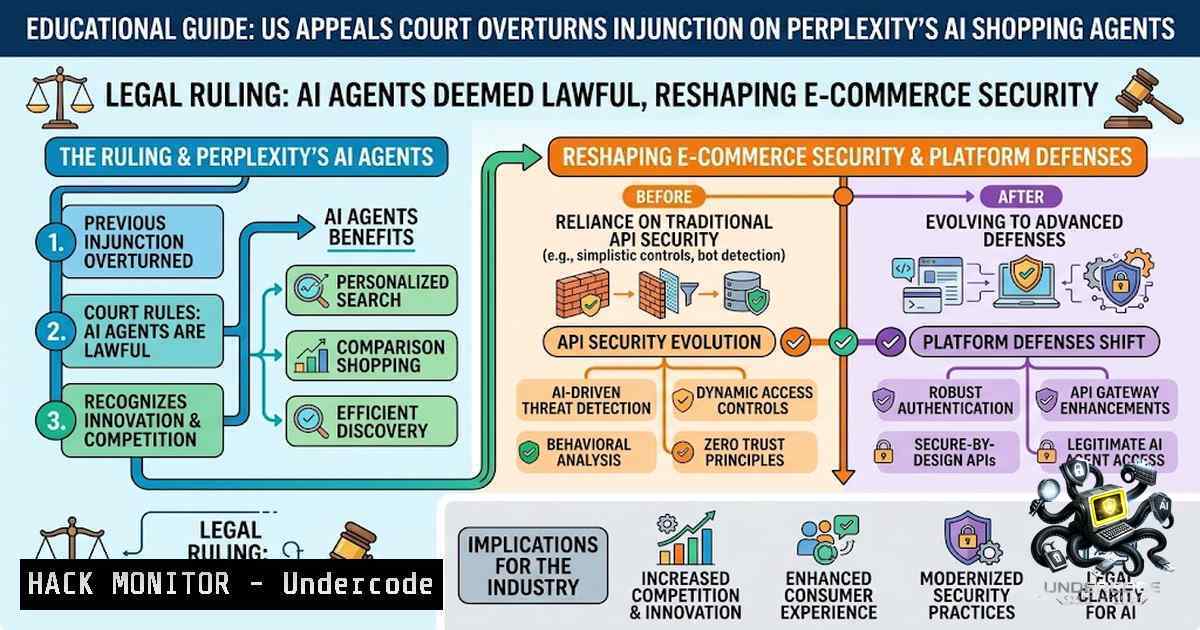
In a landmark ruling that redefines the legal boundaries of web automation, the US Court of Appeals has overturned a preliminary injunction against Perplexity’s agentic AI shopping tools, asserting that user-instructed AI agents do not violate the Computer Fraud and Abuse Act (CFAA) by bypassing platform interfaces. This decision fundamentally challenges the defensive moats of major retailers, compelling a strategic pivot from consumer-facing UI optimization to the monetization and hardening of structured API endpoints. As autonomous agents become the primary arbiters of purchasing decisions, the cybersecurity paradigm shifts from blocking bots to authenticating and controlling synthetic buyers through advanced API security, zero-trust architectures, and real-time traffic analysis.
Learning Objectives:
- Understand the legal and technical distinction between unauthorized access and user-directed automation under the CFAA.
- Identify the key API security vulnerabilities introduced by autonomous shopping agents, including parameter tampering and rate-limiting bypasses.
- Implement practical hardening techniques for API endpoints, including OAuth 2.0 scopes, mTLS, and behavioral analytics for synthetic traffic.
You Should Know:
- Decoding the CFAA Ruling and Its Technical Implications for Web Scraping
The court’s decision hinges on the interpretation of “without authorization” under 18 U.S.C. § 1030. Unlike traditional scraping that exploits vulnerabilities, Perplexity’s agents act on explicit user instructions (e.g., “find the best price for product X”), analogous to a user manually searching via a browser. The ruling establishes that as long as the agent accesses the site after the user has logged in and does not circumvent technical barriers (e.g., paywalls or CAPTCHAs), it does not constitute a CFAA violation.
Step‑by‑step guide to analyze web traffic and distinguish between human and agentic requests for security auditing:
This process involves inspecting HTTP headers and request patterns to identify automated behavior.
- Step 1: Capture Network Traffic
Use `tcpdump` on Linux or Wireshark on Windows to capture live traffic to your e-commerce platform.
Linux Command: `sudo tcpdump -i eth0 -w capture.pcap host your-api-domain.com`
Windows Command (PowerShell): `netsh trace start capture=yes tracefile=capture.etl`
- Step 2: Analyze Header Fingerprints
Extract and reviewUser-Agent,Accept-Language, and `Sec-Fetch-` headers. Autonomous agents often present unique identifiers or omit typical browser-specific attributes.
Command (Linux): `tshark -r capture.pcap -Y “http” -T fields -e http.user_agent | sort | uniq -c | sort -1r` - Step 3: Evaluate Session Consistency
Human users exhibit variable session times and navigation paths. Agents demonstrate precise, high-speed sequences. Use SIEM tools to calculate standard deviation in page load timing.
Tool Suggestion: Set up a Splunk query to detect deviations: `index=web_logs | stats avg(duration) by session_id | where avg < 200ms`
- API Security Hardening: Defending Against Autonomous Price-Comparison Agents
With the legal green light for agents, organizations must pivot to API-level security rather than bot-blocking at the network edge. The primary vector is not DDoS, but business logic abuse—massive scraping of pricing and inventory data without transacting.
Step‑by‑step guide to implement OAuth 2.0 with mTLS for agent authentication:
- Step 1: Enable mTLS on Your API Gateway (e.g., Kong or NGINX)
Generate client certificates and restrict access to trusted partners.
NGINX Configuration Snippet:
server {
listen 443 ssl;
ssl_client_certificate /etc/nginx/trusted_ca.crt;
ssl_verify_client on;
if ($ssl_client_verify != SUCCESS) { return 403; }
}
- Step 2: Implement Granular Scopes in OAuth 2.0
Limit agent access to read-only inventory but require a secondary authorization for price-comparison modules.
cURL Request for Token: `curl -X POST https://auth.api.com/token -d “grant_type=client_credentials&scope=inventory:read” –cert client.crt –key client.key` - Step 3: Enforce Rate Limiting and Anomaly Detection
Apply dynamic rate limiting tied to the OAuth client ID, not just IP address, to prevent distributed scraping via compromised legitimate tokens.
Redis Lua Script to increment counters per client: `local current = redis.call(‘incr’, KEYS); if current > 100 then return 429 end` </li> </ul> <ol> <li>Windows and Linux Forensics: Detecting Compromised Endpoints Used for Agent Orchestration</li> </ol> Security operations must also consider that agentic tools may be misused by malicious actors to conduct reconnaissance. IT teams should monitor endpoints where AI agents are deployed. Step‑by‑step guide to audit PowerShell and Bash scripts for unauthorized web requests: <ul> <li>Step 1: Monitor Outbound Connections (Linux) </li> </ul> <h2 style="color: yellow;">Audit active connections and filter for unusual ports.</h2> Command: `ss -tulpn | grep -E '443|80' | awk '{print $7}' | cut -d= -f2 | sort | uniq` - Step 2: Windows PowerShell Logging Enable deep script block logging to detect automation commands. PowerShell (Admin): `Set-ItemProperty -Path "HKLM:\SOFTWARE\Microsoft\Windows\CurrentVersion\Policies\System\Audit" -1ame "ScriptBlockLogging" -Value 1` <h2 style="color: yellow;">Review logs in Event Viewer under `Microsoft-Windows-PowerShell/Operational`.</h2> <ul> <li>Step 3: Integrate with EDR Use CrowdStrike or Microsoft Defender to alert when headless browsers (e.g., Playwright, Puppeteer) launch on endpoints not authorized for development.</li> </ul> <ol> <li>Cloud Hardening: Securing AWS/GCP Infrastructure Against AI Agent Exploitation</li> </ol> Retailers moving to monetize API endpoints must ensure their cloud environments are not vulnerable to privilege escalation, which could allow an agent to pivot from read-only price data to modifying backend inventory. Step‑by‑step guide to implement AWS IAM policies restricting agent roles: <ul> <li>Step 1: Create a Specific IAM Role for AI Agents Attach a policy that explicitly denies write access to DynamoDB or RDS. </li> </ul> <h2 style="color: yellow;">Policy JSON Snippet:</h2> [bash] { "Version": "2012-10-17", "Statement": [ {"Effect": "Deny", "Action": "rds:Modify", "Resource": ""}, {"Effect": "Allow", "Action": "execute-api:Invoke", "Resource": "arn:aws:execute-api:region:account:stage/GET/prices"} ] }- Step 2: Deploy Web Application Firewalls (WAF) with Bot Control
Configure AWS WAF to inspect JSON payloads for malformed requests that bypass UI constraints.
Rule Snippet: Block requests with `Content-Type: application/json` containing parameters not matching the standard schema (e.g., `price_floor` values outside predefined ranges). -
Step 3: Enable VPC Flow Logs
Trace traffic to detect data exfiltration attempts by compromised agents.
Command to analyze logs with Athena: `SELECT srcaddr, dstaddr, bytes_transferred FROM flow_logs WHERE protocol = 6 AND bytes_transferred > 1000000`
- The Shift to API Monetization: Building a Secure Revenue Channel
The ruling forces a business model evolution. Platforms must now deploy “structured API endpoints for synthetic agents,” turning a security threat into a revenue stream by authenticating and billing for agentic access.
Step‑by‑step guide to set up an API Product tier using API Gateway:
- Step 1: Define Usage Plans
In AWS API Gateway or Azure API Management, create a “Synthetic Agent” product with a quota of 10,000 requests/hour. -
Step 2: Implement API Keys for Monetization
Generate keys specific to Agent IDs (e.g., Perplexity, Shopping.ai).
cURL Header Requirement: `-H “x-api-key: your-key-here”`
- Step 3: Validate with Signed Requests
Use HMAC signatures to ensure the request hasn’t been tampered with.
Python Code Snippet (Validation):
def verify_signature(payload, signature, secret):
computed = hmac.new(secret, payload, hashlib.sha256).hexdigest()
return hmac.compare_digest(computed, signature)
What Undercode Say:
- Key Takeaway 1: The CFAA is insufficient for protecting platforms from user-directed automation; technical controls (OAuth, mTLS, rate limiting) must now assume that any authenticated session could be an agent.
- Key Takeaway 2: The era of “customer relationship” is disintermediating; the true defensive asset is not the shopping cart UI, but the audit logs of who (or what) is calling the price and stock APIs.
Analysis: This ruling exposes the fragility of the traditional e-commerce security model, which relied on obscuring data behind a friendly GUI. By affirming that AI agents are essentially “power users,” the court has accelerated the need for deep API security maturity. Organizations must treat every API call with suspicion and implement granular authorization (e.g., OAuth scopes) while simultaneously monitoring for business logic abuse (e.g., scraping price history to drive competitors’ pricing models). The immediate risk is not a cyber breach but a revenue erosion attack, where autonomous agents systematically arbitrage price discrepancies faster than human traders. The long-term opportunity lies in charging premium rates for real-time, validated data feeds, effectively transforming the defensive SIEM into a business intelligence asset that verifies and monetizes synthetic traffic.
Prediction:
- +1 Major retailers will aggressively adopt “Verified Agent” programs, offering premium, authenticated API access with guaranteed uptime, turning a legal vulnerability into a high-margin B2B revenue stream.
- -1 The development of “shopping agent malware” will surge, where attackers inject malicious instructions into otherwise legitimate agent frameworks to exfiltrate competitor pricing or manipulate inventory levels at scale.
- -1 Web Application Firewalls (WAFs) will face a critical failure rate in blocking agentic traffic, leading to a rise in “credential stuffing 2.0” attacks where stolen session cookies are fed directly to headless browsers, bypassing traditional bot detection.
- +1 Security vendors will pivot to “agent identity” solutions, developing new forms of cryptographic attestation (e.g., signed manifests from the agent’s runtime) to prove the AI’s intent and prevent man-in-the-middle prompt injections.
- -1 Legacy e-commerce platforms that cannot implement mTLS and OAuth scopes within 12 months will face severe margin compression, as competitors’ agents automatically capture price advantages and re-route customer purchases.
▶️ Related Video (72% Match):
🎯Let’s Practice For Free:
🎓 Live Courses & Certifications:
Join Undercode Academy for Verified Certifications
🚀 Request a Custom Project:
Secure, high-velocity infrastructure and disruptive technological engineering. Contact our engineering team for high-tier development and proprietary systems:
[email protected]
💎 Smart Architecture | 🛡️ Secure by Design | ⭐ Trusted by ThousandsIT/Security Reporter URL:
Reported By: https://lnkd.in/p/enPaJfZj – Hackers Feeds
Extra Hub: Undercode MoN
Basic Verification: Pass ✅🔐JOIN OUR CYBER WORLD [ CVE News • HackMonitor • UndercodeNews ]
📢 Follow UndercodeTesting & Stay Tuned:
- Step 2: Deploy Web Application Firewalls (WAF) with Bot Control


