Listen to this Post
Introduction:
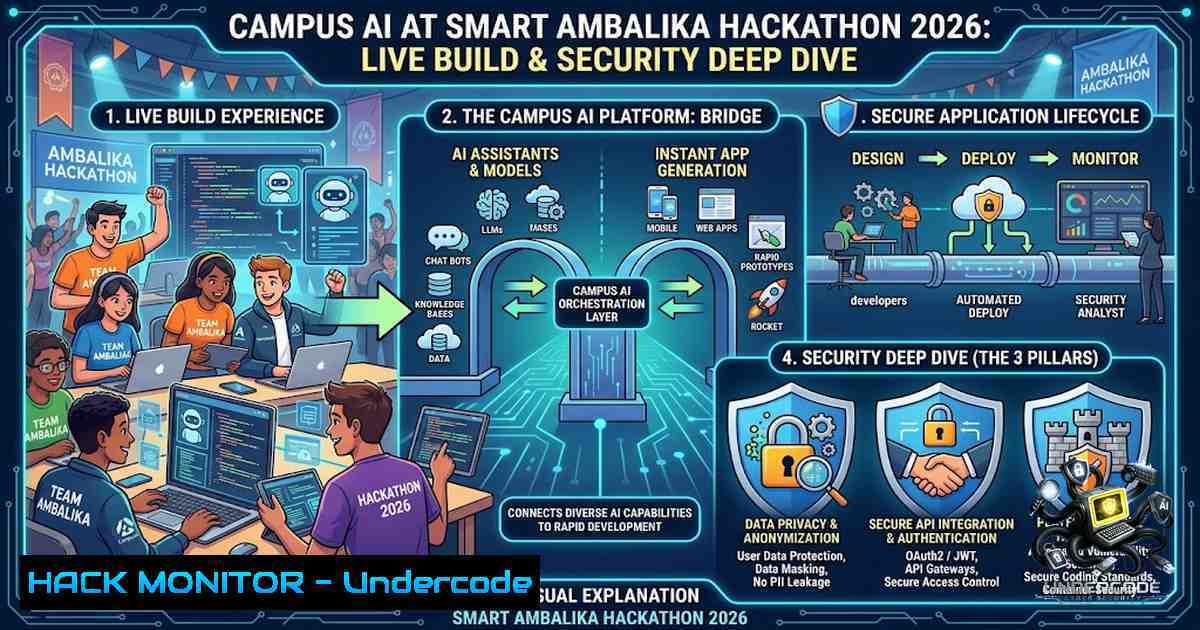
The Smart Ambalika Hackathon 2026 is witnessing the live development of “CampusAI,” a digital hub for AIMT students that combines a 24/7 AI Assistant with an instant application generator. While the hackathon energy is focused on functionality and speed to demo, this live coding environment serves as a critical case study in rapid API development, real-time data handling, and the inherent security risks of deploying AI-powered assistants in an institutional ecosystem. This article extracts the core technical architecture behind such a platform, exploring the cybersecurity measures necessary to protect student data and prevent prompt injection attacks in generative AI tools, while also providing hardening guidance for the underlying infrastructure.
Learning Objectives:
- Understand the technical stack components of a campus AI assistant and application generator.
- Implement API security best practices to protect AI endpoints from malicious inputs and data leakage.
- Apply Linux and Windows hardening commands to secure the servers hosting real-time AI applications.
- Develop a threat model for AI assistants, focusing on prompt injection, data privacy, and output validation.
- Configure cloud firewalls and Web Application Firewalls (WAF) for web-based AI services.
You Should Know:
1. Securing the AI Assistant API Endpoint
The core of the CampusAI project is its 24/7 AI Assistant, which likely relies on large language models (LLMs) accessible via REST APIs. Exposing these endpoints during a hackathon or production requires strict input validation. To prevent prompt injection—where a user manipulates the AI to ignore its system prompts—engineers must sanitize user inputs. A crucial step involves implementing a reverse proxy that filters requests before they reach the model. On a Linux server, you can use NGINX to rate-limit and filter requests:
– Command: `sudo apt install nginx`
– Config: Add a rate-limiting zone: `limit_req_zone $binary_remote_addr zone=mylimit:10m rate=5r/s;`
– Filtering: Use `if ($request_body ~ “ignore previous instructions”) { return 403; }` to block common injection attempts.
Additionally, ensure your API keys are not hard-coded in the application code. Use environment variables: export OPENAI_API_KEY="your-key". On Windows, the equivalent is setx OPENAI_API_KEY "your-key". This prevents keys from being exposed in version control, a common mistake during rapid hackathon development.
2. Hardening the Instant Application Generator Backend
The “Instant Application Generator” implies a backend that interprets user queries to create application templates or code. This component is highly vulnerable to command injection if user inputs are passed directly to system shells. To mitigate this, developers must use parameterized queries and avoid using `os.system()` or `exec()` with unsanitized user data. For Linux servers, implement a strict firewall using ufw:
– `sudo ufw default deny incoming`
– `sudo ufw allow from
– `sudo ufw allow 443/tcp` (HTTPS)
– `sudo ufw enable`
On Windows, use the `New-1etFirewallRule` PowerShell cmdlet to block ports: New-1etFirewallRule -DisplayName "Block Port" -Direction Inbound -LocalPort 8080 -Action Block. Furthermore, run the generator in a Docker container to isolate it from the host system:
– `docker run -d -p 8080:80 –1ame app-generator –read-only your-image`
The `–read-only` flag ensures the container’s filesystem cannot be written to, mitigating ransomware-like threats.
3. Database Security for Student Data
A digital hub for students will inevitably store personal data. Securing this data involves encrypting it at rest and in transit. For PostgreSQL (common in such projects), enable SSL/TLS:
– Modify postgresql.conf: `ssl = on`
– Place certificates in the `data` directory.
– Force SSL for all connections: hostssl all all 0.0.0.0/0 md5.
For auditing, enable logging: `log_statement = ‘ddl’` to track schema changes. On the application side, use the principle of least privilege; create a database user with only `SELECT, INSERT, UPDATE` permissions, never `DROP` or ALTER. This is critical to prevent SQL injection from destroying the application’s structure. If using MongoDB, enable authorization by starting the server with `–auth` and creating admin users.
4. Real-Time Monitoring and Logging
During a live hackathon demo, visibility into system health is paramount. Set up Prometheus and Grafana to monitor CPU, memory, and request latency. On Linux, install Node Exporter:
– wget https://github.com/prometheus/node_exporter/releases/download/v1.7.0/node_exporter-1.7.0.linux-amd64.tar.gz`tail -f /var/log/nginx/access.log | grep “admin”`. This proactive monitoring helps the team identify and mitigate attacks before they impact the judges’ demo.
- Extract and run: `./node_exporter &`
For Windows, use the Windows Exporter. Additionally, implement centralized logging using the ELK stack (Elasticsearch, Logstash, Kibana). Create a Logstash pipeline to parse Nginx access logs and detect anomalies, such as a high 404 error rate indicative of directory traversal attempts. A simple script to monitor logs for suspicious "admin" requests:
5. Securing the Cloud Environment and CI/CD Pipeline
Deploying “CampusAI” to a cloud provider (AWS, Azure, GCP) requires identity and access management (IAM) hardening. Ensure that no root keys are used. Create an IAM role with limited permissions for the application. For the CI/CD pipeline (e.g., GitHub Actions), use secrets for credentials. Create a `.github/workflows/deploy.yml` that enforces security scanning:
– Step 1: Run `npm audit` or `pip-audit` to check for vulnerabilities in dependencies.
– Step 2: Use `docker scan` to find vulnerabilities in the container image.
– Step 3: Deploy only if the scan passes.
Implement a Web Application Firewall (WAF) to protect against OWASP Top 10 risks. On AWS, enable AWS WAF with a rule to block SQL injection and cross-site scripting (XSS). For example, a rule that blocks requests with `Union+Select` or `