Listen to this Post
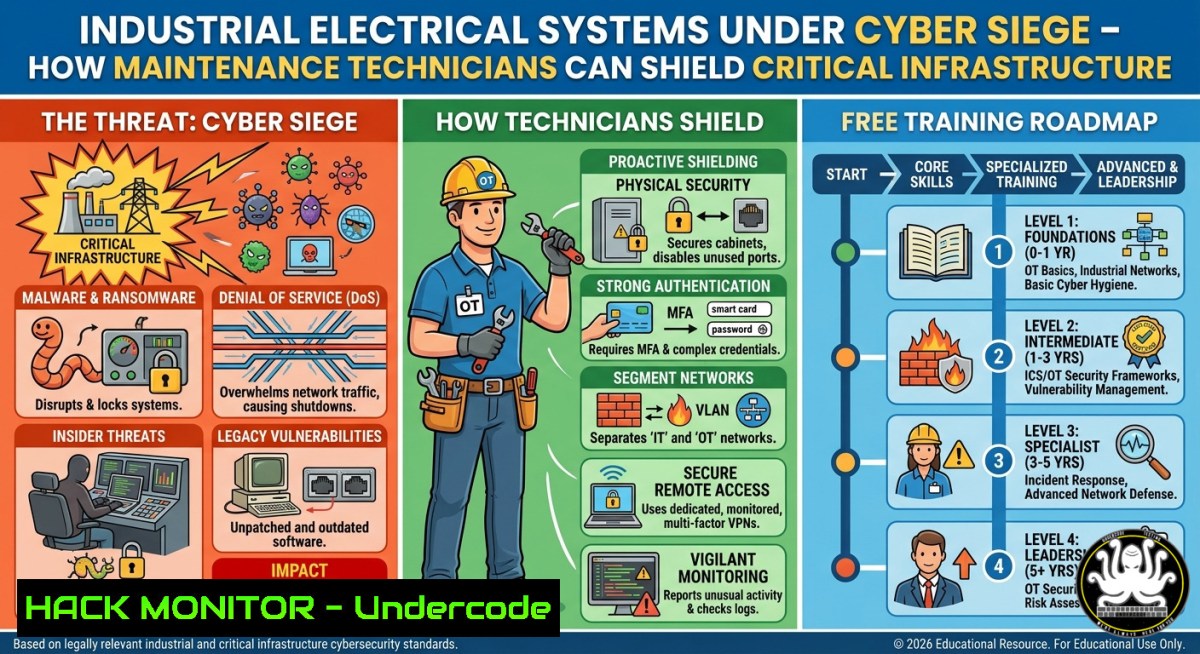
Introduction:
Industrial control systems (ICS) and motor control centers (MCCs) are increasingly targeted by cyber adversaries, yet traditional electrical maintenance often overlooks digital security. As oil & gas, water treatment plants (WTP/STP), and critical infrastructure rely on interconnected relays, pumps, and blowers, a single exploited vulnerability can cascade from a control panel to a full‑scale operational meltdown. This article bridges the gap between physical electrical troubleshooting and cybersecurity hardening—delivering actionable commands, configuration guides, and a training roadmap for technicians and engineers.
Learning Objectives:
- Understand cyber‑physical attack vectors on MCCs, VFDs, protection relays, and API‑connected SCADA dashboards.
- Execute Linux/Windows commands to audit industrial network segmentation, scan for exposed Modbus/TCP devices, and detect anomaly logs.
- Implement step‑by‑step hardening for control systems, remote monitoring edges, and response playbooks aligned with NIST SP 800‑82.
You Should Know:
- Mapping Electrical Schematics to Cyber Kill Chains: Identifying Lateral Movement Paths
Step‑by‑step guide: Start by obtaining one‑line diagrams and network topology maps. Identify every device with an Ethernet or serial‑to‑IP gateway (e.g., PLC, RTU, IED). Cross‑reference IP subnets against electrical zones (motor control centers, switchgear, generator controls). Use Nmap to discover live assets and open ports (TCP/102 for S7, 502 for Modbus, 44818 for EtherNet/IP).
Linux commands:
`nmap -sS -p 102,502,44818,2222 –open 192.168.1.0/24` – scans for common industrial protocols.
`nmap -sU -p 161 –script snmp-info 192.168.1.100` – enumerates SNMP details from a PLC.
Windows PowerShell:
`Test-NetConnection -Port 502 -ComputerName 192.168.1.100 -InformationLevel Detailed` – checks Modbus TCP reachability.
After discovery, correlate each device with its electrical function (e.g., pump VFD at 192.168.1.50). This map reveals lateral movement paths: an attacker compromising a low‑criticality sensor can jump to a motor starter.
- Hardening Motor Control Centers (MCCs) Against Remote Takeover
Step‑by‑step guide: Disable unused physical ports and protocols on programmable logic controllers (PLCs) and remote terminal units (RTUs). For engineering workstations, implement application whitelisting and host‑based firewall rules. On Windows‑based HMI/SCADA servers, restrict inbound RDP, SMB, and Modbus traffic to only authorized automation subnets.
Windows firewall (PowerShell as Admin):
`New-NetFirewallRule -DisplayName “Block SMB from OT Net” -Direction Inbound -RemoteAddress 10.0.0.0/8 -Protocol TCP -LocalPort 445 -Action Block`
`New-NetFirewallRule -DisplayName “Allow Modbus Only from PLC Net” -Direction Inbound -RemoteAddress 192.168.10.0/24 -Protocol TCP -LocalPort 502 -Action Allow`
Linux (iptables for SCADA gateway):
`iptables -A INPUT -p tcp –dport 502 -s 192.168.10.0/24 -j ACCEPT`
`iptables -A INPUT -p tcp –dport 502 -j DROP`
Additionally, enforce 802.1X on switch ports connected to MCC panels to prevent rogue device insertion.
- Diagnosing Faults Like a Threat Hunter: Using SIEM and Log Analysis for Predictive Maintenance
Step‑by‑step guide: Aggregate syslog and event logs from PLCs, protective relays, and engineering workstations into a central SIEM (e.g., Splunk, ELK, Wazuh). Create correlation rules that alert on simultaneous electrical trips and unauthorized remote login attempts. For Linux‑based PLCs (e.g., Codesys runtime), monitor systemd journals.
Linux command to check recent anomalies:
`journalctl –since “1 hour ago” | grep -iE “overcurrent|phase loss|unauthorized|modbus exception”`
Windows Event Viewer filtering (PowerShell):
`Get-WinEvent -FilterHashtable @{LogName=’Security’; ID=4624; StartTime=(Get-Date).AddHours(-1)} | Where-Object {$_.Message -like “motor”}` – finds logon events that coincide with motor control actions.
Export logs to CSV and use timeline analysis to see if a relay trip followed a suspicious SMB login (potential ransomware spreading).
- API Security for Remote Monitoring Systems in WTP/STP
Step‑by‑step guide: Many modern water treatment plants expose REST APIs for mobile dashboards or cloud IoT platforms. Identify API endpoints by inspecting network traffic from the SCADA frontend (use Fiddler or Burp Suite). Test for missing authentication, improper rate limiting, and command injection.
Verification with curl (Linux/WSL):
`curl -X GET http://scada-api.example.com/api/motor/status?unit=MCC101` – check if unauthenticated read is allowed.
`curl -X POST http://scada-api.example.com/api/setpoint -H “Content-Type: application/json” -d ‘{“motor”:”MCC101″,”speed”:9999}’` – attempt to write an out‑of‑range value. Monitor for lack of server‑side validation.
Python fuzzing snippet:
import requests
for speed in [0, 9999, -1, 65535]:
r = requests.post('http://scada-api/setpoint', json={'motor':'MCC101','speed':speed})
print(f"Payload {speed} -> {r.status_code}")
Mitigation: Implement API gateways with OAuth2 client credentials and input validation against logical motor limits.
- Cloud Hardening for Edge Gateway Devices in Oil & Gas
Step‑by‑step guide: Edge gateways (e.g., AWS IoT Core, Azure IoT Edge) collect data from MCCs and forward to the cloud for predictive analytics. Harden by enforcing TLS 1.3, rotating X.509 certificates every 90 days, and applying network ACLs that restrict egress to only the cloud endpoint.
Verify TLS configuration from the gateway:
`openssl s_client -connect edge-gateway.local:8883 -tls1_3 -CAfile ca.pem` – confirms that TLS 1.3 is negotiated.
Windows Test‑NetConnection for cloud connectivity:
`Test-NetConnection -ComputerName your-iot-hub.azure-devices.net -Port 8883 -InformationLevel Detailed`
Linux iptables to enforce strict egress:
`iptables -A OUTPUT -d 54.xxx.xxx.xxx -p tcp –dport 8883 -j ACCEPT` (replace with cloud IP range)
`iptables -A OUTPUT -p tcp –dport 8883 -j DROP`
Additionally, disable unused services (e.g., Telnet, FTP) on the edge device and enable Secure Boot.
- Vulnerability Exploitation and Mitigation: Modbus/TCP Injection in Pumps and Blowers
Step‑by‑step guide: Modbus/TCP (port 502) is ubiquitous but lacks built‑in security. An attacker with network access can write arbitrary values to holding registers, overspeeding pumps or tripping blowers. To simulate and test, use `modpoll` (Linux) or ModbusPal (Windows).
Linux command (simulate write to address 40001, float value 99.9):
`modpoll -m tcp -a 1 -r 40001 -t 4:float 192.168.1.100 99.9`
Windows alternative using PowerShell and NModbus library:
$modbus = New-Object Modbus.IP.ModbusIpMaster
$modbus.Connect("192.168.1.100", 502)
$modbus.WriteSingleRegister(40001, [bash]65535)  dangerous write
Mitigation strategies:
- Deploy a Modbus/TCP firewall (e.g., Tofino, MGuard) that enforces whitelists of function codes and addresses.
- Implement deep packet inspection to reject writes outside expected ranges (e.g., pump speed 0–60 Hz).
- Use SCADA software with role‑based access control requiring two‑factor authentication for setpoint changes.
- Training Courses for Industrial Cybersecurity and Electrical Technicians
Step‑by‑step guide to upskill: Begin with free foundational courses from CISA’s ICS Training (online, self‑paced). Then pursue vendor‑neutral certifications: ISA/IEC 62443 Cybersecurity Fundamentals, SANS ICS410, or Certified SCADA Security Architect (CSSA). For hands‑on labs, deploy OpenPLC (open‑source PLC simulator) and Conpot (ICS honeypot) on a virtual machine.
Linux lab setup (Ubuntu 22.04):
`sudo apt install docker.io`
`docker run -d -p 502:502 -p 80:80 –name openplc openplc/openplc` – runs a Modbus slave.
`git clone https://github.com/mushorg/conpot` and `cd conpot; docker-compose up` – starts a simulated ICS honeypot logging attacks.
For Windows technicians, use Factory I/O with the SIMBA interface to test security controls. Many employers (like Madre Integrated Engineering) value candidates who can demonstrate basic OT hardening alongside electrical troubleshooting.
What Undercode Say:
- Key Takeaway 1: Electrical maintenance technicians are the first line of defense against cyber‑physical attacks – mastering both voltage and packet inspection is non‑negotiable for roles involving MCCs, control systems, and remote monitoring.
- Key Takeaway 2: Short‑term project roles (like this 2–3 month Qatar gig) are ideal for upskilling in ICS security; bring your CV with documented cybersecurity modules (e.g., ISA/IEC 62443 awareness) to stand out in oil & gas hiring pipelines.
Analysis (10 lines): The job posting from Madre Integrated Engineering reflects a critical blind spot – while they urgently need electrical technicians for maintenance in Qatar, there is zero mention of cybersecurity awareness, even though modern MCCs, protection relays, and SCADA dashboards are remotely accessible. In the Middle East oil & gas sector, ransomware attacks (e.g., Aramco 2016, Colonial Pipeline ripple effects) have proven that a compromised engineering workstation can manipulate motor speeds, pressure valves, and pump sequences. A technician who can diagnose a ground fault AND detect a spoofed Modbus packet adds immense defensive value. The 2‑3 month duration suggests a project likely involving legacy or temporary equipment – often the most vulnerable, as patching is irregular. I recommend candidates ask during interviews: “Does our maintenance procedure include network segmentation for motor control centers?” Companies must integrate basic OT cybersecurity into job descriptions. The Talent Engine of Middle East should pivot toward “Cyber‑Physical Maintenance Engineer” roles to stay competitive. Additionally, the listed requirements (ITI/Diploma in Electrical) should be supplemented with a preference for candidates who have completed at least an introductory ICS security course (free from CISA). This convergence is inevitable.
Prediction:
By 2027, over 60% of industrial electrical technician job postings in the Gulf region will require baseline cybersecurity certifications (e.g., ISA/IEC 62443 Foundation or GIAC Global Industrial Cyber Security Professional). The convergence of OT and IT will make “motor control center” synonymous with “network access point” – expect automated patch management for MCCs, AI‑driven anomaly detection on harmonic distortion and power draw, and mandatory air gaps for legacy blower controls. Short‑term project hires will face pre‑employment cyber‑physical practicals, such as identifying a malicious Modbus write using Wireshark. Madre Integrated Engineering and similar firms will rename roles to “Industrial Cyber‑Physical Technician” to attract dual‑skilled talent, and cybersecurity drills will become as routine as lockout/tagout procedures.
▶️ Related Video (70% Match):
🎯Let’s Practice For Free:
IT/Security Reporter URL:
Reported By: Hiringnow Urgenthiring – Hackers Feeds
Extra Hub: Undercode MoN
Basic Verification: Pass ✅


