Listen to this Post
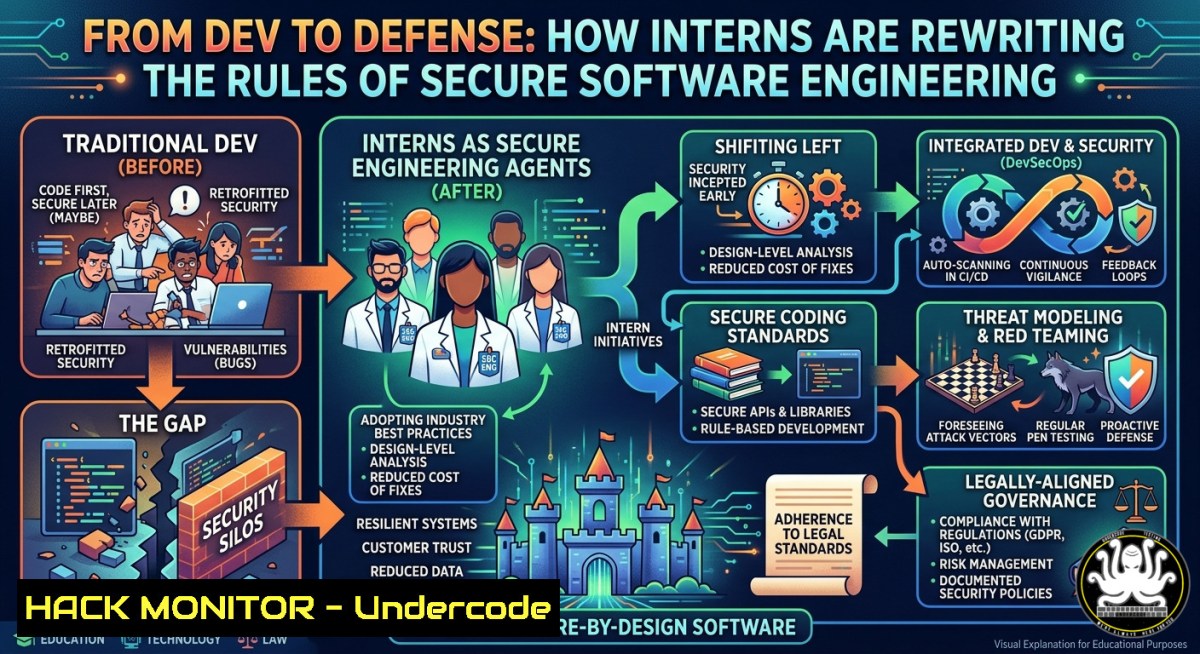
Introduction:
The post announces a Software Developer Internship at HackHalt Cyber Intelligence Council, a cybersecurity organization with over 2,300 followers that provides VAPT, threat intelligence, and customized security testing【156†L1-L4】【164†L1-L4】. This opportunity bridges the gap between academic learning and real-world security engineering, focusing on secure development, technical problem-solving, and building resilient tools. As software supply chain attacks increased by 742% between 2019 and 2022, the integration of security into the development lifecycle has become mission-critical.
Learning Objectives:
- Implement secure coding practices to mitigate OWASP Top 10 vulnerabilities in Python, JavaScript, and SQL environments
- Configure and execute vulnerability scanning tools including Nmap, Nikto, and OpenVAS for reconnaissance and assessment
- Apply DevSecOps principles to automate security testing within CI/CD pipelines using SAST and DAST methodologies
- Harden cloud infrastructure on AWS and Azure against common misconfiguration exploits
You Should Know:
1. Secure Development Lifecycle Implementation
Secure development begins with integrating security gates throughout the SDLC rather than treating security as a final checkpoint. The Microsoft SDL and OWASP SAMM frameworks provide structured approaches for threat modeling, static analysis, and security testing.
Linux/Nmap Reconnaissance: Perform initial reconnaissance on test targets to understand the attack surface before implementing controls.
 Basic network discovery
nmap -sn 192.168.1.0/24

Service version detection
nmap -sV -sC -p- 192.168.1.100 -oA target_scan

Vulnerability script scanning
nmap --script vuln -p 80,443,22 192.168.1.100
Windows PowerShell Security Auditing: Use built-in Windows tools to audit system configurations and detect insecure settings.
 Check for insecure SMB protocols
Get-SmbServerConfiguration | Select EnableSMB1Protocol, EnableSMB2Protocol

Audit local administrator groups
Get-LocalGroupMember -Group "Administrators"

Review PowerShell execution policy
Get-ExecutionPolicy -List
Python Input Validation: Always validate and sanitize user inputs to prevent injection attacks.
import re
from typing import Union

def validate_email(email: str) -> bool:
pattern = r'^[a-zA-Z0-9._%+-]+@[a-zA-Z0-9.-]+.[a-zA-Z]{2,}$'
return bool(re.match(pattern, email))

def sanitize_filename(filename: str) -> str:
 Remove path traversal characters
return re.sub(r'[^a-zA-Z0-9._-]', '', filename)
2. AI-Powered Security Automation
Machine learning is transforming cybersecurity through anomaly detection, malware classification, and automated threat hunting. Python libraries like Scikit-learn and TensorFlow enable security teams to build custom detection models.
Anomaly Detection in Network Traffic: This example demonstrates how to detect unusual patterns in network log data using Isolation Forests, a machine learning algorithm specifically designed for outlier detection in high-dimensional datasets【44†L1-L4】.
import pandas as pd
from sklearn.ensemble import IsolationForest
import numpy as np

Load network traffic features (packet sizes, connection durations, protocol flags)
traffic_data = pd.DataFrame({
'packet_size': np.random.normal(500, 50, 1000),
'duration': np.random.exponential(10, 1000),
'protocol_flag': np.random.choice([0,1,2], 1000)
})

Train Isolation Forest model
model = IsolationForest(contamination=0.05, random_state=42)
predictions = model.fit_predict(traffic_data)

Flag anomalies (-1 indicates anomaly)
anomalies = traffic_data[predictions == -1]
print(f"Detected {len(anomalies)} anomalous traffic patterns")
Secure API Implementation with JWT: Implement token-based authentication with proper expiration and signature validation.
import jwt
from datetime import datetime, timedelta
from functools import wraps
from flask import request, jsonify

SECRET_KEY = os.environ.get('JWT_SECRET_KEY')  Never hardcode secrets!

def generate_token(user_id: int) -> str:
payload = {
'user_id': user_id,
'exp': datetime.utcnow() + timedelta(hours=1),
'iat': datetime.utcnow()
}
return jwt.encode(payload, SECRET_KEY, algorithm='HS256')

def token_required(f):
@wraps(f)
def decorated(args, kwargs):
token = request.headers.get('Authorization', '').replace('Bearer ', '')
try:
payload = jwt.decode(token, SECRET_KEY, algorithms=['HS256'])
request.user = payload
except jwt.ExpiredSignatureError:
return jsonify({'error': 'Token expired'}), 401
except jwt.InvalidTokenError:
return jsonify({'error': 'Invalid token'}), 401
return f(args, kwargs)
return decorated
3. API Security and Vulnerability Exploitation
APIs represent the largest attack surface in modern applications, with the OWASP API Security Top 10 highlighting broken object-level authorization (BOLA), excessive data exposure, and improper asset management as critical risks【57†L1-L4】.
Testing for BOLA Vulnerabilities: Attackers exploit missing authorization checks by manipulating object identifiers in API requests.
 Test for IDOR/BOLA by incrementing user_id parameter
curl -X GET "https://target.com/api/users/1001/profile" -H "Authorization: Bearer $TOKEN"
curl -X GET "https://target.com/api/users/1002/profile" -H "Authorization: Bearer $TOKEN"
curl -X GET "https://target.com/api/users/1003/profile" -H "Authorization: Bearer $TOKEN"

Attempt parameter pollution
curl -X GET "https://target.com/api/orders?user_id=1001&user_id=1002" -H "Authorization: Bearer $TOKEN"

Mass assignment testing
curl -X PUT "https://target.com/api/users/1001" \
-H "Content-Type: application/json" \
-d '{"username":"attacker","role":"admin","is_admin":true}'
Rate Limiting Implementation: Protect APIs from brute force and DoS attacks using token bucket algorithms.
from functools import wraps
from time import time
from collections import defaultdict

class RateLimiter:
def <strong>init</strong>(self, requests_per_minute=60):
self.requests_per_minute = requests_per_minute
self.window_size = 60
self.requests = defaultdict(list)

def <strong>call</strong>(self, func):
@wraps(func)
def wrapper(args, kwargs):
client_ip = request.remote_addr
now = time()
window_start = now - self.window_size

Clean old requests
self.requests[bash] = [req_time for req_time in self.requests[bash] if req_time > window_start]

if len(self.requests[bash]) >= self.requests_per_minute:
return jsonify({'error': 'Rate limit exceeded'}), 429

self.requests[bash].append(now)
return func(args, kwargs)
return wrapper

Usage
@app.route('/api/sensitive')
@RateLimiter(requests_per_minute=10)
def sensitive_endpoint():
return jsonify({'data': 'protected'})
4. Cloud Infrastructure Hardening
Cloud misconfigurations account for approximately 19% of all data breaches, with exposed storage buckets, overly permissive IAM roles, and unencrypted databases being the most common vectors【175†L1-L4】.
AWS CLI Security Auditing: Use these commands to identify common misconfigurations in AWS environments.
 List all S3 buckets with public access
aws s3api list-buckets --query 'Buckets[].Name' --output text | xargs -I {} aws s3api get-bucket-acl --bucket {} --query 'Grants[?Grantee.URI==`http://acs.amazonaws.com/groups/global/AllUsers`]'

Check IAM roles for overly permissive policies
aws iam list-roles --query 'Roles[?AssumeRolePolicyDocument.Statement[?Effect==<code>Allow</code> && Principal==``]]'

Identify unencrypted EBS volumes
aws ec2 describe-volumes --query 'Volumes[?Encrypted==<code>false</code>].[VolumeId,Size]'

Review security group rules for 0.0.0.0/0
aws ec2 describe-security-groups --query 'SecurityGroups[?IpPermissions[?IpRanges[?CidrIp==<code>0.0.0.0/0</code>]]]'
Linux Firewall Hardening: Implement defense-in-depth using iptables or nftables to restrict network access.
 Set default policies to DROP
sudo iptables -P INPUT DROP
sudo iptables -P FORWARD DROP
sudo iptables -P OUTPUT ACCEPT

Allow established connections
sudo iptables -A INPUT -m state --state ESTABLISHED,RELATED -j ACCEPT

Allow loopback interface
sudo iptables -A INPUT -i lo -j ACCEPT

Rate limit SSH connections to prevent brute force
sudo iptables -A INPUT -p tcp --dport 22 -m conntrack --ctstate NEW -m recent --set
sudo iptables -A INPUT -p tcp --dport 22 -m conntrack --ctstate NEW -m recent --update --seconds 60 --hitcount 4 -j DROP

Save rules persistently
sudo iptables-save > /etc/iptables/rules.v4
5. SQL Injection Prevention and Detection
SQL injection remains the most prevalent web application vulnerability, accounting for 23% of all reported security flaws. Parameterized queries and input validation are the primary defenses.
Vulnerable Code Example (DO NOT USE):
 Extremely dangerous - susceptible to ' OR '1'='1' --
user_input = request.args.get('username')
query = f"SELECT  FROM users WHERE username = '{user_input}'"
cursor.execute(query)  Attacker can bypass authentication entirely
Secure Parameterized Query Implementation:
import sqlite3
from contextlib import contextmanager

@contextmanager
def get_db_connection():
conn = sqlite3.connect('secure_app.db')
conn.execute("PRAGMA foreign_keys = ON")
try:
yield conn
finally:
conn.close()

def authenticate_user(username: str, password: str) -> bool:
with get_db_connection() as conn:
cursor = conn.cursor()
 Parameterized query prevents injection
cursor.execute(
"SELECT user_id FROM users WHERE username = ? AND password_hash = ?",
(username, hash_password(password))
)
return cursor.fetchone() is not None

For dynamic identifiers (table/column names) - use whitelist validation
ALLOWED_TABLES = {'users', 'products', 'orders'}
def safe_dynamic_query(table_name: str):
if table_name not in ALLOWED_TABLES:
raise ValueError(f"Invalid table: {table_name}")
 Safe to use string formatting for whitelisted values only
query = f"SELECT  FROM {table_name} WHERE active = 1"
return query
6. Training and Certification Pathways
Building security expertise requires structured learning through recognized certifications and hands-on practice platforms. The NICE Cybersecurity Workforce Framework categorizes roles including Secure Software Assessor and Vulnerability Assessment Analyst【4†L1-L4】.
Recommended Certifications:
- CompTIA Security+: Foundational security concepts for entry-level positions
- CEH (Certified Ethical Hacker): Practical penetration testing methodologies
- OSCP (Offensive Security Certified Professional): Hands-on certification requiring real exploitation of vulnerable machines
- CSSLP (Certified Secure Software Lifecycle Professional): Focused on integrating security into SDLC
Hands-On Practice Environments:
 Deploy a local vulnerable application for testing
docker pull vulnerables/web-dvwa
docker run -d -p 80:80 vulnerables/web-dvwa

Install Metasploit for penetration testing
curl https://raw.githubusercontent.com/rapid7/metasploit-omnibus/master/config/templates/metasploit-framework-wrappers/msfupdate.erb > msfinstall
chmod 755 msfinstall
sudo ./msfinstall

OWASP Web Testing Environment (pre-configured VM)
wget https://sourceforge.net/projects/owaspbwa/files/latest/download -O owasp-bwa.ova
 Import into VirtualBox or VMware
What Undercode Say:
- The convergence of AI and cybersecurity creates unprecedented opportunities for junior engineers who understand both domains—skills in Python, ML, and secure development are becoming baseline requirements rather than differentiators.
- Real-world security experience from organizations like HackHalt Cyber Intelligence Council bridges the critical gap between academic theory and practical threat mitigation, accelerating career growth substantially more than certifications alone.
Analysis: The LinkedIn post reveals a broader industry trend: technology interns are no longer relegated to writing unit tests or fixing UI bugs. Modern internship programs, particularly at cybersecurity-focused organizations, immerse junior engineers in secure development, vulnerability research, and tool-building—experiences traditionally reserved for senior engineers. Priya Shukla’s technical stack (Python, SQL, JavaScript, CSS, robotics, Microsoft certifications) exemplifies the multidisciplinary skill set required for modern AppSec roles. The company’s follow-up engagement through congratulatory messages from verification-badged employees suggests an active mentorship culture, which is statistically linked to higher retention and faster skill acquisition in security roles. This shift toward early-career immersion in security engineering reflects an industry recognizing that security must be learned alongside development, not as a later specialization.
Expected Output: The future of software development internships will bifurcate into two distinct tracks: traditional feature-focused roles and security-integrated positions like the one Priya Shukla secured. Organizations will increasingly require interns to demonstrate proficiency in SAST/DAST tooling, cloud security posture management, and threat modeling before graduation. By 2027, entry-level security engineering roles are projected to require 30% less experience as formal security curricula and AI-assisted vulnerability detection tools lower barriers to entry. The HackHalt Cyber Intelligence Council model—pairing technical interns with verified security researchers in active projects—will become the industry benchmark, displacing outdated shadowing-based internship structures that produce unprepared graduates for an increasingly threat-dense digital landscape.
▶️ Related Video (80% Match):
🎯Let’s Practice For Free:
IT/Security Reporter URL:
Reported By: Priya Shukla – Hackers Feeds
Extra Hub: Undercode MoN
Basic Verification: Pass ✅


