Listen to this Post
Introduction:
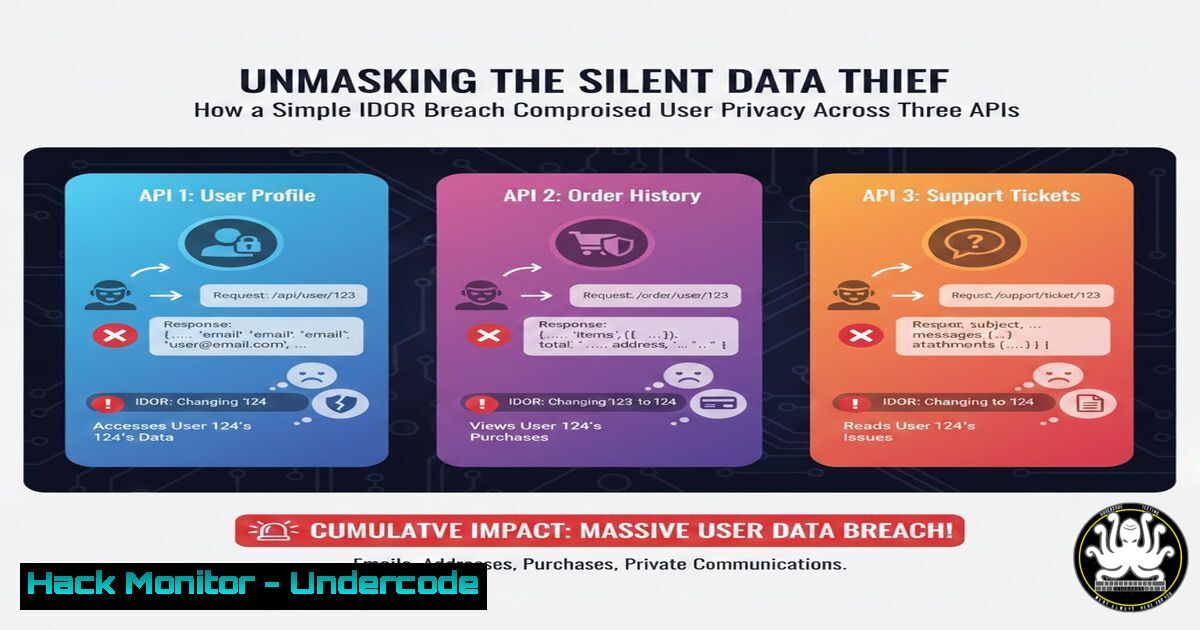
In the interconnected world of modern web applications, Application Programming Interfaces (APIs) serve as the essential connective tissue, enabling seamless data exchange and functionality. However, this very connectivity can become a critical vulnerability when proper authorization checks are missing, leading to an Insecure Direct Object Reference (IDOR). As exemplified by a recent Bugcrowd finding where three APIs were chained to expose user data, IDOR remains a prevalent and severe threat, allowing attackers to access sensitive information they are not entitled to see.
Learning Objectives:
- Understand the core mechanism and real-world impact of Insecure Direct Object Reference (IDOR) vulnerabilities, particularly in API contexts.
- Learn a systematic methodology for discovering and exploiting IDOR flaws, including techniques for parameter identification and access control bypass.
- Master the definitive coding practices and cloud security principles required to prevent IDOR vulnerabilities in modern applications.
You Should Know:
1. The Anatomy of an API IDOR Vulnerability
An IDOR vulnerability is fundamentally an access control failure. It occurs when an application uses user-supplied input (an identifier) to directly access an object—like a database record, file, or user profile—without verifying if the requesting user has permission to access that specific object.
Imagine an apartment building where your key lets you into your unit (101). An IDOR is like discovering that simply knowing another apartment’s number (102) allows you to unlock its door. In technical terms, this “identifier” is often found in URL paths (/api/users/12345), query parameters (?order_id=9876), or POST request bodies. The exploitation is simple: an authenticated, low-privileged user changes the identifier value. If the application returns another user’s data, a critical IDOR vulnerability is confirmed.
Step‑by‑step guide explaining what this does and how to use it.
1. Map the Attack Surface: Use tools like `curl` or browser developer tools to analyze all API requests made by an application. Document every endpoint and note parameters like id, user_id, account, document, etc.
Linux Command: `curl -H “Authorization: Bearer
2. Authenticate: Obtain valid credentials for a low-privileged test account. Effective IDOR testing requires the context of an authenticated session.
3. Identify and Manipulate: Choose a parameter from a legitimate request. Systematically modify its value.
Technique 1 (Sequential): Change `/invoice/2000` to `/invoice/2001`.
Technique 2 (Horizontal): Switch from your user ID to a guessed or discovered ID of another regular user.
Technique 3 (Vertical): Attempt to access identifiers belonging to administrative users or resources.
4. Analyze the Response: A successful exploit is indicated by an HTTP 200 OK response containing data belonging to another user, or a successful action (like a POST or DELETE) on an unauthorized resource.
- The Attacker’s Playbook: Chaining APIs for Maximum Impact
The referenced Bugcrowd report highlights a sophisticated exploit: chaining multiple API calls. Attackers don’t just manipulate a single parameter; they use one API’s output as input for another, bypassing layered controls. For instance, an attacker might first call a “GetUserList” endpoint (which they shouldn’t access) to harvest user IDs, then feed those IDs into a “GetUserProfile” endpoint to exfiltrate full details.
Step‑by‑step guide explaining what this does and how to use it.
1. Reconnaissance & Discovery: Use scanning and discovery tools to enumerate all available API endpoints, including those not directly linked from the main application.
Linux Command: `nmap -sV –script http-jsonp-detection
2. Understand Data Flow: Manually test or reverse-engineer how the front-end client uses APIs. A “view profile” action might trigger multiple backend calls. Tools like Burp Suite are invaluable for intercepting and mapping these sequences.
3. Exploit the Chain:
Step A: Find an initial API (/api/v1/projects) that leaks object references (e.g., other users’ project IDs) in its response.
Step B: Extract a target identifier (e.g., project_id: 4567) from that response.
Step C: Use the stolen identifier in a subsequent, more sensitive API request (/api/v1/project/4567/documents).
4. Automate the Attack: For widespread data theft, simple scripts automate this chaining process.
Example Script Snippet (Conceptual):
import requests
session = requests.Session()
session.headers.update({'Authorization': 'Bearer YOUR_TOKEN'})
 Step A: Get list of accessible objects
response = session.get('https://api.target.com/user/projects')
project_ids = [p['id'] for p in response.json()]
 Step B & C: Use each ID to access unauthorized detail
for pid in project_ids:
details = session.get(f'https://api.target.com/project/{pid}/admin/details')
if details.status_code == 200:
print(f"[+] Leaked Admin Data for Project {pid}")
3. Fortifying Your Code: The Developer’s Defense Checklist
Preventing IDOR is about robust server-side authorization, not obfuscation. The core rule is: Never trust the client. Always verify permissions on the server..
Step‑by‑step guide explaining what this does and how to use it.
1. Implement Object-Level Access Control: For every request, validate that the authenticated user owns or has explicit rights to the requested object.
Insecure Pattern (Vulnerable): `project = Project.find(params[:id])` // Searches all projects.
Secure Pattern: `project = current_user.projects.find(params[:id])` // Scopes the search to the current user’s projects only. This ensures the database query itself enforces access.
2. Adopt Indirect Reference Maps: Where possible, avoid exposing direct database keys (PKs). Use temporary, session-specific, or per-user mapped IDs. However, remember this is a defense-in-depth measure; authorization checks are still mandatory.
3. Use Complex, Unpredictable Identifiers: Replace sequential integer IDs (1, 2, 3) with universally unique identifiers (UUIDs) like 550e8400-e29b-41d4-a716-446655440000. This makes mass enumeration impractical but does not replace access control.
4. Conduct Systematic Testing: Integrate automated security testing into your CI/CD pipeline. Tools like Aikido’s AI pentesting can simulate authenticated attacks, systematically probing endpoints by substituting identified parameters to detect missing checks.
- The Cloud-Native Shield: Integrating IDOR Prevention into Cloud Security
Modern applications are built in the cloud, making cloud security principles integral to defeating IDOR. The shared responsibility model is crucial: while the cloud provider secures the infrastructure, you are responsible for securing your data, identities, and application logic—including access controls.
Step‑by‑step guide explaining what this does and how to use it.
1. Enforce Zero Trust and Least Privilege: Adopt a Zero Trust model (“never trust, always verify”). Implement the Principle of Least Privilege (PoLP) using Identity and Access Management (IAM) tools. Ensure users and service accounts have only the minimum permissions needed for their role.
Action: Regularly audit permissions with Cloud Infrastructure Entitlement Management (CIEM) tools to find and remove excessive privileges.
2. Leverage Cloud-Native Application Protection Platforms (CNAPP): A CNAPP integrates security across the development lifecycle. Use its components:
Cloud Security Posture Management (CSPM): Continuously scans for and alerts on misconfigurations in cloud services that could expose APIs or data.
Cloud Workload Protection Platform (CWPP): Secures the workloads (like containers) running your API code, providing runtime protection.
3. Secure All APIs: Treat every API as a public-facing attack surface. Use API gateways for rate limiting, authentication, and logging. Ensure all internal microservice-to-microservice communication is also authenticated and authorized.
- From Recon to Pivot: Essential Commands for the Security Practitioner
Understanding the attacker’s toolkit is key to defense. Here are essential commands for probing vulnerabilities and understanding system context post-exploitation.
Step‑by‑step guide explaining what this does and how to use it.
Network Reconnaissance & API Discovery:
nmap -sV -p 443,8080,8443 <target>: Discovers open ports running potential web/API services.
curl -k -I https://<target>/api/v1/endpoint: Fetches HTTP headers to confirm an endpoint’s existence and server type without downloading the full body.
Windows Post-Exploitation (If an API server is compromised): Attackers may use built-in commands to gather intelligence for lateral movement.
netstat -ano: Lists all active connections and listening ports, identifying other systems the server communicates with.
whoami /priv: Displays the privileges of the current user context (e.g., the API service account), which is critical for understanding potential privilege escalation paths.
systeminfo & wmic qfe list: Lists detailed system information and installed patches, helping attackers identify unpatched vulnerabilities on the host.
What Undercode Say:
- IDOR is a Primary Data Breach Vector: It is not a low-severity flaw. A single IDOR vulnerability in a core API can lead to massive data breaches, violating regulations like GDPR or HIPAA and eroding customer trust. Prioritize its remediation as highly as vulnerabilities listed in CISA’s Known Exploited Vulnerabilities (KEV) catalog.
- Automation Cuts Both Ways: Just as attackers automate IDOR discovery and exploitation, defenders must leverage automated security testing integrated into development (DevSecOps) and cloud posture management. Manual reviews are insufficient at scale.
Prediction:
The future of IDOR exploitation will intersect with AI and increasingly complex cloud architectures. We will see a rise in AI-assisted IDOR discovery, where machine learning models analyze API schemas and traffic patterns to predict and test for flawed authorization logic at unprecedented scale. Furthermore, as applications become more distributed across hybrid and multi-cloud environments, IDOR risks will amplify due to inconsistent security policies and entitlement sprawl. Proactive defense will shift left, requiring dynamic, context-aware authorization engines embedded within CI/CD pipelines and CNAPPs, capable of detecting and preventing access control flaws before deployment, transforming cloud security from a guardrail into an innate property of the application fabric.
▶️ Related Video (76% Match):
🎯Let’s Practice For Free:
IT/Security Reporter URL:
Reported By: Shahd Muhammad – Hackers Feeds
Extra Hub: Undercode MoN
Basic Verification: Pass ✅


