Listen to this Post
Introduction:
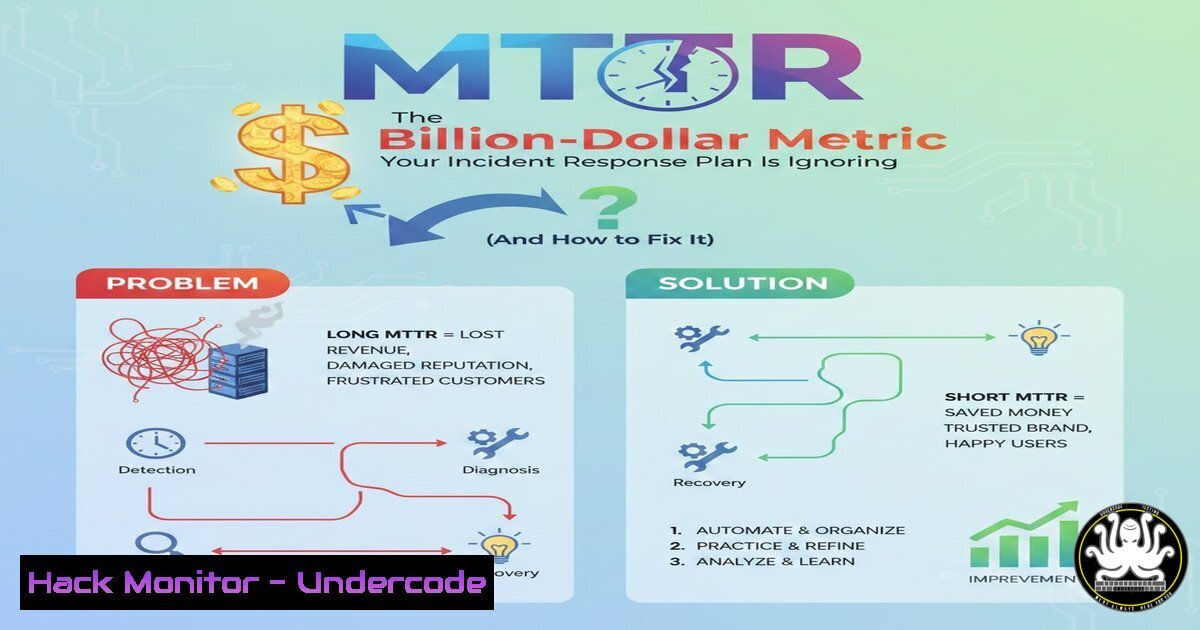
While most security teams obsess over detection times, the real financial and operational battlefield is Mean Time to Recovery (MTTR). A slow recovery can turn a contained incident into a catastrophic breach, with data showing an average cost difference of €1.82M per incident between fast and slow responders. This article deconstructs MTTR, moving from theory to actionable technical implementation to transform your recovery capability into a measurable competitive advantage.
Learning Objectives:
- Understand how to technically measure and baseline MTTR across different threat categories.
- Implement automated containment scripts and tools to slash recovery times.
- Harden incident response protocols with documented playbooks and decision trees to reduce dwell time.
You Should Know:
1. Measuring and Baselining Your MTTR: The Foundation
You cannot improve what you do not measure. MTTR must be tracked per incident category—malware, identity compromise, data exfiltration—as each has unique recovery workflows. Start by instrumenting your SIEM and ticketing systems to log key timestamps: detection time, containment time, eradication time, and recovery/validation time.
Step‑by‑step guide:
- Define Timestamps in Your SIEM: Ensure every alert or incident ticket automatically logs
time_detected. Create manual action buttons for analysts to log `time_contained` andtime_recovered.
Splunk SPL Example: `index=incidents | eval mttr = (time_recovered – time_detected)/3600 | stats avg(mttr) by threat_category`
2. Establish Baselines: Run a historical analysis over the past 6-12 months. Calculate average MTTR for each category. This baseline is your key performance indicator.
Linux Command for Log Analysis: `grep “Incident-Closed” /var/log/ir-platform.log | awk -F”category=” ‘{print $2}’ | sort | uniq -c` to count incidents by category. - Dashboard Creation: Build real-time dashboards in Grafana or your SIEM to visualize current incident MTTR against baselines. This puts immediate pressure on exceeding thresholds.
2. Automation for Containment: Slashing Critical Seconds
The first hour after detection is decisive. Automated containment scripts can reduce initial MTTR from hours to minutes by isolating compromised assets before an analyst even logs on.
Step‑by‑step guide:
- Network Containment via API: Integrate your SIEM with firewall and network access control (NAC) APIs.
Python Pseudocode for Cisco ISE/Firewall:
import requests
def contain_host(ip_address):
 Quarantine via NAC
ise_url = "https://ise:9060/api/1.0/mac-address/contain"
requests.post(ise_url, json={"ip": ip_address}, auth=(user, pass))
 Block at perimeter firewall
fw_url = "https://firewall/api/block-ip"
requests.post(fw_url, json={"rule_name": "IR_Contain", "ip": ip_address}, verify=False)
2. Endpoint Isolation: Use your EDR tool’s API to isolate a host.
CrowdStrike Falcon CLI Example: `falcon-container contain –hostname HOSTNAME123`
3. Identity Lockdown: Automate disabling of AD accounts and revocation of SaaS sessions.
Windows PowerShell Command: `Disable-ADAccount -Identity “compromised_user”`
3. Building Decision Trees for Faster Escalation
Confusion and approval chains kill MTTR. Documented, role-based decision trees eliminate hesitation during an incident.
Step‑by‑step guide:
- Threat-Category Playbooks: Create a dedicated playbook for each threat category (e.g., ransomware, phishing, data theft). Each playbook must start with a clear decision tree.
2. Example Decision Tree for “Suspected Data Exfiltration”:
Step 1: Is the data classified as “High” or “Critical”? (Y/N)
Step 2 (If Y): Activate automated network containment for source IP. Immediate escalation to CISO. Legal team notified automatically via ticketing system.
Step 3: Begin forensic collection via EDR agent: (EDR Agent) collect-forensics --host <target> --upload-to <siem>.
3. Tool Integration: Embed these decision trees as clickable workflows in your incident response platform (like TheHive or JIRA Service Desk) to guide analysts step-by-step.
4. Cloud-Native Incident Response Hardening
Cloud environments require specific tactics. Leverage native logging and serverless functions for near-instant response.
Step‑by‑step guide:
1. AWS Example – Automated S3 Bucket Lockdown:
Create an AWS Lambda function triggered by GuardDuty or CloudTrail alerts for UnaizedAccess.
Function code to set bucket to private and disable all access:
import boto3
def lambda_handler(event, context):
s3 = boto3.client('s3')
bucket = event['detail']['requestParameters']['bucketName']
 Block all public access
s3.put_public_access_block(
Bucket=bucket,
PublicAccessBlockConfiguration={
'BlockPublicAcls': True,
'BlockPublicPolicy': True
})
2. Azure Example – Contain Compromised Identity:
Use Azure Logic Apps with Microsoft Graph API to revoke sessions, reset passwords, and require MFA re-registration on alert from Microsoft Defender for Identity.
- Post-Incident Analysis: The Feedback Loop to Reduce Future MTTR
Every incident is a learning opportunity. A blameless post-mortem focused on process, not people, is essential.
Step‑by‑step guide:
- Conduct a Technical Retrospective: Answer: What steps caused the longest delays? Was data missing? Were commands incorrect?
- Update Playbooks: If a new TTP (Tactics, Techniques, and Procedures) was observed, add a new detection rule and corresponding containment step to the playbook.
Example Sigma Rule Update: Add the new malicious command line or parent process to your Sigma detection rules in the SIEM. - Validate with Tabletop Exercises: Quarterly, run tabletop simulations for each threat category using the updated playbooks. Measure the simulated MTTR and compare it to the baseline.
What Undercode Say:
- Recovery Speed is the New Security Currency: Prevention will inevitably fail. The organizations that survive and thrive are those that architect their systems and processes for rapid recovery, transforming resilience from an abstract concept into a quantifiable KPI.
- Automate or Stagnate: Manual response processes are a liability. Strategic investment in API-driven containment automation provides the highest ROI in security, directly impacting the €1.82M per-incident cost differential.
The analysis reveals a paradigm shift. The post’s core argument—that MTTR optimization can pay for security infrastructure 3x over—is not just financial modeling; it’s a strategic blueprint. By baselining MTTR, automating containment, and hardening decision loops, security teams evolve from a cost center to a value driver. This technical maturity directly influences board-level perception, shifting the conversation from fear of breach to confidence in resilience. The future of cybersecurity belongs not to those with the strongest walls, but to those with the fastest repair crews.
Prediction:
Within two years, MTTR will surpass detection metrics as the primary KPI for security team performance and cyber insurance underwriting. We will see the rise of “Recovery Engineering” as a dedicated discipline, and security platforms will compete on integrated, AI-assisted recovery automation features that predict containment paths and execute them with minimal human approval, reducing critical incident MTTR to under 10 minutes.
▶️ Related Video (78% Match):
🎯Let’s Practice For Free:
IT/Security Reporter URL:
Reported By: Francescofaenzi Trusteverybodybutcutthecards – Hackers Feeds
Extra Hub: Undercode MoN
Basic Verification: Pass ✅


