Listen to this Post
Introduction:
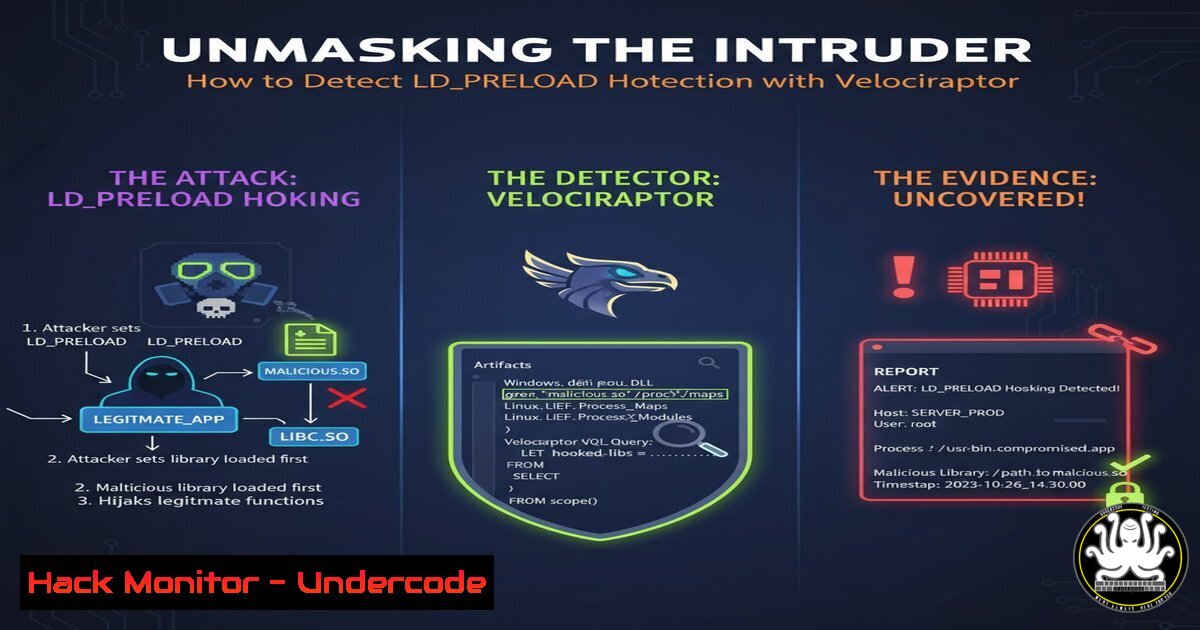
In the realm of Linux digital forensics and incident response (DFIR), the LD_PRELOAD environment variable is a powerful but double-edged sword. While legitimate for debugging and library injection, it is a classic technique for attackers to hijack shared library functions and hide their presence. This article details a professional methodology for hunting and exposing this stealthy persistence mechanism using the Velociraptor platform.
Learning Objectives:
- Understand the mechanics and malicious use cases of LD_PRELOAD.
- Learn how to craft and deploy a Velociraptor artifact for hunting LD_PRELOAD abuse.
- Analyze the collected forensic data to identify suspicious process hooking.
You Should Know:
1. The Fundamentals of LD_PRELOAD
The `LD_PRELOAD` environment variable allows a user to specify shared libraries to be loaded before any others. This gives the preloaded library precedence, enabling it to override functions from standard libraries like libc.
Verified Linux Command:
 Example of setting LD_PRELOAD for a process
LD_PRELOAD=/tmp/malicious_lib.so /usr/bin/vim

Check for LD_PRELOAD in a running process's environment
cat /proc/<PID>/environ | tr '\0' '\n' | grep LD_PRELOAD
Step-by-step guide:
The first command demonstrates how an attacker would launch a process (in this case, vim) with a malicious shared library. The second command is a forensic technique to inspect the environment of a specific process by its PID, translating null bytes into newlines for readability and then grepping for the `LD_PRELOAD` variable. Finding this in a process’s environment is a direct indicator of library preloading.
2. Building a Velociraptor Hunting Artifact
Velociraptor uses YAML-based artifacts to define collections of forensic data. The artifact below queries process memory to find evidence of LD_PRELOAD.
Verified VQL (Velociraptor Query Language) Artifact:
name: Custom.Linux.Detection.LD_PRELOAD_Abuse
description: |
Detects processes with LD_PRELOAD environment variable set.

sources:
- query: |
SELECT pid, ppid, name, commandline, environ,
getpid(pid) AS Proc
FROM pslist()
WHERE Proc.environ =~ 'LD_PRELOAD'
Step-by-step guide:
This artifact definition, which can be uploaded to your Velociraptor server, works by listing all running processes (pslist()). For each process, it examines the `environ` column (the process’s environment). The `=~` operator is a regex match, searching for the string ‘LD_PRELOAD’ within the environment string. When a match is found, it returns the Process ID (PID), Parent PID (PPID), process name, full command line, and the environment, providing a complete picture for analysis.
3. Leveraging the Built-in Linux.Sys.Processes Env Artifact
Velociraptor comes with powerful built-in artifacts. A more targeted approach is to use the existing environment collector and filter its results.
Verified VQL Command:
 Using the built-in artifact with a WHERE clause
SELECT Pid, Name, CommandLine, Env
FROM Artifact.Linux.Sys.ProcessesEnv()
WHERE Env.Key =~ 'LD_PRELOAD' AND Env.Value != ""
Step-by-step guide:
This query uses the standard `Linux.Sys.ProcessesEnv` artifact, which already collects the environment variables of all processes. It then filters the results to show only rows where the environment variable key (Env.Key) matches ‘LD_PRELOAD’ and where the value is not empty. This is often more efficient than writing a custom artifact from scratch and provides immediate visibility into potentially hijacked processes.
4. Deep Dive with Process Memory Analysis
For advanced threats that may try to clear their environment, a deeper analysis of the process’s memory map can reveal the initially loaded library.
Verified Linux Command & VQL:
 Manual inspection of a process's memory mappings
cat /proc/<PID>/maps | grep -i preload
 VQL to check memory mappings for all processes
SELECT pid, name, maps.Filename
FROM pslist()
JOIN proc_maps(pid=pid) AS maps ON TRUE
WHERE maps.Filename =~ 'preload'
Step-by-step guide:
The Linux command inspects the memory map of a specific process, looking for any mapped file containing “preload”. The VQL query automates this at scale across all processes. It joins the process list with the output of the `proc_maps()` VQL function (which reads /proc/<PID>/maps) and filters for filenames containing “preload”. This can catch libraries that were preloaded even if the environment variable was later unset.
- Cross-Platform Insight: Windows Analogy DLL Search Order Hijacking
While LD_PRELOAD is a Linux-specific mechanism, understanding its Windows counterpart is crucial for cross-platform DFIR teams.
Verified Windows Command (PowerShell):
 List loaded modules for a specific process
Get-Process -Id <PID> | Select-Object -ExpandProperty Modules

Check for DLL search order hijacking via PATH or .local
echo $env:PATH
dir C:\Windows\System32.local
Step-by-step guide:
On Windows, attackers achieve similar results by abusing the DLL search order. The first PowerShell command lists all DLLs loaded by a process, which can help identify malicious ones. The second set of commands checks common hijacking techniques: inspecting the system `PATH` for rogue directories and looking for `.local` files, which are used for DLL redirection. This provides a parallel investigative mindset.
6. Mitigation: Hardening Systems Against Preload Attacks
Detection is only one part of the story. System hardening is critical to prevent such attacks from being successful in the first place.
Verified Linux Security Configurations:
 1. Restrict LD_PRELOAD in sudoers (use with caution)
Defaults env_reset
Defaults env_keep -= "LD_PRELOAD"

<ol>
<li>Use filesystem attributes to make critical binaries immutable
sudo chattr +i /usr/bin/sudo
sudo chattr +i /usr/bin/passwd</p></li>
<li><p>Configure SELinux/AppArmor to restrict library loading
Example AppArmor rule for a specific binary
deny /usr/bin/vim mrwxl,
Step-by-step guide:
The first command, added to the `/etc/sudoers` file via visudo, tells sudo to reset the environment and explicitly remove LD_PRELOAD, preventing it from being passed to privileged commands. The second command uses the `chattr` command to set the immutable flag (+i) on critical binaries, preventing them from being modified or deleted. The third point involves using mandatory access control systems like AppArmor to create profiles that deny unauthorized library loading for specific applications.
7. Automating Response with Velociraptor Collections
Once a malicious process is identified, Velociraptor can be used to collect and analyze the offending binary for further intelligence.
Verified VQL for Artifact Collection:
name: Custom.Linux.Response.Collect_LD_PRELOAD_Process
sources:
- query: |
LET TargetPid = 1234 // Typically populated from the hunt
SELECT  FROM Artifact.Generic.ForensicProcessMemory(Pid=TargetPid)
SELECT  FROM Artifact.Generic.ForensicProcessFile(Pid=TargetPid)
Step-by-step guide:
This artifact template is designed for incident response. After a hunt identifies a suspicious PID (e.g., 1234), this artifact can be launched against that specific endpoint. It uses built-in forensic artifacts to dump the process’s memory (ForensicProcessMemory) and to collect the binary file and related libraries (ForensicProcessFile). This collected evidence can then be sent to a malware analysis sandbox or analyzed manually.
What Undercode Say:
- Prevalence Over Obscurity: LD_PRELOAD is not a new technique, but its effectiveness lies in its simplicity and the fact that many basic detection scripts fail to check process environments thoroughly. It remains a high-value, low-complexity attack for persistence and evasion.
- The Power of EDR Platforms: The shift from manual command-line checks to automated, platform-wide hunting with tools like Velociraptor represents the modern standard for DFIR. It transforms a tedious, reactive process into a scalable, proactive security control.
The analysis reveals that while the underlying technique is simple, its detection at scale requires a sophisticated toolset. Velociraptor fills this gap perfectly by providing a unified language (VQL) to query endpoint state across an entire enterprise. The true value isn’t just in finding one compromised host, but in being able to instantly query thousands of systems to determine the scope of an intrusion. This moves the security posture from one of manual, isolated investigation to one of continuous, automated monitoring.
Prediction:
The abuse of core system mechanisms like LD_PRELOAD will continue to be a mainstay for attackers, especially as more sophisticated threats use it to load rootkits that hide their activity from other processes. The future of DFIR will see a tighter integration between EDR platforms like Velociraptor and low-level system telemetry, potentially leveraging eBPF in Linux to gain even deeper, more performant visibility into library loading and process execution in real-time, making this class of attack significantly harder to execute undetected.
🎯Let’s Practice For Free:
IT/Security Reporter URL:
Reported By: Deniz Ciftci – Hackers Feeds
Extra Hub: Undercode MoN
Basic Verification: Pass ✅


