Listen to this Post
Introduction:
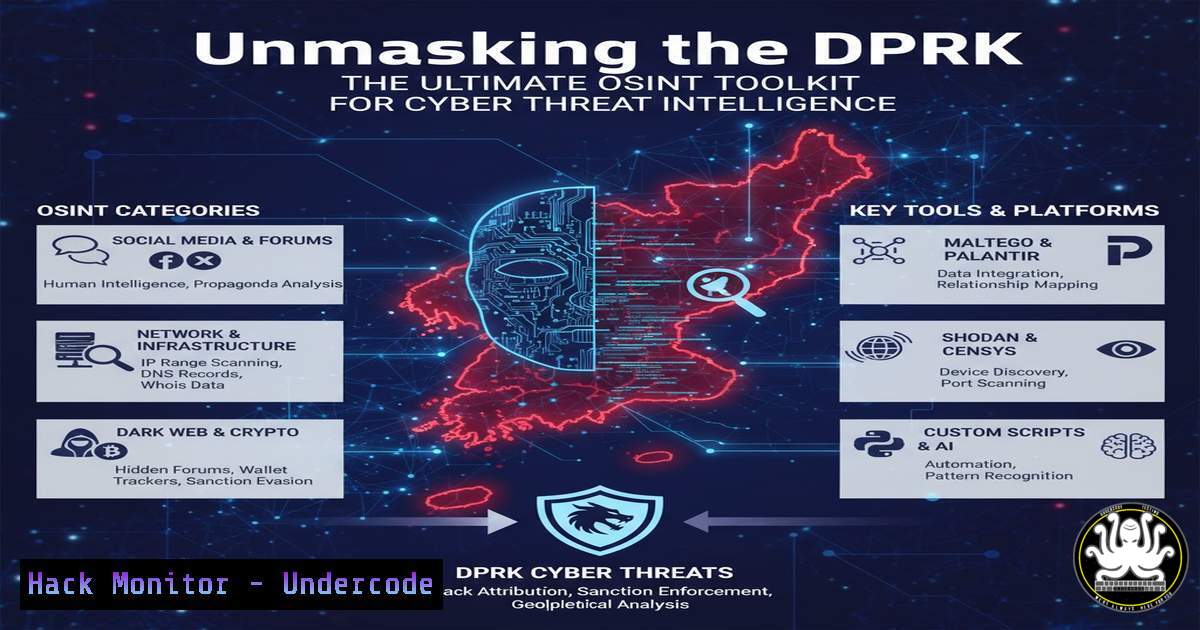
Open-Source Intelligence (OSINT) has become a critical discipline in cybersecurity, particularly for tracking state-sponsored threat actors. This article provides a professional toolkit for conducting OSINT investigations into the Democratic People’s Republic of Korea (DPRK), leveraging the framework shared by UNISHKA Research Service to enhance your cyber threat intelligence capabilities.
Learning Objectives:
- Master fundamental OSINT commands and techniques for DPRK-focused investigations
- Implement advanced data correlation methods across multiple intelligence sources
- Develop defensive counter-intelligence measures based on OSINT findings
You Should Know:
1. Open Data Portal Intelligence Gathering
Verified OSINT commands for data aggregation:
 Use wget for bulk downloading from open data portals
wget --recursive --no-parent --accept pdf,doc,docx,xls,xlsx https://naenara.com.kp/

Harvest documents with specific metadata using metagoofil
python metagoofil.py -d nknews.org -t pdf,doc,xls -l 50 -n 20 -o results -f output.html

Extract metadata from downloaded documents
exiftool .pdf | grep -i "creator|producer|createDate" > metadata_analysis.txt
This methodology allows investigators to systematically collect and analyze publicly available information from DPRK-associated portals. The wget command recursively downloads accessible content while metagoofil specializes in document intelligence gathering. Exiftool then extracts hidden metadata that can reveal document origins, creation tools, and potential operator information.
2. Business and Entity Mapping Techniques
Verified command sequence for corporate intelligence:
 Use Maltego for entity relationship mapping
maltego --transform "CompanyStalker" --entity-type Company --filter "North Korea"

Python script for corporate registry analysis
import requests
registry_api = "https://opencorporates.com/repositories/kp_companies"
response = requests.get(registry_api)
companies = response.json()

Whois and DNS intelligence gathering
whois koryolink.com | grep -i "registrant|admin|tech"
dig ANY korea.com.kp +short
These commands enable the mapping of DPRK-linked business networks, which are crucial for understanding how cyber operations are funded and supported. Maltego transforms visualize relationships between entities, while DNS and whois queries reveal technical infrastructure connections that might be masked through front companies.
3. People Search and Social Network Analysis
Verified OSINT commands for individual identification:
 Use Sherlock for username enumeration across platforms
python3 sherlock.py "KimJong" --nsfw --print-found

Social media intelligence with Twint
twint -u "@rodong" --since 2020-01-01 --verified -o dprk_tweets.csv --csv

LinkedIn company employee extraction (ethical boundaries apply)
linkedin2username -c "Korea Computer Center" -o kcc_employees.txt
This approach helps identify individuals associated with DPRK cyber units and their digital footprints across social platforms. Sherlock scans hundreds of sites for username reuse, while Twint provides historical Twitter intelligence without API limitations. These techniques must be used within legal and ethical frameworks.
4. Media Source Verification and Analysis
Verified commands for media intelligence:
 Extract video metadata from DPRK broadcasts
ffmpeg -i kcna_video.mp4 -f ffmetadata metadata.txt

Website change monitoring with urlwatch
urlwatch --urls urls.yaml --config urlwatch.yaml --hooks python

RSS feed monitoring for state media
python3 rss_monitor.py -f dprk_feeds.txt -d alerts.db
Media analysis provides insights into DPRK strategic communications and potential embedded signals. Video metadata can reveal production details and modification histories, while automated monitoring tracks content changes that might indicate upcoming operations or policy shifts.
5. Geospatial Intelligence (GEOINT) Operations
Verified GEOINT commands:
 Satellite imagery analysis with gdal
gdalinfo KPA_base.tiff | grep -i "size|coordinate"

Geotag extraction from public photos
exiftool -GPSLatitude -GPSLongitude -GPSAltitude dprk_photo.jpg

OpenStreetMap data extraction for infrastructure mapping
osmium getid -t north_korea_railways.osm.pbf n123456789 -o railway_station.osm
Geospatial intelligence complements cyber OSINT by providing physical context to digital findings. These commands help analyze satellite imagery, extract location data from photos, and map critical infrastructure that might correlate with cyber operations targeting specific sectors.
6. Transportation Network Monitoring
Verified transport intelligence commands:
 AIS vessel tracking data analysis
python3 ais_parser.py --input marine_traffic.csv --filter "flag='KP'"

Flight tracking correlation
adsb2db --input-feed adsb.json --output-db aircraft.db --filter "operator='Air Koryo'"

Port activity monitoring script
python port_scanner.py --country KP --days 30 --output port_activity.csv
Monitoring DPRK transportation networks can reveal patterns in personnel movement and logistics that might correlate with cyber campaign timelines. AIS data tracks maritime activity, while ADS-B monitoring follows aviation movements that could indicate key personnel transfers.
7. Threat Intelligence Correlation and Analysis
Verified threat intelligence commands:
 MISP threat intelligence platform queries
misp-search -eventinfo "Lazarus Group" --category "Payload delivery"

STIX/TAXII feed consumption
python3 taxii_client.py --collection "DPRK_APT" --output indicators.json

YARA rule generation from OSINT
python3 yara_generator.py --input osint_findings/ --output dprk_rules.yar
This final stage correlates OSINT findings with established threat intelligence to identify active campaigns and attribution patterns. MISP queries connect findings to known attack patterns, while STIX/TAXII feeds provide structured intelligence sharing. YARA rules operationalize findings for defensive detection.
What Undercode Say:
- The DPRK’s digital footprint is intentionally obscured but leaves consistent patterns across business, technical, and social domains
- Multi-source correlation is essential—no single OSINT technique provides complete visibility
- Defensive applications of this intelligence can harden networks against known TTPs
- Ethical boundaries must be strictly maintained to avoid harassment of individuals
The comprehensive OSINT framework provided by UNISHKA demonstrates that while DPRK actors employ sophisticated obfuscation techniques, their digital ecosystem remains vulnerable to systematic investigation. The key insight for cybersecurity professionals is that persistent, multi-disciplinary OSINT can pierce through state-level operational security when properly correlated and analyzed. This intelligence becomes actionable when converted into detection rules and defensive measures that anticipate rather than react to DPRK cyber operations.
Prediction:
The increasing sophistication of DPRK cyber operations will be matched by more advanced OSINT countermeasures, leading to an intelligence arms race where AI-powered correlation engines will automatically connect seemingly unrelated data points across business registries, technical infrastructure, and social networks. Within two years, we predict real-time DPRK threat actor tracking will become standard in enterprise security operations centers, fundamentally changing how organizations defend against state-sponsored threats by anticipating attack vectors through continuous intelligence gathering rather than post-incident analysis.
🎯Let’s Practice For Free:
IT/Security Reporter URL:
Reported By: Logan Woodward – Hackers Feeds
Extra Hub: Undercode MoN
Basic Verification: Pass ✅


