
Listen to this Post
Introduction:
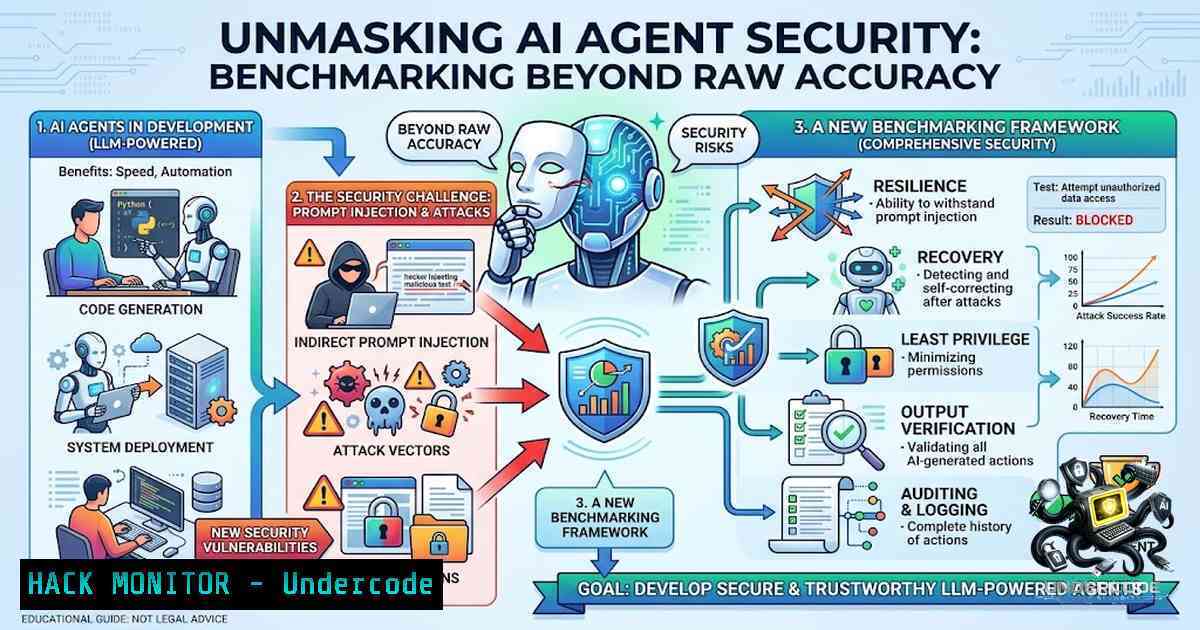
The rapid integration of Large Language Models (LLMs) into software development pipelines has introduced a paradigm shift in code generation, yet it has also created a sprawling attack surface that traditional security metrics fail to capture. The recent work conducted at the Laboratory for Analytic Sciences (LAS) by intern Mahzabin Tamanna highlights a critical evolution in AI evaluation: moving beyond comparing base models to analyzing the security and performance implications of agentic scaffolding. This research underscores that the true measure of an AI’s utility lies not in its ability to produce working code, but in how it handles complex, real-world bug fixes and the inherent security trade-offs between speed, cost, and safety.
Learning Objectives & Secrets:
- Objective 1: Master the evaluation of LLM agents against real-world GitHub bug-fix tasks and security-focused coding benchmarks within isolated, containerized environments.
- Secret Tip 2: Leverage failure pattern analysis; understanding why an agent fails provides deeper security insights than simply measuring its success rate, often revealing vulnerabilities in reasoning chains.
- Secret Tip 3: Optimize cost and latency without sacrificing security by using dynamic agent scaffolding that scales complexity based on task criticality, avoiding expensive “over-thinking” for simple queries.
You Should Know:
1. The Agent Scaffolding Evaluation Framework
The core of the LAS research involved a comparative analysis between standalone LLM API calls and LLMs equipped with agent scaffolding. Agent scaffolding refers to the architecture that allows an LLM to interact with its environment—using tools, executing code, and maintaining memory. This is not just a performance test; it is a security audit.
To replicate such an environment, one must set up isolated containers and benchmark suites. This ensures that agent actions do not affect the host system and that test results are reproducible.
Step‑by‑step guide to setting up a basic isolated benchmarking environment:
– Step 1: Container Setup. Use Docker to create a lightweight, isolated environment. This mitigates the risk of a rogue agent command escaping.
docker pull python:3.10-slim
docker run -it --rm --1ame agent_benchmark python:3.10-slim /bin/bash
– Step 2: Install Dependencies. Inside the container, install necessary packages for code analysis and testing.
pip install pytest bandit pylint requests
– Step 3: Simulate API Calls. Use Python scripts to simulate API calls to LLMs (e.g., OpenAI or local models via Ollama). Measure latency and token usage.
import requests
import time
start = time.time()
response = requests.post('https://api.openai.com/v1/chat/completions', json={...}, headers={...})
print(f"Latency: {time.time() - start}")
print(f"Cost: {response.json()['usage']['total_tokens']  0.002 / 1000}")
– Step 4: Run Security Benchmarks. Integrate tools like `bandit` to scan generated code for common security issues.
bandit -r generated_code/ -f json -o security_report.json
2. Security Implications of AI-Generated Code
The research highlights that AI-generated code, especially when unverified, can introduce vulnerabilities like injection flaws, unsafe system calls, and logic errors. The “patch-level” analysis revealed that agents often fix surface-level issues but fail to address underlying architectural weaknesses.
To mitigate these risks, we must enforce strict validation on the input and output of AI agents. This involves both pre-processing (sanitizing prompts) and post-processing (validating code before execution).
Step‑by‑step guide to implementing a security validation layer:
- Step 1: Prompt Sanitization. Strip any potentially malicious instructions from the user input before it reaches the LLM. This is a first line of defense against prompt injection.
- Step 2: Static Analysis. After code generation, run an automated static analysis tool like `semgrep` or `CodeQL` to check for vulnerabilities.
semgrep --config=p/r2c-ci generated_code/ --json > semgrep_results.json
- Step 3: Dynamic Analysis. Execute the generated code in a sandboxed environment to observe its behavior. Monitor for network connections, file system writes, and excessive resource usage.
strace -f -e trace=network,file python generated_code/script.py
- Step 4: Patch Validation. Implement a patch verification system that checks if the agent’s fix actually addresses the root cause of the vulnerability (e.g., checking if a SQL injection patch correctly escapes inputs).
- Cost, Latency, and the “Speed vs. Security” Dilemma
Mahzabin’s tool recommendation engine is designed to optimize trade-offs. In cloud environments, cost and latency are directly tied to the compute resources allocated to the agent. The research likely involved tracking token usage and compute time against the security of the output. A faster agent might skip crucial validation steps, leading to insecure code.
Step‑by‑step guide to monitoring cost and latency for API calls:
– Step 1: Token Counting. Implement a function to count tokens in the prompt and response.
import tiktoken
enc = tiktoken.encoding_for_model("gpt-4")
tokens = enc.encode("Your prompt here")
cost = (len(tokens) / 1000)  0.03  Example pricing
– Step 2: Timeout Handling. Set strict timeouts for agent operations to prevent Denial of Service (DoS) risks.
import signal
signal.alarm(30)  30-second timeout
– Step 3: Benchmarking Matrix. Create a matrix to analyze the results.
| Model Type | Latency (s) | Cost (USD) | Security Score (Bandit) | Success Rate (%) |
||-||-||
| Base API | 1.2 | 0.01 | 65/100 | 78 |
| Agentic | 4.5 | 0.08 | 92/100 | 94 |
4. API Security and Cloud Hardening
When deploying agents, they often require API keys and access to internal systems. This introduces significant API security risks. Hardening the cloud environment is non-1egotiable. The research implicitly relies on secure API handling to ensure the integrity of the evaluation.
Step‑by‑step guide to hardening agent API interactions:
- Step 1: Use Secrets Management. Never hardcode secrets. Use environment variables or services like AWS Secrets Manager.
export OPENAI_API_KEY=$(aws secretsmanager get-secret-value --secret-id openai-key --query SecretString --output text)
- Step 2: IAM Policies. Implement strict Identity and Access Management (IAM) policies. The agent should have the minimum necessary permissions.
- Step 3: Audit Logging. Enable comprehensive logging for all API calls to track anomalies and potential abuse.
sudo journalctl -u agent-service -f | grep -i "api call"
- Step 4: Rate Limiting. Implement rate limiting to prevent excessive usage costs and mitigate brute-force attacks.
5. Vulnerability Exploitation and Mitigation
The most interesting finding is that failure patterns reveal vulnerabilities. If an agent consistently fails to solve a bug, the reason—be it context window limitations, lack of tool access, or flawed reasoning—exposes a systemic weakness that an attacker could exploit. For example, if an agent struggles with SQL injection tasks, it likely produces vulnerable code, which is a critical risk.
Step‑by‑step guide to mitigating common AI code generation vulnerabilities:
– Step 1: Fine-Tuning. Fine-tune the base model on secure coding datasets to reduce the likelihood of generating vulnerable code.
– Step 2: Prompt Engineering. Use specific prompts that enforce security constraints. For example: “Write a Python function to query a SQL database using parameterized queries.”
– Step 3: Context Injection. Inject security rules into the agent’s system prompt.
system_prompt = "You are a security-focused developer. Always use parameterized queries, validate user input, and avoid using eval()."
– Step 4: Guardrail Models. Use a secondary, smaller model to evaluate the primary agent’s output for safety before execution.
What Undercode Say:
- Key Takeaway 1: The dichotomy between API calls and agentic scaffolding is not just about performance but about security posture. Agents, while more capable, exponentially increase the attack surface and require robust containment.
- Key Takeaway 2: The economic and operational costs of AI must be factored into security risk assessments; a 10x cost increase for a 20% security improvement might be a justifiable trade-off in critical systems, but a disaster for mundane tasks.
- Analysis: The LAS research is a pivotal step toward maturing AI security. By focusing on the “how” of failures, we move from reactive patching to proactive vulnerability discovery. The creation of a recommendation engine is clever, as it automates the complexity of balancing these variables, allowing developers to select the right tool for the job based on specific risk appetites. This approach is essential for enterprises where a one-size-fits-all AI policy is dangerous. The shift from evaluating just the model to evaluating the entire “agentic system” is the correct and necessary evolution for securing the future of AI-driven development.
Prediction:
- +1 The standardization of benchmarking frameworks like the one developed at LAS will lead to a new wave of “Security-Graded” AI models, allowing enterprises to select models certified for specific risk levels, similar to FIPS certifications in cryptography.
- -1 The complexity of agent evaluations will create a new “eval gap” where smaller organizations lack the resources to properly assess agent security, leading to widespread, silent vulnerabilities in their software supply chains.
- +1 The identification of failure patterns will accelerate the development of “Self-Healing” AI agents that can detect their own mistakes and request human intervention or additional tools before propagating insecure code.
- -1 As we optimize for cost and latency, there will be a dangerous trend of “Security Throttling,” where agents are stripped of safety checks to save computational resources, resulting in an increase in high-impact, AI-generated vulnerabilities.
- +1 The research will spur innovation in “Agent Observability,” giving rise to a new market for tools that monitor, audit, and explain agent decisions in real-time, bridging the gap between black-box AI and white-box security controls.
▶️ Related Video (86% Match):
🎯Let’s Practice For Free:
🎓 Live Courses & Certifications:
Join Undercode Academy for Verified Certifications
🚀 Request a Custom Project:
Secure, high-velocity infrastructure and disruptive technological engineering. Contact our engineering team for high-tier development and proprietary systems:
[email protected]
💎 Smart Architecture | 🛡️ Secure by Design | ⭐ Trusted by Thousands
IT/Security Reporter URL:
Reported By: https://lnkd.in/p/eezFgsaE – Hackers Feeds
Extra Hub: Undercode MoN
Basic Verification: Pass ✅


