
Listen to this Post
Introduction:
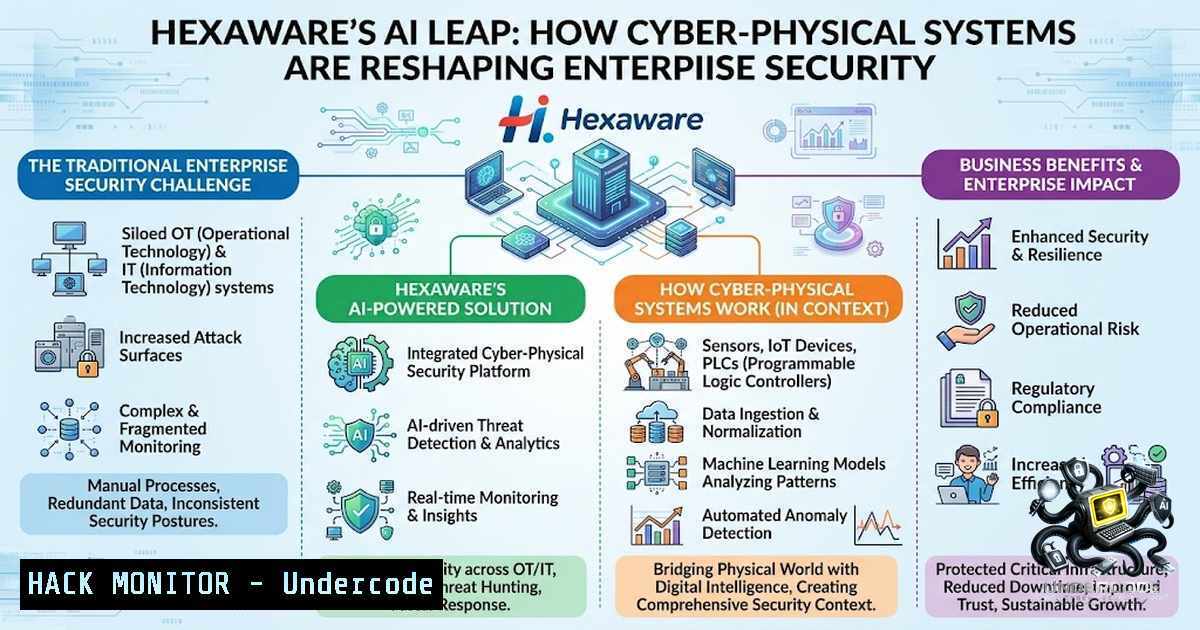
Hexaware’s recent disclosure that over 50% of its revenue now stems from AI and AI-infused solutions marks a pivotal shift in enterprise technology. The company’s move beyond chatbots into image recognition, spatial understanding, and machine interaction introduces a new frontier where cybersecurity must protect not just data but physical assets. This transition from software-defined AI to cyber-physical systems (CPS) demands a fundamental rethinking of security architectures, as demonstrated by Hexaware’s own warning about hackers potentially taking control of robot dogs and other physical AI systems.
Learning Objectives & Secrets
Objective 1: Understand the Cyber-Physical Security Risks in AI Deployments
Secret Tip: When securing AI systems that interact with physical environments, always implement “safety governors” — independent monitoring systems that can override AI control commands if they detect anomalous patterns. This provides a fail-safe mechanism even if the primary AI is compromised.
Objective 2: Master API Security for AI-Infused Solutions
Secret Tip: Implement JSON Web Token (JWT) validation with short expiration times (5-10 minutes) for all AI service APIs. Additionally, use HMAC-based request signing to prevent man-in-the-middle attacks on image and sensor data transmissions.
Objective 3: Implement Zero-Trust Architecture for Cloud-1ative AI Platforms
Secret Tip: Deploy micro-segmentation using network policies (e.g., Calico or Cilium) in Kubernetes environments to ensure that even if one AI service is breached, lateral movement is blocked. Combine this with mutual TLS (mTLS) between all AI service mesh components.
You Should Know
1. Securing AI APIs in Cyber-Physical Systems
AI systems like Hexaware’s repair assistant — which analyzes washing machine photos to diagnose faults — rely heavily on APIs to receive image data and return instructions. These APIs become critical attack surfaces.
Step-by-Step Guide: Securing AI Image Processing APIs
1. Input Validation and Sanitization
Validate all incoming image files against allowed MIME types (image/jpeg, image/png) and file size limits (e.g., max 10MB). Use image fingerprinting to detect adversarial attacks:
from PIL import Image
import hashlib

def validate_image(image_path):
 Check file signature
with open(image_path, 'rb') as f:
header = f.read(12)
if not header.startswith(b'\xFF\xD8') and not header.startswith(b'\x89PNG'):
raise ValueError("Invalid image format")

Generate perceptual hash for anomaly detection
img = Image.open(image_path)
phash = hashlib.md5(img.tobytes()).hexdigest()
return phash
2. Implement Rate Limiting and Anomaly Detection
Use Redis-based rate limiting to prevent API abuse. On Linux:
 Install Redis
sudo apt-get install redis-server
 Configure rate limiting in Nginx
limit_req_zone $binary_remote_addr zone=ai_api:10m rate=10r/m;
location /api/v1/process {
limit_req zone=ai_api burst=5 nodelay;
proxy_pass http://ai_backend;
}
3. API Gateway with Authentication
Deploy an API gateway (e.g., Kong or Tyk) with OAuth2/OIDC authentication. Generate API keys with scoped permissions:
 Generate API key using OpenSSL
openssl rand -hex 32
 Store securely in HashiCorp Vault
vault kv put secret/ai_api/key value=<generated_key>
4. Logging and Monitoring
Centralize logs using ELK stack and set alerts for anomalous request patterns (e.g., sudden spike in image uploads from a single IP). On Windows, use PowerShell:
 Monitor AI API logs in real-time
Get-WinEvent -LogName Application | Where-Object { $_.Message -like "AI_API" } | Select-Object TimeCreated, Message
2. Securing the Zerovity Platform: Cloud-1ative AI Hardening
Hexaware’s Zerovity platform builds custom software in weeks rather than years. This rapid development requires rigorous security automation.
Step-by-Step Guide: Hardening a Cloud-1ative AI Platform
1. Container Security Scanning
Scan all container images using Trivy or Clair before deployment:
 Install Trivy
sudo apt-get install trivy
 Scan image for vulnerabilities
trivy image zerovity/ai-service:latest --severity HIGH,CRITICAL
2. Kubernetes Security Policies
Implement Pod Security Standards and network policies:
 NetworkPolicy to restrict AI service communication
apiVersion: networking.k8s.io/v1
kind: NetworkPolicy
metadata:
name: ai-service-policy
spec:
podSelector:
matchLabels:
app: ai-service
policyTypes:
- Ingress
- Egress
ingress:
- from:
- podSelector:
matchLabels:
app: api-gateway
egress:
- to:
- podSelector:
matchLabels:
app: database
3. Secrets Management
Use HashiCorp Vault or AWS Secrets Manager for AI model credentials:
 Store and retrieve secrets in Vault
vault kv put secret/zerovity/model_credentials api_key=xxxx
vault kv get secret/zerovity/model_credentials
4. Implement Service Mesh Security
Deploy Istio or Linkerd for mTLS encryption between services:
 Enable mTLS in Istio
kubectl apply -f - <<EOF
apiVersion: security.istio.io/v1beta1
kind: PeerAuthentication
metadata:
name: default
spec:
mtls:
mode: STRICT
EOF
5. CI/CD Pipeline Security
Integrate security scanning into GitHub Actions or GitLab CI:
 .github/workflows/security-scan.yml
name: Security Scan
on: [bash]
jobs:
scan:
runs-on: ubuntu-latest
steps:
- uses: actions/checkout@v2
- name: Run Trivy
run: trivy fs --severity HIGH,CRITICAL .
- name: Run Gitleaks (secrets detection)
run: gitleaks detect --verbose
3. AI Model Security and Adversarial Attacks
When AI systems understand images and physical spaces (as Hexaware’s technology does), adversarial attacks become a critical concern.
Step-by-Step Guide: Protecting Against Adversarial Attacks
1. Implement Input Preprocessing
Apply image transformations to mitigate adversarial perturbations:
import numpy as np
from scipy.ndimage import gaussian_filter
from skimage.transform import rotate

def preprocess_image(img):
 Apply Gaussian blur to reduce adversarial noise
img_blurred = gaussian_filter(img, sigma=1.0)

Random rotation augmentation
angle = np.random.uniform(-5, 5)
img_rotated = rotate(img_blurred, angle)

return img_rotated
2. Use Ensemble Models
Deploy multiple models and use voting to reduce susceptibility to single-model attacks:
def ensemble_predict(image, models):
predictions = []
for model in models:
pred = model.predict(image)
predictions.append(pred)

Majority voting (for classification)
final_pred = np.argmax(np.bincount(predictions))
return final_pred
3. Monitor Model Drift
Track model performance over time to detect potential adversarial inputs. On Linux, set up monitoring:
 Install Evidently AI for drift detection
pip install evidently
 Run drift detection
python -m evidently --config config.json --data-source /logs/predictions
4. Implement Input Filtering for Physical Systems
For robot control systems, implement safety bounds on outputs:
def safe_control(command_limits):
max_speed = 2.0  m/s
max_torque = 50.0  Nm

Clip commands to safe ranges
speed = np.clip(predicted_speed, -max_speed, max_speed)
torque = np.clip(predicted_torque, -max_torque, max_torque)

return speed, torque
4. Legacy System Migration: Cobol to AI Modernization
Hexaware’s pursuit of the $29–30 billion Cobol replacement market requires secure modernization strategies.
Step-by-Step Guide: Secure Cobol-to-AI Migration
1. Code Analysis and Extraction
Use tools like AbstrO to analyze Cobol logic:
 Install Cobol analysis tool
wget https://github.com/abstracts/abstract/releases/latest/abstract-linux
chmod +x abstract-linux
./abstract-linux analyze /path/to/cobol/source
2. Generate Intermediate Representation
Convert Cobol logic to a language-agnostic representation:
 Using Cobol-to-Java transpiler
java -jar cobol2java.jar --input legacy.cbl --output Modernized.java
3. Modernize with AI Integration
Embed AI capabilities using REST APIs:
// Java class for AI-enhanced processing
public class AILogicProcessor {
private static final String AI_ENDPOINT = "https://api.zerovity.ai/process";

public String processWithAI(String data) {
// Send data to AI service
String result = RestClient.post(AI_ENDPOINT, data);
return result;
}
}
4. Security Hardening for Modernized Systems
Apply OWASP Top 10 checks to newly generated code:
 Run OWASP dependency check
mvn org.owasp:dependency-check-maven:check
 Run static code analysis
sonar-scanner -Dsonar.projectKey=modernized_ai
5. Securing the Human-Robot Teaming Pipeline
Hexaware’s motion-capture suit controlling a humanoid robot creates new attack vectors through the data pipeline.
Step-by-Step Guide: Protecting Human-Robot Interaction
1. Encrypt Motion Data in Transit
Use TLS 1.3 for all communications between suit and robot:
 Generate TLS certificates
openssl req -1ewkey rsa:2048 -1odes -keyout robot.key -x509 -days 365 -out robot.crt
 Configure robot to use TLS
echo "TLS_CERT=/etc/ssl/robot.crt" >> /etc/robot/config
echo "TLS_KEY=/etc/ssl/robot.key" >> /etc/robot/config
2. Implement JWT for Command Authentication
Validate all movement commands:
import jwt

def validate_command(jwt_token):
try:
payload = jwt.decode(jwt_token, 'secret_key', algorithms=['HS256'])
 Verify sender identity and permissions
if payload['role'] != 'operator':
raise PermissionError("Invalid role")
return True
except jwt.InvalidTokenError:
return False
3. Latency and Integrity Checking
Ensure commands arrive in correct order without tampering:
def validate_sequence(seq_num, expected):
if seq_num != expected:
 Reject out-of-sequence commands
return False
return expected + 1
4. Physical Safety Systems
Implement hardware-level emergency stop independent of AI control:
// Arduino code for emergency stop
define EMERGENCY_PIN 2
void setup() {
pinMode(EMERGENCY_PIN, INPUT_PULLUP);
attachInterrupt(digitalPinToInterrupt(EMERGENCY_PIN), emergency_stop, FALLING);
}
void emergency_stop() {
// Disable motors immediately
digitalWrite(MOTOR_ENABLE, LOW);
}
6. Cyber-Physical Security: Defending Against Robot Takeover
Hexaware’s warning about robot dogs being hacked highlights the urgent need for cyber-physical security.
Step-by-Step Guide: Hardening Robotic Systems
1. Secure Boot Implementation
Ensure only authorized firmware loads:
 For U-Boot based systems
mkimage -A arm -O linux -T kernel -C none -a 0x8000 -e 0x8000 -1 "Signed Kernel" -d vmlinux kernel.img
 Sign with private key
openssl dgst -sha256 -sign private.key -out kernel.sig kernel.img
2. Disable Unused Services
Hardening robot Linux systems:
 List active services
systemctl list-units --type=service
 Disable unnecessary services
systemctl disable bluetooth.service
systemctl disable avahi-daemon.service
 Remove listening ports
netstat -tulpn | grep LISTEN
3. Implement Network Segmentation
Isolate robot control networks:
 Create VLAN for robot control
vconfig add eth0 100
ifconfig vlan100 10.0.100.1 netmask 255.255.255.0 up
 Apply firewall rules
iptables -A INPUT -i vlan100 -j ACCEPT  Only allow control traffic
iptables -A OUTPUT -o vlan100 -j ACCEPT
4. Log Forensics for Anomaly Detection
Implement robust logging:
 Configure rsyslog for security events
echo "kern. @10.0.0.100:514" >> /etc/rsyslog.conf
 Monitor robot actions
tail -f /var/log/syslog | grep "MOTOR_CMD"
What Undercode Say
Key Takeaway 1: The transition from software-only AI to cyber-physical systems fundamentally changes the threat landscape. Organizations must extend security boundaries beyond data centers to include physical assets, implementing safety governors and hardware-level failsafes that independent security teams can monitor and control.
Key Takeaway 2: Hexaware’s success in monetizing AI across multiple domains (repair, retail, entertainment, and manufacturing) demonstrates that AI is no longer experimental — it’s generating real revenue. However, this commercialization brings increased exposure to advanced persistent threats (APTs) targeting both intellectual property and physical infrastructure.
Analysis: The robot dog hacking scenario isn’t hypothetical — we’re seeing active research into adversarial attacks against robotic systems. The defense community is racing to develop countermeasures, including encrypted control protocols, anomaly detection in actuator commands, and fail-safe systems that don’t rely on the compromised AI. The $900 billion SaaS market opportunity, while massive, requires a parallel investment in security tools and practices. Hexaware’s Zerovity platform, which accelerates development cycles, must balance speed with security automation, ensuring that rapid code generation doesn’t introduce vulnerabilities. The Cobol migration opportunity is particularly interesting, as many legacy systems run critical infrastructure; modernizing them with AI must include rigorous security validation. Overall, the security community needs to evolve from protecting data to protecting physics, ensuring that AI remains a tool rather than becoming a threat vector.
Prediction
+1 The $29–30 billion Cobol modernization market will drive innovation in AI-assisted code translation, potentially reducing vulnerabilities in legacy systems while creating new opportunities for AI to detect and patch security flaws automatically.
+1 Hexaware’s Zerovity platform, if properly secured, could revolutionize enterprise software development by embedding security into the development pipeline, setting a new standard for secure AI deployment in regulated industries.
-1 The proliferation of AI-powered robots without adequate security hardening will lead to successful attacks against physical infrastructure within the next 18–24 months, potentially causing significant operational disruptions and safety incidents.
-1 The integration of AI into physical spaces without parallel investment in cyber-physical security training will create a skills gap, with organizations prioritizing deployment speed over security, increasing the attack surface exponentially.
+1 Growing awareness of cyber-physical risks, as highlighted by Hexaware, will accelerate the development of specialized security frameworks (e.g., IEC 62443, NIST SP 800-82) for AI-powered industrial systems, improving overall resilience.
-1 The use of AI in defence applications, as referenced by Hexaware, will inevitably lead to an AI arms race, where adversarial AI techniques are developed to compromise enemy systems, potentially leading to unintended escalation and civilian infrastructure targeting.
▶️ Related Video (88% Match):
🎯Let’s Practice For Free:
🎓 Live Courses & Certifications:
Join Undercode Academy for Verified Certifications
🚀 Request a Custom Project:
Secure, high-velocity infrastructure and disruptive technological engineering. Contact our engineering team for high-tier development and proprietary systems:
[email protected]
💎 Smart Architecture | 🛡️ Secure by Design | ⭐ Trusted by Thousands
IT/Security Reporter URL:
Reported By: https://lnkd.in/p/eaaaBaXw – Hackers Feeds
Extra Hub: Undercode MoN
Basic Verification: Pass ✅


