
Listen to this Post
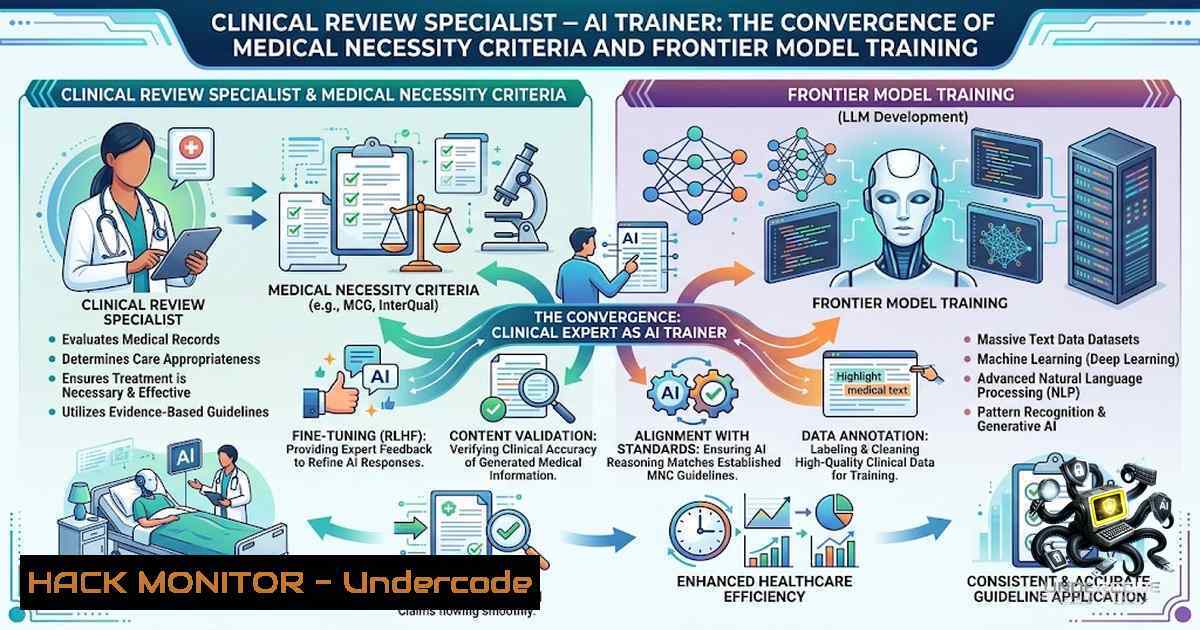
Introduction:
The integration of artificial intelligence into healthcare administration has reached a critical inflection point, where prior authorization workflows—historically burdened by manual documentation review and payer-specific criteria interpretation—are being transformed through AI-assisted clinical reasoning. Mercor, a San Francisco-based talent network backed by Benchmark, General Catalyst, Peter Thiel, and Jack Dorsey, is recruiting Clinical Review Specialists to serve as AI Trainers, bridging the gap between evidence-based medical necessity criteria (InterQual, MCG) and the training of frontier AI models. This role represents a new category of cybersecurity-adjacent work: the human-in-the-loop validation of AI-generated clinical recommendations, where accuracy and appropriateness must be rigorously enforced to prevent algorithmic harm.
Learning Objectives & Secrets:
- Objective 1: Master End-to-End Prior Authorization Workflow Automation – Understand how to manage prior authorization across commercial, Medicare Advantage, and Medicaid payers while leveraging EHR platforms (Epic, Cerner) and authorization management systems. The secret is mapping each payer’s proprietary criteria to structured data fields that AI models can consume.
-
Objective 2 Secret Tip: Annotate AI Outputs for Model Fine-Tuning – Learn to provide structured clinical feedback that corrects AI-generated justification drafts. The secret is using a rubric-based annotation system (e.g., Likert scales for medical necessity, confidence scores for evidence alignment) to create high-quality training datasets, as recommended by interdisciplinary data annotation best practices.
-
Objective 3 Secret Tip: Evaluate AI Against Domain-Specific Quality Rubrics – Develop the ability to identify factual, aesthetic, and presentation errors in AI-generated work products (documents, spreadsheets, slide decks). The secret is to treat each AI output as a penetration test of clinical reasoning—looking for hallucinations, missing contraindications, or misapplied criteria that could lead to denial or patient harm.
You Should Know:
- InterQual and MCG Criteria: The Backbone of Medical Necessity Determination
Prior authorization decisions hinge on evidence-based criteria sets. InterQual and MCG (Milliman Care Guidelines) provide standardized frameworks for assessing whether a proposed service is medically necessary. AI models must be trained to parse clinical documentation—provider notes, imaging history, lab results—and map them to specific criteria subsets.
Step‑by‑step guide for integrating criteria into AI training:
- Extract criteria subsets – Use Python with libraries like `pdfplumber` or `pymupdf` to parse InterQual/MCG PDFs into structured JSON. Example:
import pdfplumber import json criteria = {} with pdfplumber.open("interqual_guidelines.pdf") as pdf: for page in pdf.pages: text = page.extract_text() Use regex to extract criteria IDs and descriptions with open("criteria.json", "w") as f: json.dump(criteria, f) -
Map clinical notes to criteria – Use natural language processing (spaCy, SciSpacy) to extract entities (diagnoses, procedures, severity indicators) from EHR notes and link them to criteria IDs.
import spacy nlp = spacy.load("en_core_sci_md") Biomedical NLP model doc = nlp(clinical_note) for ent in doc.ents: if ent.label_ in ["DIAGNOSIS", "PROCEDURE"]: Query criteria JSON for matches -
Generate AI justification drafts – Use a fine-tuned LLM (e.g., Llama-3 or GPT-4 with clinical fine-tuning) to produce draft justifications. Prompt engineering is critical:
"Given the following clinical note and payer criteria [insert criteria],
generate a prior authorization justification that cites specific criteria
elements and addresses medical necessity. Highlight any missing documentation."
-
Human validation loop – The Clinical Review Specialist reviews each draft, flags errors, and provides corrective annotations. Store these as training pairs for the next model iteration.
-
EHR Integration and API Security for Prior Authorization
Proficiency with EHR platforms (Epic, Cerner) is mandatory. These systems expose APIs (e.g., Epic’s FHIR APIs, Cerner’s REST APIs) that must be secured to prevent unauthorized access to patient data—a critical cybersecurity concern.
Step‑by‑step guide for secure EHR API integration:
- Authenticate using OAuth 2.0 – Obtain client credentials and access tokens. Example using `requests` in Python:
import requests token_url = "https://ehr.example.com/oauth2/token" payload = { "grant_type": "client_credentials", "client_id": os.getenv("EHR_CLIENT_ID"), "client_secret": os.getenv("EHR_CLIENT_SECRET") } response = requests.post(token_url, data=payload) access_token = response.json()["access_token"] -
Query patient data via FHIR – Use the access token to retrieve clinical documents.
headers = {"Authorization": f"Bearer {access_token}"} fhir_url = "https://ehr.example.com/fhir/Patient/12345/DocumentReference" docs = requests.get(fhir_url, headers=headers).json() -
Implement audit logging – Log all API calls with timestamps, user IDs, and patient IDs to meet HIPAA and CMS compliance requirements. Use a SIEM tool (e.g., Splunk, ELK stack) to monitor for anomalous access patterns.
-
Encrypt data in transit and at rest – Enforce TLS 1.3 for all API traffic and use AES-256 for stored clinical data. Regularly rotate encryption keys using a KMS (e.g., AWS KMS, HashiCorp Vault).
-
AI Output Annotation: Structuring Clinical Feedback for Model Training
The role requires annotating AI outputs and providing structured clinical feedback to support AI training datasets. This is analogous to red-teaming an AI model—systematically probing its weaknesses.
Step‑by‑step guide for annotation workflow:
- Define annotation schema – Create a rubric with dimensions: (a) Clinical Accuracy (1–5), (b) Criteria Alignment (1–5), (c) Completeness of Justification (1–5), (d) Safety/Red Flags (binary). Use tools like Label Studio or Doccano for UI-based annotation.
-
Batch processing – Use a script to loop through AI-generated outputs and present them to annotators.
Linux: Use jq to extract outputs from JSONL files
cat ai_outputs.jsonl | jq '.draft' | while read draft; do
echo "Review: $draft"
Launch annotation UI
done
-
Consensus review – For high-stakes cases, require two independent annotators and measure inter-rater agreement (Cohen’s Kappa). If agreement < 0.8, escalate to a senior reviewer.
-
Feedback integration – Convert annotations into training signals. For example, use Reinforcement Learning from Human Feedback (RLHF) to fine-tune the model:
Pseudocode for RLHF update
for annotation in annotations:
reward = compute_reward(annotation.accuracy, annotation.completeness)
model.update(policy_gradient, reward)
-
Prior Authorization Automation Tools: Notable Sidekick, Optum Digital Auth Complete
Healthcare organizations are deploying AI co-pilots to reduce prior authorization handling time. Notable’s Sidekick reduced MIT Health’s handling time by 45%, processing ~750 cases with fewer denials. Optum’s Digital Auth Complete integrates with 250+ payer systems, automating documentation bundling and achieving a 96% first-pass approval rate.
Step‑by‑step guide for evaluating automation tools:
- Assess workflow integration – Map the tool’s data flow: EHR → AI co-pilot → payer portal. Ensure the tool supports your EHR (Epic, Cerner) and payer systems.
-
Test with synthetic data – Use synthetic patient records (e.g., Synthea-generated data) to test the tool’s accuracy without exposing real PHI.
Generate synthetic data using Synthea
java -jar synthea.jar -p 100 -m prior_authorization
-
Measure performance metrics – Track handling time, denial rate, and peer-to-peer review requests. Compare against baseline manual workflows.
-
Customize automation level – Optum’s InterQual Auth Accelerator allows users to customize automation levels but explicitly avoids auto-denials. Configure the tool to flag uncertain cases for human review.
5. Security Hardening for AI Training Pipelines
Training AI models on clinical data introduces unique attack surfaces: model poisoning, data exfiltration, and adversarial inputs. Implement the following hardening measures:
Step‑by‑step guide:
- Data de-identification – Use tools like AWS Comprehend Medical or Microsoft Presidio to scrub PHI from training data. Verify with
scrubadub:import scrubadub clean_text = scrubadub.clean(clinical_note, replace_with="[bash]")
-
Model access control – Restrict model weights and training data to authorized personnel using IAM policies. Enable MFA for all access.
-
Adversarial robustness testing – Use libraries like `CleverHans` or `TextAttack` to generate adversarial examples and test model resilience.
from textattack import Attack
from textattack.attack_recipes import TextFoolerJin2019
attack = TextFoolerJin2019.build(model)
adversarial_example = attack.attack(original_text)
-
Monitor for data drift – Use statistical tests (e.g., Kolmogorov–Smirnov) to detect shifts in input data distribution that could degrade model performance. Set up alerts in a monitoring dashboard (Grafana, Prometheus).
6. Linux/Windows Commands for Clinical Data Processing
Efficient data processing is essential for managing large-scale annotation workflows.
Linux commands:
 Count lines in annotation files
wc -l annotations.csv

Extract specific columns (e.g., criteria IDs) using awk
awk -F',' '{print $3, $5}' clinical_data.csv

Search for specific diagnoses in clinical notes
grep -r "diabetes" ./clinical_notes/

Monitor system resources during model training
htop
Windows PowerShell commands:
 Count lines in CSV
(Get-Content annotations.csv).Count

Filter for specific payer types
Import-Csv clinical_data.csv | Where-Object {$_.payer -eq "Medicare"}

Search for text in files
Select-String -Path .\clinical_notes\ -Pattern "prior authorization"
What Undercode Say:
- Key Takeaway 1: The Clinical Review Specialist – AI Trainer role is not merely a clinical position; it is a cybersecurity-critical function. Annotators serve as the last line of defense against AI hallucinations that could lead to wrongful denials, delayed care, or HIPAA violations. The structured feedback they provide directly shapes the safety and reliability of frontier medical AI models.
-
Key Takeaway 2: The convergence of prior authorization automation and AI training creates a new attack surface. Adversaries could poison training data to favor specific payers or procedures, or exfiltrate sensitive clinical annotations. Organizations must implement robust security controls—data de-identification, access logging, adversarial testing—to protect both patient privacy and model integrity.
Analysis: The $105/hour compensation reflects the high-stakes nature of this work. Mercor’s talent network of 30,000+ experts earning over $2 million daily signals a mature market for human-in-the-loop AI training. However, the reliance on manual annotation introduces scalability challenges; future systems will likely incorporate active learning to prioritize uncertain cases for human review, reducing annotator burden while maintaining quality. The role’s requirement for EHR proficiency and familiarity with AI tools indicates that technical acumen is becoming as important as clinical expertise. As Optum and Notable demonstrate, AI-powered prior authorization is no longer experimental—it is operational, with measurable ROI in time savings and denial reduction. The next frontier will be real-time, touchless authorization, where AI agents handle the entire workflow from order to approval without human intervention. For Clinical Review Specialists, this means evolving from reviewers to system architects who design and validate the rules that govern autonomous AI agents.
Prediction:
- +1 AI-driven prior authorization will reduce average handling time from 11 minutes to under 2 minutes by 2028, enabled by multi-agent systems that automate documentation gathering, criteria mapping, and submission.
- +1 The demand for clinical AI trainers will grow exponentially, with salaries exceeding $150/hour for specialists who combine clinical licensure with data science skills.
- -1 Automated prior authorization systems will face regulatory scrutiny after high-profile denials caused by model bias, leading to mandatory human review mandates for vulnerable populations.
- +1 Open-source criteria mapping libraries (e.g.,
interqual-parser,mcg-mapper) will emerge, reducing vendor lock-in and enabling smaller practices to adopt AI automation. - -1 Cyberattacks targeting prior authorization APIs will increase, with ransomware groups encrypting authorization data to extort hospitals, forcing investment in zero-trust architectures for healthcare AI pipelines.
▶️ Related Video (76% Match):
🎯Let’s Practice For Free:
🎓 Live Courses & Certifications:
Join Undercode Academy for Verified Certifications
🚀 Request a Custom Project:
Secure, high-velocity infrastructure and disruptive technological engineering. Contact our engineering team for high-tier development and proprietary systems:
[email protected]
💎 Smart Architecture | 🛡️ Secure by Design | ⭐ Trusted by Thousands
IT/Security Reporter URL:
Reported By: https://lnkd.in/p/e3QQ-ssd – Hackers Feeds
Extra Hub: Undercode MoN
Basic Verification: Pass ✅


